2012: NEW MOVIES TO SEE BEFORE THE APOCALYPSE

January 10, 2012

Screen Shot 2020-02-03 at 11.16.10 AM

I always work better with a deadline. Since the world is ending on December 21st, 2012, I expect to have the most productive movie-going year of my young, super-handsome life. In preparation for these blessed final hours in darkened theaters, I’ve drawn up a list of new releases I wish to see before my anticipated demise, those which I expect would give me the most pleasure in my twilight year. I hope it is also some help for you, dear reader, usefully arranged in descending order of preference.

Gebo et L’Ombre (Gebo and the Shadow), directed by Manoel de Oliveira

What better way to shuffle off this mortal coil than with the latest film from that ageless wonder, Manoel de Oliveira, the only man likely to survive doomsday. Gebo is an adaptation of the eponymous play by modernist Portuguese writer Raul Brandão (1867 – 1930), who was born in the same city as Oliveira, Oporto. The play is from 1923, and portrays an accounting clerk who is divided between wealth and honor, and who has to sacrifice himself to protect his own son. The production company, O Som E A Furia, rather blandly says the film, “portrays the poverty and the tragedies of life of ordinary people who can easily be related to contemporary life.” The sterling cast is made up of Oliveira regulars Ricardo Trepa and Leonor Silveira, plus the august triumverate of Jeanne Moreau, Claudia Cardinale and Michael Lonsdale. Likely to premiere at the Cannes Film Festival in May, it should hopefully reach these shores by the end of the year, in one fashion or another. Oliveira has already started production on another film, A Igreja do Diabo (The Devil’s Church), starring Fernanda Montenegro and based on the short story by Machado de Assis.

***

A Pigeon Sat On a Branch Reflecting On Existencedirected by Roy Andersson

This is more hope than reality, as there’s only a slim chance this gets completed in time to screen this year. But since I wanted to type out that amazing title, here it is. It is the third and final section of Andersson’s “Living” trilogy, following the extraordinary duo of Songs From the Second Floor (2000) and You, the Living (2007). In October the film was awarded 650,000 Euros from The Council of Europe’s Eurimages fund, and CineEuropa reported it is “shooting for a 2013-2014 delivery”. We might be waiting awhile. For a taste, here is Roy Andersson talking to Ethan Spigland in 2010, when he was calling it A Dove Sat On a Branch…:

Can you say something about your next project?

RA: It’s a sum-up of my life; of the way I see existence. I have a preliminary title: A DOVE SITTING ON A BRANCH REFLECTING ON EXISTENCE.

ES: I like it.

RA: With a title like that you can be totally free—it’s not predictable. A painting by Breughel inspires it. It depicts a bird sitting on a branch overlooking a city. You can see the city from above and all the human activities below. Stylistically it will be similar to SONGS FROM THE SECOND FLOOR and YOU THE LIVING, but this time I want to reach two things: more brutality as well as more poetry. . .and also more jokes, more humor.

ES: You want to push everything a bit further?

RA: Yes, I want to be more expressive. Anyway, I will try.

***

Flying Swords of Dragon Gate 3D, directed by Tsui Hark

Tsui Hark, whose Detective Dee and The Phantom Flame was one of the inimitable  delights of 2011, makes his first foray into 3D with this martial arts extravaganza. It opened on December 22nd in Hong Kong, and while it should be easy to find DVDs of this at online Asian retailers, I dearly hope I can see it in 3D. An irrepressible showman with an innate command of action cinematography (if not narrative), this could be one of the visual treats of the year.

***

Casa De Mi Padredirected by Matt Piedmont (March 16th)

Three Mississippi, directed by Adam McKay (Thanksgiving weekend, according to Vulture)

After a down year for American comedy in 2011 (Bridesmaids excepted), I am relieved that Will Ferrell will be appearing in no less than three movies in 2012 (I left off Dog Fight, in which Ferrell and Zack Galifianakis play dueling South Carolina politicians, because of wet rag director Jay Roach). I have been anticipating Casa since a trailer appeared almost a year ago. A parody of Mexican telenovelas, it has Ferrell playing frequently shirtless rancher Armando Alvarez, who is trying to save his father’s farm. The gimmick is that the film is almost entirely in Spanish, with Ferrell speaking the language phonetically throughout. With co-stars Diego Luna and Gael Garcia Bernal, this looks just ridiculous enough for me to love. Three Mississippi is the latest collaboration between Ferrell and McKay, after The Other Guys in 2010. The duo has perfected an improvisatory approach to comedy, in which they push scenarios – and language itself – into realms of absurdity previously breached only by the Marx Brothers. I prefer John C. Reilly to Mark Wahlberg as Ferrell’s co-star, but I’ll take them however I can get them.

***

Untitled Terrence Malick Project

It’s a Terrence Malick movie, which at this point is enough. It stars Ben Affleck, Rachel McAdams, Rachel Weisz, Javier Bardem and other famous people. Here is what IMDB says about the story:

A romantic drama centered on a man who reconnects with a woman from his hometown after his marriage to a European woman falls apart.

OK!

***

Holy Motors, directed by Leos Carax

Leos Carax’s first film since Pola X in 1999. I know very little about this, other than its delightfully eclectic cast of Eva Mendes (a wonderful comedienne: see The Other Guys and Stuck On You for proof), Michel Piccoli, Kylie Minlogue and Denis Lavant. Here is the summary from CineEuropa:

Holy Motors traces 24 hours in the life of a person who travels between different lives, including that of a murderer, beggar, CEO, monstrous creature and father of a family.

Like a lone killer acting in cold blood and going from one hit to the next, he has a completely different identity in each of his intertwining lives. Like in a film-within-a film, he plays different roles. But where are the cameras, the film crew and the director? And where is his house, his resting place?”

Some production photos show Eva Mendes crawling out of a sewer, which would lead one to believe there are some elements borrowed from his segment of Tokyo! , in which Denis Lavant played a gibbering idiot named Merde who lived in the sewers, and who also wreaked havoc on the streets of Japan.

***

Tabudirected by Miguel Gomes

After being enchanted by Our Beloved Month of August a few years back, I hotly anticipate Miguel Gomes’ new feature, Tabu, which was just announced to be part of the Competition slate at the Berlin Film Festival. Apparently unrelated to F.W. Murnau and Robert Flaherty’s  film of the South Seas, its production company describes it thusly:

A temperamental old woman, her Cape Verdean maid and a neighbour devoted to social causes live on the same floor of a Lisbon apartment building. When the old lady dies, the other two learn of an episode from her past: a tale of love and crime set in an Africa straight from the world of adventure films.

Otherwise all we know are that the stills are in B&W, and they look gorgeous.

***

Resident Evil: Retribution 3D, directed by Paul W.S. Anderson (September 14th)

The Masterdirected Paul Thomas Anderson

A battle of Andersons! W.S. is one of the few contemporary directors to fully investigate the possibilities of 3D, with both Resident Evil: Afterlife and The Three Musketeers templates for how to shoot fight scenes in depth, with multiple planes of action roiling at once. P.T. is one for grand statements and grander tracking shots, an ambitious auteur with capital A’s adept at sketching particularly charismatic strains of grandiose American self-deception. His next entry is about the rise a religious sect, reportedly based on Scientology, starring Philip Seymour Hoffman. I look forward to both, but admit, if I had to choose, that I’m a W.S. man (and a Jovovich one, too).

***

The Grandmaster, directed by Wong Kar-Wai

Whether or not this actually comes out this year is anybody’s guess, as Wong likes to camp out in his editing room, but this is his return to Hong Kong filmmaking after the awkward, intermittently affecting My Blueberry Nights, and it stars dreamboat Tony Leung. Its subject is Ip Man, the Chinese martial artist who trained Bruce Lee, and who was also the subject to two fine fight films starring Donnie Yen.

***

Others, in brief:

Bullet to the Head, directed by Walter Hill (April 13th)

Did you see it’s directed by Walter Hill? Well it is! And starring the intriguingly decomposing Sylvester Stallone. It’s Hill’s first theatrical feature since the underrated Undisputed in 2002.

Barbaradirected by Christian Petzold

Will premiere at the Berlinale. Have a pressing urge to gorge on the psychologically astute, visually controlled films of the Berlin School. Petzold (Jerichow, Beats Being Dead), is the exemplar of this style.

Haywire, directed by Steven Soderbergh (January 20th)

Curious to see how MMA fighter Gina Carano’s imposing physicality translates to the screen. Also, it’s Soderbergh’s first collaboration with writer Lem Dobbs since The Limey, which was great fun.

The Three Stooges, directed by The Farrelly Brothers (April 13th)

This is the project the Farrelly’s have been trying to make their entire career. Hopefully it unleashes the spastic, slapstick body-comedy-horror of their earlier work.

Lock-Outdirected by James Mather and Stephen St. Leger (April 20th)

The latest from the Luc Besson meathead factory, this Escape From New York knockoff drops wisecracking Guy Pearce into a max security space prison in order to rescue the president’s daughter (!). The trailer shows Pearce to be adept at falling and quipping.

FIRST LOOK: AN ADVENTUROUS NEW SERIES AT THE MUSEUM OF THE MOVING IMAGE

January 3, 2012

Screen Shot 2020-02-03 at 11.10.50 AM

Since I’m not stinking rich just yet, my plan to go on a heavily medicated tour of international film festivals has been put on indefinite hold. Luckily, the Museum of the Moving Image has purloined 13 new features from all over the world, most without U.S. distribution, for their inaugural “First Look” series (Jan. 6-15), bringing the best of the fests to NYC. Since distributors continue to lose money on any film not in English (or, occasionally, French), it’s something of a miracle that any foreign titles reach our shores at all. This leaves a huge glut of films without any stateside release, left as rumors of masterpieces in the words of the few industrious critics and curators able to send word back to us in the sticks. “First Look” was programmed by some of these proud few: Dennis Lim, the editor of Moving Image Source, Assistant Curator of film Rachael Rakes and Chief Curator David Schwartz. It’s a small but impactful series, with invigorating entries from old masters like Chantal Akerman and enchanting young voices like Gonçalo Tocha.

The opening night slot is given to Akerman, who will be in person to present Almayer’s Folly (2011), her impressionistic rendering of Joseph Conrad’s first novel. As with her adaptation of Proust’s The Captive (2000), Akerman eschews textual faithfulness in order to establish a specific atmosphere. In The Captive it is of airless enclosures, as Simon (Stanislas Merhar) creeps at the edge of the frame, seeking to imprison Ariane (Sylvie Testud) within his own paranoia, subtly shifting the narrative center of Proust’s story over to the woman. It owes as much to Vertigo as Proust, and Almayer’s Folly is  equal parts Tabu and Conrad, using the story as a loose outline to contain images of luxurious colonial decay. It is filled with shallow-focus tracks through greenery and static shots of Almayer’s arthritic stumbling around his crumbling kingdom. Almayer (again Stanislas Merhar, equally opaque and vainly controlling as his Simon) is a Dutch trader who seeks his fortune in Malaysia (the film was shot in Cambodia). He marries a local, Zahira (Sakhna Om) because his mentor, Captain Lingard (Marc Barbé), believes the woman’s family owns land on top of a gold mine. The plan fails, and Almayer is marooned in a combative marriage on a dilapidated farm, his only respite his daughter Nina (Aurora Marion), whom Lingard enrolls in a strict French boarding school. As Almayer and Zahira slowly decompose into their surroundings, nurturing mutual resentments and growing manias, Nina increasingly occupies the center of the frame and the narrative, Akerman’s camera fixated on her placid, inquisitive face. This shift is signaled in the opening scene, in which an adult Nina is a backup dancer to her sometime lover Dain, as he lip-synchs to Dean Martin’s “Sway”. After an unknown attacker carries Dain off, Nina is left alone on stage, still dancing, seemingly oblivious to the world around her. Then, she takes the center in a close-up, and sings a gorgeously melancholic version of “Ave Verum Corpus”. A Eucharistic hymn to the redemptive power of Jesus’ suffering, it turns Nina into a martyr before the narrative proper begins, a grievous angel who pays for the sins of her father.

The protagonists of Christoph Hochhäusler’s The City Below (2010) live in a world without God and sin, but plenty of greed, as they sleepwalk their way through the global financial crisis. It premiered at the Cannes Film Festival in 2010, but was never released in the U.S.. A co-editor of the German film magazine Revolver, and associated with the loose cadre of “Berlin School” filmmakers, Hochhäusler is a precise technician, as his follow-up, One Minute of Darkness (2011, part of the Dreileben trilogy) shows. The City Below follows two empty suits: bank president Roland Cordes (Robert Hunger-Buhler) and Svenja (Nicolette Krebitz), the bored wife of one of his employees. Svenja is exhausted from constant re-location (from Hamburg to Houston to Frankfurt) and desperate for a way out of her modern glass-walled life, which Hochhäusler frames with geometrically precise right angles. His tracking shots use frequent jump cuts, however, irruptions in style that neatly echo the characters’ fissuring psyches. In the first shot, Svenja sees a woman wearing the same blouse as her, so she follows her steps, even ordering the same Danish (and spitting it out), desperately trying out a new life.  Cordes is equally eager for escape, fiercely identifying with (and gaining voyeuristic pleasure from) heroin addicts, as well as an employee in Indonesia who was kidnapped and killed. Cordes pretends that the victim’s childhood was his own – a lie he acts out for Svenja during their mutual seduction. It is a union of split, hollow personalities, who continually break-up and reunite in increasingly violent fashion, as if they were a rapidly multiplying microbe, set to take over and infect the world.

Phillipe Garrel’s mindset is still set squarely in the ‘60s, no matter what year his films are set in. His newest work is That Summer (2011) an earnestly affecting relationship drama in which its characters discuss revolution as if the May ’68 riots where happening right outside their doors. But no, it is set in the present day, and Phillippe’s son Louis plays Frederic, a mercurial, adulterous painter still passionately in love with his movie star wife, Angele (Monica Bellucci). When he invites his friend Paul (Jerome Robart) and girlfriend Elisabeth (Celine Sallete) to stay in their Paris apartment, they are there to witness the spectacular flameout of Frederic and Angele’s love. Garrel lovingly cultivates the star personas of Bellucci and and his son – Louis is insanely sensitive and brooding, Belluci imperiously cold and beautiful, more mythic archetypes than human beings. Frederic is all Dionysus with no Apollo, an artistic, atavistic soul not fit for the world, and so he departs it. Bellucci, who has never stood out to me in a film before, is wonderful as the herder of Frederic’s untrammeled emotions – and when her Olympian reserve cracks, it does so spectacularly in an uninhibited dance with a stranger, which Garrel shoots in a generously long take.

The standout title in the First Take series, though, is Gonçalo Tocha’s It’s the Earth, Not the Moon (2011), an absorbingly inventive three-hour documentary about the smallest island in the Azores archipelago, Corvo, population 440. Tocha spent parts of two years on the island, and attempted to film everything he could: knitting, cheese curdling, lock-making, accordion-playing, sitting, standing and dancing. Tocha is a restless social historian, trying to capture every tradition and personality on the island before they disappear – lending the film its joyous and elegiac qualities. He gets Ines Ines (a name she married into) to knit him an old-style beret, the retired cheese maker to make him some wheels of cheddar (“you have to take care of them just like babies”), and the 94 year old Uncle Pedro to play his accordion that he hadn’t brought out for ages. Tocha explores not just the people, but the volcanic landscape which produces the almost unearthly neon greens of the caldera vegetation, and the rocky shores that are nightly attacked by rising waters. The locals track these waters like sacred texts, producing a photo book of the highest wave crests. A former whaling port, the population has the ocean in their blood, even if it no longer provides a living. One of the former lookouts says of the whales, “I still dream with them”, before backtracking (“You want more lies?”). Tocha’s Corvo is not simply a necropolis sliding into the ocean, though, but a town, like any other, struggling to adapt to brutal new economic realities.

First Look is an essential new series, bringing together a cross-section of styles and approaches impossible to see in your neighborhood arthouse. And I haven’t even mentioned (or seen) the other entries in the program, including Johnnie To’s financial crisis drama Life Without Principle and Raya Martin’s Super-8 road trip freakout, Buenos Noches, Espana. With the number of films exploding and distribution channels shrinking, I hope this First Look is one of many to come.

LEARNING LATTUADA: THE OVERCOAT (1952) and COME HAVE COFFEE WITH US (1970)

December 27, 2011

lattuada

On December 6th, RaroVideo released two films from director Alberto Lattuada on DVD. Relatively unknown in the U.S., he was an eclectic talent who came up under the sway of neorealism, and who later made an uncategorizable series of literary adaptations and bitterly satirical farces. I have asked a Ph.D candidate in Italian Studies at NYU, Alberto Zambenedetti, to help me discuss his work. Mr. Zambenedetti will write about The Overcoat (1952), widely considered his masterpiece, and I will look at Come Have Coffee With Us(1970), one of his late sex comedies.

Alberto Lattuada’s 1952 adaptation of Nikolai Gogol’s short story The Overcoat (1834) can be considered, together with Vittorio De Sica’s Miracle in Milan (1951), one of the very few forays into the Surreal and the Fantastic in Italian postwar film. Iconic screenwriter Cesare Zavattini contributed to both screenplays, and both films express a clear desire to move past Neorealism’s aesthetic and narrative model. In this sense, the story of The Overcoat‘s protagonist, Carmine De Carmine, and his daily struggle for survival in an indifferent if not outright hostile world, resembles De Sica and Zavattini’s Umberto D.(1952). Yet the lofty literary source offers Lattuada the opportunity to crack down on the structures of power and their hypocrisy with a venom and a pessimism of which his contemporaries were not capable. The exquisite ambiguities of Gogol’s philosophical tale find a correlative in the depiction of the bureaucratic apparatus, which has overtones of both Fascism’s militaristic hierarchy and of the Christian Democrats’ misguided appeals to decency and decorum. After all, The Overcoat tells the tale of a victim who comes back from the dead to haunt the society who abused him: what story could be more suited to represent the psyche of a country who lived through over twenty years of dictatorship and then expunged it from its collective consciousness?

Comedian Renato Rascel delivers an interesting and nuanced performance in his first dramatic role, for which he was awarded a Silver Ribbon in 1953 by the Italian National Syndicate of Film Journalists. Famous for his singing voice and perfect diction (he is best known in the U.S. for his original song “Arrivederci Roma” and for the film The Seven Hills of Rome, dir. Roy Rowland), the small-framed actor is used by Lattuada mainly for his Chaplinesque pantomime and his distinct appearance, which allow for a contained physical comedy. A meek calligraphist and copyist, De Carmine occupies the lowest rung in the ladder of public servants; he is close enough to the sun to know that it exists, yet he is too far to feel the warmth of its rays. He is the nexus between the starving populace and the new aristocracy of bureaucrats, a self-involved class that turns a deaf ear to the needs of their constituency and basks in the glory of power and wealth. To the protagonist, the fine overcoat represents the dream of social mobility and, perhaps, even the love of Caterina, the town mayor’s young and luscious lover (played by Yvonne Sanson, star of many melodramas directed by Raffaello Mattarazzo).

However, in what is perhaps Lattuada’s major departure from Gogol, De Carmine displays an unfaltering sense of justice and loyalty to the lower classes, themes that were very dear to the eclectic director. De Carmine marvels at the mayor’s absurd spending of public money, and he tries to have him read a plea for a pension on behalf of a disenfranchised neighbor, to no avail. Doors, screens, windows, and hallways are used as devices to keep the two worlds separate, with De Carmine shuttling between them in an ever-growing frenzy that, when he is robbed of his precious overcoat, sentence him to a fever-induced death. Remnants of Lattauda’s neorealist masterpiece Il bandito (1946) can be noticed in the extended ballroom scene that depicts high society as shallow and unsympathetic, as well as in the film’s attention to Pavia’s urban landscape. Absolutely unforgettable is the scene in which De Carmine’s horse-drawn hearse interrupts the pompous mayor’s speech, forcing him to remove his hat and salute the body of the (temporarily) vanquished hero.  –Alberto Zambenedetti

***

Lattuada ended the 1960s with L’amica (1969), a sex romp about a bourgeois wife cuckolding her husband, and he began the 70s with Come Have Coffee With Us (1970), a sex comedy viewed from the male’s perspective. The man is Emerenziano (Ugo Tognazzi, La Cage aux Folles), a middle-aged accountant seeking “caresses, warmth and comfort” in his dotage in the small town of Luino, on the banks of Lake Maggiore. Introduced adjusting his tie in a mirror, he is a picture of aging vanity, albeit one without many outlets. He is shown living in a rather drab flat, his prized object a copy of Paolo Mantegazza’s “Physiology of Love”, a 19th century book that encourages one to cut through fruit to release sexual urges. Emerenziano has clearly not sown many oats, a fastidious man who clips his cigarettes in half to avoid too much pleasure. But now he has decided to indulge himself, and he targets the Tettamanzi girls, three sisters who had just inherited a great sum of money from their naturalist father. A trio of exaggeratedly ugly sisters (not unlike Cinderella’s), with upturned noses, beehive hairdos and unflattering cloth duds, Emerenziano assumes he’d at least get warmth and comfort from one of them.

Lattuada emphasizes their freakish nature with insert close-ups of their relative deformities, of Tarsilla’s mole, Camilla’s mousy face and twitchy gestures, and Fortunata’s mountainous head of hair. These shots from Emerenziano’s POV are much more about the man’s twisted worldview than the ladies’ desirability – Lattuada appears as a doctor to tend to the ailing Emerenziano, an affliction that is as much psychological as physical.. The girls are housed like their father’s taxidermied owls, a trio of spinsters with little connection the outside world until Emerenziano swaggers in and introduces them to the ways of the flesh. His strategy becomes clear when he creates one healthy apple from three rotten ones in their pantry. For he soon decides to marry Fortunata, but after they return from their honeymoon, he spends time in every sister’s boudoir. The maid dutifully keeps a schedule of Emerenziano’s manic schedule, fulfilling his wish for “caresses” and then some. He lives out all his teenage fantasies, but in an aging man’s body, and his libido is far too voracious for his heart to keep up.

A poson-tipped fable of middle-age delusions, small-town desperation and the dangers of sexual repression, Come Have Coffee With Us finds Lattuada working out some familiar themes in a graceful manner. Never uproarious but always amusing, it’s a solid late entry in Lattuada’s impressive career. Well received upon its original release, it eventually came out in the U.S. in 1973, to a similarly pleased reception. Vincent Canby in the NY Times enthused about Tognazzi’s intricately fussy performance: “The actor is a model of what I can describe only as a thoroughly masculine but dainty self-assurance, whether he is carefully placing a toothpick in an ashtray (after cleaning one ear and one fingernail) or pompously explaining to the three sisters, on an early meeting, how an old war wound has left him with a troublesome (but not incapacitating) deviated rectum.” Presented in an HD transfer from a 35mm negative, the RaroVideo DVD is a superb edition of a morbidly funny Italian comedy.  -R. Emmet Sweeney

THE TOP TWELVE GENRE FILMS OF 2011

December 20, 2011

genre 2011

As the carcasses of prestige pics get picked over by awards committees and prognosticators, I like to distract myself from this pointless posturing by watching movies featuring actual corpses. After last year’s rundown of genre flicks received a good response, I return to the bloody well again, this time with twelve of my favorite action/horror/exploitation items released in the past year. Sure to be ignored by your local film critics circle, they are works of grim resourcefulness and ingenuity, deserving of more attention. I look forward to your criticisms, insults and recommendations in the comments. My picks are presented in alphabetical order.

Attack the Block, directed by Joe Cornish

With his origins in sketch comedy (the British “Adam and Joe Show”), one would expect Joe Cornish’s debut alien invasion feature to be episodic and tongue-in-cheek. While laced with humor, Attack the Block is instead a sleekly designed chase film, as a wanna-be gang of teens defend their South London project from the alien hordes. It was shot at the dilapidated Heygate Estate (which is now undergoing demolition), whose brutalist, prison-like facade emphasizes the kids’ status as second-tier citizens, convicts even in their freedom. They roam the streets and halls, led by Moses (played with sensitive stoicism, and shades of Gary Cooper, by John Boyenga), harrassed by cops while they harass (and rob) outsiders, as if outlaws in their own Wild West, Moses facing his own kind of High Noon.

***

Detective Dee and the Mystery of the Phantom Flame, directed by Tsui Hark

I devoted an entire post to this pulpy marvel back in April (read here), so I’ll be brief here. Suffice it to say that Hark combines martial arts, Sherlock Holmes and steampunk into one of the most deliriously entertaining films of the year. Reveling in the sheer joy of storytelling, it hearkens back to Poverty Row serials of the 30s and 40s, telescoping an entire season’s worth of incidents and cliffhangers into its 2 hour running time. And yes, the CGI looks fuzzy and second-rate, but for me, it only added to its ramshackle charm.

***

Fast Five, directed by Justin Lin

I had not seen any of the previous iterations of this revived testosterone oil slick of a franchise, attracted only by the presence of Dwayne “The Rock” Johnson, who enlivens whatever material he swaggers into. He is, of course, a magnetic presence in this one, his Diplomatic Security Service agent growling out orders with a starved pit-bull intensity. But the bombastic world that Justin Lin inflates around him is equally compelling – especially the turbocharged action sequences which are both outrageous and rigorously designed, from the moving train car heist to the torn-out bank vaults which are chained to cars and used as wrecking balls. Justin Lin is one of the few Hollywood directors to have firm control of the modern action film aesthetic, his quick cuts and mobile camera managing to convey a coherent geography (if this is “chaos cinema”, I’ll take it!). Examine the extended, wall breaking fistfight between The Rock and Vin Diesel for a meaty example.

***

Insidious, directed by James Wan

Finding creative solutions to monetary restrictions led James Wan to make one of the most profitable movies of the year. Insidious was made for $1.5 million and has since earned $97 million worldwide (figures from BoxOfficeMojo). Building tension off of long takes, smoke machines and a record playing Tiny Tim’s “Tiptoeing Through the Tulips”, this is an elegant shocker that also has the gall to build defined characters. Patrick Wilson is a distant, condescending husband and father, Rose Byrne an artistically frustrated songwriter turned housewife. Wan and screenwriter Leigh Wannell use the couple’s bad faith and turn it into the stuff of nightmares — their mutual resentments manifesting in the form of a vengeful wraith who absconds with their child. The second-half dimension-folding freak-out fails to exert the same slow-burn creep of the haunted first, but it still houses more indelible scares than any other film this year.

***

I Saw the Devil, directed by Kim Jee-woon

A cat-and-mouse revenge thriller where the roles of hunter and prey are continually reversible. The sociopathic killer Kyung-chul (Choi Min-sik) and secret agent Soo-hyun (Lee Byung-hun) engage in a pas-de-deux of sadism, each torturing the other in a game of gruesome one-upsmanship. Containing elements of fairy tales (a cannibal’s house reminiscent of Hansel and Gretel) and self-reflexive black humor, it attempts to encompass all forms of revenge narratives, seeming, as Dave Kehr wrote, to be “the natural endpoint in the revenge film cycle kicked back off by Tarantino.”

***

The Mechanic, directed by Simon West

The pick of the Statham platter this year (other options: Killer Elite and Blitz), this remake of the 1972 Michael Winner/Charles Bronson original is an effectively no-nonsense bruiser. Statham is upscale hitman Arthur Bishop, who takes on hard-headed Steve McKenna (Ben Foster) as an apprentice. Bishop is an ascetic aesthete, living in a gorgeous arts & crafts style cabin on the water, with a preference for high-necked cable-knit sweaters out of the J Crew for assassins catalog. McKenna is necessarily a bit of a drunk and a hothead, needing the guidance of Bishop’s meditative nowhere-man. Director Simon West, if not exactly a stylist, is at least efficient, and frames fight scenes of lucid brutality. Statham brings a coiled physicality and a reliably self-effacing charm, while Ben Foster continues his run of mannered, fastidiously manic performances, his McKenna exhibiting non-stop DTs. He pops off the screen with garrulous intensity, and he’s building a gallery of eccentrics worthy of the great character actors. He’s no M. Emmet Walsh yet, but he’s on his way.

***

Point Blank, directed by Fred Cavaye

A refreshingly brisk 84 minutes long, this breathless French thriller wastes no time on exposition and races headlong into a chase. Samuel (Gilles Lellouche) is a nurse in training who inadvertently interrupts the murder of a hood (Roschdy Zem) in the ER. Soon his wife gets kidnapped and he is forced to ally himself with Zem to save his wife and his reputation. They race through Paris city streets, with Cavaye’s camera following them in hurtling tracking shots. Structured as one epic sprint, there is no time to sketch in character detail or complicated plot maneuvers, so while there is no emotional investment here, it still packs quite a kick of adrenaline.

***

The Robber, directed by Benjamin Heisenberg

A resolutely anti-psychological heist film, it examines the daily routine of marathon runner and bank robber Johann Rettenberger with clinical detachment. The true story it is based on, of “Pump-Gun Ronnie”, a runner who also wore a Reagan mask during jobs, is more spectacular than what it is on screen. Heisenberg pares away any hint of backstory, forcing lead actor Andreas Lust to express everything through his sinewy body. Curling into himself, Lust rejects any outside help, even recoiling at the accidental touch of a stranger in a park. It is when he falls for his childhood friend Erika (Franziska Weisz) that he lets the outside world inside – which collapses his carefully manicured facades. Outside of this, it’s a terrifically staged action film, including an open air stunner in which Lust sprints from one bank robbery to another, weaving through hotel lobbies, parking garages and open fields – leaving the police huffing and puffing behind him. Using controlled handheld camera (no shaky cam here) in sinuous long takes, Heisenberg and DP Reinhold Vorschneider create one of the most propulsively exciting chase scenes of the year.

***

Stake Land, directed by Jim Mickle

My favorite vampire experience since Mel Brooks’ Dracula: Dead and Loving It. So it’s been a while. Set in a post-apocalyptic America ravaged by the pointy-toothed beasts, it’s part survivalist horror, part road movie, and anchored by a quietly charismatic performance by Nick Damici (who also co-wrote the screenplay with Mickle). Damici plays “Mister”, a crusty self-sustaining loner who has built his life around a violent routine: rifle abandoned shops for food and dust a few blood suckers. He picks up Martin (Connor Paolo) along his desultory journeys, the lone survivor of a slaughtered family. Mentoring Martin in the ways of survival and vamp-killing, Mister gains a purpose outside of himself, and is determined to ferry Martin to “New Eden”, a supposed safe zone in Canada. Mickle shoots the film in a dusky low-light, as if in a perennial twilight, where danger lurks in every unexplored nook and cranny, from vamps to the fundamentalist cult which worships them. With haunting makeup and creature design, these are not the dapper vampires du jour, but demons in decaying bodies, oozing goopy fluids which can only be replaced by fresh blood. It’s a genuinely unique vision – and one that aids the film’s subtle allegory of American intellectual decline (it’s no coincidence the promised land is in Canada).

***

Unknown, directed by Jaume Collet-Serra

Following up the cold precision of his ace horror flick Orphan, Serra again churns out a film of with strong compositional lines and an entertainingly ridiculous scenario. What stands out this time is his tactile sense of place, a multi-cultural Berlin of five-star hotels and seedy flop-houses. It’s a huge improvement on its model, Taken, the previous Liam Neeson Euro-sploitation outing, which was directed by Pierre Morel. While that film took place in a world of Eastern-European stereotypes and chopped its action sequences to bits, here the city still seethes with racial tension (a taxi dispatcher blames the city’s perceived decline on immigrants), but Neeson is assisted in his quest by a Bosnian cab driver (played convincingly by Diane Kruger) and her African immigrant pal named Biko (a nod to South African activist Steve Biko, played by Clint Dyer). As with Orphan, its actions sequences are concise bits of legible brutality . Bruno Ganz steals the movie as a proud former Stasi member who aids Neeson in his quest for identity. In what is surely to be one of the finest scenes of the year, Frank Langella swings by to cradle Ganz in his arms, as they discuss how to die with dignity.

***

The Ward, directed by John Carpenter

The unjustly derided return to the big screen for John Carpenter, who shows his talent for slow-burn scares is as sharp as ever. Working with a hacky script, Carpenter turns this story of a haunted insane asylum into an experiment in visual repetition, evoking the ritualized circular movements of these girls’ daily lives. An example of form triumphing over content. You can read my full thoughts in my post from June.

***

The Yellow Sea, directed by Na Hong-jin

Na Hong-jin’s follow up to The Chaser, is an operatic bloodbath about a poor Chinese immigrant in Korea, trying to find the wife who abandoned him years ago. There are no guns in this movie – everyone gets stabbed or bludgeoned by an axe-handle– and there are some epic battles here. With South Korea’s highly restrictive gun ownership laws, even the underworld has trouble obtaining firearms. Without shoot-outs, each death becomes more personal, because you have to get close and smell the sweat of your opponent before taking their life. It is a ritual bloodletting to rid the world of the infection of humanity.

Honorable Mentions: Drive AngryWreckedBurke & Hare (which I wrote about here).

HOME VIDEO ROUNDUP: CHRISTMAS EDITION!

December 13, 2011

nickel ride

It’s that festive time of year again, when family ties are maintained through the ritualized exchange of fabrics, wrought plastics and optical discs. This joyous occasion ensures that husband and wife, or parent and child, can contentedly ignore each other until the next wallet-busting holiday. I am here to ensure the smooth operation of this essential human activity, providing an idiosyncratic list of new DVDs and Blu-Rays that, if wrapped in glossy paper, will blind your favored loved one to your significant shortcomings. To prove my goodwill, my wife and fellow writer Andrea Janes will close out the list with her thoughts on a movie I asked her to watch, as a distraction from my lax grooming habits. Seasons Greetings!

The Nickel Ride (1975, DVD)

Released today on DVD from the canny studio library raiders at Shout! Factory (in a set with John Frankenheimer’s dire 99 and 44/100% Dead), this gorgeously elegiac gangster film should be exhibit #1 when making an over-enthusiastic case for the work of director Robert Mulligan. Remembered mainly for his adaptation of To Kill a Mockingbird (1962), he was an elegant craftsman who could completely inhabit a character’s point-of-view. In Mockingbird and The Man in the Moon (1991) he restricts it to children through low-angles and gliding, youthfully quick tracking shots. In Nickel Ride Mulligan depicts the decaying mental state of an aging paranoiac through cinematographer Jordan Cronenweth’s palette of rotting browns, and lead actor Jason Miller’s remarkable ability to deflate himself into the posture of a crumpled paper bag. Miller plays Coop, a low-level fixer for the Los Angeles mob who is getting pushed out of his position by a young, sweetly psychotic Southerner (Bo Hopkins, channeling Jon Voigt in Midnight Cowboy). One of Eric Roth’s (Forrest Gump) earliest scripts, it is also his most effective, a film about the cruelty of time’s passing and the crueler tricks of an addled mind.

***

Tora! Tora! Tora! (1970)

For the 70th Anniversary of the Pearl Harbor bombings, 20th Century Fox released a handsome Blu-Ray edition of this sober, ambitious docu-drama of Dec. 7th, 1941. Darryl Zanuck was eager to recreate the box-office bonanza of The Longest Day (1962), and takes that film’s gimmick of telling the historical event from different points of view, and with entirely different crews, an idea which Clint Eastwood adopted for his WWII diptych, Flags of Our Fathers and Letters From Iwo Jima. In this case, Richard Fleischer was tasked to direct the American side, and Akira Kurosawa the Japanese (Joseph McBride notes that John Ford was eager to take on the project, but was never considered for it). Kurosawa dropped out early in the production, after endless disputes with American production supervisors. Fleischer, in his autobiography, writes that Kurosawa, “felt this was a gross intrusion and an insult to national honor.” He was used to total artistic freedom, and that wasn’t the Hollywood way. Toshio Masuda and Kinji Fukasaku (Battle Royale) took over. Fleischer claims the only scene in the film shot by Kurosawa was one of the American ambassador in the U.S. embassy in Tokyo, and “it is the worst scene in the picture.” The film was hugely expensive to make, and was a massive failure at the box office. Part of the problem was that The Longest Day dramatized a victory, and Tora! Tora! Tora! an ignominious defeat, hardly an audience grabber. As a film, it is fascinatingly dry, a top-down version of history, in which gray-suited men sit in mahogany chairs and make history. Massive amounts of research went into the film, with Dr. Gordon Prang, appointed by General Douglas MacArthur as the official historian of the Pacific War, hoarding material at the University of Maryland. Fleischer, Masuda and Fukasaku create some pleasing diagonals out of the lines of secretaries, functionaries and soldiers, but for the most part the film plays as a luxuriously illustrated lecture.

***

Rapture (1965)

John Guillermin is not a director whose work I had sought out, although The Day They Robbed the Bank of England (1960) lingers in the memory as a bracingly cold-hearted and fleet-of-foot heist film. (In)famous for the cheap thrills of The Towering Inferno (1974) and the King Kong remake (1976), I was totally unprepared for the psychosexual  intensity of Rapture, which Twilight Time has just released in an excellent Blu-Ray, available through Screen Archive. Shot in silvery B&W CinemaScope on location off the coast of Brittany, it’s an easy movie to get lost in. The novel Rapture in my Rags was initially adapted by frequent Fellini collaborator Ennio Flaiano (8 ½), although the final script credit goes to Stanley Mann (Conan the Destroyer). It follows the blighted life of Agnes (Patrica Gozzi), a young girl who lives in a crumbling mansion with her eccentric, haunted father Frederick (Melvyn Douglas) and blowsy blonde maid Karen (frequent Bergman actress Gunnel Lindblom). Frederick is an ex-judge who writes crackpot newsletters in his study, while Agnes’s only wish is to build a scarecrow so she can have a friend to call her own. Agnes’ married sister recommends she be confined to an insane asylum. But after she builds her scarecrow, a soulful escaped prisoner (Dean Stockwell) appears wearing its clothes, and it looks to Agnes like her sexual desires have blossomed violently to life. While it has its narrative lulls and repetitions, this is the rare coming-of-age film that captures the inchoate madness of adolescent lust.

***

Fright Night (1985)

Recently re-made with Colin Farrell, the original is an amiable bit of Hammer horror nostalgia graced with a delightfully mischievous Roddy McDowall performance. Another lovely Blu-Ray from Twilight Time, it shows high-schooler Charley (William Ragsdale) discovering a vampire-next-door, played with evident self-regard by Chris Sarandon. Ragsdale and his girlfriend Amy (Amanda Bearse from Married, With Children) seek out Peter Vincent (McDowall) for help, an ex-star of Hammer-style gothic vampire flicks who now hosts a late-night horror movie show. Recently fired and facing eviction, Vincent readily accepts Amy’s cash to flush out the would-be demon, which he assumes is Charley’s childish fantasy. When Chris Saradon’s flowing locks and insatiable thirst for blood prove to be all-too-real, the trio has to fight for their lives. The imaginative creature design from the team under visual supervisor Richard Edlund (Raiders of the Lost Ark, Ghostbusters) is refreshingly physical, and an appropriate homage to the menacing effects of the Hammer titles writer/director Tom Holland (Child’s Play) is clearly so enamored with (Christopher Lee is even glimpsed on TV). McDowall is the main reason to see the film though, adding unexpected layers of pathos to this beaten down ham.

***

Special Capsule review by Andrea Janes:  Night Watch (1973, Warner Archive)

At first Night Watch evokes such circa-70s portmanteau films as Tales from the Crypt, with its Gothic tale of a rich neurotic housewife obsessed with the decaying house behind hers (which she views from a Rear Window-esque vantage point through the back garden). Then the 1973 thriller — stuffed with creepy neighbors, incredulous policemen, remote husbands, and resentful housekeepers — froths into a soapy, pulpy revenge drama. Ellen Wheeler (Elizabeth Taylor) navigates this labyrinth of menace in a haze of cigarette smoke, her trembling hands restlessly rearranging the pieces of the enormous jigsaw puzzle perennially strewn across her parlour table, while the haunting memory of her dead former husband keeps her nerves unstrung and her beautiful cameo face blanched with worry. At long last, though, the smoke clears and, as Ellen says of her jigsaw puzzle, “It’s easy to figure out once you see where all the pieces should be.” A third-act reversal is none the less enjoyable for being somewhat expected, and Taylor hammers it home with good old fashioned bloody delight.

THE HAND THAT ERASES: JEAN-LUC GODARD’S HISTOIRE(S) DU CINEMA (1988 – 1998)

Originally published at Movie Morlocks, the official blog of Turner Classic Movies

December 6, 2011

histoire

It is now possible to hold Jean-Luc Godard’s Histoire(s) du Cinema in your hand, after remaining a rumor in the years following its completion in 1998. It was caught in a snarl of copyright issues that lasted almost as long as the ten years it took Godard to make it, with Gaumont not able to clear the fusillade of music and film rights until 2007. Olive Films took the gamble to license the film for a U.S. DVD release, and now Godard’s grand cinematic convulsion can finally be grappled with in the relative privacy of your mortgaged home, starting today.

One of the first on-screen texts reads, “May Every Eye Negotiate For Itself”, and that is as good a guide as any for this deeply idiosyncratic history of moving images, which is also, per Godard, necessarily a history of the 20th Century. Throughout the 8 episodes (totaling 266 minutes), Godard provides densely and playfully layered super-impositions of film clips, paintings, newsreels, texts and voice-overs, attempting to create a dialogue between art and history, word and image. It is an overwhelming torrent of cultural material, which the viewer has to navigate for themselves. Approach with a computer close at hand (a necessity here to look up quotes and historical figures), and let your eyes wander, finding your own way through Godard’s argumentative thickets and ecstatic epiphanies.

I found my way in through pictures of hands. In Part 1 (Episode 1A: All the (H)istories), Godard slows down a shot from Fritz Lang’s M, in which a concerned citizen writes the eponymous chalked letter on his palm, which he will later smack on the back of Peter Lorre’s child murderer. The citizen discreetly wipes off his hand afterward. Layered over the image of this close-up is a paraphrased quote from 13th century mystic Meister Eckhart: “Only the hand that erases can write”. Godard lops off the last two words, “the truth”, not one to deal with absolutes. In its immediate context Godard uses this gnomic quote to express how works of art are capable of erasing their subjects. Who remembers the actual bombed landscape of a Basque town? It is only Picasso’s Guernica that lives on in cultural memory. Or, Godard continues, we forget Valentin Feldman (a French Resistance fighter executed in 1942) but remember Goya’s etchings and paintings of prisoners. In Part 7 (Episode 4A: The Control of the Universe) he spins a similar argument about Hitchcock’s work, that he was able to turn “shapes into style”, imbuing everyday objects with uncanny power. Godard claims we forget Ingrid Bergman’s motivations in Notorious, but remember the champagne bottle and key. The latter is arguable, but continues to set up the larger point of artistic erasure. All of it leads to the essential failure of the 20th century, of how the world, and the art inside of it, could not put a stop to the Holocaust.

Near the close of Part 1 (Episode 1A), Godard drops one of his most famous and controversial statements: “If George Stevens hadn’t used the first 16mm color film in Auschwitz and Ravensbruck, Elizabeth Taylor’s happiness would never have found a place in the sun.” After this statement, he superimposes Taylor over footage from the Holocaust, and then, in the middle of a devotional painting, with an image of Mary reaching her arms downward toward Liz. A bitterly ironic and startlingly beautiful image, as Taylor’s star power ascends to the heavens, with the image of the camps dissolving behind her. Godard has Stevens and Taylor commit the ultimate erasure.

As Mary’s hands grace downward in an embrace of the great Hollywood star, Part 2 (Episode 1B: A Single History) documents fissures and separations, cinema as the “history of loneliness/loneliness of history”. The defining image of hands here is a desiccated Giacometti figure; fingers pointed rightward, which dissolves into the human hand of a prisoner, touching the ground.  This segment begins with a flash of Gauguin’s painting of a French Polynesian woman, artist and subject separated by a wide gulf of race and culture. Godard then layers images of cinema’s capacity for depicting solitude, including clips from Victor Sjostrom’s The Wind and a long excerpt of Jennifer Jones crawling in the desert in Duel in the Sun. Images of people boxed in and controlled, the camera frame as prison.

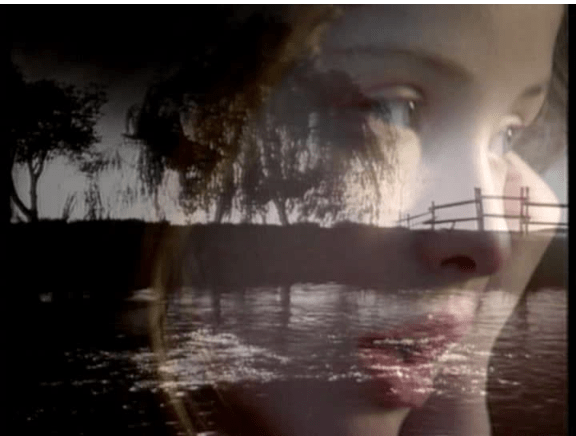
Godard opens things up in Part 3 (Episode 2A: Only Cinema), which concerns itself with the technological wonder of cinema – what makes it unique. It opens with images of eyes, a woman at a microscope, a man behind a camera, and a giant Cyclops. Godard tries to provide context to these images, giving a disquisition on French mathematician and engineer Jean-Victor Poncelet, who provided the groundwork for projective geometry while inside a Moscow prison. Godard extrapolates that he came up with the “mechanical application of the principles of projection”, giving a scientific backing behind the microscope and camera, and provides a correlative to the Cyclops by using a long clip of the canoe ride The Night of The Hunter, including a shot of the monstrous Robert Mitchum performance. Godard has Julie Delpy, shown puttering around her Paris apartment, reading Baudelaire’s “The Voyage” over the clip from the Laughton film, which suitably enhances the movie’s infernal beauty. She reads, “The world is equal to the child’s desire, who plays with pictures by his nursery fire.”

It is with Part 4 (Episode 2B: Fatal Beauty) that Godard returns to the theme of an art that annihilates. Here it is the way men have devoured women in the arts over the centuries. In a discomfitingly funny bit, Godard is shirtless during this segment, wearing a tinted visor and smoking his ever-present cigar, looking like a dissolute Hollywood producer, as, I’m sure, he intended. It begins with a montage of women running and falling, from Shirley MacLaine in Some Came Running to Anna Magnani in Rome, Open City, with a return performance by Jennifer Jones in Duel in the Sun. He ends this flurry with a return to the shot from M, and the art that erases, this time of feminine subjectivity. Returning to the theme of erasure, means a return to the horrors of the Holocaust. Godard speaks: “And Friedrich Murnau and Karl Freund. They invented the Nuremberg lighting, when Hitler couldn’t even afford a beer at a Munich café. With his table lamp casting a sufficiently Germanic shadow on the wall he says, “Dirty Hands.” This is an allusive reference to Siegfried Kracauer’s cultural study From Caligari to Hitler, which drew a line between German Expressionism and Nazism. Images of Conrad Veidt in The Hands of Orlac flash by, followed by the text, “Think With the Hands”. In that movie, Veidt’s hands are transplanted from a killer, and he fears those hands might think to kill again.

This thought manifests itself differently in Part 7 (Episode 4A: The Control of the Universe), in which Godard shows an image of two hands reaching towards each other into a clasp. Over this, he says, “The spirit is only real when it manifests itself, and it manifests through the hand. Love is the epitome of the spirit. And the love of one’s fellow man is an act. Which means a hand held out. Not a covered feeling. An ideal that crosses on the road to Jericho, in front of the man robbed by bandits.” This is a hopeful vision of Palestinian-Israeli amity, the current crisis that he cannot allow art to erase. It anticipates a similar image of trapeze artists joining bodies in a segment on Palestine in Film Socialisme (2010), indicating that no matter how much art has failed him, he still stubbornly dreams of its triumph, of a hand that restores:

“If a man walked thru paradise in his dream, and received a flower as a sign of his visit, and found the flower in his hand when he woke up, what can we say? I was this man.”

SILENTS PLEASE: HUGO and THE ARTIST

November 29, 2011

silents please

In one of those serendipitous quirks of scheduling, two homages to the silent film era are opening at the same time. Martin Scorsese’s Hugo, a 3D extravaganza adapted from Brian Selznick’s gorgeously illustrated children’s book The Invention of Hugo Cabret, uses the life and work of  Georges Melies as the central mystery for its eponymous hero to uncover. Conceived for 3D, it uses the contemporary (and derided) version of movie magic to look backward at a magician who was famed for his own glorious special effects fakery.

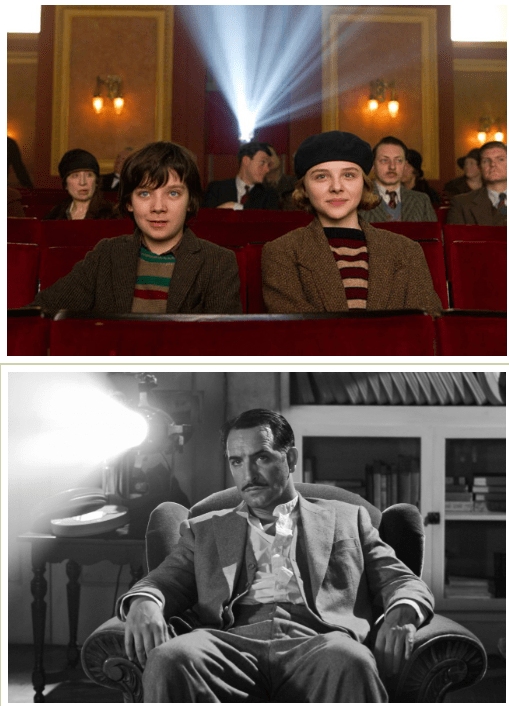
Michel Hazanavicius’ The Artist is a labor of love that made to mimic a 1927 silent. It was shot without sound on Hollywood back lots, framed in the old 1.33:1 aspect ratio, and was converted to B&W in post-production. Where Hugo posits Melies’s art as contemporary as the Hollywood blockbuster he is a character inside, The Artist embalms the object of its adoration.

Hugo elaborates the tale of a tousle-haired tot (Asa Butterfield) who lives in the walls of a Paris train station, working in secret as a clock winder, after the soused uncle (Ray Winstone) who taught him the trade drowned in the Seine. Hugo’s only respite from drudgery is the automaton left to him by his equally dead father (Jude Law). He spends his days stealing gears from the station’s toy store, hoping to spring the rusty marvel to life. With the aid of young bookworm Isabelle (Chloe Moretz), he tries to get the automaton up and running, while investigating the mysterious owner of the toy shop, Georges (Ben Kingsley), who seems to know more than he lets on.

Scorsese embraces 3D technology with an impressive gusto, opening with a swooping CGI-aided shot through the packed halls of the station, the forward motion pushing through layers with a dizzying speed. Likely inspired by the CGI long takes by Robert Zemeckis in his motion-capture films, as well as David Fincher in Panic RoomHugo finds Scorsese in an experimental mode, testing the boundaries of the technology. This long opening, which ends on Hugo’s eye peeping out of a clock face,  helps set up the mini-neighborhood that makes up the station. Hugo is immediately established as a viewer, as he watches the daily routines of the cafe owner, the doughy merchant who loves her, and the growing romance between the flower seller (Emily Mortimer) and the seemingly villainous station inspector (Sacha Baron Cohen).

On his first outing with Isabelle, he helps her sneak into the movies, where Harold Lloyd’s Safety Last is playing. Scorsese and his frequent DP Robert Richardson push the camera in closer to watch Isabelle and Hugo’s faces burst into grins as Lloyd works his stunts. This blooming cinephilia starts to enter Hugo’s waking life, as he later dangles from a clock hand just like Lloyd, and his nightmares, as he dreams his becomes part of the clock machinery, like Chaplin in Modern Times. Later his investigation of Georges reveals his past as a master filmmaker, and the creator of the first moving image Hugo’s father had seen, from A Trip to the Moon. Clearly a deeply personal project for Scorsese, it contains lovely tangents on the need for film preservation, which his Film Foundation supports, and a pocket history of Melies’ career, including generous clips from his films, which look glorious in hand-tinted 3D. To maul a Faulkner quote for my own ends, a great director’s past is never dead. It’s not even past.

The wonderful 5-disc DVD set of Georges Melies films from Flicker Alley just went out of print due to interest generated by the movie. Once they get it back in stock, it’s well worth the investment.

***

For Michel Havanicius, however, the past is most certainly dead, and in need of a nostalgic revival. He came to prominence with the face-pulling parody of the two OSS films, broad take-offs of James Bond style spy thrillers. The Artist is a more sincere reclamation attempt, but Hazanavicius can’t tamp down his natural flair for burlesque, so the film ends up as a goofy, and slightly condescending pastiche, rather than an authentic heir to the old movie melodramas.

It’s a mash-up of a Busby Berkeley backstage musical and A Star is Born, with George Valentin (Jean Dujardin, from the OSS films) entering the downswing of his swashbuckling acting career with the arrival of sound. Before he crashes, he meets-cute with young hoofer Peppy Miller (Berenice Bejo, also from OSS), and gets her a job at the studio, whereupon she starts her rapid ascent to box office dominance. As Valentin descends into poverty, it is up to Miller to salve his wounded male pride and get him back on-screen.

Valentin is less Valentino than Douglas Fairbanks, with his pencil moustache and persona of roguish athleticism. Miller starts as a plucky Ruby Keeler-type, plucked from nowheresville into Hollywoodland, and then transitions into Jean Arthur-style screwball. Both Dujardin and Bejo play their types with exaggerated pantomime, in epileptic fits of toothy grins and eyebrow levering. This playing-to-the-rafters style existed in the silent cinema, but did not define it — D.W. Griffith’s actors, for example, were famous for their studied underplaying. In wholeheartedly accepting this common stereotype, Hazanavicius makes his characters into quaint oddities, something for our modern tastes to laugh at with proud disdain.

The world in which he places Valentin and Miller is a clear labor of love, with brilliantine art deco sets by Laurence Bennett. The conversion of the color film to B&W, though, makes the film more shades of gray than the deep blacks available to Murnau or Lang, an example of the losses incurred by technological advancement (B&W stock is hard to come by these days). There is also the crystalline sharpness of the close-ups, the norm in our HD age, which lack the woozy mystery of the filtered and soft-focus techniques of the 20s.

It becomes clear that Hazanivicius’ real interest lies in 30s and 40s Hollywood, as his torrent of movie references attest. There is the aforementioned plot device from A Star is Born, a terrier lifted from The Thin Man, the breakfast table scene from Citizen Kane, a blonde bimbo sound test from Singin’ In the Rain, a snippet of the score from Vertigo, and a final city-scape dance number inspired by Fred Astaire and Ginger Rogers. It is in this final duet that Hazanivicius closes his ironic distance from the material and exhibits the simple joys of two actors moving in tandem.  Perhaps if he applied his chameleonic style to an RKO musical instead of a silent, he would be able to channel the unselfconscious magic of the original.

GOING BACK TO THE WELLMAN: SAFE IN HELL, MY MAN AND I, and LAYFAYETTE ESCADRILLE

November 22, 2011

safe in hell

William A. Wellman was an attractive guy who happened to make a lot of movies, one of those directors who led an entire life before entering the cinema (as salesman, hockey player, soldier). For Wellman and so many other early Hollywood craftsmen, directing was, as John Ford described it, just another “job of work”. Wellman was one industrious worker, credited with 83 shorts and features from 1920 – 1958. He excelled at compact stories of blue-collar types getting sore at each other (or what Manny Farber called “hard-visaged ball bearings standing around – for no damned reason and with no indication of how long or for what reason they have been standing.”), able to create a humming rhythm out of wisecracks and violence. The studios, however, tasked him with tackling much more, leading him to clumsily apply his blunt style to melodramas and comedies (his ’37 Star is Born is especially sluggish). His career is wildly uneven but well worth looking into, especially the period in the 30s where he was cranking out saucy and speedy pre-coders like Night Nurse and Other Men’s Women (both 1931). The Warner Archive has just released a third film from his stellar ’31: Safe in Hell  (along with later Wellman efforts My Man and I (1952) and his final film Lafayette Escadrille (1958)).

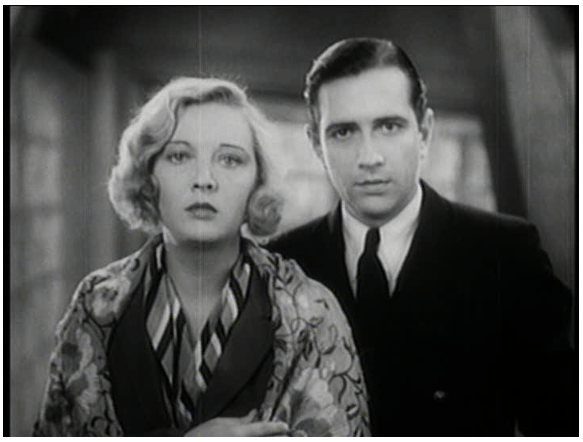
Safe in Hell was shot from mid-September to October 18th of 1931, and was released December 12th. A quickie produced by First National Pictures (which had merged with Warners), it’s a seamy pre-code drama about a prostitute who believes she has committed murder, and then flees to a Caribbean island that does not have an extradition treaty with the United States. The lead role of the whore without a heart of gold was originally slated for Broadway legend Marilyn Miller, and was then assigned to rising star Barbara Stanwyck, who gave a deliciously sardonic performance in Wellman’s Night Nurse earlier that year (she ended up in Frank Capra’s Forbidden instead). The role fell to Dorothy Mackaill, who Ralph Flint of the NY Times said was, “on return from her summering at Hawaiian resorts, [and] was pressed into service.”

Mackaill was a British born actress, who cut her teeth as a dancer in the Ziegfeld Follies before forging a productive career on-screen in the silent era, notching the leading role in the 1924 The Man Who Came Back, and in Alfred Santell’s 1926 The Dancer of Paris. Work dwindled with the arrival of sound, and First National declined to extend her contract at the end of 1931. That marked the beginning of the end of her career in pictures. It’s unclear why the studio felt she wasn’t fit for sound, as her performance in Safe in Hell is impressively wild and unhinged, wrenching the underwritten part into something tangible and affecting.

She plays Gilda Karlson, an in-demand prostitute in New Orleans, who is paid an unwelcome visit by a john, the one who led her into vice. She conks him over the head with a vase, and, thinking she killed him, is frittered away to the Caribbean by her merchant marine boyfriend Carl (Donald Cook). She is ensconced in a shady hotel populated by a murderer’s row of lowlifes, each ogling her with lip-smacking impunity. Wellman catches the crew (including my favorite name and face: Gustav von Seyffertitz) in a series of leering reaction shots, before they slowly turn their chairs around and await her return trip downstairs. With Carl away on a job, the seedy patrons urge Gilda to sink back into her old ways, and the rest of the drama details this dilemma.

Wellman gets the story rolling with alacrity, establishing Gilda’s character by opening on a close-up of her gams sitting next to a phone – the two necessary implements of her job. Within a few scenes a man is presumed dead and Gilda is stowed away on a ship, heading South, her eyes visible through a slit in a box, as she quips, “I always traveled 1st class!”. The hotel in the Caribbean is run by Nina Mae McKinney, a wildly talented black actress who was shunted into supporting or “musical” roles because of the institutional racism of the period (she was later known in Europe as the “Black Garbo”). Here she sings the theme song with a smile while serving her customers. The bellboy is played by another grievously under-used black actor, Clarence Muse, who injects a patrician weariness and humor into his stock character. He tells Gilda that they serve liquor, since they are in “a civilized country”, unlike the Prohibition era U.S.

The film loses its spark in the closing third, in which sexual deviancy is replaced by an unconvincing shift to the value of constancy, robbing the starkly downbeat ending of much of its power. An uneasy mix of entertaining smarm and queasy sentimentality, Safe in Hell  is probably the least of Wellman’s great 1931 run (The Public Enemy, Other Men’s Women, Night Nurse), but it still exerts a strange fascination. I should note that the Warner Archive transfer looks soft and scratched up, most likely taken from an old TV master. It is not up to the usual standards of the company’s releases, but the fact that this rarity is available at all is reason enough to celebrate.

***

My Man and I (1952) is a showcase for Ricardo Montalban, who plays Chu Chu Ramirez, an itinerant Mexican farmer who gains his citizenship, but is unable to escape racist attitudes. This earnestly melodramatic film was co-written by novelist John Fante, who (according to Doug Bonner) modeled the love story between Montalban and Shelley Winters on the romance from his most famous novel, Ask the Dust. Chu Chu, an almost idiotically optimistic character, immediately believes he can save Nancy (Winters) from her alcoholism through sheer force of will. Wellman militates against the ridiculous goody-two-shoes nature of Chu Chu’s character by placing him in cramped, dense frames, with looming faces present in the foreground (one of them belonging to Jack Elam, playing the cynical Celestino), used especially in Chu Chu’s flophouse. This sense of visual claustrophobia runs counter to Chu Chu’s continually stated belief in the American melting pot, which he proves by constantly wielding his citizenship letter from the President. In his scenes with Nancy, Wellman uses low-light, throwing dramatic shadows against the wall, visualizing the dark pit of despair that Nancy cannot escape from. Despite his best efforts, Wellman cannot entirely free the film from the hackneyed script, which transitions into a traditional courtroom drama, with all of its moralizing banalities. The ultimate saving grace, though, is the presence of Claire Trevor as an unsatisfied housewife whose husband hires the buff (and often shirtless) Montalban to clear a field, and whose withering putdowns and shivering carnality electrify every scene she appears in.

***

Wellman often said that Lafayette Escadrille was the worst movie he ever made, and I won’t argue the point. The story of American soldiers who sign up to fight in the French Air Force in WW1 was a personal one, as Wellman had served in the unit. He even cast his son, William Wellman, Jr., in one of the supporting roles. But Warner Bros. forced him to add a happy ending, and cast the handsome teen idol mannequin Tab Hunter in the lead role. The idea was to bring in a younger audience, but all it did was dilute Wellman’s vision more. What was intended as a melancholic homage to the American dead of WWI was turned into a raucous boys-on-the-town movie, and it’s a mainly joyless affair. There are some nicely shot flying scenes, and a very young Clint Eastwood picking lice out of his hair, but otherwise it is a lost cause. This is a shame, because one of his previous passion projects, the monochromatic Track of the Cat (1954), is one of his greatest visual accomplishments. Escadrille was his last film, but no matter, he got the job done more often than not.

DIETERLE WATCH: LOVE LETTERS, FASHIONS OF 1934, JUAREZ

November 15, 2011

dieterle watch

The previously hazy career of William Dieterle is slowly being brought into focus, as the Warner Archive and repertory screenings grant incrementally wider access to this neglected German-American filmmaker. The Archive has just released Fashions of 1934 (’34) and Juarez (1939), while the 92Y Tribeca recently screened a gorgeous new print of Love Letters (1945, scheduled to air on Jan. 21st at 10PM on TCM). The Warner Archive discs display opposite poles of his career, the dynamic fantasist and the staid historical dramatist, while the hallucinatory Love Letters lies somewhere in between.

Fashions of 1934 reunites Dieterle with William Powell, whom he had worked with two years earlier on Jewel Robbery (which I wrote about earlier this year). Powell again plays a suave member of the criminal class, but instead of a dapper thief he’s con-man Sherwood Nash, dealing knock-off couture gowns to department stores around town. Along to help him are Bette Davis as the eager fashion designer Lynn and Frank McHugh as his trusty dissembler Snap. In order to keep ahead of the trends, they fly to Paris to spy on the elite fashion housesAs the cops and the real designers close in on them, it’s up to Sherwood to lie his way out once again. Like Jewel Robbery, Fashions is a fairy tale of criminality, only focused through a male POV this time. Both define thievery and pirating as a kind of harder working entrepreneurship that leads straight to our preferred dream life.

It seems like the entire budget was funneled into the Busby Berkeley-directed musical number towards the end of the feature, but Dieterle makes the most of the drab office sets at his disposal. He focuses on Powell’s posture, his leans over the desks and chairs indicating the relative state of his pocketbook and love life. The dialogue is rolled out in an unvaryingly speedy pace, with the only indication of an emotional shift present in Powell’s relationship to furniture. Even when urging Lynn to marry another man, his voice betrays nothing – it is his body that gives him away. In seduction mode, he tilts forwardas if heading into an oncoming wind, offering his body to his suitably awed targets. It works with the store owners who agree to stock his knock-offs, as well as the vamp who bamboozles a French designer. With Lynn though, he always stands ramrod straight, often in group shots with Snap. It is only when he kneels down at the end in supplication that he can win her hand.

Davis was not happy with the film, saying that she “was glamorized beyond recognition”, and she does seem uncomfortable, never quite locking in to the screwball tempo set by Powell. Despite her reservations, the film was fairly well received, with positive notices from influential gossip columnist Louella Parsons (“very excellent”) and the New York Times: “The story is lively, the gowns are interesting and the Busby Berkeley spectacles with Hollywood dancing girls are impressive. ” The Berkeley musical, wrenched in as part of Sherwood’s plot to increase demand for ostrich feathers, is suitably insane, turning the female models into mutating patterns of harps, flowers and oarsmen. The harp-women are fun and disturbing, but it is Sherwood’s demonic energy in conjuring his dreams into reality that lingers.

Juarez (1939), a dramatization of the Mexican Revolution, lacks the speed and physical expressiveness of Fashions, collapsing under the weight of its ambition. This was a major project for Warner Brothers, and Dieterle assuredly didn’t have the freedom as on his previous quickies. The AFI Catalog lists the massive amounts of resources poured into the feature:

The picture represented Warner Bros. most ambitious project to date. According to the production files, every detail was exhaustively researched for historical accuracy. The files contained long lists of reference books in both English and Spanish. Press releases refer to the film’s extensive research. According to modern sources, the writers had a bibliography of 372 volumes, documents and period photographs. Art director Anton Grot drew 3,643 sketches from which engineers prepared 7,360 blueprints for the exteriors and interiors of the settings. A complete Mexican village was built on the Warner Ranch in Calabasas, CA.

Dieterle did not excel in the realist mode, with his light touch being weighed down with the anvil of historical “truth”, at least that according to studio researchers. It’s no surprise that the result is leaden and monotonously expository, which is not aided by Paul Muni’s grotesque makeup job as Benito Juarez, looking like he got a jumbo Botox injection. Every character states their motivation and provides historical context within the same sentence. The saving graces occur in the prissy arrogance of Claude Rains as Napoleon III, and the sensitive handling of Carlotta’s (Bette Davis) descent into madness, which rekindles for a moment Dieterle’s skill at eliciting hyper-real, dreamlike performances.

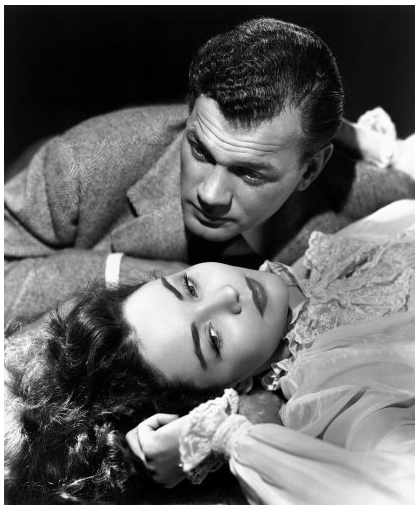
This skill is on full display in Love Letters (1945), a delirious romantic melodrama that Dieterle made when he was a freelancer, taking on short-term deals with studios. Producer Hal Wallis tapped him to direct the treatment, starting a professional relationship that would last until 1953. According to Bernard F. Dick’s biography of Wallis,  the producer purchased the rights to Chris Massie’s novel, Pity My Simplicity, in 1944, for $35,000, and was adapted for the screen by Ayn Rand (whose novel Fountainhead was released in ’43). It tells the story of Quinton (Joseph Cotten), an army man who ghost writes love letters for his friend while at the front. Although they have never met, Quinton falls in love with the woman he is writing them to, Victoria Morland (Jennifer Jones). After a tragic murder, Victoria is struck with amnesia, whereupon Quinton finally meets her, and falls desperately in love. But what will happen when she remembers her past?

Both Cotten and Jones were loaned out from David O. Selznick, with plenty of strings attached. Jones was negotiated to receive $100,000 for nine weeks of work, and Selznick had final approval over her hairstyle, makeup and wardrobe. He also stipulated that Lee Garmes be hired as director of photography, who had just shot Jones in Since You Went Away (1944). Within these restrictions Dieterle crafts an unsettling love story that equates the spiritual and the ghostly. It begins in the content of his letters, in which he writes he envisions “life as a dream of beauty”, and his friend tells him that Victoria is a “pin-up girl of the spirit”. For Quinton, Victoria is a disembodied vision of love, a Platonic ideal to strive toward.

Then this ideal comes jarringly to earth. After Quinton is wounded in war, framed against the gauzy curtains of the army hospital, he returns home. At a party, the blonde hostess (Ann Richards) tells him “I see things that may happen to you”, with both their faces in a close-up. The world is contracting and shuddering around him. He inherits his Aunt’s cottage, and when he arrives the table is mysteriously set. A ghost servant! No, it is only Mac, a gruff Scottish butler whom Quinton had forgotten, and who he calls “gargoyle”. The border between life and death, and past and present (as Quinton rummages through his childhood toys) seems awfully thin indeed. It is within this atmosphere that he meets Victoria, whose identity has been subsumed inside an amnesiac who calls herself “Singleton”. Singleton has no past or future, an unearthly presence to match the fantasy “spirit” of the letters. Quinton’s great fear is that Victoria will regain her body, and he will again have to re-enter the fraught thicket of memory and psychology that embodiment will bring. He envies her “contagious serenity”, and fervently believes that she has “lost a world, but gained a soul”. This use of Quinton’s fantasy to motor the plot is a similar device to Jewel Robbery, in which Kay Francis’ erotic desire seems to will William Powell’s thief into existence.

The pace is subdued compared to his 30s films, but the deliberation is appropriate to document the slow re-emergence of Victoria and the subtle fissures between worlds. Dieterle instead utilizes elaborate set design and tight compositions to convey the sense of the uncanny. The film is shot entirely on backlots, an artificial world for incomplete people, shot in dramatic chiaroscuro by Garmes. There are endless shots of lamps lit and extinguished, intermittently illuminating a red splotch on a white dress that will end Quinton’s dream and re-start Victoria’s reality.

NETFLIXING: SHOWTIME’S REBEL HIGHWAY (1994)

Originally published at Movie Morlocks, the official blog of Turner Classic Movies

November 8, 2011

rebel highway

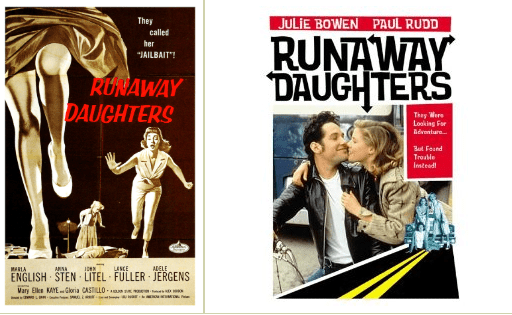
In one of the stranger experiments in cable television history, Showtime’s 1994 Rebel Highway series commissioned ten filmmakers to remake a 1950s exploitation movie. It was the brainchild of Lou Arkoff (the son of American International Pictures founder Samuel Z. Arkoff) and Debra Hill (producer of Halloween). They gave directors $ 1.3 million and a 12 day shooting schedule, to roughly approximate the original shooting conditions (modified for inflation). Unlike the ’50s cheapies, though, they were given final cut, and could choose their own screenwriter, editor and director of photography. This proved irresistible to the (mostly) impressive list of talents who signed on: Robert Rodriguez (Machete), John McNaughton (Wild Things), Mary Lambert (Pet Sematary), Allan Arkush (Rock ‘N’ Roll High School), Joe Dante (Gremlins), Jonathan Kaplan (The Accused), John Milius (Conan the Barbarian), William Friedkin (The Exorcist), Ralph Bakshi (Fritz the Cat) and Uli Edel (The Baader Meinhof Complex).

All of the filmmakers, except for Rodriguez, were old enough to have lived through the era of the film they remade, engaging the aesthetics and politics of the originals in strikingly different ways, alternating between affection and parody often in the same film. Since its original airing, the series has completely disappeared from cultural memory, but Netflix Watch Instantly, that haphazard repository of moving image detritus, is now streaming every entry, and it’s well worth sampling the project’s eccentric film-historical time travel. Below, some thoughts on my favorites.

Joe Dante’s Runaway Daughters, an adaptation of Edward L. Cahn’s 1956 AIP production, is one of the few entries to completely stand on its own as a feature. It is a companion piece to Matinee, Dante’s loving evocation of a 1950s movie-huckster, modeled on William Castle, that he made the previous year. Both films were written by Charlie Haas, and share a tone of gentle satire, about the paranoia brought on by the threat of nuclear war and the space race, respectively. Runaway Daughters follows three high school girlfriends who chase down the no-good boy who loved and left.  Working class Holly (Mary Nicholson) thinks she’s pregnant, and is convinced by rich girl Angie (Julie Bowen from Modern Family) and middle-class Laura (Jenny Lewis, who later formed indie-rock band Rilo Kiley) to track the dog down. So they steal a car and hit the road, intercepting the cad before he signs up for the Navy.

Dante opens the film with an irony-drenched  found footage montage set to “Let the Good Times Roll”, from a jubilant Eisenhower and Nixon, to the NAACP hung in effigy, and closing with the repressed sexual longings of I Was a Teenage Werewolf (1957), the title character getting hairy while watching a stretching gymnast. The longing on-screen enters the narrative, as the trio of not-so-repressed girls is watching Werewolf at a drive-in, necking with impunity and ignoring the metaphors on screen. One of the neckees is Paul Rudd in one of his earliest roles, playing Angie’s bad boy squeeze, Jimmy Rusoff (named after the original screenwriter, Lou Rusoff). Dante gifts Rudd with the catch phrase from Speed Crazy (1959, a major part of Dante’s mash-up Movie Orgy (’68)), “Don’t crowd me!”, which Rudd dishes with appropriate petulance to his greasy gearhead Dad (played against type by Fabian, a late ’50s teen idol).

From this opening scene, it’s clear the girls are more mature than the films representing them, although the Red Menace makes them shaky just like everyone else. Bob (Chris Young) gets in Holly’s pants by waxing poetic over Sputnik, which has just launched into space. For the rest of the movie, though, the phalluses fail. On their journey, the girls run into drunk cops and a gang of flaccid anti-commies, the only sympathetic voice brought by an uncredited cameo from Cathy Moriarty. The lone competent male is played by Dante-axiom Dick Miller, a crusty private detective with a reflexive disdain of the young and their newfangled perversions. He asks the girls’ parents if they ask their kids “about the strange night world of twisted kicks, of weird rituals and equipment? Of whips and chains and rubber balls and dildos and handcuffs?” In this world, it is clear the ladies have to take the world into their own hands, and so they do.

***

Robert Rodriguez’s Roadracers (adapted from the immortal Arthur Swerdloff version of 1959) lacks any of the historical identifiers of Runaway Daughters, taking place completely in Hollywoodland. The most stylized entry in the series, Rodriguez has no interest in interrogating the period, only in refining his style, which at this point was still potently kinetic, coming right after El Mariachi. It stars David Arquette as cynical greaser Dude (in an appropriately mannered performance), who cruises around town with his girl Donna (Salma Hayek) and his fidgety buddy Nixer (John Hawkes). The overriding mood is provided by Invasion of the Body Snatchers, which is playing at the local cinema, and which Nixer returns to ritualistically. Dude doesn’t have to see it to know his town has been co-opted by evil. He’s chased by a sadistic cop (William Sadler) and his moderately sadistic son (Jason Wiles). Rodriguez institutes a rhythmic editing style, set up in the opening when he intercuts a rockabilly band and a car chasematching the downbeat with screeching turns. This tempo is maintained throughout, accessorized by swaggering slow-motion and low-angle anti-hero close-ups. As Dude grows more certain of the town’s rot, the images get more delirious and the action more violent, ending in a farrago of gleeful self-annihilation.

***

The most jaw-dropping part of the series is provided by the pen of Sam Fuller, who with his wife Christa provided the script for Girls in Prison, which was directed by John McNaughton (adapted from the 1956 Edward L. Cahn film). An overheated women-in-chains movie, it is graced by an opening of transcendent pulp paranoia. It  sets up the back-stories of the eponymous girls, in three bloody tales: a red-baiting newscaster gets bludgeoned to death with a hammer; a budding screenwriter (Ione Skye) mounts an Off-Broadway play, “The Witch Hunt”, that drives her father insane and leads her to savage a bigot with a broken bottle; and a budding country star (Missy Crider) is framed for the brutal stabbing of a abusive producer. Filmed with canted angles and looming shadows, it’s a wild and terrifying hallucination of a society spiked with a insatiable need for vengeance. It is impossible for the rest of the film to live up to this fever dream, but it goes through the rest of dramatic motions with enough pep and smarminess (including a deliciously vampy turn from Anne Heche) to make it a worthwhile sit.

***

Shake, Rattle and Rock is a joyful and reflective evocation of 50s rock musicals, this one a remake of the ’56 Edward L. Cahn movie about a town that tries to ban Rock ‘n’ Roll (for more on Cahn, check out Dave Kehr’s profile in a forthcoming Film Comment).  Directed by Allan Arkush in bright pastels and a wall-to-wall soundtrack of pop hits (from Fats Domino to Eddie Cochran), it is the most culturally precise movie in the series, along with Runaway Daughters. Renee Zellweger takes the lead as the rock aficionado whose parents just don’t understand. She first appears as a bouncing blur, singing along to Little Richard’s “The Girl Can’t Help It” (also used in the great Frank Tashlin film of the same name) in her bedroom, her addiction not outed to her parents until she appears dancing again on a local American Bandstand-type TV show, hosted by Danny Klay (Howie Mandel). Once Zellweger’s mom (Nora Dunn) sees this horrible gyrating, she gathers her sewing circle (including P.J. Soles from Rock ‘n’ Roll High School and a wonderfully bitchy Mary Woronov), to shut down the show and ban the music. There is also a subplot involving a black acapella group, “The Sirens”, who are trying to break through the town’s color barrier and hit it big, and who Zellweger teams up with to protect the town from her mom’s crew.

Arkush elicits effortlessly appealing performance from Zellweger, a perky ball of cashmere with a fierce sense of her personal rights. The director also has a light, and very funny, ironic touch in presenting the parents’ retrograde attitudes, but intimates that these comical buffoons are not a plot point to be overcome but the avatars of an entire culture. Instead of the expected ending of a bridged age-gap, it concludes on a note of muted despair, with freedom reluctantly deferred. It is unexpectedly the most political film of the series, robbing its characters of the young people’s bill-of-rights stated by Florine in Jean-Luc Godard’s Film Socialisme: “To be twenty years old, to be right, to keep hope, to be right when your government is wrong, to learn to see before learning to read.” For Zellweger, there is nothing to see and nothing to read, her only hope an escape to parts unknown.

For more information, please read Jonathan Rosenbaum’s review of the series, in which he compares it to the French one produced by Arte, Tous les garcons et les filles de leur age.