JIM BROWN, MOVIE STAR: THE SPLIT and THE SLAMS

March 20, 2012

Screen Shot 2020-02-03 at 4.05.31 PM

Jim Brown retired from the National Football League in 1965, after nine seasons of transcendent athleticism. “For mercurial speed, airy nimbleness, and explosive violence in one package of undistilled evil, there is no other like Mr. Brown,” wrote Pulitzer Prize-winning sportswriter Red Smith. Brown was only thirty years old when he shockingly hung up his spikes, but he never much cared about public opinion. Instead of exposing his body to more pounding (he never missed a game in his astonishing career), he entered the comfier confines of the movie business, where stuntmen will happily take beatings for you. In his debut, Gordon Douglas’ fine Western Rio Conchos (1964, I wrote about it here), he establishes the quiet tough guy routine he would soon build upon. It was with The Dirty Dozen (1967) that he became a bankable name, and Brown knew it, as  it was during production of that blockbuster that he announced his retirement from football. He went on to star in close to twenty films over the next decade, and the Warner Archive recently released a sample of this output on DVD, four works from 1968 – 1973: The Split (1968), Kenner (1969),…tick…tick…tick (1970) and The Slams (1973).

Brown churned out three ensemble action movies in 1968, slowly moving his way up the credits. He provided solid support in the violent mercenary film Dark of the Sun and cold-war submarine adventure Ice Station Zebra, but it wasn’t until November of that year, in The Split, that Brown gained top billing. Robert Chartoff and Irwin Winkler had produced Point Blank for MGM the previous year, and sought to replicate its success by again adapting one of Richard Stark’s (the pseudonym of Donald E. Westlake) crime novels featuring the ruthlessly efficient thug, Parker. John Boorman’s icy stylization on Point Blank was replaced by the anonymous workmanship of  British TV director Gordon Flemyng, who brought Stark’s The Seventh to the screen. Retitled The Split, it also changes the no-nonsense Parker’s name to McClain, played by Jim Brown.

Just out of prison, McClain is eager to take on a new job. He’s tipped to the heavy amount of cash flowing through the Memorial Coliseum during Los Angeles Rams games, and begins assembling a team to snatch it. The heist goes off with nary a hitch, but soon the money goes missing, and the crew starts turning against each other to find the cause.

Stark’s books excel in breaking down the brute mechanics of crime, of the intricate processes and rituals involved, from the punchy language of black market firearms deals to the nitty-gritty of pawn shop cons. The Split is a cartoon version of the novel, replacing process with pizzazz. This would be a disaster except for the eager cast, which is a motley collection of odd-faced acting talent. The team that McClain puts together is played by Ernest Borgnine, Jack Klugman, Warren Oates and Donald Sutherland, with Gene Hackman as the cop sent to take them down.  Each is given one characteristic to play with, and they mug it to the hilt. Borgnine is the hot-headed muscle, Klugman the anxious wheelman, Oates the antic lock-picker and Sutherland an aesthete sniper. Brown puts each through a gauntlet of ridiculous tests to prove their worthiness, like running Klugman off the road and drop kicking Borgnine.

When not involved in some spectacular fight scenes, Brown is tentative in the lead, still clinging to his early roles as a quietly monotonal badass. He hasn’t yet developed the deadpan humor that would so invigorate The Slams, so he tends to fade into the background when next to his engagingly over-the-top castmates. But when the fists start flying, he is the one who overwhelms. The bout between Brown and Borgnine is a classic office smashing bruiser, a slugfest so brutal that Borgnine recalled, “I actually got my head bashed in because he took things a little too seriously.”

Brown was nothing if not serious, and always took offense to his films being described as “Blaxploitation.”  He told David Walker that, “the word is basically irrelevant… Whenever you sign a contract to play a role and make money, you’re exploiting yourself. Nobody else is exploiting you.” Later, he quipped, “You could say that James Cagney was white exploitation, or John Wayne, because they did action films, they made money, and they were major stars.” For Brown then, these were very lucrative “self-sploitation” movies, although ones in which he could play “roles that had never before been played by black actors.” In simply being the leader of an otherwise all-white ensemble in The Split, he was breaking ground, gaining a position of power where he could sell-out more than any white actor could dream of. This was a practical kind of equality he could believe in, which also allowed him to found organizations like the Negro Industrial and Economic Union, to stimulate investment in black-owned businesses.

In Kenner and …tick…tick…tick, Brown tried to expand his limited range. In Kenner, he played a merchant seaman in Bombay, trying to track down a man who conned him out of case. Instead he gets mixed up with a street kid, and a tender relationship develops. In …tick, he tries his hand at social drama, as Lilies of The Field director Ralph Nelson plops him into an In the Heat of the Night style anti-racism drama, in which he plays a sheriff caught in the middle of a brewing race war. These are rather stodgy films, obvious in their emotional manipulations, but Brown continued to get more comfortable as a performer, developing a relaxed charm to go with his intimidating physicality.

By the time of The Slams (1973) Brown could really command the screen, introducing a looseness and humor to his strong silent type that no longer needed an ensemble to carry a film. The film originated when Gene Corman (brother of Roger) was inspired to make a film based on the 1970 “Soledad Brothers” incident, when three black inmates at Soledad Prison in California killed a white guard, in retaliation for the shooting deaths of three inmates. Corman had interest in casting Diana Ross as Angela Davis, who advocated on the Brothers’ behalf, but that never came to fruition. The film that was made has almost no relation to the original incident, aside from scenes of racial tension in prison. Corman had just made the successful Blaxploitation film Hit Man, so tailored The Slams to feature as much brawling and shootouts as possible.

Brown plays Curtis Hook, a small-time thief who finds his way into a million dollars. Before getting cuffed for the job, he manages to hide the money at an abandoned amusement park. In jail on a misdemeanor, all he has to do is bide is time until he is released, and become a rich man. But alas, the local mob syndicate has put a hit out on him, which the white supremacists are eager to collect on. While fighting for his life, he learns that the amusement park will be demolished, and his fortune with it…

Director Jonathan Kaplan had earned his Corman spurs with the sexploitation-ers Night Call Nurses (1972) and The Student Teachers (1973), learning to favor speed and spectacle over anything else. The Slams careens along with relentless action, from the opening shoot-out to the wildly intricate jailbreak that dominates the last third. He barrels forward with handheld camera and the ever-present zoom, always goosing the action with one or the other. Brown confident and cocksure as Hook, radiating arrogant calm rather than fading into the backdrop as in The Split. In the parade of fight scenes, which include inventive tortures like molten steel getting poured down a man’s throat, he gets to display his quick-twitch athleticism and penchant for kidney shots, getting especially brutal with the freakishly tall supremacist Glover (Ted Glover), whom he leaves writhing in pain at the end of almost every scene.

The cast is filled with pungent turns, including Roland Bob Harris as a skin-crawlingly obsequious Captain, Quinn K. Redeker as the short-fused warden, Betty Cole as Hook’s wise mother (“You know you can’t mess with the man!”), Paul Harris as  sleepy-eyed pimp Barney, and an indelible cameo by Joe Dante fixture Dick Miller as an incredulous cab driver. A relentlessly entertaining action movie, it presents Jim Brown at the peak of his star power. While never as elegant and jaw-dropping as his play on the field, his performances from this period hold a brusque, brutal charm (similar to Jason Statham’s current run), while his fight scenes should be objects of rapt contemplation.


THE FILMS OF ROBERT MULLIGAN, PART 4

March 13, 2012

Screen Shot 2020-02-03 at 12.04.20 PM

This the final post in my series on the films of Robert Mulligan. Click for parts onetwo and three.

As much as Robert Mulligan is associated with the South, for To Kill a Mockingbird and The Man in the Moon, he was actually born in the Bronx. A few years after his tepidly received L.A. noir The Nickel Ride (1975), he adapted Richard Price’s Bronx-set second novel, Bloodbrothers, which was released in ’76 (the film came out in September of 1978). An epithet-laced trawl through an Italian working class family, Mulligan toned-down the language (from the book’s first page: “His hand smelled from that oily shit inside Trojans”), but captured the twitchy, carnal energies that fueled such texturally dirty talk.

Robert Surtees, who had shot Mulligan’s Summer of ’42 (’71) and The Other (’72), returns as the director of photography, although the the gauzy images of those films are replaced with hard-edged, dark blue tones. Clearly Mulligan was impressed with Jordan Cronenweth’s similarly detailed work in Nickel Ride. The film opens in a helicopter shot of a smoggy Bronx as night falls, crossing highways and subways until there is a cut to a crane shot that eases onto the facade of Banion’s Bar, seemingly the palpitating heart of the borough.  This amiable joint, the local watering hole for the construction worker’s union, is named after wheelchair bound Irish carouser/owner Banion (played with immense warmth by Kenneth McMillan) who trades handjob jokes and chummy backslaps with the volatile De Coco brothers, the insecure macho teddy bears whose family is the center of the film.

Banion’s is more home to the brothers than their walk-up apartments, filled as they are with the disheartening markers of adulthood like children, wives and bills. Tommy De Coco (Tony Lo Bianco) and his brother Chubby (Paul Sorvino) are the patriarch of a struggling clan, with Tommy’s wife Maria (Laila Goldoni) on the brink of a nervous breakdown, while his fragile, feminine youngest son has been browbeaten about his weight into anorexia. Tommy’s hope lies with his eldest, Stony (Richard Gere), a handsome, reassuringly hetero playboy who is about to enter the construction union. But alas, Stony has dreams of escape, implied in the cut from Banion’s to the elaborately outfitted cavern-disco he frequents, with faux-stalactites dripping from the ceiling in honor of his own raging, confused hormones. Focused by the straight talk of liberated chick Annette (an inflammatory Marilu Henner) Stony shirks construction for a job as a recreation assistant at the local hospital, fulfilling his dream of working with kids. Tommy is incensed, and Stony has to choose between family or freedom.

The script by studio veteran Walter Newman (Ace In the Hole) is overstuffed with incident (and received an Oscar nomination for it), and Mulligan embraces the abundance by pushing for an across-the-board hysterical style of acting. This is grating and invigorating in turn, with Tony Lo Bianco performing as an over-gesticulating stereotype, while Paul Sorvino’s papa bear routine secrets away layers of pain that well up in his often overfilled eyes (although he does have the benefit of the most emotionally naked monologue in the film). Richard Gere is effective in mumbly James Dean mode, a figure of naive charm starting to become aware of a world outside the Bronx. Although, as with all of Mulligan’s coming-of-age films, this knowledge is rife with dangers. Just as William and Jane fly away into uncertainty in The Pursuit of Happiness, so do Stony and his brother drive off into the unknown, with only a few bucks to their name, but a dream of independence just over the horizon.

There is none of this richly moving ambiguity in Same Time, Next Year, a stodgy farce that Mulligan cranked out quickly the same year. It was released in November of 1978, only two months after Bloodbrothers. It was based on a hugely successful Broadway play of the same name, about two lovers who meet once every year for a one-night stand. Written by TV scribe Bernard Slade (The Flying Nun, The Partridge Family), it ran for close to 1500 performances and netted Ellen Burstyn a Tony Award. For the film, Slade wrote the screenplay and Burstyn returned to play the role of Doris. Charles Grodin, who played George in the stage version, was replaced by Alan Alda.

It is nothing more than a filmed version of the play, taking place almost entirely in a hotel room, with little choreography inside the frame. It’s mostly Alda and Burstyn jawing back and forth at each other.  Robert Surtees returns as DP (his final film credit), and it contains the warm, nostalgic filtered light of Summer of ’42, but is only shown to its full beauty in a few exterior shots. The play itself is a clunky contraption, revisiting the lovers every five years or so, larded with cheap signifiers to denote each era. In the 60s, Burstyn dons Native American dress and talks about protesting, while Alda slides into a suit and talks about voting for Goldwater. The characters get lost in symbolism, and never crackle with erotic intensity (which comes with casting Alan Alda). The film was then of course nominated for four Oscars.

Mulligan, now deep into his 50s, began to slow down his working pace considerably. He had made ten features in the 60s, and six in the ’70s, but would go on to direct only two films in the ’80s, before capping his career with The Man In the Moon in 1991. He was still garnering awards and praise, so it is likely Mulligan could have been more productive if he so chose. But with the  turn to Jaws-imitating blockbusters, perhaps there were just not many appealing projects offered to him. His next feature, the supernatural romantic-comedy Kiss Me Goodbye (1982) would tend to affirm this theory.

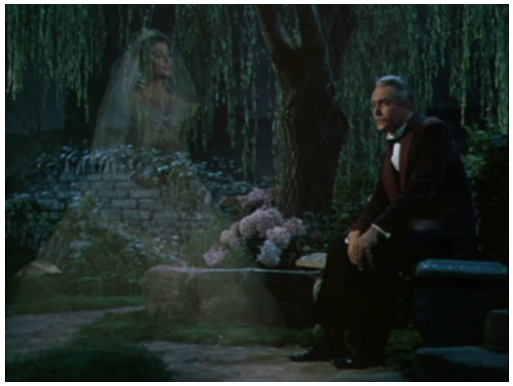
Never one for “high-concept” plots, Mulligan has here agreed to direct a very loose adaptation of Dona Flor And Her Two Husbands (1976), about a woman whose dead husband begins to haunt her when she is to marry again. At the time of its release, the original was the most successful film in Brazilian history. It seems Mulligan could only make his kind of intimate drama if it had this kind of box-office goosing gimmick. And despite how ill-suited he was to this kind of genre mash-up, it ends up as a diverting treat, if not at the top-tier of his accomplishment.

He’s helped by a game cast, first and foremost Jeff Bridges, whose uptight Egyptologist at the Met Museum honorably channels Cary Grant’s similarly anal scientist in Bringing Up Baby. While not matching Grant’s athleticism and uncanny comic timing, Bridges does have a talent for embattled exasperation, his expression one of barely concealed disgust. And as Grant is drained by the  kookiness of Katherine Hepburn’s wealthy family, so is Bridges of his rich fiance, Sally Field. Field is innocuous in her usual chipper munchkin routine, so Claire Trevor (as her mother) easily sashays away with the show in her final feature film. It is worth watching just to see her grand industrial-strength bitchiness cut Bridges down to size. James Caan, as Field’s ghost husband, is woefully miscast as a charismatic Broadway choreographer, but he is nothing if not game, which could be said for this entire film, a modern contraption that Mulligan manages to make look towards the past. The film performed modestly at the box-office, finishing with $15.78 million, right in between Death Wish 2 and the re-issue of Star Wars (according to Box Office Mojo).

Then came the longest layoff in his career, six years, before he agreed to make Clara’s Heart (1988) for Mary Tyler Moore’s production company, MTM. He was clearly only willing to make films on his terms at this point, and this coming-of-age tale returns to his favored themes of maturation and disillusionment. Based on the novel by Joseph Olshan, it follows teenaged David (Neil Patrick Harris, in his first screen role), as he grapples with the death of his baby sister and the resultant crack-up of his parents’ marriage. He turns to his Jamaican nanny Clara (Whoopi Goldberg) for stability and strength. I harbored fears that this would devolve into one of those Hollywood wish-fulfillment fantasies where the kindly black character solves all of the rich white people’s problems, but thankfully, things simply get more complicated from there.

Mulligan had the good fortune to hire Freddie Francis (The Elephant Man) as his DP, and the film includes some of the most emotive set-ups of his career. In the opening sequence, Mulligan and Francis hold a close-up of David as a funeral ends, with flashes of black tuxedos passing him in the foreground. It is an image of a boy made scattered and incomplete by mourning. Later, they execute another shot of incompletion, during one of his parents’ arguments. In one long take, the mother is sitting screen right in a living room, the father to the left, in his study. The rooms are separated by a wall, so each are ensconced in their separate worlds. This image alone defines the dissolution of their union, and yet another rupture in David’s life.

His relationship with Clara is fraught, as he transitions from bratty teen to the realization that she is the only stable part of his life. They test and circle each other, waiting to expose each other’s vulnerabilities, as their racial and class boundaries are forefronted by Mulligan (the cut from David’s suburban mansion to the Jamaican neighborhood in Baltimore acts as a closure – there is not easy passing between these two zones). They develop their own wary love for each other, and by the time Clara reveals her own past traumas (that are as vast and unresolved as David’s), they accept each other for the imperfect, guilt-ridden creatures that they are. This is Mulligan’s kind of (ir)resolution, the recognition of limitations his own happy ending. So he ends it with another close-up of David, this time free and clear of all obstructions, aside from the ones in his memory. The film bombed, earning just over $5 million (right behind the Chuck Norris cheapie Hero and the Terror) and earned no Oscar nominations.

The Man in the Moon is a distillation of this theme of irresolution, one which opens with the idolized older sister saying, “sometimes things just don’t make sense, and all of a sudden, I get scared.” As with the opening shot of Bloodbrothers, Mulligan has his DP (Freddie Francis this time), crane his camera down into the film’s thematic heart, instead of a bar, it’s a screened in porch. This downward craning shot also has an echo in To Kill a Mockingbird, in which the camera descended a tree and outlined the main drag of the town, before backtracking to introduce Scout. The Man in the Moon‘s shot reveals another headstrong tomboy, Dani (Reese Witherspoon, who, like NPH, makes her screen debut. Mulligan was an ace talent scout). She is listening to Elvis’ “Loving You” for the umpteenth time, and is chastised by her older sister Maureen (Emily Warfield), who a few moments later will discuss her undefinable fear.

The story is utter simplicity, but rendered with subtlety in Jenny Wingfield’s original script (her first). Dani is in the process of trashing her Elvis posters and fixing her attentions on a real live boy – the dreamy new neighbor Court (Jason London). He literally crashes her childhood idyll, jumping into a swimming hole she had considered her own private domain. This rupture spurs Dani’s maturation, and engages her in a world of petty jealousies, shocking violence, and unutterable tragedy. All of Mulligan’s coming-of-age stories are steeped in death, the loss of innocence revealing the world in all its unresolved, unanswerable reality. Dani, as with Scout, or William (Pursuit of Happiness), or Hermie (Summer of ’42) has the veil removed from their childhood games, and they shift from a mythologized childhood to fraught adulthood. This transition is made visible Mulligan’s through subjective camera, the low-angles in Mockingbird and the idolizing slow-motion of ’42 changing to sober eye-line matches and close-ups.

Dani is visualized in tracking shots, speeding from house to lake in frolics of determined intensity. The first is seen before her initial encounter with Court at the lake, the last in a mournful sprint from her first funeral service. She opens by racing to something, and ends by sprinting away, into the unknown.  There is also a visual rhyme to that opening crane shot, which has its correlate in the shattering closer. The camera drifts towards the front of the house, reversing the opening shot, before cutting to the interior. It floats past the newborn baby and settles on their  Mom and Dad in bed, as Dani asks (offscreen): “Marie? Is it always going to hurt this bad?”. The implicit answer is in their father’s face, played so engagingly laconic by Sam Waterston, who has an inexplicable smile on his face as he turns and faces his wife, happy to be at home, regardless of the tragedies outside.

This reverie stops as Mulligan cuts to a static shot of the walled-in patio, where Maureen is combing Dani’s hair. Now the dreams are in the interior of the house, and the adolescents outside are growing into the no-nonsense world of static two-shots:

Dani:  “Sometimes, I think that nothing’s ever going to make sense again”

Maureen: “Maybe life’s not supposed to make sense.”

Dani: “Doesn’t that scare you?”

Maureen: [whispered] “Yes, it does.”

Maureen’s tossed-off lines at the beginning of the film, meant to assuage Dani’s own insecurities, are now repeated, and have accrued layers of resonance. It is one of those scenes that can reduce me to tears, regardless of how many times I’ve seen it, which has made this particular transcription particularly vexing.These lines are an acknowledgment that there is no governing logic to our lives, but whatever happens, that it can be endured with grace. There is no better way to encapsulate his extraordinary career than those words of Dani and Maureen, in their brave resignation.

So, watch some Mulligan.

FILM COMMENT SELECTS 2012

March 6, 2012

Screen Shot 2020-02-03 at 12.00.04 PM

The 12th edition of Film Comment Selects concluded this past week at Lincoln Center, having screened 32 films from all over the cultural map. The stoned dropout to the New York Film Festival’s Ivy League grad, the films chosen by Film Comment magazine’s editorial staff tend towards the spectacular and the underground, and occasionally underground spectaculars. Plucking from the festival scene (Hirokazu Kore-eda’s I Wish), genre titles (Alexander Zeldovich’s Target) and experimental multi-projection performances (J. Hoberman’s Land Passion War of the Dead Christ Worlds), it has something for everyone. That is, if everyone was a creepy cinephile shut-in.

The selection of Target (2011) encapsulates the mission of FCS, a Russian sci-fi film too genre-bound to make the NYFF, and too arty to pick up mainstream distribution. The film is conceptually simple but dramatically sprawling, pulling from influences as disparate as  Stalker and Gattaca. The year is 2020, and China has emerged as the dominant super-power, its culture seeping into every corner of Russian daily life. The Mandarin-speaking minister of Natural Resources, Viktor (Maksim Sukhanov), is tiring of his sterile marriage to Zoya (Justine Waddell), a feckless beauty who spends her mornings getting her face un-wrinkled by a nano-bot infused death-mask. Longing for the days when the felt something resembling emotion, they light out for the mountains of Central Asia, in which an abandoned astrophysics laboratory is rumored to emit cosmic rays that grant eternal life. They are joined by Zoya’s hyperactive TV-host brother Mitya (Danila Kozlovskiy), the thuggish customs agent Nikolai (Vitaly Kishchenko) and Anna (Daniela Stoyanovich), the dreamy narrator of a Chinese-for-Beginners audiobook.

As with Stalker’s Zone, the astrophysics site seems to have a consciousness all its own, with the guides referring to it as “The Thing, The Detector, The Target”, both an active agent and a receptacle for divine radiation, an elusive and contradictory force.Viktor and his entourage ignore this ambiguity, and approach it as just another slumming self-help adventure, the simple rural living distracting them from all those riches. But then the site has its effects, and immortality ain’t what it’s cracked up to be. The radiation makes them act younger and more impulsive, as if slightly buzzed. The movie shifts from sci-fi futurism to melodramatic fucking and fighting, as the group turns into an overheated brat pack of randy adolescents. Eternal love in this situation becomes not a promise, but an existential threat.

The films of director Alexei Balabanov present another kind of threat, not of the banality, but the deadpan absurdity of evil. His relentlessly black comedies eviscerate the Russian state apparatus in stories of institutional incompetence and sickeningly casual violence.  A Stoker is a return to contemporary Russia after the early 20th Century detour of his Bulgakov adaptation  Morphia (2008,selected for the 2010 FCS). Skryabin (Mikhail Skryabin) is a native Siberian Yakut who was shell-shocked in the Afghanistan war and never recovered, spending his days in the boiler room fueling the furnace, and typing away at a novel he’s been writing obsessively for decades. His face is a placid mask, and his reactions sluggish, as if instructions were dropped into him down a deep, cobwebbed well. Balabanov shows this garlanded hero as a zombie of Russia past, lobotomized into a cog in the mob’s death machine, as he burns up assassinated corpses in his furnaces. It is only when his daughter gets caught up in that same machinery that he dodders back to life, adding a few more drops of blood into his country’s vast reservoir, before drifting back off to sleep.

Also easing into the land of dreams is Sara Driver’s Sleepwalk (1983), a hypnotic nocturne set in the Lower East Side of Manhattan. Agitated typesetter and single mom Nicole (Suzanne Fletcher) agrees to translate a sheaf of Chinese nursery rhymes to make some extra cash. Her life is already filled with everyday surreality, from her perpetually bleeding finger to the trance-like rhythms tapped out by her sullen workmates, but with these translated tales reality entirely escapes her, and she is left circling through a laid-back nightmare. Everything gets repeated, from a child’s obsessive street-crossing to the elevator’s insistence on stopping at every floor. Shot with the languorous long takes of DP Jim Jarmusch, Driver’s film approximates the feeling of half-sleep, when the day’s events are cycling through your head but your body is shutting down, your consciousness slipping away.

There is nothing sleepy about the wide-eyed adorability of I Wish (2011), the latest family drama from Hirokazu Kore-eda (Nobody Knows). Returning to more commercial ground after his experiment with latex love in Air DollI Wish was partly financed by Kyushu Railway Company, whose bullet train provides the central plot point of the film. It’s a simple tale of a family split by divorce. The two sons split, with Ryonosuke (Oshiro Maeda) living with the father (Joe Odagiri) in Fukuoka, while the older brother Koichi (Koki Maeda) stays with their mother in Kagashima. They vow to cut class and meet at the midpoint between their two cities, believing that when the new bullet train passes that point, their dreams will come true. A saccharine set-up, but Kore-eda leavens it with such melancholy and lightness of touch, it ends up indelibly moving. This is in no small part to the charismatic kid leads, real-life brothers who perform as the manzai (comic duo) act Maeda Maeda (according to Mark Schilling in the Japan Times). Already professional comedians, they have impeccable timing and rapport, with Koki playing the straight man and Oshiro the loudmouth madman. That this routine works despite their being separated for the majority of the film is a testament to their rhythm, as well as the fine parallel editing of Kore-eda’s team.

Film critic J. Hoberman (now of Blouin Art Info) does some editing of his own in Land Passion War of the Dead Christ Worlds, his multi-projection spectacular that layers Passion of the ChristWar of the Worlds (2005) and Land of the Dead on top of each other in an orgy of martyrdom and Hollywood pizzazz. This special presentation grew out of Hoberman’s college lectures, in which he experimented with Passion as well as Rocky, playing all five (at that time) in the series at once.Passion was projected on film in its entirety, stretched vertically from its original Scope ratio to fit into the fatter 1.85, giving the characters, as Hoberman said, “an El Greco look”. Then scenes from War of the Worlds, and all of Land of the Dead were projected digitally over it, and hidden affinities began to emerge. It calls attention to the cookie-cutter manner of Hollywood screenwriting, in which “beats” all occur in the same spots, regardless of whether it’s Jesus’s crucifixion or a zombie rebellion. Then there are the smaller bits of serendipity, with Satan’s snake slithering towards a cowering Tom Cruise, or fireworks blooming over Pontius Pilate. As Hoberman admitted, it was more of an installation than a crafted work of deconstruction, and encouraged wanderings in and out. I remained lodged in my seat (with no booze nearby), so I let my mind wander instead, grazing over each layer of action, waiting for moments of convergence, after which I oohed as if wooed by the latest blockbuster, which, at Film Comment Selects, it most certainly was.

Click to read what I previously wrote about FCS selections Despair (1978) and Almayer’s Folly (2011).

THE FILMS OF ROBERT MULLIGAN, PART 3

February 28, 2012

Screen Shot 2020-02-03 at 11.56.26 AM

This is the third part of a series discussing the complete filmography of director Robert Mulligan. Click to read Part 1 and Part 2.

As the 1960s ended, so did Robert Mulligan’s collaboration with producer Alan Pakula. After seven films together, Pakula embarked upon a successful directing career of his own, beginning with the college romance of The Sterile Cuckoo in 1969 (which would earn Liza Minnelli her first Oscar nomination). Mulligan also tried his hand at courting the youth market,  starting production on The Pursuit of Happiness late that same year, although it was not released until 1971. It was the first coming-of-age story that Mulligan directed since To Kill A Mockingbird, and its melancholic sense of lost innocence pervades all of his work in the early 1970s.

As with all of the Pakula-Mulligan productions, The Pursuit of Happiness was adapted from a novel, this time by Thomas Rogers. The rights were purchased by David Susskind, a prolific producer of TV movies who re-entered theatrical features with this low-key story that was shot late in 1969 (he made the hit sex comedy Lovers and Other Strangers (1970) immediately afterward). Sidney Caroll (The Hustler) wrote the script, but a revision by George Sherman introduced so many changes that Caroll requested his name be changed to Jon Boothe. The final draft follows lapsed-radical William Popper (a morose Michael Sarrazin) as he argues with his student-activist girlfriend Jane (Barbara Hershey) and accidentally sulks his way into prison. There he decides to drop out of society for good.

Working on location in NYC with D.P. Dick Kratina, who had just shot seedier parts of the city in Midnight Cowboy, Robert Mulligan crafts a sympathetic, though distant, portrait of a disaffected ex-Leftist youth. Mulligan, who had joined the Marines at the tail end of WWII, was an outsider to the violent revolutionary stirrings of the 60s, saying that, “We were in the process of a nightmare that I didn’t understand. and that I didn’t feel anyone else understood. I mean, the riots were going on, the campuses were being burnt, the ghettos were being burnt, the marches were going on, people were being killed. It just didn’t make any sense.” Pursuit is his attempt to comprehend a generation he is entirely disconnected from, and the result is a film of great sensitivity and sadness, because he can never bridge that gulf.

Kratina and Mulligan open the film on a close-up of a toy sailboat, bobbing in a park pond, inter-cut with shots of William. He is instantly identified as adrift and alone, cutting through a sea of humanity, each protesting inaudible causes. Kratina’s camera roams with a cinema-verite freedom, the frames crammed with idealistic bodies that William swiftly navigates away from.William ignores them, Sarrazin’s face holding a persistent dopey calm, a smirk perpetually creeping up his lips. He slices his way to his girlfriend (an engagingly perky Barbara Hershey), who was originally inflamed by his passion, and now vaguely annoyed by his apathy and creeping nihilism. Their academic world is filled out by their Hippie pal Melvin (an adorably manic Robert Klein), who is seen mostly sleeping in William and Jane’s bed.

Their circumscribed world comes apart when William is involved in a car accident, and faces serious jail time. Then the world outside floods in, and with it the revelations that he comes from a rich, well-connected family, and political resentments ooze out of every corner. His aunt asks, “still a communist?”, while his grandmother bluntly states how her neighborhood declined once the “negroes and jews” moved in. Because of his wealth, he gets fine representation from a blustery E.G. Marshall, who pithily comments that “when you got in trouble, you came straight for the reactionary bastard.” The sense of class betrayal is ever-present, no more so in the painfully bittersweet scene when William declines his Grandmother’s offer to inherit the family mansion. She, like William Buckley Jr., wanted to “stand athwart history, yelling stop!”, but had to watch her grandson embrace the multi-cultural future instead.

When William decides to escape America once and for all, it should be a moment of triumph, and would be in a traditional counter-culture movie of the period. But Mulligan senses tragedy in this breakdown of society, no matter how nakedly corrupt he has shown it to be. Their departure sequence occurs in near-silence, after an uncomfortable barter with a smarmy pilot played by William Devane. The transaction is starkly capitalistic, as if the couple is swapping one exploitative system for another (one of crime). So when they take to the air, headed for Mexico, the overwhelming emotion is not one of release, but of unutterable sadness. The lovely Randy Newman song that plays under their escape captures this ambivalence perfectly:  “Let me go, let me go, let me go/Don’t give me the answer/cause I don’t want to know”.

Columbia Pictures delayed the release of The Pursuit of Happiness for over a year, perhaps because of how “square” the film would look next to Easy Rider (1969), and put it out to little fanfare in February of 1971. In the interim, Mulligan shot the deeply personal Summer of ’42, which Warner Brothers released to enormous box office in April of that same year. It’s a nostalgic coming-of-age tale of three young boys as they spend a summer on Nantucket. Seemingly tailored for Nixon’s so-called Silent Majority, with its loving evocation of small-town American life, it nevertheless retains the ambivalent melancholy of The Pursuit of Happiness, its youths also lost inside of different kinds of American myths.

Herman Raucher wrote the autobiographical script in the 1950s while as a TV writer, but he couldn’t get anyone to look at it. He was acquaintances with Mulligan from those days, and once the director gained enough clout, was able to get the picture funded for “a million dollars” (interview in the TC Palm). The story centers on Hermie (Gary Grimes) and his infatuation with Dorothy (a dreamy Jennifer O’Neill), the beautiful army wife whose husband is fighting during WWII.

It is Mulligan’s first collaboration with the great DP Robert Surtees (The Last Picture Show), and they opt for heavily filtered images of browns and greens, the beaches fading like old Polaroids. This sense of the movie as memory is enhanced by the voice-over, which is read by the director himself. The events are clearly past, mythologically so, with scenes of troops sailing off to war, first dates at the movie house, and fumbling over an old sex manual. These are scenes that could come out of a Budweiser commercial, but Mulligan invests them with such emotion and detail they become monumental. He shoots Hermie’s hand marching down the shoulder of his date as if he was conquering Normandy. One starts to notice the expressivity of clothes and objects, the gritty texture of Hermie’s beach shoes and rolled up slacks, as if a Victorian orphan in short pants, unfit to be seen in the presence of Dorothy’s snug cable sweaters and J. Crew yachtswoman wear. Through Hermie’s gaze, Dorothy is a mystical object.

The penultimate sequence, in which Dorothy falls into Hermie’s embrace, is a marvel of tonal ambiguity, as unexpected as the close of The Pursuit of Happiness. What should be Hermie’s glorious climax is a scene of mourning and cold comfort. Hermie enters her room, and Mulligan and Surtees isolate objects of her presence: a cigarette, a skipping turntable and a crumpled letter. The room is heavy with her presence, a ghostly atmosphere. Hermie resets the music, and Michel Legrand’s score fills the room, opening a space for Dorothy’s entrance. She enters, and it’s become clear her husband has died. The music ends and the clicking sound repeats with grief-stricken repetitions. Dorothy falls into Hermie’s arms, and Mulligan continues to focus on details: feet, hands, shadows on wallpaper. Neither are whole individuals, Dorothy is slowly collapsing, Hermie overwhelmed to keep her together. The lurid climax of the usual hetero sex comedy has turned into something tragic and uncertain. In the end, the ghostly Dorothy disappears, and Hermie is left to look at the ruins of his childhood, saying in retrospective voice-over, “I lost Hermie, forever”.

The Other (1972) is also about loss, but fudged into the Manichean machinations of a boilerplate horror tale. It’s adapted from actor-turned-author Tom Tryon’s best-selling novel about twin boys who have a penchant for astral projection, hallucinations and a few murders. It is 1935 and Holland and Niles Perry live an idyllic-Satanic life in Connecticut, stealing jam from the neighbors and a finger from their dead father. The family’s maid, Ada (Uta Hagen, in her first screen role), has been teaching the boys how to astral project their bodies, but has begun to suspect these lessons are not being used for good.

It retains the thrust of his other work in this period, of the tragic death of childhood illusions (and no viable afterlife), but the vehicle for this idea is a rickety one. Tryon’s script never develops a coherent character out of either twin, both just inexpressive conduits for a few slaughters, with no childhood left to mourn. Without this emotional undertone, the film becomes a slog of unmotivated plot twists. The child actors, Chris and Martin Udvarnoky, are eager but uncharismatic, never gaining the unaffected naturalness of the kids in Summer of ’42 or To Kill a Mockingbird. These tots are always over-emphasizing their lines, more or less pounding them flat. Despite all these dramatic flaws, the film still looks gorgeous, with Mulligan and Surtees bathing it in a golden-green glow, and pulling off some impressive subjective camera shots, which become fractured along with Niles’ psychology.

Mulligan followed up this misfire with one of his greatest works, The Nickel Ride (1974)Mulligan depicts the decaying mental state of an aging paranoiac through cinematographer Jordan Cronenweth’s palette of rotting browns, and lead actor Jason Miller’s remarkable ability to deflate himself into the posture of a crumpled paper bag. Miller plays Coop, a low-level fixer for the Los Angeles mob who is getting pushed out of his position by a young, sweetly psychotic Southerner (Bo Hopkins, channeling Jon Voigt in Midnight Cowboy). One of Eric Roth’s (Forrest Gump) earliest scripts, it is also his most effective, a film about the cruelty of time’s passing and the crueller tricks of an addled mind. Instead of youth passing into adulthood, it is about middle-age passing into death.

Originally called 50-50, Eric Roth recalled in Backstory 5 that it was supposed to be about “a man turning fifty, a film noir with intimations of mortality.” Robert Mulligan agreed to make it for producer David Foster, his first film after making McCabe & Mrs. Miller (1971), who had secured a distribution deal with 20th Century Fox. The lead was originally intended to be played by George C. Scott, but he had to drop out, leaving the part to relative newcomer Jason Miller, fresh off of The Exorcist. Miller is extraordinary, giving a performance of hollowed-out intensity. He painfully maintains his everyman persona at the local watering hole and with his painfully young wife (Linda Haynes), as his fears start to devour him. His speech becomes clipped and his face draws ever tighter into a skeletal mask. At his lowest point he is stalled by the side of the road, an infernal red tail light edging his body, sure that his life is about to end. He just sighs, “Things change.”

TARKOVSKY TIME: GEOFF DYER’S ZONA

February 21, 2012

Screen Shot 2020-02-03 at 11.53.26 AM

Andrei Tarkovsky’s Stalker (1979) is the latest beneficiary of Geoff Dyer’s cultural immersion method. Zona, which comes out today from Pantheon Books, is a pellucid scene-by-scene ramble through Tarkovsky’s sci-fi head trip, alive to the film’s textures as much as its ideas.  In his non-fiction works, Dyer is a dilettante angling for expertise, his books (whether on jazz, photography, or WWI) documents of an enlightenment-in-progress. Like a student prone to daydreaming, Dyer often strays off-topic, doodling in the corners of his notebook, not Van Halen logos, but on his susceptibility to boredom, how his wife looks like Natasha McElhone in the Solaris remake, or simply on his love of knapsacks. These detours are maddening and lovely, bracing returns to everyday neuroses in the midst of high-minded esthetic ruminations. It’s this whiplash between objective and subjective modes, from high to low (he’ll go from quoting William James to thoughts on three-ways), that makes his work so addictive.   The pleasure of Zona lies in Dyer’s method, in its constant sense of discovery, as if he had just stumbled out of a screening and was sharing his thoughts with you after a beer or three.

Dyer originally intended to give the book 142 chapters, one for each shot in the film, but found, “I kept losing track of where one shot ended and another began.” Instead, he splits the book into two parts, corresponding to the rather arbitrary split in the film itself. It is not a rigorous textual analysis, although it has some striking instances of that, but “an account of watchings, rememberings, and forgettings”, of how the film has implanted itself in his memories and his working life, not as a static object. It is a similar approach to what Jonathan Rosenbaum attempted in Moving Places, his cinematic autobiography, on how films affected, and were affected by, the time and place he watched them. Zona is less personal and more attuned to the active viewing experience, a kind of diary of his eye as it wanders around the screen.

He first gazed upon Stalker on February 8th, 1981, which is also the day I was born. A transformative day for us both, although perhaps more life-changing for Dyer, who says that if he had not seen the film in his twenties, “my responsiveness to the world would have been radically diminished.” For the uninitiated, the film follows a stalker (a kind of mystical tour guide) as he leads a Writer and a Professor through the cordoned off area of the Zone, said to contain a Room that grants one’s innermost wish (it was adapted from the Russian sci-fi novel Roadside Picnic, which is receiving a new English translation that comes out May 1st). In the more conventional analytical sections of the book, Dyer does a fine job of breaking down the film’s use of time, space and language, all of which expand and contract in the amorphous landscapes of the Zone.

The Zone is surrounded by barbed wire and armed guards, but when the Stalker’s wife protests his latest jaunt, he proclaims that everywhere is a prison. As Dyer demonstrates, the language of the Gulag permeates the world of Stalker. He quotes Anne Appelbaum’s Gulag: “the world outside the barbed wire was not referred to as ‘freedom’, but as the bolshoya zona, the ‘big prison zone’ larger and less deadly than the ‘small zone’ of the camp, but no more human – and certainly no more humane.” Then there is the most dangerous section of the Zone, the “meat grinder”, which is how prisoners often referred to the Gulag. But in the Zone, these definitions are not fixed, as each new sector provides both new freedoms (of solitude and silence) and new forms of imprisonment (forcing you to reside inside your own head).

Dyer’s sense of Tarkovsky Time is generated through the history of Russia and of cinema. He first brings it up in the context of war strategy, one that “had done for Napoleon and would do for Hitler too: ‘Trade space for time’, a message Tarkovsky took to heart.” Russian army strategists gave up chunks of land for more time to defend it, and Tarkovsky traverses a delimited amount of space (there are only a few sets in Stalker) but explores every inch of it in his heavingly slow zoom-ins and tracking shots. Then Dyer describes his first viewing of Antonioni’s L’Avventura (“the nearest I have ever come to pure cinematic agony”), in which “every second lasted a minute, every minute lasted an hour, and an hour a year, and so on. Trade time for a bigger unit of time.” Tarkovsky pushes Antonioni-time even further, where in a minute an eternity could have passed, what Tarkovsky said, required “a special intensity of attention”. Dyer has this intensity in spades, although not for another slow-footed European modernist, the recently deceased Theo Angelopolous, of whose Ulysses’ Gaze he describes as “another nail in the coffin of European art cinema.”

Dyer has plenty of tossed off, heretical bon mots like this, designed to raise the hackles of any passionate cinephile. He says that Luis Bunuel’s The Discreet Charm of the Bourgeoisie and Belle du Jour “sucked”, Godard’s Breathless was “unwatchable”, Kieslowski’s The Double Life of Veronique “made straight-ahead porn seem tasteful”, Jim Jarmusch’s The Limits of Control was “vacuous” and that Lars Von Trier’s Antichrist was “a highly crafted diminution of the possibilities of cinema”. These are all stashed away in the footnotes, and in the adrenaline provided by my indignant rage, serve as potent energy boosters to binge-read through the rest of the book.

In any case, let’s remain thankful he wrote about Stalker, and not Bunuel. His obsessive viewings of the film have given him an innate sense of the atmosphere and landscapes of the film. The book is a marvel of tactility, no more so when Dyer describes the trio’s first landing in the Zone:

It is every bit as lovely as Stalker Claims – and, at the same time, quite ordinary. The air is full of the sound of birds, of wind in the trees, running water. Mist, muted greens. Weeds and plants swaying in the breeze. The tangled wires of a tiled telegraph pole. The rusting remains of a car. We are in another world that is no more than this world perceived with unprecedented attentiveness. Landscapes like this had been seen before Tarkovsky but – I don’t know how else to put it – their beingness had not been seen in this way.

Then, after noting rhyming images with Walker Evans’s “sagging shacks” and Bresson’s dictum to “Make visible what, without you, might perhaps never have been seen’, Dyer embarks one of his more majestic digressions, of his own childhood adventures in a decaying industrial landscape, an old train station at Leckhampton. “Faded, rain-buckled, the timetable was still displayed – a memorial to its own passing.” This memory fits what Dyer would later define to be “quintessentially Tarkovskyian…: the magic of the discarded ordinary, the filmic archaeology of the everyday.” This is the elegiac highlight of the book, in which Dyer alchemically lifts his childhood memory into the realm of art, and brings Stalker, as mysterious an object as cinema has given us, deep down into the swampy earth.

DEATH IS NOT AN ADVENTURE: ALL QUIET ON THE WESTERN FRONT (1930)

February 14, 2012

Screen Shot 2020-02-03 at 11.50.23 AM

On February 4th, the last living veteran of WW1 passed away in King’s Lynn, England. Florence Green was 110 years old, and had joined up with the Women’s Royal Air Force in September 1918, two months before the armistice. The last surviving combat veteran, Briton Claude Choles, died in Australia in 2011. The Great War is no longer part of the world’s living memory, and so drifts slowly from history and into myth (see: War Horse). This process will accelerate in 2014-2018, the 100th Anniversary of the conflict. But no images, not even Spielberg’s, have defined the war more than those in All Quiet On the Western Front, Universal’s grim gamble of 1930. Banned in Poland, reviled in Germany, and a tough sell to  studios, this adaptation of Erich Maria Remarque’s landmark novel is one of the bleakest films ever made in Hollywood. Universal is releasing it on Blu-ray today in a pristine restoration, in a nearly-complete 133 minute version, while also including the rare silent edition, which was made for theaters not yet equipped for sound (For background on all the edits inflicted on the film, please read Lou Lumenick’s article in the NY Post).

In 1929 Universal’s president and co-founder Carl Laemmle appointed his son, Carl Jr., as production head, a gift for his 21st birthday. Already notorious for his nepotism (Ogden Nash quipped, “Uncle Carl Laemmle has a very large faemmle), it was considered a bit mad for him to invest $1.25 million in the adaptation of Remarque’s novel, only to have his inexperienced son produce it. Not only was the book brutally violent and corrosively anti-war, it also necessitated having main characters who were German, not a popular country at the time. According to Andrew Kelly’s Filming All Quiet on the Western Front, “industry commenters dubbed the film ‘Junior’s End’”, punning on the title of another WWI film (directed by James Whale), Journey’s End (1930).

Journalists were denied their Schadenfreude when Laemmle, Jr. organized a wildly talented team for the production unit. According to Kelly, Paul Fejos (who directed the sublime Lonesome (1928)) claimed to have initiated the purchase of the book rights, and wanted to make the film. He was then dropped, sadly, for Herbert Brenon, who had recently completed the East-Indies adventure The Rescue (1929), starring Ronald Colman. Universal balked at his asking price ($125,000, according to Patrick McGilligan in his George Cukor biography), and instead gave the job to Lewis Milestone, who had just won the only Oscar ever for Best Director, Comedy Picture (a category that should return!) on Two Arabian Knights (1929), a WWI POW laffer with Boris Karloff in a supporting role. Ironically, Milestone would end up pocketing $135,000 after the film went over-schedule and over-budget.

Maxwell Anderson was tapped to adapt the script, since he had written the play that was the basis for Raoul Walsh’s hit war front comedy What Price Glory? (1926). His treatment was then given a couple of polishes by Milestone’s friend Del Andrews and stage director George Abbott. The cinematographer was Arthur Edeson, a frequent collaborator of Raoul Walsh (The Thief of Bagdad (1924), who would go on to shoot Walsh’s 70mm stunner The Big Trailafter All Quiet wrapped, an astonishing duo to shoot back-to-back. Maybe the greatest coup in staffing was the addition of George Cukor as dialogue coach. His agent Myron Selznick recommended him to the Laemmles, and they were allowed to borrow him from Paramount for the shoot, aiding the callow 20-year-old Lew Ayres in playing the biggest role of his life (Ayres was so affected by the film that he later became a vocal pacifist, which torpedoed his career during WWII). Universal originally wanted Douglas Fairbanks, Jr. for the part, but United Artists was slow in arranging a loan-out, and they could never line up the schedule.

As in the book, the film follows Paul Baumer (Ayres) and his classmates as they join the Army out of high school, burning with ideological fervor for land and country, only to end up in the killing fields of the Western Front, where they are slaughtered like cattle. The film hews close the book’s plot details, but simplifies its structure. Remarque’s novel begins in combat and interpolates flashbacks of Baumer’s naïve youth,while Milestone’s film smooths out the narrative, making the story a linear march from boyhood to soldier-dom. This robs these early scenes of some of their bitterness in the book, where Baumer recounts his youthful fervor while enduring a mortar bombardment in a muck-filled trench.

While Remarque presented these childhood scenes in a mode of seething regret, Milestone and Edeson frame them in images of barely suppressed hysteria, their shockingly mobile camera (nothing is locked down in this early sound film) craning back from the confetti-strewn streets of the military parade into the classroom, from pumped-up grandeur to jittery boredom in the length of one shot. Once inside, the images become more fractured. As their schoolmaster urges them to enlist in the army, Milestone opts for increasingly close singles of the teacher and his students, their eyes popping wide and the flop sweat of patriotism beading on their foreheads. The editing is as fevered as their teacher’s jingoism, cutting faster and faster until it lands on his face in extreme close-up, strained into a rictus of exultation.

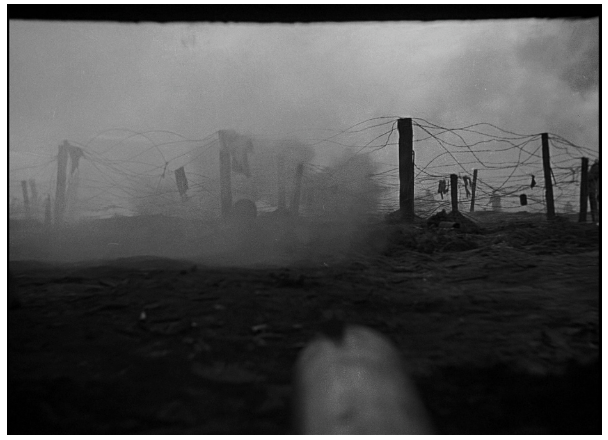
In these exultant close-ups they are still individuals, but for the rest of the film Milestone will break them down into inhuman lines. Lines that, when erased, will be immediately replaced by other lines, as if in the manic hand of a sadistic animator. In Baumer’s first mission, he is tasked with his company of running a line of barbed wire along No-Man’s land. The camera follows along in horizontal tracking shot, the men dissolving into a group. This will continue in the actual battle, when the camera angles down into the trenches and pushes forward with relentless speed, as men are mowed down on both sides as if on an assembly line. The static shots are brief punctuations of these winding sentences, an image of detached hands gripping the wire, or a body falling lumpen to the ground. These sequences are the basis for Spielberg’s justly celebrated D-Day sequence in Saving Private Ryan, of battles moving too fast for the men to process. The difference is that Milestone uses the trench as his guiding visual cue, sliced arteries that pump blood onto the sodden landscape, while Spielberg’s is the combat photographer, in which the center is always moving, with nowhere to retreat.

The cast does a fine job of embodying the gruff survivalist types and scared-shitless kids of Remarque’s novel, the baby faces with shell-shocked stares. Ayres is a receding presence, quiet, reflective and rather defiantly uncharismatic. It is a haunting performance of a masked piece of flesh going through the motions. The bulldog-faced Louis Wolheim is the most identifiably human soldier, his character old enough to have developed a personality before war froze all of their lives in place. He is the hulking softie, a devastating brawler with a mother-hen feeling for his troops. These individual idiosyncrasies rise to the surface and wash away in the flood of violence, until they walk as one man into their muddy, worthless Valhalla.

THE FILMS OF ROBERT MULLIGAN, PART 2

February 7, 2012

Screen Shot 2020-02-03 at 11.45.54 AM

This is Part Two of a four-part series that looks at the career of director Robert Mulligan. You can find Part One here.

After the success of To Kill a Mockingbird, Robert Mulligan and producer Alan Pakula made five straight films together to close out the 1960s, before Pakula departed to become a director himself. Using Mockingbird as a template, the duo chose projects that dealt with hot button issues (Love With the Proper Stranger and Up the Down Staircase), or were prestigious literary adaptations (Baby the Rain Must Fall and Inside Daisy Clover). Their final collaboration, The Stalking Moon, with a story taken from a Western novelis the exception. Regardless of their middlebrow origin, these are films sensitively attuned to the social and geographic landscapes of their subjects, to the ebb and flow of urban overcrowding and the oppressive emptiness of the open plains. These films also continue Mulligan’s interest in outsiders adapting to new realities, in “dramas of experience intruding upon innocence”, as Kent Jones eloquently put it.

Love With the Proper Stranger was filmed in March, 1963, just as To Kill a Mockingbird was opening nationwide, and was released that December by Paramount. The original script by Arthur Schulman is a downscale romantic comedy, about two struggling New Yorkers, one the out-of-work musician Rocky Papasano (Steve McQueen), the other Macy’s cashier Angie Rossini (Natalie Wood), who are thrown into a relationship after a one-night stand. Angie is pregnant and confronts Rocky, but only wants him to help pay for her abortion.

The musician role was originally offered to Paul Newman, but he turned it down to play the title role in Martin Ritt’s Hud. McQueen doesn’t look the part (he’s more Celtic than Italian-American), but his impassive, slightly hunched interpretation of his character’s protective cynicism is effective and affecting. He walks uncertainly, as if he depended on the city’s walls to hold him upright.

The movie came out a year after Helen Gurley Brown’s Sex and the Single Girl was published (and was filmed a month after The Feminine Mystique came out), and the film channels some tenets of this embryonic feminist text. Angie, when she learns she is pregnant, initially decides to get an abortion, and repeatedly refuses Rocky’s request to get married. Above all else, she wants to live on her own and have financial independence, one of Gurley Brown’s main tenets. Natalie Wood plays Angie with a childish impudence, her stand on women’s rights emerging out of foot-stamping temper tantrums. As the film progresses, and the power roles shift, Wood is able to direct McQueen’s actions with the power of her gaze.

Mulligan has Rocky and Angie continually navigate densely populated spaces (most of which were shot handheld, on location in NYC), going with and against the flow of crowds. In the opening, in which the musicians’ union hall is shown slowly filling to capacity, Angie has to squeeze through to track down Rocky, who doesn’t even remember her. Angie’s apartment is a jungle of mattresses, loud-mouthed brothers and spiteful mothers. Rocky is only seen in his mistress’ place, filled with a half-dozen dogs and cardboard cut-outs of her burlesque act. The world only empties out when they head to the Meatpacking district and meet the black-market abortionist on an abandoned street corner. The world subsides, and decisions must finally be made.

Mulligan re-teamed with McQueen for Baby the Rain Must Fall (1965), a Southern melodrama made for Columbia Pictures about a Texas rockabilly singer and his relationship with his estranged wife. Horton Foote, who wrote the To Kill a Mockingbird screenplay, adapted his own 1954 play, The Traveling Lady for the screen version. The film follows Georgette (Lee Remick) and her daughter as they travel to the small town of Columbus, TX, to see her husband Henry (McQueen), recently released from jail. He is a talented singer-songwriter and a dedicated drunk, unable to resist the lure of the juke joints. An orphan, Henry was raised by the dictatorial Miss Kate (Georgia Simmons), who beat and belittled him as a child. Henry has to overcome his personal and family demons to have any chance at a decent life.

Shot in B&W by veteran Ernest Laszlo (Kiss Me Deadly), the look is the drab grays and hard-edged realism of WPA photographers like Dorothea Lange, while Mulligan opts for contrasts of wide landscapes and looming close-ups. Henry and Kate are connected in the opening bus ride by match cuts on their faces looking off-screen, and their relationship is closed by looking away from each other in the final shot.

The visuals are reliably elegant, but the story is a bit overwrought, with the deeply felt story of Henry and Georgette’s relationship getting overshadowed by the bizarre Southern Gothic subplot of Miss Kate, whose arch-villainy provides a too-pat explanation for Henry’s self-destructive behavior. It’s better to shut your ears and just watch Mulligan and Laszlo go to work.

Mulligan and Pakula went to Warner Brothers for their largest project to date on Inside Daisy Clover, which Natalie Wood was eager to make. Wood had known author Gavin Lambert because of his association with Nicholas Ray, who had directed her in Rebel Without a Cause (1955). Lambert was a young film critic for the British magazine Sequence who later became Ray’s assistant and co-screenwriter on Bitter Victory (1957). Wood contacted him to adapt his own book, and the project started up.

Wood had a personal interest in the satirical tale of Daisy Clover, the young girl plucked from obscurity and groomed into a major studio star, a trajectory largely similar to Wood’s, who gained fame as a little girl in Miracle on 34th St.(1947). The story tracks Clover’s ascent from a celebrity photo stand in Angel Beach, CA, to the heights of Hollywood glory. Along the way she loses her mother and any sense of personal identity. Molded by Swan Studios head Raymond Swan (a deliciously supercilious Christopher Plummer), she becomes a sexless child-star into her late teens, a Mary Pickford of the ‘30s (when the film is set).

It was an odd project for Mulligan to take on, a campy, deeply ironic text put in the hands of an earnest, old-school dramatist. If directed by someone as gifted at caricature and exaggeration as George Axelrod, it would undoubtedly be funnier and more ruthless, however Mulligan does elicit fine performances from Wood, Robert Redford and Ruth Gordon (who received a Best Supporting Actress nomination as Daisy’s ditzy mother). Wood’s transition from smart-aleck street urchin to trembling neurotic is pitched at the same manic level, as if Daisy were hoping that if she kept moving she would never collapse. Redford’s Wade Lewis is the dashing leading man who marries Daisy and breaks her heart. Lewis was originally written as homosexual, although Redford didn’t want to play it that way:

“I wanted to play him as a guy who bats ten ways – men, women, children, dogs, cats, anything – anything that salves his ego. Total narcissism.”

He is Valentino-suave, a nimble seducer who can back men and women willingly into any corner. It is a impressively eroticizied performance for the young Redford, who was singled out for positive notices in the generally hostile reviews. It was also one of the few depictions of a homosexual, or bisexual, character in the 1960s that was not killed in the last reel (as Vito Russo writes in The Celluloid Closet).

Manny Farber described the film as a “thoroughly soft Hollywood self-satire”, but rightly points out the tragic heart of the film, the scene in which Daisy breaks down during a dubbing session. “One scene that is dynamite as anti-Hollywood criticism and the only scene in which Natalie Wood, snapping her fingers to get in time with a giant screen image of herself, is inside the Daisy role with the nervous, corruptible, teenage talent discovered years ago by Nick Ray.” With her image duplicated up on-screen, Daisy repeatedly tries to fill that screen icon’s mouth with her own words, but she can’t do it. The image up there no-longer represents the woman in the booth, and she breaks down, the first step in breaking free.

Inside Daisy Clover was Mulligan-Pakula’s first big failure at the box-office, so they retrenched with a smaller-scale movie, again at Warner Brothers. The two Bronx boys returned with a small high-school drama set in East Harlem, Up the Down Staircase. It was based on the novel by Bel Kaufman, and adapted for the movie by Tad Mosel. It was filmed in Benjamin Franklin High School (now the Manhattan Center for Science and Mathematics), and uses what looks like real students as extras.

In a return to the style of Love With the Proper Stranger, Mulligan uses a lot of mobile handheld cameras to get right into the chaotic flow of teenagers rampaging through hallways. He follows Sandy Dennis through the chaos, playing a teacher straight out of grad school and thrown into the English department. The movie, which opens in the morning herd, is all about organizing the herd into an efficient shape. The routine of the school is expertly plotted by Mulligan and his DP Joseph Coffee, looping in and around the main office as Dennis picks up the endless paperwork and adapts to the quick, repetitive rhythms of a NYC bureaucracy. Mulligan rarely slows down the speed, but when he does, it’s a stunner. He singles out one of Dennis’ students, Alice, for a particular investigation.

As in Proper Stranger’s Meatpacking District, the world empties out, and Alice wanders the hallways with a love letter in her hand. Keeping a respectful distance behind her, Mulligan follows her progress into the office as she drops it off, exits to the middle of the school, hesitates, and returns. She is aghast to see the “unpublished writer, and therefore dangerous” Paul Barringer (Patrick Bedford) holding her letter in his hand, with a smug smile on his face. This simple scene has psychological ramifications that radiate throughout the rest of the film. It is a sequence that tracks Alice’s movements as well as her thoughts, the hesitation revealing the worlds of emotion weighted beneath her surface.

The idea of “moving-as-thinking” is key to The Stalking Moon (1968), a spare Western with no social significance or literary pedigree (it was based on a book by Theodore V. Olsen). For their final collaboration, Mulligan and Pakula make a film that is simply pure cinema, a chase between reluctant hero Gregory Peck and the vengeful, displaced Salvaje (Nathaniel Narcisco). In 1881, Peck is working his last day as an Army Scout, but finds an American, played by Eva Marie Saint, who had been a captive of the Apaches for 10 years. Peck, after much harrumphing, agrees to help Saint and her child travel to Columbus, OH. When he discovers that the legendary Apache warrior Salvaje is the child’s father, he invites them to stay at his cabin, and protect them the best he can. It is an extended chase film, in which one side (Salvaje), is barely seen. The perspective is restricted to Peck, whose looks and hesitations express more than the minimal dialogue he is given.

There is a moment in the cabin, in the low-light of the room shot by DP Charles Lang, in which Peck sits and stares, waiting for Salvaje to enter. Everything is dark except for Peck’s face, the only point of contemplation, in this frame-as-sensorium, where every little movement or sound gives one away. In the end it is a sliver of light that marks Salvaje’s downfall, and the beginning of a new, protective family unit, awake to the world around them.

I am very indebted to Kent Jones’ article on The Stalking Moon in Film Comment.

THE FILMS OF ROBERT MULLIGAN, PART 1

January 31, 2012

Screen Shot 2020-02-03 at 11.37.34 AM

As part of the 100th Anniversary of Universal Pictures, the studio is remastering a series of classic library titles for Blu-Ray, including a 50th Anniversary edition of To Kill a Mockingbird (1962), which comes out today. The movie has become embedded in American culture, but the quiet craftsman behind the adaptation has been largely forgotten. Over the next four weeks I will be doing an exhaustive (but hopefully not exhausting) film-by-film analysis of Robert Mulligan’s directing career. You have Kent Jones to blame for this, who organized the revelatory 2009 retrospective at the Film Society of Lincoln Center, in which I discovered Mulligan’s masterful use of point-of-view and his innate, deeply affecting sympathy for society’s outsiders. He was trained in television like Sidney Lumet and John Frankenheimer, but his elegant style and temperament is straight out of the old studio system. Today I’ll cover his work from Fear Strikes Out (1957) through To Kill A Mockingbird (1962).

Robert Mulligan was born in the Bronx on August 23rd, 1925. After Navy service in WWII and completing a bachelor’s degree from Fordham University, Mulligan got a job as a messenger with CBS. He climbed the ladder to become a television director, most prolifically for “Suspense” (1949 – 1954), a live half-hour drama for which he directed 29 episodes. In 1957 Mulligan made his first theatrical feature, Fear Strikes Out, an adaptation of Boston Red Sox center-fielder Jimmy Piersall’s memoir. It was the first of seven films that Mulligan would make with producer (and later director) Alan J. Pakula (The Parallax View), who also hailed from the Bronx.

In the first of Mulligan’s neurotic protagonists, Fear Strikes Out (1957) stars Anthony Perkins as Piersall, an insecure outfielder who has a nervous breakdown soon after getting called up to the majors. After a year of therapy, and dealing with the excessive pressure pinned on him by his striving father (Karl Malden), Piersall returns to the bigs. He ended up playing parts of 17 years in the league, with two All-Star appearances and Gold Gloves to his credit (here is his Baseball Reference page). Paramount paid a modest $50,000 to secure the rights to Piersall’s pop-psych bestseller, with a production budget of just under a million dollars.

Production head Don Hartman assigned his old assistant Pakula to produce and Mulligan to direct, both first-timers. It is an assured debut for both, shot B&W in the VistaVision process (Paramount’s widescreen competitor to CinemaScope) by veteran DP Haskell Boggs (The Furies, The Geisha Boy).  The live TV shows in which Mulligan cut his teeth used a very mobile camera to create different set-ups on the fly, and Mulligan carries this over to Fear Strikes Out. In one striking sequence, the Piersall family’s poverty is expressed in a few wordless shots. Karl Malden walks inside their spartan home (that overlooks a baking factory), exchanging a bitter look with his wife. Then the camera follows as he walks to the sink, and starts doing the dishes. Mulligan pushes the camera closer to their backs until he finally starts speaking, and it becomes clear he had lost his job, equally embarrassed to tell the camera as his wife.

Anthony Perkins presents another wounded bird for his remarkable menagerie of neurotics, his Piersall a jangly-limbed obsessive who’d rather practice his slide than talk to girls. As Piersall’s world constricts to the one on the field, and his state-of-mind is determined by his batting average, Perkins taps into his inner psycho and rips out a freak-out more outsized than Norman Bates’ sneer. After a slump-busting home-run, Piersall races to the stands behind home plate, and in a full-throated roar asks a dumbstruck Malden if that was good enough, screaming the question until his body convulses into a spastic fit. Francois Truffaut was a young admirer, calling it one of the best of the year, describing it as a “bitter and disillusioned film that doesn’t make you want to live in America. But if there were French directors as lucid and talented as Mulligan…the image of our country on the screen would be a bit less simplified.”

The Rat Race (1960) is not likely to lead anyone to book an American vacation either. The first of two star vehicles Mulligan made with Tony Curtis, it an adaptation of a Garson Kanin play (again made for Paramount), for which Kanin also wrote the script. Curtis is a Midwestern jazz musician who moves to NYC hoping to join a big band, auditioning for the likes of Gerry Mulligan. Debbie Reynolds is his disillusioned roommate, her dreams of modeling already diminished into a job as a taxi dancer who endures harassment from her pervy boss (a menacingly seedy turn by Don Rickles). It’s a dark romantic comedy, with laughs derived from robbery, poverty and desperation. It is another portrayal of outsiders adapting to an antagonistic society, with Curtis and Reynolds forming a shell of defense through their rapport of wisecracking flirtation. Reynolds is especially affecting as a worn-down cynic in one of her first purely dramatic performances. Mulligan does seem hamstrung by the simple studio sets, making do with the materials of what is little more than a filmed play, but it is still a tough, affecting little farce.

Mulligan and Curtis moved to Universal to make The Great Impostor (1961), a comedy based on the true story of Ferdinand Waldo Demara, Jr., a talented con man who passed himself off as a doctor, a warden and a monk. Mulligan and screenwriter Liam O’Brien present Ferdinand as another disillusioned kid, using con-games and play-acting to deny the reality of his impoverished upbringing. While in the army, Ferdinand realizes he can’t get a commission because he lacks a high-school diploma, so he forges a whole illustrious educational career, and he’s off to the multiple-identity races.  While the characters of Fear Strikes Out and The Rat Race find ways to defend themselves from reality (through therapy or love), Ferdinand simply decides to ignore it.

The tone ranges wildly, from madcap farce (like the Novacane overdose teeth-pulling session) to sober melodrama (a prison riot). Curtis is an able chameleonic blank, turning off the charisma spout and turning on the sobriety where necessary.  Mulligan does a workmanlike job with this star vehicle, although unwisely tries to goose the antics with punchline zoom-ins that over emphasize jokes that work well enough on their own. The Great Impostor is a winning trifle that is major in its own way, for it was the first time Mulligan worked with legendary art director Henry Bumstead (Vertigo). A relentless hard-worker and polymath, Mulligan told Bumstead biographer Andrew Horton that the art director “knew infinitely more about the practical, nuts and bolts business of putting a story on camera than you did”. Bumstead had to quickly erect sets for all of Ferdinand’s professions, the most memorable being the arches of the Holy Cross monastery, which seeming recede infinitely into the distance, the sense of divine infinity nicely contrasting with Ferdinand’s get-identity-quick schemes. They would collaborate four more times, culminating in Bumstead winning an Oscar for his work on To Kill a Mockingbird.

The duo would work together again for Universal on Come September (1961) the first of two big-budget spectacles they would make starring Rock Hudson. This one is a frothy generation-gap comedy in which stinking rich capitalist Hudson sees his Italian mistress Gina Lollobrigida every September at his villa in Portofino. Unbeknownst to him, the villa’s caretaker turns the estate into a hotel the rest of the year. So when Hudson shows up unannounced for a summer dalliance, his place is stuffed with a busload of rebellious American teens in heat, including Sandra Dee and Bobby Darin.

Rock Hudson is presented as pretty adolescent himself, secretly sketching a scantily clad woman at a business meeting and expecting Lollobrigida to to be charmed by the scraps of attention he gives her. Considering that he is Rock Hudson, and wears form-fitting white suits, this works for a time, although eventually she rebels and reveals him to be the sniveling juvenile he really is.

Shot in CinemaScope and Technicolor by William H. Daniels (Some Came Running), the frame oozes with bright daubs of color to offset Hudson’s dazzling whiteness, which Lollobrigida obliterates in whirling dervish performance of screwball mania and lithe sexual intensity (her character’s last name is Fellini – coincidence?). Anytime she’s off-screen the pace lags, especially with the milquetoast Darin-Dee couple, but thankfully her absences are brief.

Alas, The Spiral Road (1962) is sans Lollobrigida, and is a long slog at 145 minutes without her. An awkward combination of medical soap opera and psychological thriller, it is about an atheistic young doctor who travels to Indonesia to learn about the containment of leprosy, and then shifts into a nonsensical adventure tale when he pursues (and is driven mad by) a voodoo medicine man. It is adapted from the novel of the same name by Jan de Hartog, and not even an early score from Jerry Goldsmith, cinematography from Russell Harlan (Gun Crazy) and a wily performance from Burl Ives (channeling his wacko survivalist routine from Wind Across the Everglades) can save it from its paternalistic moralizing and slack pacing.

By the time The Spiral Road was released in August of 1962, Mulligan had already shot To Kill a Mockingbird, which received its official premiere in Los Angeles on Christmas Day. Russell Harlan returns as DP, Henry Bumstead as art director and Alan J. Pakula as producer, with whom Mulligan had formed Pakula-Mulligan Productions, Inc. Graced with his finest script to date by Horton Foote, and very comfortable with his regular group of collaborators, Mulligan was free to experiment with his visual style, tinkering with subjective camera-positions for the first time since Fear Strikes Out, a technique he would hone the rest of his career.

After the credit sequence, Mulligan lays out the geography of a small Alabama street. In an elaborate crane shot, which starts high in the tree branches, the camera lowers to eye level and travels left along the turn in a road, before getting distracted by a horse and gliding back to the right. It is as if an impatient eye was diverted by the stout animal, and right as if on cue, Scout (Mary Badham) swings from one of those same tree branches off-screen right into the edge of the frame, announcing herself as the enunciating force of the movie.

Mulligan experimented with POV shots in Fear Strikes Out, memorably so in an aural hallucination of crowd noise, but with To Kill a Mockingbird he structures the whole movie around the technique (with a few necessary cheats in the courtroom scene). The movie exerts such an emotional pull because Mulligan masks the adult world from Scout’s view, choosing low-angles that peer half-obscured truths that she can not yet process. She is shown peeping into the courtroom (with no matching counter-shot), staring over a fence at the Radley home, which is lit like a haunted house of a child’s imagination, and when they get close, Boo Radley’s shadow passes over them like Nosferatu’s when he climbs the stairs – Scout and Jem’s own Universal horror movie.

When societal horrors come to the fore, and Atticus reveals the nature of his case, the POV subtly shifts, from a birds’ eye view of Scout in the balcony to Atticus’ eye-level view down on the courtroom floor. This shift in POV matches Scout’s maturation, that her stubbornly gained knowledge of life’s real terrors are often more awful than her imagination. It is a beautiful, trembling film, that all of the cast and crew bring to shuddering life, highlighted by Gregory Peck’s performance of exhausted virtue, each of his dignified acts becoming more wearying with age.

The Universal Blu-Ray is predictably pristine, the funereal grays of Harlan’s cinematography popping out in granular detail. This will likely be the only Robert Mulligan film to make the leap to HD, but it is only the beginning of his stylistic experimentation with the subjective camera – he uses it to brilliant ends in horror (The Other), gangster movies (The Nickel Ride) and coming-of-age tales (The Man in the Moon). Next week I’ll look at the rest of his films from the 60s, from Love With the Proper Stranger (’63) through The Stalking Moon (’68).

PICNIC-ING

January 24, 2012

Screen Shot 2020-02-03 at 11.31.11 AM

The intrepid Twilight Time label continues their line of limited edition Blu-Ray releases with an absolutely gorgeous version of Picnic, Columbia’s romantic smash of 1955-1956. Sold exclusively through on-line retailer Screen Archives, it presents James Wong Howe’s Technicolor cinematography in eye-titillating detail. Based on William Inge’s Pulitzer Prize winning play from 1953, Picnic is a garishly entertaining melodrama that sets earthy he-man William Holden after prim beauty queen Kim Novak, upending a small Kansas town in the process.

The play,  directed by Joshua Logan, ran for 477 performances, and gave Paul Newman his first big break in a co-starring role alongside Ralph Meeker and Janice Rule. After a bidding frenzy, Columbia Pictures purchased the rights in September, 1953 for around $350,000. Logan, coming off of directing and co-writing the Broadway juggernauts South Pacific (1949) and Fanny (1954), was tapped to direct the movie adaptation, despite his limited screen experience, having only co-directed (with Arthur Ripley) the 1938 Joan Bennett-Henry Fonda drama I Met My Love Again. The screenplay by Daniel Taradash met immediate disapproval by the Production Code Administration, which sought to eliminate any hint that Holden and Novak have pre-marital sex, although the finished film leaves little doubt as to their amorous adventures.

Holden plays Hal, an ex-college football star turned hobo, riding the rails into Kansas to find his rich frat brother Alan (Cliff Robertson). Walking with a tipsy swagger as if he was leaking testosterone, he stumbles past phallic imagery (grain elevators and swinging chutes) into the Owens household, where he immediately enraptures the teenage bookworm Millie (a delightfully snot-nosed Susan Strasberg) and their repressed schoolmarm neighbor Rosemary (a hysterically campy Rosalind Russell). The eldest Owens daughter, Madge (Kim Novak), is expected to marry into Alan’s wealth, but is innately attracted to Hal’s raw, destructive physicality. At the end of a Labor Day picnic, these unspoken attractions burst forth in a torrent of passion and recrimination.

Logan was never comfortable in casting Paul Newman as the lead roustabout Hal, telling him, according to Newman biographer Marian Edelman Borden, that he “did not carry any sexual threat at all”. So the part went to Holden, who at 37 seems miscast as a callow young brute, although his perpetually exposed torso was still toned enough to believably seduce an entire household (was this a template for Pasolini’s Teorema?). Newman’s old stage role of Alan was given to the appropriately starchy Robertson.

Picnic was the beginning of Kim Novak’s major star push from Columbia head Harry Cohn, who depended on James Wong Howe to make her look irresistible. After bowing as a blonde, Cohn wanted to make her a redhead as the discontented Madge, and asked Wong to make some screen-tests of various shades. Picnic, in CinemaScope and Technicolor, is worthwhile viewing for the shifting highlights of this hair alone. Depending on the lighting, it can look Titian red, and then a kind of dark golden blonde, halfway between cinnamon and honey. In one loaded shot, Novak collapses in a new dress, a sobbing puff of blue tulle. This composition, of auburn hair, blue dress, and gray-green eyes, contains the entire chromatic shift of the film, from calm blues and grays to intense, libidinous reds and back again.  This maniacal attention to color detail is part of what attracted the French New Wave to the film. After seeing Picnic, Rivette enthused rather confusingly that Joshua Logan was “Elia Kazan multiplied by Robert Aldrich” (perhaps meaning that Logan merges the realism of Kazan (Picnic was shot on location in Kansas) with moments of pure style (the Aldrich of Kiss Me Deadly)). Truffaut said of Logan, “He is a pure director, a man we know will not be walked on.”

This hypnotic aspect of Novak’s hair is one small example of the film’s mastery of color design. Together with Logan and the production design team led by Jo Mielziner (who deservedly won an Oscar), the film abounds in soft pastels, of a cream and wedgwood blue that adorns the Owens home and the suits of their male admirers. This palette continues through the centerpiece picnic sequence of the film, a bizarre bit pitched between Renoir pastoral, pure Americana corn and small-town Lynchian freak-out, which Jonas Mekas described as “a gaudy display of boobus Americanus.”  Screaming babies, seemingly cast for their old-man sourpusses, are inter-cut with an orgy of fairground games of increasing absurdity. Sack races and pie-eating give way to zombie-like warblers and a  girl-carrying competition. The crowds behind these manic episodes overflow with grays and light-blues, with Novak wearing a cream-colored dress and Russell a light-blue jacket.

The blues get darker in the dusk of day’s end, which is then pricked by irruptions of red. Russell removes the jacket, revealing a blouse of blood-red flowers. These match the bouquet of roses Novak cradles after she wins a beauty contest, sailing downriver in a Queen’s red robe. As these colors set off Novak’s hair, so it initiates a purging of passions, with Russell doing screaming harridan routine, Strasberg puking in a corner, and Novak, ready to embrace her sexuality, enacting a sensuous slow-dance to “Moonglow”, a pantomime of what Logan can’t show on-screen. After this lightfooted pas de deux, which expresses inner states through action, the film starts unloading leaden slabs of exposition, love expressed in words instead of glances.

Reading the images tells a more interesting story. Muted colors return the day after the picnic, with Novak making her climactic decision in a gray-blue jacket, the image of sobriety. The bus she steps onto, however, is streaked with red – pointing towards an uninhibited, uncertain future.

WARNER ARCHIVE ROUNDUP: SMILIN’ THROUGH (1941) AND WELCOME TO HARD TIMES (1967)

January 17, 2012

Screen Shot 2020-02-03 at 11.25.36 AM

The Warner Archive continues to summon the ghosts of Hollywood past onto DVD, a bit of studio witchery we should all get behind. One of their most intriguing recent séance jobs is Frank Borzage’s Smilin’ Through(1941), a haunting WWI melodrama. Despite the mammoth Murnau, Borzage and Fox box set, there are still great stretches of Borzage’s career missing on home video (including essential titles like Man’s Castle (’33, hopefully a Sony MOD candidate) and Moonrise (’48), which is streaming on Netflix)). Smilin’ Through, though flawed, has moments of doomed romanticism that rival anything else in his work, with superimpositions establishing the intractable hold the past exerts on the present. A similar theme is lugubriously told in Welcome to Hard Times (’67), a Western in which old studio hand Burt Kennedy flails to channel A Fistful of Dollars on a low budget. Originally made-for-TV, MGM decided to release it into theaters before airing it on ABC, after which it disappeared. Featuring a spate of studio standbys, including Henry Fonda and Aldo Ray, it’s a fascinating failure in which MGM hires old studio craftsman to make a film that blatantly reaches for the youth market.

Frank Borzage had moved from Warner Brothers to MGM in 1937, starting with Big City, and continued there through Seven Sweethearts (’42, also on the Warner Archive), after which he became an independent contractor. The Warner Archive has released seven of these titles, all of which (excepting the well-regarded Mortal Storm (’40)) are due a second look. His stay at MGM was not a smooth one, with the usual studio interference and hijinks (producer Victor Saville famously claimed to have directed the majority of The Mortal Storm, an idea debunked by biographer Herve Dumont).  In January 1941 Borzage was removed from a re-telling of Billy the Kid after initial location shooting (he was replaced by David Miller), and was shifted to a Joan Crawford project, Bombay Nights, which never materialized. He didn’t sit idle long, with production on Smilin’ Through starting in early May.

The project was a rather moldy chestnut, based on a 1919 play by Jane Cowl and Jane Murfin, that had already been adapted twice for the screen, in 1922 (starring Norma Talmadge) and 1932 (with Norma Shearer). The scars of a 19th century love triangle are torn open on the eve of WWI, as Sir John Carteret (Brian Aherne) refuses to sanction the marriage of his adopted daughter Kathleen (Jeanette MacDonald) to Kenneth Wayne (Gene Raymond, MacDonald’s husband), whose father had destroyed Carteret’s marriage decades before. Borzage opens the film on the Diamond Jubilee of Queen Victoria, celebrating 60 years of her rule. The camera pans left to a church, with the ramrod figure of Aherne the only figure not gesticulating in a celebratory fashion. He sourly says, “I don’t like anniversaries”, the weight of the past present in each of his deliberate steps.

He is momentarily levered back into the present by the appearance of Kathleen, the niece of the woman he loved, Moonyean (also played by MacDonald). Entranced by her forthrightness (and resemblance to Moonyean), he temporarily eases his obsession with the past, which manifested in conversations with his ghostly deceased love, and embraces an attentive, active role as a father. Immediately upon making this decision, and loosing the grip of his memory, Borzage collapses time in a gorgeous, layered montage of spring flowers and children’s games. Kathleen’s childhood is compressed into thirty seconds, the narrative resuming once Carteret is once again ensnared by his loss of Moonyean.

The world of the film becomes a kind of necropolis, with Kathleen first meeting Kenneth in the abandoned mansion of his father, Jeremy. They dust off his decanter of wine, untouched since his death, and hold hands for the first time while staring up at his portrait, deeply ensconced in Carteret’s memories of his dead nemesis. Carteret is entombing his family in his obsessive memory, and can only free them by telling his story, and moving on. Borzage privileges this moment in an extended flashback of his doomed wedding day, an unburdening and a confessional, that ends with Carteret cradling Moonyean in a Pieta-like pose, allowing himself to mourn for the first time, instead of simply nursing his hatred. It ends on a transporting image, of a ghostly Carteret-Moonyean and a physical Kathleen-Kenneth passing in the night, going in different directions on time’s arrow, but both savoring the moment.

Please read Kent Jones’ wonderful career overview in Film Comment for a fuller view of Borzage’s career.

***

In 1967, MGM was trying to crank out genre films on a budget by making deals with television networks, while still reaping the box office rewards from theatrical release. Kerry Segrave wrote in Movies at Home that the studio had renegotiated its deal with ABC, allowing the final three of their six co-productions to be released theatrically before they hit the tube. These were Day of the Evil Gun (starring Glenn Ford and Arthur Kennedy, 1968), Hot Rods to Hell(with Dana Andrews, 1967) and Welcome to Hard Times (1967). Warner Archive has just released Hard Times in a handsomely remastered DVD, and is an artifact of a studio’s shfit to producing tele-films and catering to the burgeoning youth market. Director/writer Burt Kennedy, famous for scripting Budd Boetticher’s psychologically astute Ranown cycle of Westerns, had moved from helming TV shows to becoming a reliable worker on cheap genre films. Right before Hard Times, Kennedy cranked out Return of the Seven (1966), a sequel to The Magnificent Seven (1960), and afterward he made a couple of popular comic-Westerns with James Garner, Support Your Local Sheriff! (1969) and Support Your Local Gunfighter (1971). Hard Times is the likely nadir of Kennedy’s work in this period, a slackly paced adaptation of E.L. Doctorow’s first novel (Doctorow told the NY Times that the film was the “second worst movie ever made.” The worst? Swamp Fire (’46) starring Johnny Weissmuller).

The film concerns the Mayor and de facto Sheriff of the Western town of Hard Times, Will Blue (Henry Fonda), a dyed-in-the-wool cynic who only acts out of base self-interest. When a drunken hell-raiser (Aldo Ray, credited as “The Man From Bodie”), razes the town to the ground, Blue just watches from a distance, not willing to get involved. Blue and a local medicine show carny build up Hard Times again by turning it into a good-times destination for local miners. As business booms, Blue braces for the return of “The Man From Bodie”. The film opens with a bang, in a near-silent sequence that is an homage to (or straight rip of) the start of Rio Bravo. Instead of a drunken Dean Martin, it’s a buzzing Aldo Ray, who smashes a bottle in close-up, drinking from the shards that are left. Ray is framed to be a force of nature, presaged by a dramatic clap of thunder and causing  raging fires. Ray starts out as intimidating, but is reduced to cartoon villainy by this overdetermined symbolism, a hacky attempt to provide the stylish ultra-violence the young crowds desired, and were delivered in the Leone Spaghetti Westerns. Even the film’s cynicism seems half-baked, as Fonda’s brittle, passive exterior gives way to a conclusion of straining sentimentality. And opening sequence aside, the film is indifferently put together, despite the incredible rogues gallery of faces Kennedy had to work with. In addition to Fonda and Ray there is Warren Oates, Elisha Cook Jr., Lon Chaney Jr., Keenan Wynn and Royal Dano. As these weathered, instinctively expressive faces slide past the screen in this ill-conceived oater, it feels like a roll call at classical Hollywood’s funeral.