VIVA LA CAVA: THE HALF NAKED TRUTH AND BED OF ROSES

November 27, 2012

Screen Shot 2020-02-05 at 5.34.58 PM

One of the advantages of being home for the holidays are the huge gaps of time that open up when work and other daily annoyances fade from view. In the lazy hours surrounding Thanksgiving I hunkered down in front of my family’s DVR and monolithic tube TV, searching the TCM schedule for something to while away the hours with. One particular item caught my eye, an early morning screening of Gregory La Cava’s Bed of Roses (1933). The description mentioned steamboats and female con-artistry, two of my favored subjects, so I clicked record in sweaty anticipation. The film turned out to be far more than an amiable time-killer, but an astoundingly subversive pre-code with some of La Cava’s finest lowdown dialogue. Wondering what other gems lay hidden in early 1930s La Cava, I also tracked down The Half Naked Truth (1932), which was a looser but still uproarious bit of scam artist screwball.

The Half Naked Truth was the fifth film Gregory La Cava directed for RKO, and the third straight produced by David O. Selznick. Following two dramas on which he didn’t receive a screenwriting credit (Symphony of Six Million and Age of Consent), La Cava was handed The Anatomy of Ballyhoo, the 1931 memoir of press agent Harry Reichenbach. Filled with outrageous incident, La Cava and Corey Ford’s script is a marvel of escalatingly elaborate scams, testing the limits of American gullibility, although much was probably re-written on the set. In a 1937 letter proposing La Cava be hired as a director-producer, Selznick wrote: “La Cava would drive me crazy as a director with the rewriting he does on set, for as you know I don’t like any projection-room surprises or shocks, but if he were his own producer we could take chance that he would shock himself.” Selznick never made him producer, but conveyed the kind of on-set improvisation that led to La Cava’s freest movies, which crackle with possibility.

Changing the name to The Half Naked Truth, the movie follows Jimmy Bates (Lee Tracy) on his rise from carnival barker to Broadway impresario. Eager to prove that not only is there a sucker born every minute, but probably every second, Bates invents outrageous backstories for his gal Teresita (Lupe Velez) and pal Achilles (Eugene Pallette) at every stop, from scorned orphan to Turkish Princess, and it makes him money every time. He states his position to the carnival owner: “the world wants excitement, sensation, baloney!”. Part of a spate of comic con man movies that flowered during the Depression, including Hard to Handle (’33, with James Cagney) and The Mind Reader (’33, starring Warren William), The Half Naked Truth made light of the fact that the only possible way to make a living was to lie, cheat or steal.

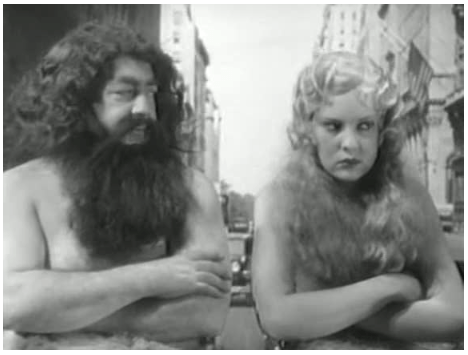
Lee Tracy is ideal casting as the motormouth promoter (despite later being sued by Selznick for repeatedly showing up late to the set). He spits out hilariously ridiculous lines with a mix of bravado and self-absorption, as when he tells Lupe Velez to, “stick with me baby, the next stop is Broadway”, as the fair burns down behind him due to his previous scheme’s spectacular failure. By the time he brings a lion into a hotel room or invents a nudist colony that parades through NYC, it becomes clear he can sell anything to anyone.

After directing the bizarre liberal fascist fantasy Gabriel Over the White House (1933, read J. Hoberman’s An Army of Phantoms on that one), La Cava was assigned another scamming Depression-era character in Bed of Roses (1933), this time a cynical prostitute hustler played by Constance Bennett. The original script by Wanda Tuchock was spruced up by La Cava and Eugene Thackrey (both receive “dialogue” credits), and is a boozy dip into the world of drunk-rolling Johns and blackmailing rich patrons. Lorry Evans (Bennett) is a jaw-droppingly amoral character who uses her formidable sexual allure to rob a boll weevil exterminator and cotton barge captain (Joel McCrea), before having herself installed in high-rise luxury by publisher Stephen Paige (John Halliday).

While Jimmy Bates bent the law to climb the ladder of success, Lorry is an out and out criminal, and Constance Bennett’s buzzed, almost slow-motion performance makes it seem positively alluring. The strengthening Production Code had just begun, and some were concerned about the film’s tone. In April of ’33,  Studio Relations Committee head Dr. James Wingate urged the film’s producer Merian C. Cooper to, “show some positive qualities of retribution and regeneration that will counter-balance this apparent glorifying of an unscrupulous adventuress.” It is unknown what changes were made to the original script, although later scenes of Lorry living an ascetic lifestyle to “prove” she could go straight were likely added due to urgings such as these.

The role of “unscrupulous adventuress” was a departure for Bennett, with The Motion Picture Herald describing it as, “quite different from Connie’s usual society stuff”, and Mordaunt Hall of the New York Times wrote in his review that it was, “disconcerting to see her emerging from a reformatory”. But Bennett seems to relish the opportunity to go slumming, with a shoulder raised and back arched, as if a bow pulled taut before flinging itself at its target. Bennett is aided in her tawdry crimes by Pert Kelton, who plays the even seamier Minnie with a spot-on imitation of Mae West, her suggestive nasal drawl and thunderous hip swagger enough to bring a few middle-western rubes to their knees.

What gives Bed of Roses an emotional kick, however, is the no-nonsense romance between Lorry and the cotton barge captain, Dan. Their meet-cute has Dan fish Lorry out of the bay after she escapes from the cops, with Lorry then tossing him into the drink for impugning her virtue. The romantic climax is no top of the Empire State Building affair, but a charged exchange of sharpened words in a shabby tenement.

The mix of McCrea’s open-hearted sweetness and Bennett’s world-weary resignation elicits not sparks but genuine warmth, and their courtship is without illusions. Neither care for past improprieties – Dan brushes off the revelation of Lorry’s whoring past with a shrug – both are only concerned for what the present may bring. It’s a tough and loving and uproarious work, and should be placed alongside My Man Godfrey (1936) as Gregory La Cava’s best. And after forcing my parents to watch it the day before Thanksgiving, my mother would agree. She said it was her new favorite movie.

LOST SOUL: THE WHITE SHADOW (1924) AND ALFRED HITCHCOCK

November 20, 2012

Screen Shot 2020-02-05 at 5.30.55 PM

The 2012 holiday season is also Alfred Hitchcock season, as studios have been looking for various ways to earn your master of suspense dollar. Universal released a brick of new Blu-rays, HBO aired The Girl, a drama about the Hitch-Tippi Hedren relationship, and Hitchcock, the dubious-looking fiction about the production of Psycho, opens in a limited theatrical release this Friday. The most exciting Hitch development won’t cost you a thing, however, as the three extant reels of The White Shadow (1924) are now free to stream on the National Film Preservation Foundation website. Part of the cache of rarities discovered in the New Zealand Film Archives in 2010, along with John Ford’s UpstreamThe White Shadow is the earliest surviving film that Hitchcock worked on. He was assistant director, editor, scenarist and art director, the second of five films on which he was the jack of all trades for director Graham Cutts. The White Shadow was a critical and box office failure, even leading to the dissolution of its production company, but what remains is an essential document of Hitchcock’s artistic maturation, containing themes of doubling and mistaken identity that would re-emerge and deepen throughout his career. Along with The National Film Preservation Foundation, great thanks are also due to David Sterritt for his informative film notes and Marilyn Ferdinand, Farran Smith Nehme and Roderick Heath, whose For The Love Of Film Blogathon funded the recording of the fine score by Michael Mortilla.

Alfred Hitchcock started his career in movies when Famous Players-BeLasky opened up an office in Islington, London in October 1919. He applied to become an illustrator for silent film intertitles, telling Francois Truffaut, “For instance, if the line read: ‘George was leading a very fast life by this time,’ I would draw a candle, with a flame at each end, just below the sentence. Very naive.” He was hired in 1921 and quickly rose up the ranks, from head of the title department into the editorial department, where he would re-write scripts. After Famous Players shuddered the studio, an enterprising production company, Balcon-Saville-Freedman, moved in. They hired Hitchcock as an assistant director, and it was on his first film with director Graham Cutts, Woman to Woman (1923), that he met his future wife and collaborator, Alma Reville. The melodramatic WW1 romance was adapted from a hit play by Michael Morton, and with the casting of popular Hollywood star Betty Compson, the movie version was a success as well. The Daily Express called it the “best American picture made in England”, which was a high compliment considering the popularity of Hollywood films at the time.

Rushing to capitalize on the film’s success, The White Shadow was fast-tracked into production, with the same team in place. Betty Compson would again star, and another Michael Morton work was used, but instead of a hit play, they adapted an unpublished novel titled Children of Chance. It was distributed in the United States by Lewis J. Selznick, whose son David would later bring Hitchcock to Hollywood. The “white shadow” refers to the human soul, which Nancy Brent (Compson) is definitively missing. She is a hard partier, taking after her alcoholic father Maurice (A.B. Imeson) instead of her delicate mother Elizabeth (Daisy Cambell) or kind twin sister Georgina (also Compson). Nancy catches the eye of the dashing American traveler Robin (Clive Brook), but she slips both his and her family’s grasp and disappears into the smoky underworld of London. Maurice searches for her – and never returns. Desperate to hide the truth, Georgina pretends to be Nancy in the presence of Robin, and they both fall deeply in love. When Nancy and her father are found in a dissolute nightclub, lies are unraveled and souls are bestowed.

It is the first half of the film that survives, which contains some fine sun dappled outdoors scenes outside of the Brent estate, as well as the high-vaulted ceiling interiors, which makes the estate seem more like a mausoleum than a home. It is nothing more than a well-photographed Victorian melodrama though, until the riveting nightclub scene, which roils with anxiety as identities are on the cusp of being revealed. Nancy is a habitue at The Cat Who Laughs Cabaret, a two-tiered dive presided over by a statue of grinning feline with satanic horns, a playfully devilish image likely designed (or procured) by art director Hitchcock. It’s a self-aware logo, mocking the do-gooders’ stereotype of their lifestyle, and  thus does so for the rest of the film’s Manichean view of good (Georgina) and evil (Nancy). The club is filled with hot-stepping revelers, who stop and yell “Get out!” to any newcomer. If they ignore the request, then they are welcomed with open arms filled with booze. It’s a strange and hilarious bit of business, again displaying The Cat Who Laughs denizens to be an ironic, intellectual lot who are far more fun than the banal world of proper society that the story is navigating Nancy back towards.

Compson is shown at the club in a seductive close-up at a poker table full of men, wearing a rakishly tilted flowered hat and smoking her cigarette in a long, stylish holder. Her sly smile shows a sense of comfort and control with her environs not seen in proper society. Graham Cutts’ camera is frustratingly static, but it’s a sequence where Hitchcock’s art design and screenplay displays his subversive humor, revealing the freedom with which emotions are expressed in the demonized zone outside of polite society.  When Georgina finally locates the cabaret, she demurely sits alone in her long skirts, trembling with anxiety. She doesn’t recognize her father, now a filthy beggar, while Robin (whom she is to marry while still pretending to be Nancy), is sitting across the room. Everyone in the room has either hidden their identity, forgotten it, or been deceived by it. Then the real Nancy makes her entrance, strutting down the main staircase with the brazen erotic energy of Mae West. It is at this point where the film cuts off. And this is probably for the best, for, instead of leading the room in a orgiastic party rejecting her former life, the plot description says she returns to a life of traditional morality, in which Nancy must be punished and Georgina martyred for their sins of being women. But in the room of The Cat Who Laughs, one can sense the sexual violence that animates Marnie and the misshapen identities and obsessions of Vertigo. Inside The Cat Who Laughs, one can sense the future of the medium.

FRAME UP: BONJOUR TRISTESSE, THEY LIVE and TWILIGHT’S LAST GLEAMING

November 13, 2012

Screen Shot 2020-02-05 at 5.24.15 PM

From the multiplicity of locations to place a camera, the director and his collaborators have to settle on one. This decision, born of practical training and on-set instinct, can turn a routine shot into an extraordinary one. Three recent Blu-ray releases display the talents of the canniest of decision makers: Otto Preminger’s Bonjour Tristesse (1958), John Carpenter’s They Live (1988) and Robert Aldrich’s Twilight’s Last Gleaming (1977). Preminger and Carpenter are naturals in the CinemaScope sized frame, both alternating between B&W and color to emphasize their images’ deceptive surfaces. Aldrich uses the boxier 1.85 ratio, but chops it up into split-screens which convey a dizzying information overload that accompanies the creeping surveillance state of that film’s USA.

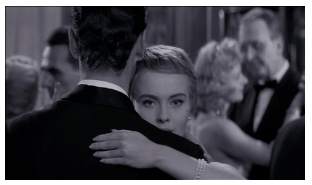
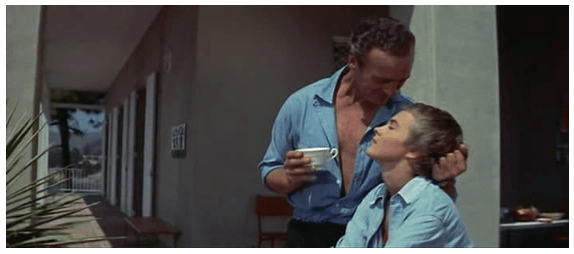
In Jean-Luc Godard’s Contempt, Fritz Lang famously said that CinemaScope was only fit for snakes and funerals, so his character clearly hadn’t yet seen Bonjour Tristesse (1958). Out today on Blu-Ray in a sublime transfer from Twilight Time (available through Screen Archives), Otto Preminger’s film uses the wide frame to emphasize surfaces, whether it’s of Jean Seberg’s impassive face or the doorways and windows that promise a depth that never materializes. Preminger bought the rights to Francoise Sagan’s novel in 1955, and gave S.N. Behrman a crack at the screenplay before turning it over to Arthur Laurents, who received sole screen credit. The story tells of Cecile (Jean Seberg), a carefree teen spending a summer on the French Riviera with her playboy  father Raymond (David Niven, with chest hair perpetually flared). They act more like swingers than family, urging each other into wild romantic escapades and laughing at the wreckage.  But when Raymond falls for their old pal Anne (Deborah Kerr), Cecile becomes wildly jealous and aims to break them up. Her efforts, tragically, succeed.

Screen Shot 2020-02-05 at 5.25.37 PM

The story is told in flashback, with the present-tense Cecile in black and white, a joyless mannequin twirling through the nightclubs of Paris. She stares dead-eyed into the camera, her arm around another interchangeable Lothario, as she speaks of happier times in voice-over. This is when the color starts to peek through, a strikingly melancholy optical printing effect, as sections of the frame next to her head burst into the color of the Riviera, flickerings of memory coming to life. B&W gives way to hot reds and shimmering blues. The effort already shows in the flashback of Raymond and Cecile’s mirthmaking, having to constantly remind each other that they’re having fun.

Screen Shot 2020-02-05 at 5.25.45 PM

Exteriors are what matter. Early on Raymond’s chirpy French girlfriend Elsa (a hilarious Mylene Demongeot) gets badly sunburned, and this reminder of physical deterioration makes Elsa not long for Raymond’s world. Soon he ignores her for the regal Anne. Preminger emphasizes the openings and closures in their Riviera cottage, where windows, doors and hallways are made visible in every shot, intimating the depths beneath the skin that Raymond and Cecile fear to tread. They are almost always outside, whether on the beach or out on the town.

Screen Shot 2020-02-05 at 5.25.54 PM

The first assistant director Serge Friedman recalled that Preminger did not have the shot choreography planned out, but would have “to do a lot of thinking before he could find the right place.” One of the most memorable shots utlilizes the full ‘Scope frame at a dinner party. A maid is arranged in the  far left edge foreground, secretly chugging a beer behind the bar, while Raymond and his clan are grouped to the right, in the middle distance, nattering on about a casino. Their total obliviousness to the world around them is encapsulated in that slyly funny frame.  Chris Fujiwara, in his Preminger study The World and its Double, writes that “the floor of the set was treated with gelatin to allow the camera to move as freely as possible”, regardless of where he chose to move it. His method is improvisatory, but the result is controlled and structured – even Elsa’s skin troubles are rhymed in the devastating final shot, when Cecile rubs in face cream to preserve her beauty, which is all she has left.

Screen Shot 2020-02-05 at 5.26.01 PM

Another film of deceptive surfaces is John Carpenter’s They Live (1988),  now out on Blu-Ray from Shout! FactoryA scathing  sci-fi satire of Reagan-era America, Carpenter uses the CinemaScope-equivalent aspect ratio (2.35:1) make his compositions as herd-like as the zombified consumer society he is depicting, of crowds and lines and glimmering store lights. The hero in this debased trickle down society is, appropriately enough, played by mulleted (and likely roided) pro wrestler Rowdy Roddy Piper. An unemployed drifter who still believes in the American dream, he is introduced as a hero from a Western, dropped off by a train in a dynamic diagonal composition, as did Charles Bronson in Once Upon a Time in the West.

Screen Shot 2020-02-05 at 5.26.09 PM

He realizes the truth upon donning some magic shades, which reveal a B&W world of alien brainwashing. Billboards scream OBEY and WATCH TV, hidden messages that are also beamed through TV screens to lull the populace into consumer comas. As with Bonjour, the sober B&W represents brute reality, and color the world of exteriors. Carpenter’s project is not one of subtlety, but a kind of satiric shock and awe. Piper’s pal, played by Keith David, is introduced behind a line of iron rebar, and they live in a smoggy abandoned lot across from a church.  They Live is a proto-Occupy Wall Street in its emphasis on extreme income inequality, visualized in alternating rows – of Piper and David’s construction sites and the aliens’ tuxedoed gentry imbibing champagne at a gala dinner.

Released today on Blu-ray from Olive Films, Twilight’s Last Gleaming may be even more timely in its visualization of image overload. A paranoid political thriller still haunted by the death toll of Vietnam, it places Burt Lancaster as a dissident Army vet who breaks into and gains control of a nuclear missile silo. Unless President Charles Durning releases a secret National Security Council memo to the public that reveals the cynical reasoning behind the war, Lancaster will fire the nukes.  A furious film, director Robert Aldrich finds an equally furious style. Instead of parallel editing between the White House, Richard Widmark’s hawkish general (modeled after Curtis LeMay) and the silo, Aldrich uses an increasingly complicated series of split screens (of two and four), in which actions unspool simultaneously, as if you are watching the live feed from the President’s Situation Room. The footage of Durning sitting with his cabinet (which includes an avuncular Melvyn Douglas and a sepulchral Joseph Cotten) as they watch a special forces raid on the silo recalls the photograph of Obama’s team watching the raid on Osama Bin Laden. Or maybe it’s the first found footage movie, a scarier version of The Blair Witch Project in which the bogeyman isn’t one pissed off ghost but the entire social and political system in which we live and work.

TWIN KILLING: THE DARK MIRROR (1946)

November 6, 2012

Screen Shot 2020-02-05 at 5.21.31 PM

In 1946 the German emigre Robert Siodmak directed a trio of brooding hits that lifted his Hollywood pay grade from programmers to prestige pics, earning him a rare share of fame for a  director of the period. The creepy slasher The Spiral Staircase was a hit in February, his noir adaptation of Hemingway’s The Killers made headlines in August, and October brought the finely wrought psychological thriller The Dark Mirror. In ’47 he would receive a lengthy profile in LIFE magazine that makes proto-auteurist arguments while stating he was “just moving into the front rank of his profession.” The first two titles are ensconced as classics of their genres, and have long been available on home video, but  The Dark Mirror has been elusive until Olive Films released a a sharp looking Blu-ray/DVD in September. Capitalizing on the spike in interest in clinical psychology following WWII, it winds together a traditional whodunit with a case study of a paranoiac, filmed with endless images of reflections and doublings by Siodmak.

LIFE reporter Donald Marshman attributes Siodmak’s sudden success to his ability to tap into “Hollywood’s profound postwar affection for morbid drama”. What Marshman calls “morbid drama” would later be termed film noir, but The Dark Mirror fits either term. In Nunnally Johnson’s screenplay of an Oscar nominated story by Vladimir Pozner, Olivia de Havilland stars in a dual role as Terry and Ruth Collins, identical twin sisters implicated in the murder of a prominent physician. While witnesses swear they spotted one of the sisters exiting the murdered doctor’s apartment building, it is impossible to determine which Collins girl they saw, and thus they are impossible to prosecute.  Lt. Stevenson (a brilliant Thomas Mitchell) refuses to bow to their apparent perfect crime, and asks psychologist and “twin expert” Scott Elliott (Lew Ayres) to study them for clues to their personalities. Elliott reluctantly agrees, and is soon falling in love with one, while suspecting the other might be a ravening lunatic.

Using effective optical printing work, de Havilland is able to play the two characters in the same frame without recourse to too many clunky back-of-head shots of body doubles. The gimmickry is mostly invisible, thanks to DP Milton Krasner and effects photographers J. Devereaux Jennings and Paul Lerpae. De Havilland’s subtle performances build on their efforts by instilling both sisters with shades of instability. Ruth is an innocent, both kind and weak, close to breaking down upon the first interrogation by Stevenson. Terry is forthright and aggressive, with an acerbic sense of humor. It is a matter of de Havilland softening or hardening her gaze, and this allows enough certainty for Siodmak to wring suspense out of Elliott’s psychiatric investigation. The two women circle each other in their spare apartment as mutual resentments build, Siodmak blocking the De Havillands like two demented tigers in a cage. Dr. Elliott does not engage them in a Freudian talking cure – no delving into the unconscious here – but a kind of investigative diagnosis, using Rorschach and polygraph tests until they reveal their true selves. Psychology is presented as simply another police tool, which the Lieutenant is eager to profit from, regardless of his potshots at Elliott’s taste in music and interior design.

Lew Ayres is interesting casting, because it was his first performance in four years, after he had declared himself a conscientious objector during WWII and was confined to an internment camp. He later relented, changing his status to “non-combatant” and serving in the Army Medical Corps. His career suffered due to this radically pacifist stance, working sporadically in features before a long career on TV. But as a man, and an image, of progressive principle, Ayres brings a sense of gravitas to this relentlessly logical character, a stereotypically tweedy intellectual, but with spine.

As impressive as the performances are in this film, and I haven’t had time to detail the blustery greatness of Thomas Mitchell, it is Siodmak’s direction that causes LIFE’s Marshman to swoon, and to even write an early version of the auteur theory, which Francois Truffaut at Cahiers du Cinema wouldn’t codify until his 1954 essay “A Certain Tendency in French Cinema”. Marshman writes in 1947:

Movie-making is a cooperative effort that can add up to nothing if one of the four principals [writers, actors, producers, directors] muffs his assignment. In a sense however, the director is the key man on the job, for his function is peculiar to the movies. The director personifies the only gadget which makes motion pictures a more glittering and fascinating and understandable form of entertainment and (sometimes) of art than any other. This is the camera, an instrument so fluid that it can believably transport an audience from a moldy temple at Angkor Wat to Grand Central Station in a single dissolve. …Movie directing is a specialized art, far removed even from something so closely related as directing a play.

This is a remarkable statement endorsing the director’s role as one exclusive to film, and is a more nuanced argument for the auteur theory (allowing that it is a collaborative art form) than the more polemical statement issued by Truffaut seven years later.

The Dark Mirror displays the “glittering and fascinating” possibilities of the art form through Siodmak and his production team’s ability to refresh a traditional whodunit with the language of postwar psychology, one in which the killer is revealed not through gunshots but by an inflection in De Havilland’s quavering voice.

WARNER ARCHIVE ROUNDUP: BORN TO BE BAD

October 30, 2012

BORNTOBEBADLC3

The Warner Archive continues to release an enormous amount of the WB back catalog, at a rate impossible to keep up with. Here is my vain attempt to catch up, covering a group of four films made up of bad men and one very bad woman. The most famous title is Nicholas Ray’s Born to Be Bad (1950), a devious noir/woman’s picture in which Joan Fontaine uses her seductive wiles to marry the heir to a family fortune. Then there is a trio of manly ne’er do wells, with Peter Graves leading a mercenary force in the spaghetti western The Five Man Army (1969), Robert Mitchum doing the same in a priest’s habit in The Wrath of God (1972), and Rod Taylor carousing his way through Dublin in Young Cassidy (1965).

Nicholas Ray shot what was then titled Bed of Roses in 35 days, from June 20th to July 30th of 1949. It was a project that the head of RKO, Howard Hughes, had indefinitely postponed in 1948, one of the provocations that caused the production head Dore Schary to quit. It had gone through seven screenwriters and five directors before Ray took over, with Joan Fontaine in the lead role. Even Fontaine was wary, with her husband William Dozier writing to Hughes, “I’m afraid Joan’s enthusiasm for this project has not heightened any with the passage of time.” It was an adaptation of the 1928 novel All Kneeling by Anne Parrish, divulging the seedy story of Christabel Caine (Fontaine), a manipulative ladder-climber eager to seduce every man she meets and then marry the one with the most money. Her target is Curtis Carey (Zachary Scott), the scion of a wealthy family already engaged to Donna (Joan Leslie), the whip-smart assistant to Christabel’s Uncle John, a publisher. Christabel also has the acidically funny Nick (Robert Ryan) on a string, who is one of John’s up and coming authors. Despite all the studio snags, Ray orchestrates a deliciously cynical melodrama of sexual power plays. It is a movie of lush upper class interiors, and Ryan has the characters constantly shifting in the frame, as seen in the bravura opening sequence, in which Donna is preparing a dinner party. Donna is a blur of preparatory focus, walking in and out of rooms while Ray returns to a fixed shot of the hallway. Eventually Donna is speedwalking toward the camera, and trips to the floor over a suitcase inconveniently placed in the hall. It is the introduction of Christabel, who is sitting patiently in a room to the right. In this clever bit of choreography, Christabel is visualized as a roadblock to Donna’s best-laid plans.

Ray is aided by richly layered performances from Fontaine and Ryan. Fontaine uses a girlish hair-flipping exterior to hide her designs, letting diabolical smiles slip out once the other characters leave the frame. Ryan is a wisecracking rogue who sees through Fontaine’s exterior, describing her dual personality to her face, and yet unable to tear himself away from her. In a damning kiss off at one of her ballroom parties, following her marriage to Curtis, Ryan tells her, “I love you so much I wish I liked you.” And yet a few scenes later he’s back in her arms, ready and willing to believe her latest bedside conversion.

If Born to be Bad exhibits the genius of the Hollywood studio system, then The Five Man Army is representative of that system’s decline. As the Paramount Decision dismantled the vertical integration of studios, they scrambled to find new ways to gain audiences. The spaghetti western was one such avenue, and as the success of these products became clear, studios cut in on the action. The Five Man Army is a U.S.-Italy co-production distributed by MGM. Although Don Taylor is credited with directing the film, various reports have producer Italo Zingarelli (the pseudonym of director Giulio Questi) and even the young co-screenwriter Dario Argento taking the reigns after Kelly had to depart early to take on a TV production. There is a marked difference between the early, dialogue heavy scenes and the epic, almost wordless train heist takes up nearly the entirety of the last half-hour of the film. I haven’t found any reliable sources on the matter, but whoever ended up sitting behind the camera, it’s an effective Seven Samurai/Magnificent Seven style mercenary film, capped by a surging Ennio Morriconne score and that extraordinary finale. Peter Graves, then famous for his role on Mission Impossible, headed the international cast, which was made up of mountainous Neapolitan tough guy Bud Spencer, the stereotyped silent Japanese “Samurai” (Tetsuro Tanba), tiny Italian firecracker Nino Castelnuovo, and Midwestern American James Daly. This roughshod group follows Graves’ immaculate white helmet hair in his attempt to rob an army train filled with gold.

The Wrath of God (1972) is a similarly post-Paramount Decision product, filled with aging Hollywood stars and shot in Mexico. Robert Mitchum, in a nod to his seminal psycho in The Night of the Hunter, plays a lapsed priest, only this time he’s a robber during the Mexican Revolution, using his priestly garb as a passkey through the country. It also features Rita Hayworth in her final feature performance, playing the mournful mother to Frank Langella’s psychopathic son. Mitchum is rounded up by a local strongman to take out Langella, aided by a feuding Englishman and Irishman – Jennings (Victor Buono) and Emmet (Ken Hutchison). Mitchum is as laid back as ever, his laconic priest passively taking in the casual indignities and random slaughters imposed upon the Mexican people. But when he finally rouses himself into action, and flings a tommy gun from behind his robes, it’s a deliriously entertaining moment.

There is nothing so daring about Young Cassidy (1965)a rote bio-pic about the early years of Irish playwright Sean O’Casey (named John Cassidy in the movie – one of O’Casey’s pseudonyms). Originally developed by John Ford, he had quite the job when assailed by a strep throat (and his usual alcoholism), and DP Jack Cardiff stepped into the director’s chair. Ford biographer Joseph McBride suggests that Ford was unhappy with the script and casting, and that his ailments were intentionally self-inflicted to get him off the film. The producers denied his request to shoot in black and white and refused to let him shoot in the old-fashioned Limerick instead of the modernized Dublin. Sean Connery was originally cast in the O’Casey role, but had to back out when he had to fulfill his contract in the James Bond film Goldfinger (1964, released before Cassidy). So instead of the Scot, the Australian Rod Taylor took over the role. He manages a decent Irish accent, but gets lost in the episodic script, which is a succession of disconnected macho escapades. The pleasures of the film are exclusively provided by the actresses – a luminous, playful Julie Christie as a Dublin prostitute, and a furtive, hesitant Maggie Smith as O’Casey’s patient girlfriend, until that patience runs out.

As ever, the Warner Archive is an essential resource for the curious cinephile, whether you’re an auteurist or a genre aficionado. This post hopefully suggests that it’s more fun to be both.

CREATURE COMFORTS: TERROR TRAIN and THE FUNHOUSE

October 23, 2012

Screen Shot 2020-02-05 at 5.11.15 PM

Every Halloween, what’s old is made new again as Hollywood pumps out horror franchise sequels (Paranormal Activity 4, Silent Hill 2) and re-packages their money-making library scare flicks. The major home video release this season is the Universal Classic Monsters: The Essential Collection set, which includes HD upgrades of eight of that studio’s classic creature features. But along with that big ticket item are some smaller cult curiosities that merit closer attention. Shout! Factory licensed  Terror Train (1980) and The Funhouse (1981) from Universal for their Scream Factory imprint, and put them out on well-appointed Blu-Ray editions last week. Both films were relatively cheap affairs set out to capitalize on the slasher box office boom initiated by Halloween, but manage to wring visual and thematic interest out of the venerable psycho killer and inbred freak genres.

In the early 1970s Roger Spottiswoode had become the favored editor for Sam Peckinpah’s slow-motion farragos (on Straw Dogs, The Getaway and Pat Garrett & Billy the Kid), and was later brought on as a kind of “editor doctor” to various troubled productions. Sandy Howard was one of the producers who hired him for such surgery, and later remembering the favor, hired Spottiswoode for his directorial debut on Terror Train. Spottiswoode recalled that he was initially asked to write the script and refused, only to discover that his name was included on promo material anyway. Howard wanted the film to be a Canadian production, presumably hoping to get state funding, and Spottiswoode was born in Ottawa. Then, Spottiswood says, “I pointed out to Sandy that this really wasn’t going to work. I couldn’t take someone else’s writing credit. It wouldn’t work. So my name came off it and he said, “Why don’t you direct it?” And I thought, well, this I might do…”

It was a seat-of-the-pants kind of operation, as Spottiswoode reworked the script by T.Y. Hilton into a shape he could live with before starting on the 25-day shoot. The key was to get another Jamie Lee Curtis slasher film onto screens before the fad kicked off by Halloween (1978) had passed, and the harried nature of the project shows in its clunky exposition and flat performances. The college guys are interchangeable lugs, while the estimable Ben Johnson (Wagon Master) dutifully cashes a paycheck as the genial engineer. Jamie Lee plays Alana, a popular college co-ed whose boyfriend holds a raucous New Year’s Eve party aboard a train. One by one her pals (and a magician played by a helmet-haired David Copperfield) get picked off by a masked psycho. There is no mystery as to killer’s identity, as his backstory is revealed in the opening scene, of a pencil-necked nerd who gets brutally hazed by a gaggle of frat brothers.

What makes Terror Train watchable is the low-light cinematography of John Alcott, who had just come off an incredible series of collaborations with Stanley Kubrick. He began as an assistant on 2001: A Space Odyssey (1968) and became a cameraman on A Clockwork Orange (1971) before being promoted to director of photography on Barry Lyndon (1975) and The Shining (1980). Instead of a light meter, Alcott just watched the light reflect off of his hand before determining the f stops of his cameras. Spottiswoode recalled to the Terror Trap:

I was proud to meet him but frankly, I wondered why he would want to do Terror Train. So I met with John and I asked him. I said, “Look, I’ve got twenty-five days to shoot this. I’m going have to shoot thirty set-ups a day. I’m gonna have to go like the wind. And he responded, “Well, Roger, if you can shoot thirty set-ups a day, you’ll make me a very happy man. I’m not used to that. On The Shining, I did ONE set-up a day.” It was the same with Barry Lyndon. It was often one or two set-ups a day and he thought it was boring! “I adore Stanley,” he said, “but thirty set-ups a day means a lot of fun for me.” (Laughs.)

Alcott’s work on Terror Train is kind of Lyndon by nite-light instead of that film’s famous candle light. The cabin interiors are quite dark, but instead of the warm flicker of lit wicks, the figures are etched in by the warm ceiling lights which Aclott had electricians install, while he highlighted eyes with pen lights he would shine himself. The movie is all edges of bodies and dumbstruck pupils, creating the feel of eternal night.

Tobe Hooper’s The Funhouse is a more complete film, with a witty screenplay from Lawrence Block (not the great crime fiction writer), the hot colors of DP Andrew Laszlo (The Warriors) and the classical slow-burn tension that Hooper elicits from his balanced widescreen frame. Where the opening of Terror Train dispenses with backstory, The Funhouse sets up a whole world of resentments. An homage to Psycho, Hooper re-stages that film’s famous shower scene as a psycho-drama between brother and sister. Universal horror fiend Joey (Shawn Carson), whose poster of Frankenstein crowns his bedroom, stalks his older sister Amy (Elizabeth Berridge) into the bathroom, and gives her the fright of her life with a rubber machete. This frightful joke, set up with POV tracking shots through a suburban hallway, is the rehearsal for the horrors to come, as the monsters on Joey’s wall manifest themselves at the local carnival, where Amy goes on a double date with her pot-smoking pals.

Amy wants escape from the ‘burbs, from her creepy brother and her boozy, inattentive mother, who is half in the bag for the entire feature. Instead of Jamie Lee’s blank slate in Terror Train, Amy has a fully sketched out life, one in which her urge for adventure and escape becomes sadly believable. Hooper had an entire working carnival built in Florida, on the old set of the Flipper TV show, so he could display the event’s shabby glory in full with the help of a 150-foot crane, which provides vertiginous shots of the seedy bacchanal. The parade of hammy grotesque includes a gloriously debased turn from Sylvia Miles as a fake-Gypsy fortune teller who rasps at her callow teen clients and offers rough sexual favors on the side. The creepiest carnies though, are embodied by Kevin Conway’s gloriously skin-crawling performances as three different carnival barkers. They are all varieties of desiccated perverts, whose lascivious lowered-eye stares don’t make your skin crawl as much as gallop.

It’s his Funhouse barker though, who emerges as the bogeyman, a drunken abusive father, whose malformed son is forced to wear a Frankenstein mask while operating the ride. Behind the mask is one of makeup artist Rick Baker’s great creations, of what looks like a predatory naked mole rat with a deviated septum. But as with Frankenstein’s monster, it is the master has unleashed evil, not his benighted creature. Prodded and cajoled into a life of abject misery, the son’s violent actions are those of a wild animal absent of any human traces. This unbalanced freak’s connection to Joey is unsettling, as both are seemingly sociopathic boys with absent parents (Joey easily sneaks out to the carnival alone), yet only Joey has the face of a human, easier to blend in with the rest of polite society, continuing the cycles of neglect and reprisal.

THE MAN WHO SAW A GHOST: THE LIFE AND WORK OF HENRY FONDA

October 16, 2012

Screen Shot 2020-02-05 at 5.08.19 PM

Devin McKinney has written a biography of uncommon urgency and feeling, about a man not prone to either.  Henry Fonda’s performances and, the book suggests, his private life, were built on varieties of withholding. Fonda’s greatest performances are models of underplaying, using his middle-Western sincerity to mask the losses that fissured his characters, manifesting only as haunted stares.   McKinney’s The Man Who Saw A Ghost: The Life and Work of Henry Fonda traces the tragedies in turn that marked Fonda’s personal life, those which lined his face and lie hidden behind his icy blue eyes. McKinney draws broad conclusions from these traumas, finding constant echoes in Fonda’s screen roles, an occasionally problematic approach that tends to reduce collaborative film efforts to manifestations of Fonda’s personality. But McKinney is a seductive and patient writer, and whenever he focuses on the physical details of a Fonda performance, his various postures and gaits, it is a revelation of the actor’s craft, how Fonda positioned himself most often to disappear, whether by shading his face or turning his back. McKinney exalts him for this reserve and modesty, a reticence and chastened demeanor the author will trace back to the ghosts that populate Fonda’s past and present, the human wreckage he has left behind in his fabulously successful life. Of all the iconic Hollywood screen presences, McKinney argues, Fonda stands apart, a symbol not of American exceptionalism but of hesitation and regret for the country that could have been.

McKinney is up front about the intent of his biographical project. It is not a data dump, replete with detailed production histories on all of Fonda’s stage and screen ventures, but selective, with “many interesting data, anecdotes, postulates, and possibilities…left out because they contributed insufficiently to the whole.” It is a crafted, thematic work, and might disappoint those looking for a linear immersion into his life. McKinney is after something grander, to position Fonda as a divided, haunted figure, his best performances “animated by the dark energy of contradiction”. He goes on to describe the types that fuel this dark energy, the “satisfied man’s paranoia, the good man’s bad urge, the hero’s despairing shade, and the patriot’s doubting conscience.” McKinney will then pair these fictional shades with Fonda’s real life losses, which include a spate of suicides of loved ones, his four busted marriages, and most paramount for McKinney, his witnessing a lynching at the age of fourteen in Omaha, Nebraska (anticipating the scenes in Young Mr. Lincoln and The Ox Bow Incident). McKinney argues that these real-life events creep their way into his work, and that through his performances “the hidden becomes visible, specters are raised, and shadows begin to move on their own.”

There is a grandiloquent intensity to these early passages in the book, using a dualistic template (light/dark, hidden/visible) that treats Fonda more as myth and symbol than as a man.  McKinney is mythologizing Fonda as much as Fonda did with Lincoln, which made him wary to take on the part. To such mythologizing, John Ford, director of Young Mr. Lincoln, responded with (as McKinney quotes): “What the fuck is all this shit about you not wanting to play this picture? You think Lincoln’s a great fucking Emancipator, huh? He’s a young jack-legged lawyer from Springfield, for Christ sake.” Early on, McKinney seems to forget that Fonda is a jack-legged actor from Grand Island, Nebraska, and not only a fading symbol of a conflicted America. But the book has a flashback structure which fills in Fonda’s life, his jack-legged roots, in between analyses of the myths he was creating in his movies. Patience is required to recognize the edifice McKinney is constructing.

Even as the structure goes up, there is plenty to inspect, as McKinney digs into the features he considers central to his career. He is dazzling when describing Fonda’s meticulous performance, but perfunctory and vague with questions of film style, or how Fonda worked with his directors or fellow actors. Consider this stunning bit on Fonda’s turn in The Grapes of Wrath:

From the start, Fonda’s body stance is nervous but composed, tense and ready. Skinny body in its black suit with high-water cuffs, arms angled outward to stick hands in pockets, pelvis jutting slightly; lots of sunlight between the bony elbows and narrow hips. Watchful eyes in a rectangular head, topped by a huge cloth cap shadowing the eyes throughout the story.

This is a conjuring act, making Fonda’s awkwardly intense Tom Joad appear before your mind’s eye, and indicating how he creates the character through angled limbs and and that insouciantly rebellious “pelvis jutting slightly.” Compare that to his description of John Ford’s compositions:  “Ford is in complete command of his early scenes… He shoots in high-contrast light and rough-hewn settings, pruning Steinbeck’s flowers of prose to leave only stalk and stem.”  Later he will say  the movie “threatens to break down when overheated by bad acting or false framing” without elaborating upon what would make a framing “false”.  I had hoped for more detail of how Fonda worked with collaborators on set, but that is something in rich supply during his extended Broadway period, which pulled him away from Hollywood for a while with the smash hit Mister Roberts (1948,  made into a film in 1955).

It is a tragi-comic navy tale for which Fonda will wear his own Navy blues, having recently been demobilized after serving as an officer on the U.S.S. Curtiss during WWII, deployed in the Marshall Islands. Mister Roberts  ends with a devastating kamikaze attack, one which Fonda himself narrowly escaped during his years of enlistment. The show was a huge hit, but Fonda still played things great interiority and reserve. Director Joshua Logan said that Fonda, “always wanted  to face upstage. I had to use tricks to get him so the audience could see him work.” As Tom Joad shades his eyes, Roberts turns away, and, McKinney writes, “the audience is again left to feel what is hidden.”

As McKinney returns again and again to Fonda’s deflective, recessionary performance style, and outlines his similarly distant relationship to his wives and children (although despite a rocky relationship, Jane’s political misadventures eventually do turn him against the Vietnam War), his arguments gain heft and weight. Fonda commits stage suicide in A Gift of Time, “a private act of empathy and remembering” for his ex-wife, Frances, who took her own life. The deaths that had marked his life continue to enter his work, until even offstage, his body begins to erode, and Henry Fonda is as synonymous with America as Abraham Lincoln. That McKinney can make one weep for the loss of his talent makes it a powerful biography, but then cry again for the evanescence of what he used to represent – the memory of a dream of a just United States, makes it a work of art.

THE 50TH NEW YORK FILM FESTIVAL, PART 3

October 9, 2012

Screen Shot 2020-02-05 at 5.04.23 PM

The New York Film Festival is in its final week, concluding on Sunday night with a screening of Robert Zemeckis’ return to live-action filmmaking, Flight. Most of the action this past weekend, though, took place during the Views From the Avant-Garde sidebar. In its 16th year, Views provides an increasingly large snapshot of experimental film practice around the globe. Taking place in the year-old Elinor Bunin Munroe Film Center, the series takes over two screens and an amphitheater space, where audiences can jump back and forth between programs, if they can afford it.  This year’s slate includes festival mainstays like Nathaniel Dorsky, future fixtures Laida Lertxundi and Ben Rivers, and the unclassifiable duo of Apichatpong Weerasethakul and Raul Ruiz, who straddle the arthouse/avant-garde divide.

Nathaniel Dorsky presented two new 16mm shorts in his packed screening, which capture a cycle of mourning and recovery. August and After was made following the death of good friends, legendary underground director George Kuchar and Fluxus artist Carla Liss. It was shot on Fuji negative, which the company recently announced will be discontinued. Using this already obsolete stock, which Dorsky noted had a “lugubrious palette”, he captures singularly mournful images. There is a portrait of George, fading into his wheelchair, and his dumbstruck brother Mike, seemingly too tired for tears. This presages Dorsky’s interest in human forms, which he has largely echewed in recent work. Later in the piece he will enter the streets of San Francisco’s Chinatown, and capture a blur of shopping figures and fabrics and bags, evoking the feeling of being adrift in the flow of humanity. There are still beautiful textures, including the pilled flannel of a red and black checked coat, but they are subsumed in this flow. It ends though, on a vision of unsettling stillness – a kind of giving up-of a freighter lying motionless in a body of water.

April is an attempt to capture the world re-emerging following the trauma of loss. It was partly funded by a gift from Carla Liss, and shot on Eastman stock, which, Dorsky said, is not designed to be projected, but to be used to create a digital intermediate. But he was seduced by its pictorial qualities, and it is an identifiably sweet film, almost sentimental – you can sense a smile behind the camera as it winds through a San Francisco spring afternoon. Here his appreciation of human figures really becomes striking, with multiple shots of office workers and students on benches, the sun creating dappled patterns over their arms as they check their smartphones and sip their fruit smoothies. In these compositions Dorsky’s subjects look lit from within, religious icons instead of administrative assistants.

Laida Lertxundi, is another artist concerned with the beauty and terror of hanging out, being alone at home and in the universe. The world premiere of her new short, The Room Called Heaven, was conceived after she was asked to show some of the B-roll of her previous films. Looking at them, she was intrigued by how they played together, placed next to each other in incongruous conversation. Always one to speak in the present tense, though, she shot new footage, but edited it is if it was B-roll, scenes and fragments abutting one another. It is a similar editing approach as Dorsky’s, although her work is more artificial and composed. Where her previous work had obsessive visual motifs (windows, doorways, screens), here the obsession is with sound design. Her penchant for using a sole backing track (or soul, as with James Carr’s “Love Attack” in A Lax Riddle Unit), is replaced with snippets of songs and a more varied aural soundscape. There is ice is poured into a tin bucket, , a tearing page, and a blinking train stop-light. Then a woman sits, and replays the melody of the fragmented tune at a piano. The atmosphere is the same as her previous works, of a cloistered loneliness, but it achieved through different tools.

The same can be said for Apichatpong Weerasethakul’s Mekong Hotel, a drowsily hypnotic sixty minutes that acts as a distillation of his style and concerns, but shot in HD rather than his usual 35mm. In a hotel near the Mekong River, Weerasethakul held a rehearsal for an old script he had dusted off, Ecstasy Garden. It’s filled with the director’s play on borders that was so resonantly deployed in Uncle Boonmee. As in that film borders are eminently permeable, whether it be between life and death, the spirit world and the physical world, men and women, Thaliand and Laos or past and future. The film’s pace is so gentle and lulling, set to a pacific, repetitive “classical Spanish blues” guitar melody, that the video can easily set one off to another border, between sleep and dream. But make sure to rouse yourself for the majestic final shot, of jet skis doing curlicues in the river in a super long shot, while a long canoe slowly makes its way to the other shore, the speed and power of the new contrasted to the grace of the old.

Ben Rivers is a filmmaker fixated on what is old and past – because what has been forgotten he can invent. An excavator and fabulist, Rivers is interested in outsiders and their ramshackle invented utopias. In his playful short Phantoms of a Libertine, he gives clues to the past of a rake and adventurer through deadpan notes and shards of photographs. We get clues like, “Oct. ’64. Nimes. I had acute diarrhea and was waiting for a train.”

Equally labyrinthine was a super rare screening of Raul Ruiz’s The Blind Owl (1987), which McElhatten had been trying to book for years, until he found the small French distributor who possessed the sole 16mm copy. A deliriously loose adaptation of Sadegh Hedayat novel of the same name and a 1625 play by Tirso de Molina, it follows the blinkered existence of a projectionist who fantasizes himself into the film on-screen, or perhaps the screen bursts into reality, a riff on Sherlock Jr. spiked with Ruiz’s elastic sense of time and space. Scenes loop, the world bends, and life is a grotesque horror-comedy-melodrama in an Arabic cinema in Belleville. Seen at the end of a marathon day of screenings, I was halfway to dreamland myself, but that is certainly how Ruiz himself would have preferred it, as I inevitably became another player on his stage of somnolent cinephiles.

In my exhaustion, there was much that I regret to have missed, from Phil Solomon’s remake of Warhol’s Empire using Grand Theft Auto, to David Gatten’s epic The Extraodinary Shadows, but I was left full to bursting with enough shadows of my own, which will cling to me until next year’s version comes back to town.

THE 50TH NEW YORK FILM FESTIVAL, PART 2

October 2, 2012

Screen Shot 2020-02-05 at 5.00.28 PM

The 50th edition of the New York Film Festival opened this past Friday night with a Gala 3D screening of Ang Lee’s The Life of Pi. While that digital projection was warmly received, later that weekend the first showing of Brian DePalma’s Passion was canceled because of an intransigent DCP (Digital Cinema Package). As the NYFF, like festivals worldwide, becomes dominantly digital, attending some of the few celluloid screenings starts to feel like a modestly defiant gesture.  Two 35mm dinosaurs,  Manoel de Oliveira’s The Satin Slipper (1985) and  Miguel Gomes’ Tabu (2012) use Portugal’s colonial past as their subject, with both using archaic forms to emphasize themes of negation and evanescence.

Booked as part of the festival’s Masterworks sidebar, The Satin Slipper (1985) is an adaptation of Paul Claudel’s 12-hour 1929 play, which Oliveira whittled down to a svelte 410 minutes. It is only the second time that the uncut film version has screened in New York City, following a brief run at the Public Theater in 1994 (Stephen Holden’s NY Times review: “not easy viewing”). It was programmed for the New York Film Festival in 1985, following its premiere in Venice, but according to associate Film Society programmer Scott Foundas, U.S. distributors Menahem Golan and Yoram Globus (of Cannon Films) would only consent to show a cut version of two and a half hours. Other titles Golan and Globus would produce/distribute in 1985: American NinjaInvasion U.S.A. and Death Wish III. One can’t help but imagine a Cannon Christmas party with Manoel de Oliveira brushing elbows with Michael Dudikoff, Chuck Norris and Charles Bronson…

The opening line of Claudel’s opus is, “the scene of this play is the entire world”, which he attempts to capture through the strivings of 50 plus characters at the turn of the 17th century. It takes place after the disappearance of the Portuguese King Sebastian on his colonialist mission in Africa, after which King Philip II of Spain brought Portugal under his power, part of his expansion that also led him to the Americas. Against this backdrop of overreach and excess Oliveira focuses on its inverse, the painfully unrequited love between Don Rodrigue (Luis Miguel Cintra) and Dona Prouheze (Patricia Barzyk). Rodrigue is the rogue whom King Philip nominates to be Viceroy of the Americas, to rule in his stead. Meanwhile the beautiful Prouheze has been married off to the much older judge, Don Pelagio (Franck Oger), whom she honors but cannot love. To restrain her emotion, and maintain loyalty to Pelagio, Prouheze places one of her slippers with a statue of the Madonna, so that if she is tempted by lust she will approach evil “with a broken foot”. Pelagio, aware of her emotional distance, will send her to Africa to control the smitten Don Camillo in order to hold the line against the Moors. Separated by oceans, Rodrigue and Prouheze nurse their love over the decades – living lives of negation and sacrifice, hoping to be reunited in death.

In an “Author’s Note” to The Satin Slipper, Claudel writes, “The most carelessly crumpled back-drop, or none at all, will do.” Oliveira takes this to heart, staging the play as if on the budget of a community theatrical troupe, with a mostly static camera shooting long speeches with few edits, as if returning to the style of early cinema, the one-shot films of Edison or Lumiere. Only the presence of sound and the scattered slow zooms indicate this is a modern feature. The ocean is created by spinning sheaths of blue papier-mache on giant rollers, stalked by cardboard whales, while mountain ranges are simply sketched backdrops. Oliveira’s Satin Slipper is very playfully self-reflexive, pointing out the artificiality of its constructions at every turn – far more so even than his previous tales of unrequited love, Amor de Perdicao (1979)and Francisca (1981, both adaptations, of Camilo Castelo Brancoo and Agustina Bessa Luis, respectively).

He opens the film with a tour-de-force tracking shot of a crowd entering a theater, stand-ins for the viewers about to sit for close to seven hours. After a narrator, never to re-appear, introduces the play (his tongue planted in his cheek), the doors fling open and the viewers enter. The camera backs up into the theater, rolling slowly down the aisles, until it tilts upwards, revealing actors in Renaissance dress standing stock still in the balcony. Eventually one of these actors descends, and the camera pans left as he climbs up on the stage, the curtains parting to reveal not a stage set, but a film screen. He speaks of the constellations of stars visible to Don Rodrigue, tied up on a ship that is equidistant between the Old World and the New. After the camera zooms close to the image of Rodrigue on the screen, Oliveira cuts for the first time, to the image of the projector, its light shimmering over all in the audience.

As Rodrigue is reflected by the light of the moon and stars, the audience is bathed in the flickering glow of the projector, the distance between the fictional and the real collapsing. It’s constructive to compare this scene to the opening of Leos Carax’s Holy Motors, which also begins in a theater, except those viewers are passive  and motionless, dulled by the clichés that Carax will enliven for the rest of his film. Oliveira is not bemoaning the state of cinema but attempting to cultivate an active viewer, as he is quoted in Randal Johnson’s Manoel de Oliveira: “My perspective is precisely to put the spectator in the action. In this way, the spectator goes from a passive, manipulated attitude to an active attitude in which he should draw his own conclusions and undertake a criticism of what he sees.” He is attempting to thrust you into the drama as it unspools, to share the light of the stars and the projector. There are the alienation effects of a jester who is shown painting backdrops and writing characters “who exist before I am finished”, and then he is able to immerse you in the emotion of the piece, seen to no greater ends then the monologue of a woman in the moon. In a long take, while slowly zooming in, Marie-Christine Barrault’s face appears in the firmament, straight out of Melies, but speaking of “never” as a kind of eternity, sacrifice as transcendence – and one begins to recognize and identify with that spark of religious belief that once lit the world ablaze.

In Tabu, Miguel Gomes is also concerned with old forms. It is a film split in two, both shot in black and white. Part One, (entitled “A Paradise Lost”, in 35mm) follows the aging human rights activist Pilar (Teresa Madruga), as she deals with the growing dementia of her neighbor Aurora (Laura Soveral), and the seeming indifference of Aurora’s black maid Santa (Isabel Cardoso).  The second half, “Paradise”, imagines Aurora’s past life in Africa, shot in hazy, grainy 16mm. This second half is narrated in voice-over, with the images from Africa granted sound effects but no sync dialogue, giving the impression of memories half-remembered, of potent emotions but vague details. This final section is set in the 60s, just prior to the African wars of independence that wrest the Portuguese colonies free of the domination that had bound them since the days of King Sebastian.

Gomes has reversed the order of these chapters from Robert Flaherty and F.W. Murnau’s Tabu (1931), in which the “Paradise” of a lovers’ tryst in the South Seas is then a “Paradise Lost” in Chapter 2, as they attempt to adapt to life on a French colony. In placing the Lost Paradise first, Gomes shades every action in the romantic Paradise with the knowledge of its ultimate outcome – his lovers are every bit as doomed as Rodrigue and Prouzhe. For a film suffused with themes of loss, the decision to shoot on 35 and 16mm becomes a part of the grander narrative. The frames on which these women are captured, stuck in silver nitrate, are now as fragile and disappearing as the narrative in which they enact. And while Oliveira could not have forseen it while he shot The Satin Slipper, his use of 35mm has become yet another distanciation effect, its depth and beauty another indication of what our present age has lost.


THE 50TH NEW YORK FILM FESTIVAL, PART 1

September 25, 2012

Screen Shot 2020-02-05 at 4.57.45 PM

The 50th New York Film Festival, which runs from September 28th – October 10th, marks the end of an era. Richard Peña, the Program Director of the Film Society at Lincoln Center, as well as the Festival’s Committee Head, is retiring after 25 years, to be replaced by the well-respected critics and curators Kent Jones and Robert Koehler. This year’s main slate, made up of 32 features from around the world, presents directors that Peña has long championed, including Alain Resnais (You Ain’t Seen Nothing Yet) and the late Raul Ruiz (Night Across the Street), but also features artists poised to take their place in the fest’s firmament. Christian Petzold makes his long overdue main slate debut with the meticulously stunning Berlin Wall-era drama Barbara, while the astonishingly productive image-grabbers from Harvard’s Sensory Ethnography Lab make their second main slate appearance, following  Sweetgrass (2008) (Foreign Parts was a sidebar selection in 2010), with Lucien Castaing-Taylor and Verena Paravel’s immersive fishing documentary Leviathan . Also making his second appearance is Leos Carax, with his weary ode to cinema Holy Motors, his first feature since Pola X (1999), which was his NYFF debut. Petzold is a classicist, the Ethnography Lab a group of experimentalists, while Carax is a bit of both – a provocative trio to kick off this year’s festival.

Barbara is the most unassuming feature of the three, a slow-boil suspense film in which the most action occurs in the eyes of actress Nina Hoss. She plays the title character, an East Berlin doctor in 1980 who is banished to a country hospital after being incarcerated for an unknown crime. Even at this distant outpost she is hounded by the police and forced to endure humiliating searches, as she plans to escape with the help of her slick West Berlin boyfriend. Only the attentions of the sympathetic wreck Dr. Andre (Ronald Zehrfeld), and the decrepit state of a teen girl abused at the Torgau workhouse crack her determination to leave.

Petzold presents a world that is manifesting Barbara’s justifiable paranoia, one that constantly pokes and prods at her inviolable wall of privacy. He generally frames her in medium shot, with Hoss placed in corners, her eyes slathered in mascara so they pop out of her pale face, looking with the same intensity as the doctors in the reproduction of Rembrandt’s The Anatomy Lesson of Dr. Nicolaes Tulip that hangs in Dr. Andre’s office. She is alert and pensive, scanning a mise-en-scene that is rebelling against her. Her apartment’s electrical outlets blow out, the doorbell sounds like a clattering death rattle (and usually portends worse), and her bike’s tires pop at regular intervals. Then while at the office, she has to aid Dr. Andre in a lumbar puncture – with work the only place she can project her fears outward. Otherwise she is in constant surveillance of her environs, woman as prison-guard tower. Nina Hoss presents Barbara as an imposing edifice, a stone-faced sphinx who speaks in brief bursts, transmitting as little information as possible. But her eyes tell the tale, climaxing in an ecstatic close-up in the hospital, in which encrustations of anxiety fall from her face, and Barbara is ready to accept her fate.

The fate of the fish in Leviathan is never in any doubt. They will end up on our tables and in our bellies. Filmmakers Lucien Castaing-Taylor and Verena Paravel are interested in how they get there – not the facts of it, though, but the experience, and from every conceivable perspective. The duo used waterproof digital cameras and tied them to fisherman’s heads, shoved them into a pile of the writhing new catch, and dipped them underwater on long poles off the coast of New Bedford, Massachusetts. Herman Melville worked as a whaler in New Bedford, and used the town as a model for Moby Dick, in which great whales are called “leviathans”.

This association reflects on the changing industry in New Bedford, which was the number one dollar value fishing port for the 12th consecutive year, thanks to the sea scallop industry, although it’s a long way from the dominant whaling port it was at the turn of the 20th century. But while the fish are smaller, the sense of awe is still present, as Castaing-Taylor, Paravel and sound designer Ernst Karel cut between the brute reality and industrial noise of life on the boat with the awesome beauty and gurgling solitude of the nature outside of it. When the cameras bob up and under the surface of the water, catching flickering visions of seagulls manifesting out of the dark, it looks as if the world is being created before your eyes. The filmmakers told Dennis Lim in the NY Times that while Melville, as well as philosopher Thomas Hobbes (“life is nasty, brutish and short”), were the original touchstones of their work, it was the original, biblical sense of leviathan as sea monster that ultimately animated their vision. It is a primal, visceral and overwhelming work, one of those artistic breakthroughs that intimates what it might have felt to view the Lumiere’s train riding towards you for the first time.

If Leviathan feels like something bracingly new, Holy Motors is obsessed with the old – with old films, old actors and old age. After years of failing to secure funding for his work, Leos Carax fueled all of his rage at the business and love for the medium into this weary spectacular. Denis Lavant plays Oscar, a burnt-out itinerant actor who travels in a stretch limo around Paris (which has a similar tomb-like quality to that of Cosmopolis), heading to nine “appointments” in which he performs scenes in a variety of genres, from softcore porn to tearjerking melodrama to a grandly romantic musical reminiscent of Jacques Demy. His whole life is performance, and performance is life, acting for an invisible crowd that we see in the opening scene lolling contentedly in their seats.

This is no celebration, though, for Oscar is exhausted, as Michel Piccoli notes in a crucial cameo. These forms and characters that Lavant so imaginatively embodies are losing their force – these grand emotions are as outdated as the lugubrious limo that creeps through town. Oscar’s tour is a joyous kind of eulogy, a superb rendering of these spectacles that is also their last. He straps on a motion capture suit, a human disco ball in a dark room, and engages in an intensely erotic pas de deux with a similarly outfitted blonde. Their bodies heave and contract as one – but their efforts result in the slick, inhuman CG of writhing dragons. Later, a movingly melancholic Kylie Minogue breaks out into a heartsick ballad, singing of her past love for Lavant, a gorgeous number in which Carax tracks the camera up a desolate building onto the roof, where they part. All that is left afterward will be some broken glass on the sidewalk, another performance ended.  In Holy Motors cinema still works, and gloriously so, but it is fated to die anyway. The film is Carax’s form of mourning this passing, and here’s hoping this film and his career will have a lengthy afterlife.

  In the coming weeks I’ll discuss the sidebar programs, including the Views From the Avant-Garde program and an ultra-rare screening of Manoel de Oliveira’s The Satin Slipper (1985) , along with more selections from the main slate.