TRUE GRITS

December 14, 2010

true grits

Regrettably, this post is not about the cookbook True Grits: Recipes Inspired By the Movies of John Wayne. My apologies to writers Lee Pfeiffer and Michael Lewis, although I do intend to make  “They Were Eggspendable” (p. 6) and “Hondocakes” (p. 12) for breakfast this weekend. No, instead I’ll be considering Charles Portis’ 1968 novel, True Grit, and the film adaptation by producer Hal Wallis and director Henry Hathaway the following year. All of this was spurred, of course, by the Coen Brothers’ take on the material, still named True Grit, which comes out on December 22nd.

Portis’ novel is anchored by the starched voice of Mattie Ross, a stiff-backed Presbyterian who recalls the grim events that followed the murder of her father, Frank. Narrating the tale as a prim spinster in 1928, she details, with stark Old Testament morality, how she earned her revenge as a young girl from Dardenlle, Yell County Arkansas (she intones her birthplace to strangers like a prayer) in 1873. She is decisive and declamatory, with an eye for irrelevant bits of history. When the trail of the murderer snakes through Indian Territory to a supply store , she dryly notes: “The store is now part of the modern little city of McAlester, Oklahoma, where for a long time ‘coal was king.’ McAlester is also the international headquarters of the Order of the Rainbow for Girls.” There is a bit of the schoolmarm in her, eager to educate as much as to “avenge her father’s blood.”

It is her voice that captivates, a preternaturally calm control stabbed with stubborn wit, rarely exhibiting the childishness of her age. As Ed Park wrote in his epic ode to Portis in The Believer, “Her steadfast, unsentimental voice—Portis’s sublime ventriloquism—maintains such purity of purpose that the prose seems engraved rather than merely writ.”  I could only detect one scene of playfulness – when she asks her two lawmen to act out a ghost story around the fire. These two men, Marshal Rooster Cogburn and Texas Ranger LaBoeuf (he prononunces it “LaBeef”), are far more immature than Mattie, at one point wasting a third of their corn dodgers for an impromptu shooting competition (not dissimilar to Montgomery Clift and John Ireland’s macho shoot-off in Red River).

Cogburn is an inveterate drunkard and former member of Quantrill’s Raiders, a Confederate guerrilla group. He’s also a Federal Marshal who had killed over 20 men since his short time wearing the badge, a fact which led Mattie to choose him to help her find the killer, Tom Chaney. Incapable of a domesticated life (“Men will live like billy goats if they are let alone”), he thrives on the deprivation of the outdoors. LeBoeuf is handsome, conceited, and a bit of a dandy. Upon first seeing him Mattie remarks, “His manner was stuck-up and he had a smug grin that made you nervous when he turned it on you.” Despite that, “he made me worry a little about my straggly hair and red nose”, one of the other rare notes of vulnerability in her bullish persona.

Mattie is a shifty, opaque creation, and endlessly fascinating. She’s a whip-smart girl who turns personal history biblical (her vengeance on Chaney, who is physically marked like Cain, recalls the Old Testament God), and biblical history local (she quotes verse to settle daily disputes). She stubbornly sits still on the ledge in-between, refusing to concede her pragmatism or her divine beliefs as rattlesnakes nip at her flesh.

Before the book was published, Portis’ agent passed out galleys to the major studios, setting off a minor bidding war. According to Randy Roberts and James Stewart Olson in John Wayne: American, Wayne’s production company, Batjac, submitted a bid of $400,000, but it was issued after the deadline had closed. The rights were awarded to Hal B. Wallis, whom Wayne soon wooed to land the part of Rooster Cogburn. The role of Mattie Ross was originally offered to Mia Farrow, who turned it down, supposedly on the advice of Robert Mitchum, and it was eventually given to Kim Darby, a little-known TV actress.  Robert Duvall snarls through the film as gang leader Ned Pepper, and Dennis Hopper has a bit part as a squealer at the same time Easy Rider was unspooling, a portentous straddle of Old/New Hollywood.  Wallis switched the shooting location from Arkansas to Montrose, Colorado, in the western slopes of the Rockies, over Portis’ objections.

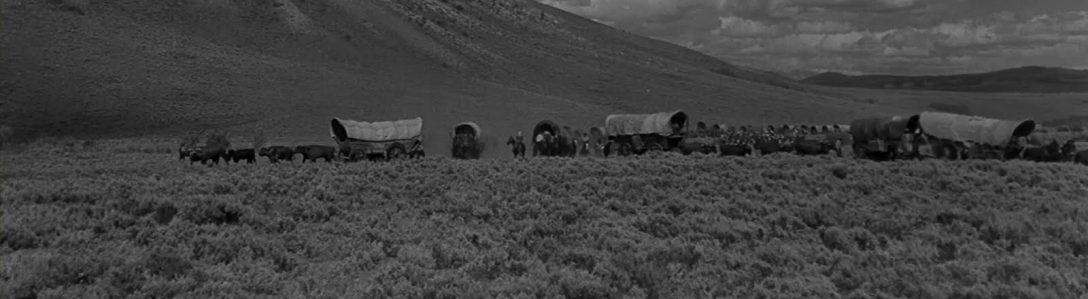
Hathaway and Wallis lightened the tone of of Portis’ more fatalistically comic work, turning it into an agreeably swashbuckling affair centered on Cogburn, whose rough edges and thieving past are sanded down to an inoffensive nub (Dave Kehr opted to call it “cutesy-poo”). There is no voice-over, which eliminates many of Mattie’s idiosyncratic asides, and the ace DP Lucien Ballard’s cinematography here is made up of bright and airy postcard shots that looks like a well-funded autumnal Coors commercial. It lacks the textural menace of nature in the book, in which cold and hunger attack as much as Chaney.

Wallis’ True Grit, then, is an entirely new work, with only a surface relationship to Portis’, and shouldn’t be limited, or belittled, solely in comparison to the book’s greatness. It was transformed into a John Wayne star vehicle as he was transitioning into more cantankerous character parts, so the film was rigged up into a sturdy, eager to please example of old Hollywood craftsmanship. Stocked with stellar supporting performances from Duvall, Hopper, Strother Martin, and even Glen Cambpell as the preening pretty boy LeBouef, it’s a companionable if not resonant bit of Saturday afternoon entertainment.

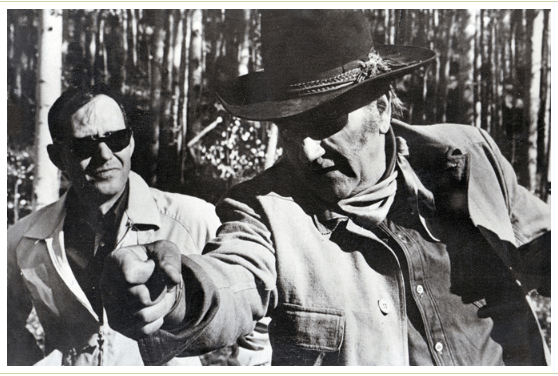
In a revealing exchange, Henry Hathway recalled the arguments he had with Wayne over wearing the eye-patch:

When he was first put to it, Wayne told me, ‘I’m not gonna wear that patch on my eye.’ He said, “I’m not an actor to begin with, I’m a reactor, and no way will I wear a patch.”

This is a wonderful pocket self-analysis from Wayne of his work – he’s such a superb and sensitive performer because of how he reacts to the actors around him. Some of his best work is in backgrounds – think of his proud, fatherly gaze and reluctant gait in Rio Bravo as he stands outside his circle of friends singing in jail – maneuvering his bulky body to convey the resignation of old age and the burdens of leadership. He’s one of the finest collaborative actors, whether it’s sparking off Montgomery Clift in Red River or bending towards Maureen O’Hara in Rio Grande like a weed to the sun. In donning the eye-patch, he becomes the buffoon being reacted to, a gallumphing showboat rather indifferent to the performers around him (Kim Darby is unmoored and affectless as a result). But his self-parodistic grunting and hamming stirred the dozing Academy voters, who awarded him his first and only Oscar for best actor.

NETFLIX INSTANTS: HORIZONS WEST AND CHINA GATE

December 7, 2010

horizons

In November, Netflix introduced a “streaming only” option to their membership plan, for $7.99 a month, another marker in the slow death of the DVD. Their “Instant” offerings are frequently presented on faded and cropped masters likely made during the VHS days, but the rarity of their hodgepodge collection makes it a near-essential outlet for those interested in American film history. Unless one lives in a cinephilic megacity like New York or L.A., VOD offerings like Netflix Instant and DVD-on-demand outfits like the Warner Archive are the only (legally) easy way to view older titles.

The decline of art and repertory theaters make these services more important than ever. While driving around Buffalo during my Thanksgiving trip home, I passed by the marquee of the art theater I worked at as a disconsolate teen. It’s where I first saw In the Mood For Love and became aware of a cinematic world outside blockbuster-era Hollywood. The letters that greeted me were: Harry Potter/Morning Glory/Inside Job. Through my nostalgic prism this was a bile-inducing travesty, but if I was growing up there now I’d have a much vaster range of titles to watch through Netflix than what I was offered at the upstanding Dipson chain of theaters (you should all go to the old North Park movie palace if you drive through Buffalo).

To underline that fact, there has been a swift uptick in the amount of rare Golden Era Hollywood titles added to the Netflix Instant archives recently. Director Joe Dante posted a tantalizing list of newly available films in the comments section of Dave Kehr’s blog a few days ago. I watched two of them this week, Budd Boetticher’s Horizons West (1952) and Sam Fuller’s China Gate (1957).

I had only known Boetticher’s film previously as the title of Jim Kitses’ seminal critical study of the Western, which is required reading for most genre courses in college. It was made four years before he was paired with screenwriter Burt Kennedy and star Randolph Scott for Seven Men From Now, which kicked off their brilliant and psychologically tortured series of revenge Westerns. They are spare, interiorized dramas tinged with expressionist visual flourishes, like the hanging tree in Ride Lonesome. In comparison, Horizons West is more conventional, with a flatter visual scheme and more transparent character motivations. But there are intimations of his future masterpieces. It is presented in its correct 1.37:1 aspect ratio, in a faded but watchable color transfer.

It tells the story of the Hammond brothers, returning home to Austin from the defeated Confederate army. Robert Ryan is Dan, the older and bitter sibling (“I don’t like to lose”), while Rock Hudson is Neil, the optimist eager to take over the family farm. Dan soon joins a gang of deserters and thieves, and builds them up from cattle rustlers to very persuasive land speculators. Soon Dan imagines building a “Western empire”, where his wife Lorna can be his queen. But before all that he has to run roughshod over his family, and steal Lorna away from the uber-capitalist Northern dandy Cord (a bitchy, superb Raymond Burr).

It is a plot-heavy scenario, with little time for the slow-burn breakdowns of Randolph Scott, but Robert Ryan’s greedy megalomaniac gets the most screen time, and there is a doomed aura to his character that could have been investigated further in a more pared down script (“-I want to make money. -What changed you? -The war, I guess.”). Ryan is a disillusioned war veteran eager to exploit the wide open capitalism of postwar Texas, and succeeds wildly, only to become more violent. His slowly wrinkling face trends downward into a snarl, emphasizing a kind of resigned brutality that Ryan is a master at portraying. It’s a provocative sketch of the haunting leads that Burt Kennedy would crystallize in his later scripts for Boetticher.

Sam Fuller’s China Gate (1957) comes during one of his peaks, a few years after Pickup on South Street (1953) and the same year as Forty Guns and Run of the Arrow. It’s another of his slam-bang pulp plots laced with punchy dialogue, bravado camera movements, and a simmering social conscience. Shot in CinemaScope by Joseph Biroc, Netflix Instant presents it cropped in 1.33:1, something of a tragedy. But it is otherwise unavailable on DVD in America, so this bowdlerized version is all we have for now. In the opening paragraph of the chapter on China Gate in Fuller’s autobiography, A Third Face, he makes the characteristic statement:

Young writers and directors, seize your audience by the balls as soon as the credits hit the screen and hang on to them! Smack people right in the face with the passion of your story! Make the public love your characters or hate them, but, for Godsakes, never – never! – leave them indifferent!

In the opening sequence of China Gate, a young boy wanders through the ruins of a small village in North Vietnam during the First Indochina War. He hides a puppy inside his shirt, only letting him out to eat some scraps on the ground. Then a starving man spies the animal, and desperate for food, chases the boy with a knife wielded high. The kid hides in a nearby bunker housing soldiers and loses him. Fuller strategically wields swooping crane shots, moving in to create tension and then back out to establish the horrifically scarred landscape.

The boy is the child of “Lucky Legs” (Angie Dickinson), an alcoholic single mother of Chinese-Caucasian descent (“I’m a bit of everything and a lot of nothing”). She survives by smuggling booze across the border to China along with, it is strongly implied, prostitution. The French Foreign Legion hires her as a scout on a mission to bomb an major rebel arms cache. The detail is led by Sergeant Brock (Gene Barry), a racist who abandoned Lucky after he discovered their child looked Chinese. Also in this group of mercenaries is Nat King Cole (Goldie), who did the part for scale, simply because of his enthusiasm for the project, according to Fuller. Cole also sings the lovely, funereal theme song, written by composer Victor Young before his death (the lyrics were by Harold Adamson, and the film’s full score was completed by Max Steiner).

It is filled with the bitter, grotesque ironies of war, such as the former French gendarme getting gunned down after an extended monologue about his previous life, which closed with, “This is the way to live!” These soldiers of fortune are brutalized and scared, with one Hungarian suffering from hallucinations of Russian troops stalking him. Brock orders that he be killed. Another dies in a fluke accident, and whose last words are, “I hope there’s a heaven. It would kill me to have to come here again.”

It’s bleak and blackly comic, a desperate and prescient anti-war film made seven years before the Gulf of Tonkin incident and the ramping up of U.S. troops in the region. I’ll give Fuller the last word:

My tale is full of human foible and confusion. I deliberately wanted that confusion. I was still thinking of Clare Booth Luce’s remark that ‘anyone who isn’t thoroughly confused, isn’t thinking clearly.’

LESLIE NIELSEN, 1926 – 2010

Originally published in Movie Morlocks, the official blog of Turner Classic Movies

November 30, 2010

leslie

Leslie Nielsen always played off the beat. Before he delivered a punchline, there was a hitch, a pause, a dumbfounded look off-screen – that made him a devastatingly funny actor. When he finally delivered the deadpan kicker it was in a sonorous tenor drained of emotion, a hollow thud of obliviousness. With his granite-jawed, silver-haired good looks he could say any absurdity with a straight face and a straighter vocal tone, and in collaboration with non-sequitur artists like the Zucker brothers and Jim Abrahams, he created some of the most ingratiating buffoons in film history. And this after a long and overshadowed career as a genial and arrogant leading man on television.  Mr. Leslie Nielsen passed away yesterday at the age of 84, while being treated for pneumonia.

Frank Drebin (The Naked Gun) and Dr. Rumack (Airplane!) are the twin monuments of my youth. Their commitment to ignoring the outside world is so intense it is almost saintly, and I worshiped them with religious fervor. Without the distractions of other human beings, Drebin and Rumack misinterpret every conversation, translating it through their simple-minded narcissism. In The Naked Gun, when Ricardo Montalban offers him a cigar, Drebin takes it as a personal question of ancestry: “-Cuban? -Ah no. Dutch-Irish. My father was from Wales.” Nielsen clips off the words quickly, with the blithe assurance that every query concerns himself. The speed in his response belies a majestic false modesty: everything is about him, but he’ll rush through it to prove he doesn’t care.

Then there’s the legendary “Don’t call me Shirley” bit from Airplane, which results from a similar misinterpretation of an innocent turn of phrase, “surely” to “Shirley”, from the descriptive to the personal. And what makes the line canonical is Nielsen’s stone-faced line-reading, an immobile expressionless mask of  vapidity. It’s hard work to be that straight, and at NPR Marc Hirsh quotes Nielsen’s Saturday Night Live monologue from 1989 to prove the point:

He didn’t understand why he had been asked to host a comedy show, because he was neither a comedian nor a comic. A comedian, he explained, was someone who says funny things. A comic was someone who says things in a funny way.

Nielsen, on the other hand, was someone who said unfunny things in an unfunny way, and for some reason, people laughed. To demonstrate this, he delivered an innocuous line – something along the lines of “Mr. Jones, sit down, I’d like to talk to you about your son” – twice. The first time, he said it as though he were in a drama, and the response was muted.

Then he told us that he was going to say the exact same unfunny line as Lt. Frank Drebin, in an unfunny way, and he did exactly that, and the audience exploded. It wasn’t just indulging him as prompted, either. Without actually tilting his delivery in that direction, Nielsen made it genuinely funny. To underscore his point, he then broke character with a look of happy exasperation and basically said, “See?”

He didn’t sell jokes or wink to the audience, but played it blank. He’s the nowhere man of dramatic acting, working to disappear into banalities until his voice is a low purr and the sound of words becomes more important than their meaning. You pay attention to the surface of things with Nielsen’s jokes, the way he harrumphs and says “Well” before a police car bursts into flame in the distance, or the hard emphasis he puts on the “p” in “poopy pants” (from an epic verbal duel with Robert Goulet in Naked Gun 2 1/2).

But the arc of Nielsen’s career is so much vaster than his sublime work with ZAZ and the later parodies (all of which are underrated to some degree, especially Dracula: Dead and Loving It); I had to delve into his TV work to see where he began. The usual line is that Nielsen was a rather bland handsome leading man until ZAZ tapped his natural talent for deadpan. But there are some raucous early performances that tend towards paranoid men suffering from quiet desperation. Even when he went prematurely gray and became a stock network guest star he gives his roles edges of self-absorption and arrogance.

Tales of Tomorrow is an early gem, a science-fiction anthology show that aired live on ABC from 1951 – 1953. Nielsen acted in six episodes, three of which are available on the site. In “Ghost Writer” (1953) he’s a struggling novelist who takes a gig polishing stories for a successful author. Then his tales start coming true.  “Appointment On Mars” (1952) finds him on the red planet struggling to contain the paranoia of his crew and his own madness as Uranium deposit riches loom (it’s Treasure of the Sierra Madre in space). And “Another Chance” (1953) casts him as a desperately poor husband who steals a valuable brooch and then undergoes a memory erasure procedure to start life anew. In all of them he’s on the edge of madness, which the cramped sets and long takes of the live TV medium really enhance.

He’s only a few years out from his NYC training at the Neighborhood Playhouse, which was under the sway of Sanford Meisner’s version of Stanislavski’s “system”, now known as the Meisner Techniqueand similar to Lee Strasberg’s famous “method”. Nielsen’s tight, raging performance in  “Another Chance” is the closest to the method he’d ever get. It’s a bracing, moody piece where he’s knocking back liquor in the first shot and gets more disoriented from there, until he gets his mind wiped by a supercilious doctor. Eventually his repressed past starts drilling back into the present, with Nielsen’s language expertly slipping into the names and places of his former life. It’s a mannered but powerful performance in this surprisingly complex forerunner of  Eternal Sunshine of the Spotless Mind .

Even the lax Hitchcock Presents episode, “The $2,000,000  Dollar Defense” (1958), finds Nielsen self-destructing. Here he’s a cuckolded husband accused of murdering his wife’s lover. The method intensity has worn off, and the cool Nielsen persona is setting in, introducing hints of snobbery and elitism to his emerging suave demeanor. A similar scenario pops up over 20 years later in George Romero’s Creepshow (1982, the same year as his comedic breakthrough with ZAZ, Police Squad). In this theatrical horror anthology (he’s an unsung hero of the form), Nielsen plays another husband with revenge on his mind. This time he buries Ted Danson in the sand, hoping to drown him in the tide. In keeping with the self-reflexivity of the whole enterprise, he hams it up, whistling “Camptown Races” as he leads Danson to his doom, and bitchily snapping off lines like “She’s waiting for her knight in shining corduroy” before watching W.C. Fields on TV.

But that’s not nearly as jolting as his appearance on Rod Serling’s horror anthology Night Gallery in 1971 (“A Question of Fear”) as an eye-patched and mustachioed war veteran challenged to spend the night in a haunted house. Claiming to have never felt fear, Nielsen’s hyper-masculine Colonel swashbuckles his way into an old dark house. There is very little dialogue as he navigates soldier-ghosts with burning hands, swinging blades and probable poisons. The final act is expository lard, but the Colonel is another example to place in Nielsen’s hubris-filled menagerie.

There were undoubtedly instances of the stoic network hero during his long TV career, like on the Disney show The Swamp Fox, but they are not readily viewable. But what is available shows that he played far more than just the “earnest heroes” that the NY Times described early on in his career. Even the most straight-laced roles, like his two guest spots on Murder, She Wrote (both on Netflix Instant), contain hints of self-absorption and menace. In “My Johnny Lies Over the Ocean” (1986),  he plays a cruise liner captain with barely contained arrogance, hitting on the intrigued Jessica Fletcher with intransigent persistence. Then, in “Dead Man’s Gold” (1986), he plays a former flame of Jessica’s, but one profligate with money and in hock to a pair of well-mannered loan sharks. With a charismatic swagger barely masking his self-destructive tendencies, he gives Jessica a romantic kiss-off.

Nielsen’s genius was codified in Airplane!Police Squad and The Naked Gun, but there’s a whole swathe of work to happily sift through if we want a fuller picture of his career. In the shift from the method theatrics of Tales of Tomorrow to the suave horniness of his Murder, She Wrote cads lies the DNA of Frank Drebin, a process of wearing down to the essential blankness of the Hollywood leading man, and to a deadpan for the ages.

FLICKERS OF THE WEEK (ON DVD): ESCAPE FROM ZAHRAIN AND HE WHO GETS SLAPPED

November 23, 2010

ahrain

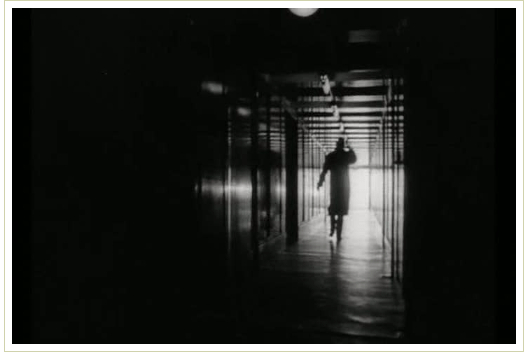
The wheezing, rickety looking vehicle you see above, silently mocked by the parallel oil pipeline, is desperately straining up the incline, hoping to reach the space outside the CinemaScope frame. Why the hurry? Because they’re trying to….Escape From Zahrain! This 1962 Paramount adventure film is being released on DVD by Olive Films on December 7th, and it delivers the ragtag-group-on-the-run goods. At age 51, it was director Ronald Neame’s first Hollywood production, after a lifetime in the British system.

An assistant cameraman on Hitchcock’s Blackmail (1929), he became a highly sought after cinematographer for 12 years, and worked frequently for David Lean (This Happy Breed, Blithe Spirit). After moving to producing duties on Lean’s Great Expectations and Oliver Twist, he segued into directing with the 1957 relationship drama Windom’s Way (1957). It wasn’t until the success of Tunes of Glory (1960), and its Oscar nomination for best adapted screenplay, that Paramount came calling. He’s mainly remembered now for The Poseidon Adventure‘s disaster theatrics, but his career seems to warrant further investigation. I’m sure there are readers out there more well-versed in Neame’s work, so please send recommendations my way.

The plot of Escape from Zahrain essentially re-locates Stagecoach to a made up Middle Eastern country, throwing together conflicting personalities into a tight space. Sharif (Yul Brynner) is the stoic imprisoned leader of a revolutionary group in Zahrain advocating the expulsion of the corrupt U.S. oil company. A student cell led by Ahmed (Sal Mineo) leads a bold jail-break scheme, springing Sharif as he is being transferred to another city. As they race away from government thugs to the border, they have to deal with the other inmates in Sharif’s car. Huston (Warden) is an arrogant American embezzler, while Tahar (Anthony Caruso) is a murderous, shifty local. When this suspicious group needs a new ride, they kidnap Laila (Madlyn Rhue) and her emergency vehicle in their rumble towards freedom.


Neame utilizes the CinemaScope frame to alternate sweaty cab interiors with epic long shots of desert and horizon, often bisected by jutting diagonals. These graphically unbalanced shots echo the shifting power relationship between the cranky travelers. Sharif stares bullets into the windshield while everyone else jockeys for position. Huston never shuts up but has his uses fixing cars, while Ahmed’s idealism smacks up against Laila’s humanist pragmatism, and Tahar is just an asshole. The actors are relaxed within the streamlined narrative, with Jack Warden especially resourceful as the cynical ugly American. The rest of the actors compare chest hair (Sal Mineo finishes last, James Mason wins in a landslide in his hilarious cameo), while Madlyn Rhue is appropriately confused. With taut storytelling, companionable characters and the expressive images, it’s a diverting gem from the waning days of the studio system.

***

He Who Gets Slapped (1924) marks another Hollywood debut, this time of the great Swedish director Victor Sjostrom, now on DVD from the Warner Archive (it’s also the first film produced under the MGM banner, and so the first to use Leo the Lion). Sjostrom’s Name the Man (1924) might have been filmed ahead of it, but Slapped beat it to screens. The film is in pretty rough shape, with shaking frames, heavy scratches and an overall softness, but at least it’s better than the version that’s streaming at Google Video.

Sjostrom was one of the pioneers in developing a language for narrative cinema. His Ingeborg Holm(1913) is a powerful melodrama about a family left destitute by the death of the father. But it’s important not just for its social conscience, but for the masterful way in which Sjostrom choreographs his actors in the frame, shifting the centers of action. David Bordwell has a brilliant post on this at his blog. He continued to have a brilliant career in Sweden, churning out outdoor adventures like The Outlaw and his Wife (1918) as well as the supernatural fable of The Phantom Carriage (1921), probably his most famous work. There he played with camera tricks, including the most complex double exposures seen up until that point, which probably caught the eye of MGM.

His visual experiments continue in He Who Gets Slapped, another monstrous melodrama starring Lon Cheney, a year after The Hunchback of Notre Dame. It’s adapted from a Russian play by Leonid Andreyev of the same name, about a brilliant unknown scientist whose discoveries (and girlfriend) are stolen by an evil Baron. As a cruel joke, the scientist, named Paul Beaumont in the film (Chaney), becomes a clown in order to laugh at his own bitter destiny. Soon he falls in love with the new acrobat Consuelo (Norma Shearer), who is also courted by the Baron who had betrayed him all those years before.

It’s scaled to the same tragic clown heights as Pagliacci, both protagonists subject to their own humiliating emasculation. But the grand emotions of the opera are not scaled down for the screen, and what is emotional when sung by a virtuoso becomes caricature and stereotyped when filmed as drama. The movie is populated with inert grotesques, with no shades of ambiguity or plausible motivation. Sjostrom imaginatively amps up his visual presentation, patterning large crowds as faceless mobs of judgment (as Fritz Lang would do in a few years later), but they are illustrating a story not worthy of his images. Despite this, Chaney manages a superb performance of a masked, bubbling breakdown, the only human element amid the burlesque, and one can see why it was one of his favorite performances, and one he recalls for his role in Laugh, Clown Laugh (1928).

Sjostrom would go on to make the magnificent The Wind (1928), another outrageous fugitive from home video. Also an MGM title, hopefully the Warner Archive can add it to their release schedule, and fill in another gap in the career of one of the great unsung directors in film history.

PHYSICAL EVIDENCE: WHITE MATERIAL (2009)

November 16, 2010

whitematerial

White Material opens with a shot of dogs crossing a headlight-lit road, followed by flashlights illuminating the well-appointed interior of an abandoned bourgeois home. The sequence ends with the image of an African revolutionary leader named The Boxer (Isaach de Bankole) lying dead, his face etched out in circles of light. It is a film about coming out of the darkness into this rather cursed light – what is revealed is dissolution and chaos. Claire Denis’ allusive and texturally beautiful film opens this Friday from IFC Films, and will appear on video-on-demand services starting November 24th. I participated in a round table interview with Denis and star Isabelle Huppert last week in NYC, and their insights will be liberally sprinkled in with my own below.

Huppert stars as Maria Vial, the sinewy-strong manager of a coffee plantation in an unnamed African nation (it was shot in Cameroon). A seductive voice crackles over the radio about armed unrest and the iron hand with which the government plans to put it down. Maria’s workers start fleeing en masse, and soon her ex-husband Andre (Christopher Lambert) urges her departure as well. Her father-in-law Henri (Michel Subor), the owner of the plantation, is a ghost-like presence, sickly and waiting for death (the fate of a white man’s burden), while her son Manuel (Nicolas Duvauchelle) shows signs of mental breakdown. Everything is falling apart, and yet Maria is obsessively intent on completing the year’s harvest. She exists in a state of willful ignorance, unable to accept the destruction of the only home she’s known.

Huppert and Denis emphasize the split nature of Maria’s personality. Together with DP Yves Cane (long time collaborator Agnes Godard was tending to her sick mother at the time), Denis frames Maria up close with a handheld camera, emphasizing her isolation. And yet within these spare framings, Huppert exudes an indomitable, intractable kind of fortitude. Her denial of reality doesn’t unmoor her from it, but makes her dig deeper inside of it. From the outside,  the perspective of the French soldiers in helicopters urging her to leave, she is fragile and soon to be victimized. But in the cocoon of close framing she is a warrior, her pink cotton dress, as Denis described it, a kind of armor. Denis again: “I remember a scene from the coffee plantation. There was this young man, young worker in the plantation, took his moto, raised his arms and said, ‘every morning when I go on my motorcycle I feel  free and strong’. I really liked that. She [Maria] was seen by the French soldier as a little fragile victim they came to rescue. A minute after riding the motorbike she starts feeling, ‘I will make it, I will manage to finish the harvest. I will not be a victim’.”

Huppert:  “As Claire was writing the script with Marie [author and first time screenwriter Marie N’Diaye], I remember she was giving me clues, she was something like a bionic woman, a super woman. By this exaggeration she gave me a clue of what she wanted. Not psychological, but a physical approach to the character. I remember when she said that to me. It really opened a whole world. A totally physical approach, and nothing else. So I started to learn how to ride a motorcycle, and when I got to Cameroon I started to learn how to ride the tractor. So the character was defined by resistance to the natural elements, and the whole situation against her.”

As self-destructive as her behavior is, Maria is still imbued with a kind of faded grandeur. She is fully committed to the colonial project even to the point of death. She identifies completely with the land, raking in the coffee cherries with the workers and focused only on keeping the farm open. It is a phenomenonally physical performance by Huppert, even standing still she seems like a natural part of the landscape, a stylish scarecrow.

Her principles are paternalistic and outmoded, but at least she has them. The violence that threatens the edge of every frame seems to have no principles except destruction. The rebels are terribly young, child soldiers drafted into a war they didn’t choose. The government is run by cynical profiteers, organizing militias for their own protection but caring little that the rest of the country will burn. In the midst of this chaos, Maria is a stabilizing presence. She is insane, but steady. This steadiness of belief is why Denis continually compares her visually to The Boxer, the mythical rebel leader, and the only other character who seems to believe in his own cause. The Boxer is also given intimate single close-ups like Maria, while the rest of the film uses medium to long shots set on a tripod.

His story is also one of dissolution. He is wounded, his life slowly draining out of him while the rebellion he once led spirals out of control. Like Marie with her family, the rebel forces are no longer under his command. And yet he remains impossibly serene, his face an imperturbable mask. Their destinies are intertwined through these visual, thematic and structural rhymes. Structural, because the opening shot of his death immediately precedes the introduction of Maria, riding a bus to nowhere, before it moves back in time to establish what led her to get that empty look on her face (She meets The Boxer briefly in this middle section). This flashback structure establishes the entropic direction of the narrative – we know things will fall apart, but not how. White Material was shot before 35 Shots of Rum, but was released a year later, not just due to the vagaries of distribution, but also because she spent so much time establishing the structure. In the interview she said the script was written in chronological order, but that the bus scene got stuck in her mind, because she wanted, “To have Maria appear in the broad daylight, already lost, already too late.” The opening shot of the Boxer was necessary because she wanted,  “Dark night preparing her to walk into daylight. I cannot explain why.”

STANLEY DONEN’S DOUBLE BILL: MOVIE MOVIE (1978)

November 9, 2010

moviemovie

The Film Society at Lincoln Center is wrapping up its superb Stanley Donen retrospective this week, and beyond the established masterpieces like Singin’ In the Rain lie charming curiosities like 1978′s Movie Movie. I missed the screening, but fortunately it is available to purchase from Amazon On Demand for $9.99. Structured like a 1930s Warner Bros. double bill (the on-screen production company is “Warren Brothers”), it pairs two hour-long features: the boxing melodrama “Dynamite Hands” and the backstage musical “Baxter’s Beauties of 1933″. Scripted with loving exaggeration by Larry Gelbart (still cranking out MASH episodes at the time) and Sheldon Keller (a veteran TV writer who started with Sid Ceasar), it’s both a parody of and an homage to the Golden Age of Hollywood. Complete with faux flyboy trailer for “Zero Hour” (“War at its best!”), it’s a similarly nostalgia-soaked recreation of past movie-going experiences as Grindhouse, with an equally poor reception at the box office.

It received generally positive reviews at the time, from Richard Schickel at Time Magazine (“an expert send up”), Pauline Kael at The New Yorker (“a pair of skillful parodies”), Vincent Canby at the NY Times(“sweet, hilarious and very witty”) and Dave Kehr at the Chicago Reader (“clever, insightful and genuinely funny”). The only negative response I could find is from Variety (“a flatout embarrassment”). But after its limited release in November of 1978, it disappeared from cultural memory, existing as a marginal cult item (the VHS is selling for $55 on Amazon, and good luck finding any images on-line). But as with Quentin Tarantino’s vastly underrated Death ProofMovie Movie is ripe for re-evaluation.

The actors, led by a mis-cast but game George C. Scott, play everything with earnest intensity. There is no eye-winking to stifle the comedy. “Dynamite Hands” has Scott portraying grizzled boxing coach Gloves Malloy, who targets wide eyed, pretty boy slum kid Joey Popchik (Harry Hamlin) as his next star. Luckily for Gloves, Joey’s sister Angie needs $25,000 for eye surgery (Joey: “You know what they charge for an eye? An arm and a leg”), and the plot machinery clangs wondrously into motion. Subplots proliferate, including the schemes of a shady promoter (Eli Wallach) and the designs a mobbed up Barry Bostwick has on Angie. It even finds time to morph into a rapid fire courtroom drama. It combines and amplifies every cliche in the genre’s life, since The Champ kicked it off in 1931.

The dialogue is the star, a barrage of contorted working class argot, producing winners like, “Funny, isn’t it? How many times your guts can get a slap in the face.” Many of these, wrung out by Hamlin with an angelic straight face, wouldn’t seem out of place in a Zucker Brothers comedy – Leslie Nielson could wring similar effects from the lovingly absurd script. Another gem comes from the femme fatale, Troubles Moran (Ann Reinking, a dancer making her debut here, she appeared in All That Jazz the following year): “Joey, after a girl’s had a taste of mink, she can’t go back to pastrami.” Words to live by.

Donen pushes the pace relentlessly to mimic these Warner quickies, and is very sparing with close-ups, keeping the camera at the waist-up  distance favored by classical practitioners. It’s questionable whether his use of zoom-ins are truly authentic for the period he’s aping, but the effect is hoky enough, along with the irises in and out, to fit the overall light comic tone.

The “Zero Hour” trailer is a delirious bit of WWI propaganda, with George C. Scott’s heavily waxed moustache playing power games with Eli Wallach, as Art Carney’s “priest with a heart” gives bad advice at home.

Then the segue into a Busby Berkeley-esque backstage musical, 42nd St. spliced with Gold Diggers of 1933. Barry Bostwick plays the Dick Powell role with what Kael called Powell’s “candied yam cheerfulness”, and Rebecca York takes on the small-town aw shucks innocence of the Ruby Keeler part. Scott plays the Warner Baxter role of overtaxed, death courting director Spatz Baxter, a flamboyant character not really in his macho wheelhouse, but his caked on makeup carries him through. Art Carney’s doctor tells Baxter that he has “6 months to live…from your last visit 5 months ago.” Wanting one last hit to guarantee a future for his estranged daughter, he employs a promising unknown to write a score: Bostwick’s gangly klutz Dick Cummings. Replete with showgirls in undergarments, last minute catastrophes and a drunken, difficult lead actress, it has all the hallmarks of those snappy Busby Berkeley classics.

Bostwick does a fine bumbling job as Cummings, a slapstick version of the Powell character, all arms and legs careening through the frames. His voice isn’t as sturdy and true as Powell’s, but he makes up for it in pratfalling intensity. Troubles Moran gets a mini-nightclub number in “Dynamite Hands”, but Donen really cuts loose in the finale of “Baxter’s Beauties”, in which him and the great choreographer Michael Kidd (whom he worked with on Seven Brides for Seven Brothers (1954)) and DP Bruce Surtees do their version of a Berkeley routine, complete with a birds-eye view of a human roulette wheel. They bring back the impossible spaces of his routines, sets which could not fit on a stage and perspectives that audiences could never see. The cut-ins to the programs, supposed to connect one back to reality, only go to show how spectacularly unrealistic the dance sequences are. And in this, Donen and Surtees honor their subject admirably: an energetic erotic spectacle that any Depression-era viewer would gladly plunk down their money for.

For a negative take on the film, David Cairns wrote a straight up pan for his great Shadowplay blog.

CHAPLIN AT KEYSTONE

November 2, 2010

keystone

Flicker Alley has just released a monstrously funny box set of all extant shorts that Charles Chaplin made at the Keystone Film Studios. It is poetically titled CHAPLIN AT KEYSTONE, and is now available for your perusal. The sketches housed therein are mean-spirited little scenarios of controlled chaos. Chaplin swats down the elderly and the teething with equal aplomb, playing drunks, con-men and resentful working class joes. Bricks are the weapon of choice, available in suspiciously convenient abundance. There is plenty of interest for those looking for evidence of his artistic development, from his control of narrative to the introduction of pathos to his work, but the real joys here are tumbles down stairs and unexpected blows to the face. The Keystones were the JACKASSes of their time.

The ringleader was Mack Sennett, who when Chaplin joined his company explained the Keystone method: “we get an idea, then follow the natural sequence of events until it leads up to a chase which is the essence of our comedy.” That is, there was no script, just a concept strung out with with improvisational business to get to the chaotic close. This was, as biographer David Robinson notes, not reassuring to Chaplin , who was “accustomed to the months of polishing that perfected the teamwork of a Karno sketch.” Fred Karno was Chaplin’s previous employer, a music hall peformer and director who formed “Fred Karno’s Speechless Comedians”, a hugely popular pantomime act that also produced Stan Laurel. They workshopped their sketches on the road for months until every last gag was milked for maximum hilarity. Now here he was in Hollywood with Sennett, completing a film in an afternoon with little time for tweaking.

It’s little surprise Chaplin clashed with his directors. On his first film, Making a Living, Chaplin was outraged at Henry Lehrman for cutting out some of his favorite gags, and he was famously chuffed at having to take orders from the younger Mabel Normand on some outings. Eventually his need for Karno-like perfection inevitably led to his taking the directorial reigns. His growing control of the material, and introduction of more dramatic elements, can be seen in The New Janitor (1914), in which Chaplin’s bumbling custodian almost tips out of a window but still manages to foil a robbery in progress and catch the eye of the secretary in distress. There is a dramatic and emotional arc to this piece absent in the earlier work.

But mapping an evolutionary arc on this point of his career would be a mistake. His development as a dramatic artist is not better, but simply marks a different path in his career. For pure comedy, I prefer the early fly by night Keystones, jury-rigged giddy contraptions of pure id. Later this week at Movie Morlocks David Kalat will single out Kid Auto Races at Venice, California (1914) as one of his favorites, and I concur whole-heartedly. It’s the first film in which audiences saw the “tramp” costume, although Mabel’s Strange Predicament was filmed first it hit theaters later. The Keystone team often filmed bits around live events in town, and for this scene Chaplin cavorts next to the second annual “Pushmobile Parade”, a children’s car race held on January 11, 1914. Allegedly filmed in 45 mintues (according to Jeffrey Vance’s DVD notes), it finds the Tramp continually blocking a news camera’s view of events as it pans right, variously posing and taunting the director of photography. His casual incursions into the frame build and build until he gives the lens the stink-eye in an extreme close-up.

What is equally interesting to the loose improvisation of the film is to watch the spectators reactions to the Little Tramp, whom they are seeing for the first time. Their reactions range from non-plussed to confused towards the shoddily dressed maniac who nearly avoids getting clipped by a toy car and incites a mini-riot with the newsreel crew. It is a loose, brilliantly executed bit of slapstick as well as a documentary depicting the birth of Chaplin’s skeptical but curious worldwide audience.

A similar routine is run through in A Busy Day, which was directed by Mack Sennett. This time they film in Wilmington on April 11, 1914 during a dedication ceremony and parade celebrating the Los Angeles Harbor expansion (from Vance’s DVD notes). Chaplin cross-dresses as the rather ill-tempered young wife of Mack Swain, who has a gigantic wandering eye. But she begins by obstructing another camera crew, posing mock seductively until someone tries to forcibly wrench her away from stardom. Her dream is forever deferred as she executes some limber kicks against these evil interlocutors before being tossed against the bandstand. Then her ire returns to her husband and a battale royal escalates to the pier and a final somersault into the water. From the start Chaplin is playing with ideas of fame, which he would wait to fully explicate until Limelight (1952).

While structurally something like Dough and Dynamite is a masterpiece, I found the blunt insanity of The Fatal Mallet to be more my style. A fever dream of male jealousy, Chaplin and Mack Swain battle over the hand of the always delightful Mabel Normand, at least until another guy comes along to divert their wrath. There are no character details beyond the cliche of their physical type, and it is structured around endless brickbats to the head. In its insistent refusal to acknowledge physical reality, it is both hilarious and sublime, a fusillade of cinderblock poetry. The men move to deathly lengths to subdue the others, as Normand looks on with increasing disinterest.

It is a box set to savor, for the minor moments of improvisational genius (like how he uses pliers to tip a girls head his way in Laughing Gas), as well as the gains in narrative and spatial coherence that clearly point to his feature length greats. Essential viewing.

NOT A SUPERSTITIOUS SUCKER: NIGHT OF THE DEMON (1957)

October 26, 2010

night of the demon

“I detest the expression ‘horror film.’ I make films on the supernatural and I make them because I believe it.”  – Jacques Tourneur, Positif

The lead character in Tourneur’s Night of the Demon, psychiatrist Dr. John Holden (Dana Andrews), declares that he is “not a superstitious sucker.” He is a sardonic skeptic of mystical powers and things that go bump in the night. Unfortunately for him, Tourneur is a master of visualizing dread, at uncanny images that disturb the orderly corridors of consciousness. So Night of the Demon, my selection for this week of supernatural selections at Movie Morlocks (it airs on TCM on October 29th at 6PM), finds Holden’s self-righteousness crumble in the face of Tourneur’s terrifying control of the medium. As Raymond Bellour wrote, Holden’s “problem is trying not to believe in the devil, while ours is trying to accept belief in the cinema.”

All inquiries into Tourneur run through Chris Fujiwara’s critical study, The Cinema of Nightfall, and the following is deeply indebted to his essay on the film. If you have the time, ditch this essay and read the book.

Holden flies to London to study the activities of a Satanic cult led by the urbane Julian Karswell (a coldly charismatic Nigel MacGinnis). He was to join Professor Harrington (Maurice Denham) in the venture, but the latter died under mysterious circumstances, torn apart as if by wild animals. Soon Karswell is warning Holden against investigating any further, and predicts his death in three days’ time. Beginning to suffer from auditory and visual hallucinations, Holden accepts the help of Harrington’s niece Joanna (Peggy Cummins), and attempts to uncover the truth behind Karswell’s morbid declaration (the ending was strikingly re-purposed in Sam Raimi’s Drag Me to Hell).

The film was based on the short story “Casting the Runes”, by M.R. James (available to read here). Charles Bennett, the scriptwriter on many of Hitchcock’s British films (Blackmail, The 39 Steps) bought the rights and worked with executive producer Hal E. Chester to bring it to the screen.  Chester was reputed to have re-written parts of Bennett’s script, and cut around 13 minutes out of the 95 minute British feature for the American release, re-titled Curse of the Demon (both versions are available now on DVD). Chester also had producer Frank Bevis re-shoot scenes to feature the title monster more prominently, alienating Bennett and Tourneur in the process. Tourneur:

The scenes in which you really see the demon were shot without me. The audience should never have been completely certain of having seen the demon.

He went on to tell Joel E. Siegel that he only wanted “four frames” of the monster to be shown in the film, during the ending on the train tracks. “People would have to sit through it a second time to be sure of what they saw.” Tourneur wanted very fleeting glimpses of the monster, to let the horrors unfold off-screen, in the viewer’s mind, as in his superb work with producer Val Lewton (Cat People, The Leopard Man). This strategy would also keep doubt alive about the ultimate reality of the creature. For while Tourneur believed in the supernatural, he wanted his viewers to come to their own conclusions.

The monster, modeled on demonology books from “3,400-year-old prints copied exactly”, was created by art director Ken Adam. Adam: “I designed the monster, but under protest. I agreed completely with Tourneur.” (from Christopher Frayling’s Ken Adam and the Art of Production Design). The demon looks grotesque enough in stills, but its immobility on film gives it the unfortunate rubber-suited ridiculousness of a Godzilla knock-off. It does not tonally fit into Tourneur’s elegant frames.

From Harrington’s first appearance it’s clear the characters in the film will be at the mercy of their environment, and that the world is disturbingly outside of their control. His car appears as a halo of light in between a thatch of dark forest, he mops his nervous brow in a medium-shot profile, and then a cut to a POV shot looking up, as branches emerge into his headlights and descend back into blackness (Bellour compares this opening flicker effect to film running through a projector). Once he arrives at the Karswell’s, to tell him he’s giving up the investigation, fearful for his life, Tourneur cuts to an extreme high angle, with Harrington dwarfed by a gaudy chandelier in the foreground. He is already swallowed up by the world, the darkness ready to take him next. After he leaves the demon makes its first, and very controversial, appearance.

It is from this sequence that Fujiwara, contra Tourneur,  makes an intriguing case for the demon’s presence, that it “fits into the film’s structural play with ambiguity of point of view.” That is, Harrington first spies the creature in a POV shot, but then there is a cut to a long shot, with Harrington in the frame watching the monster. The latter backs away from subjective identification with Harrington, taking an exterior perspective, and, “his [Harrington’s] presence in the frame splits the viewer’s gaze into two – one that identifies with Harrington’s look and one that frames Harrington himself and the image constructed by this other gaze.” Fujiwara notes a similar play with POV in the rest of the feature, including Holden’s optically wavering hallucinations, and the uncanny appearance of an aging hand that is seen by no-one in the film’s universe. The viewer is constantly weighing the verity of each shot, as well as the idea that it might be impossible to determine the difference between what the characters see or imagine.

Holden ends as dazed and confused as the viewer, no longer safe in his assumptions about a rational world, or in man’s ability to discover absolute truths. His last line is, “it’s better not to know”, and then he disappears behind a passing train.

THE CLAUSTROPHOBIC CINEMA OF PAUL W.S. ANDERSON

September 24, 2009

the-rotting-corpse-paul-w-s-anderson-more-movies-81221f817c

The old Hollywood studio-hand W.S. Van Dyke — who directed, amongs countless other things, “The Thin Man” — once advised a young Orson Welles to “just keep it close, and keep it moving.” And an unlikely inheritor of this wisdom is Paul W.S. Anderson, whose latest work to hit screens is this week’s “Pandorum,” which he executive produced, leaving the directing to German up-and-comer Christian Alvart. Rivaled only by Uwe Boll for the title of worst-reviewed director of the past decade, Anderson’s also been one of the most resourceful. Working with the flimsiest material (video game adaptations and remakes) in the least respectable of genres (sci-fi, horror), he’s managed to construct a remarkably coherent body of work. With his longtime producer Jeremy Bolt and a loose coterie of actors, he’s created a series of films that focus on the expressiveness of claustrophobic spaces and the physical grace of his (mainly) female protagonists.

Anderson’s interest in confined spaces may have come to him in childhood. He was born and raised in Newcastle upon Tyne, in the northeast of England, which was a major coal mining town through the first half of the 20th century. He told the New York Times’ Dave Kehr about “the lure of going down there into the dark. It’s in my blood. My grandfather, who brought me up, was a coal miner. I visited the mines with him. I remember it vividly. It was horrible. I’m glad I didn’t go into the family business.” Instead, he went to school, graduating from the University of Warwick with a degree in film and literature. He continued on to earn an MBA, with the hopes of running his own production company.

Anderson’s entrée into show business was as head writer for “El C.I.D.,” a wonderfully titled ITV cop drama starring Alfred Molina. Then he met up with Bolt, a philosophy student at the University of Bristol, Ken Russell’s driver and a fledgling film mogul. In 1992, they formed the production company Impact Pictures, and started looking for cash for their first feature, “Shopping.”

A strange mélange of rebellious youth drama and dystopic sci-fi, “Shopping” cast an angelic Jude Law in his first starring role across from his future ex-wife Sadie Frost. Gleefully amoral, Jude (as Billy) and Sadie (as Jo) head a group of homeless “ram-raiders,” kids who crash cars into storefronts, and steal whatever tickles their fancy. Anderson (no W.S. yet) envisions the city as a succession of inky black tunnels, smoky warehouses and abandoned industrial sites. He explores these spaces with all his film school tricks, including canted angles, extreme chiaroscuro lighting, and circling camera movements to underline Billy and Jo’s aimless self-destruction.

Their rebellion is cultural more than political: after rifling through a stolen car, Jo brandishes a cassette tape with religious fervor and screams, “Billy Joel, fuck that!” Then, they blare some Jesus Jones over the radio. Billy’s brooding is in stark contrast to Jonathan Pryce’s enigmatic police chief, the first in a parade of fascistic government figures to make an appearance in Anderson’s films. This central drama is under-written, but Anderson successfully captures a mood of bruised teenage romanticism. Banned in some U.K. theaters for its violence, “Shopping” still managed to nab a spot at the Sundance Film Festival. Despite only receiving an edited, direct-to-video release in the U.S., the film earned enough attention for Anderson to move across the pond.

In a 1992 article at the Independent, Anderson said, “I get very angry when I go to Leicester Square and all the movies are American.” Three years later, he went to Hollywood, never to return to his native England. His big break came with the adaptation of “Mortal Kombat,” an incredibly bloody video game that Anderson played at arcades while he was in college. It was a self-consciously silly film — he said he wanted to make it a cross between “Enter the Dragon” and “Jason and the Argonauts.” It reflects the hand-made, amateur ethos of that combination, maintaining a jokey, self-reflexive tone not unlike “Big Trouble in Little China.” (The 2006 Impact Pictures-produced “D.O.A.:Dead or Alive” has a similar spirit). The main set is a labyrinthine, fantastical underground lair, where the tournament’s fighters wander with bemused nonchalance, even when they stumble upon a Ray Harryhausen-esque six-armed behemoth planning their demise. Here, Anderson utilizes his constricted set as a genre playground, mutating to throw fighters together or supply the material for a clunky bon mot from the dry-witted Johnny Cage (Linden Ashby) or the gun-toting Bridgette Wilson. It made over $120 million worldwide.

The film’s success gave Anderson the leverage to bring over Bolt, and the Impact Pictures logo has been slapped on all of their subsequent features. Having a producer’s credit doesn’t equal freedom, however, and Anderson’s next two films, “Event Horizon” (1997) and “Soldier” (1998), suffered from bad luck and studio interference. “Horizon” contains another classic Anderson setting, an abandoned spaceship that is manifesting a malevolent force from within, the first of his sets that is a character in itself. With glowering performances from Sam Neill, Lawrence Fishburne and Jason Isaacs (a member of Anderson’s nascent stock company), menacing production design from Joseph Bennett and a restrained, longer-take style from Anderson (still no W.S.), it has all the elements of a quality slow-burn chiller. But it’s saddled with a shaky third act made even more incomprehensible by studio-mandated cuts, and it ends up a compromised failure.

The “Soldier” shoot was even more harrowing. Intended as Anderson’s first landscape movie, it was slated to shoot outdoors until the El Niño hurricane swooped in and pushed everything into studio soundstages. This changed the entire visual scheme of the film, which takes place in the same world as “Blade Runner” (both scripts were written by David Webb Peoples). Star Kurt Russell broke his ankle the first week of shooting, compounding the difficulties. The visual palette is drab greens and browns, and the sets have an airless, slapped together feel, which is devastating for a filmmaker of Anderson’s interests. Kurt Russell’s grizzled, monosyllabic performance is a compensatory pleasure.

After “Soldier” flopped, Anderson went back to his basics, a video game adaptation set in the tight quarters of an underground biological warfare lab. The result was “Resident Evil” (2002), for which he wrote his first screenplay since “Shopping.” He received a modest $30 million budget from the German company Constantin Films (a relationship that has continued through “Pandorum”), and he churned out a beautifully controlled piece of zombie mayhem.

An amnesiac Alice (Milla Jovovich) goes down a corporate rabbit hole to a facility that produces the T-Virus, an experimental weapon that happens to turn dour government types into drooling brain eaters. Aided by a brusque security team and an enigmatic artificial intelligence named the Red Queen, Alice tries to lead the troops back to the surface. Anderson told Collider that “I’ve always liked strong women characters in films. When I first came to Hollywood, there was this kind of rule that was expounded by several people within the industry that I heard many times that female led action movies don’t work.” He continues to prove them wrong.

The casting of Jovovich was especially fortuitous. Her piercing blue-green eyes open the film, while her brusque line readings and lithe athleticism carry it to its close. You can’t blame W.S. (this is where he adopts the initials, the same year as that other Paul Anderson’s “Punch-Drunk Love”) for falling in love with her. (They were married in real life this past August.) Successful enough to inspire two sequels, the “Resident Evil” trilogy is a bloody, oozing love letter to Ms. Jovovich, keeping the camera close to her expressively stony face as she dropkicks zombie dogs, incinerates mutated crows and slices through the rest. She bottles her desperation up into a twinge at the side of her mouth, and grows increasingly jaded in each iteration of the series as the world edges closer to dissolution. It’s a profoundly pessimistic franchise.

Anderson wrote all three entries, but handed off directing duties to the sequels as the landscapes expanded beyond his favored darkened corridors. He carefully matched locales with genres, so 2004′s “Resident Evil: Apocalypse”‘s action-film ethos is set in the teeming urban warfare of Raccoon City, handled with speed and aplomb by Alexander Witt, a second unit director for “The Bourne Identity” and “Casino Royale.” For the third film, 2007′s “Extinction,” Anderson pairs the wide-open desert spaces surrounding Las Vegas with a spaghetti western element (as well as a thrilling “Birds” homage), outfitting Jovovich in a duster and leather boots, and bringing back “Mortal Kombat”‘s Linden Ashby to play a sharpshooting cowboy. Russell Mulcahy (“Highlander”) was tapped as the director, and his visual scheme of airy long shots, subordinating the characters to the emptied out horizon lines, is very effective in conveying the debilitating spread of the virus.

The “Resident Evil” trilogy is Anderson’s greatest accomplishment, and appropriately for his aims, it’s a modest one. They are nasty, brutish and short pieces of genre business, infused with lively character performances, resourceful production design and a bracingly downbeat worldview, all anchored by the unfussy bulldozer performances of Jovovich. His other directorial project in this period, 2004′s “Alien vs. Predator,” brought in more money than any of the “Evils,” but it’s a muddle in comparison, a joyless exercise in geometrical gore. “The Dark,” a ghost story he produced in ’05, is a far superior slice of Andersonian claustrophobia. Directed by John Fawcett, it’s a classically structured horror film that moves with sinuous tracking shots around a collapsing family, constructing a vision of hell out of candle wax and unlit rooms.

He found himself on solid footing again with “Death Race” (2008). With a small budget, dour stars (a superb Jason Statham and Joan Allen), a minimum of CGI and a maximum of twisted steel, it’s as fleet footed as “AvP” is sluggish. The booby-trapped race track might be his most sadistic work in a confined space yet, centering on a demolition derby with video game inspired power-ups to juice the carnage. Allen is especially menacing as another of Anderson’s fascistic overlords, leaning in to intimidate her prey with a low, gruff whisper before flipping the switch that snaps their necks. This is also what Mr. Paul W. S. Anderson does best. He keeps it close, keeps it moving, and then something goes boom.


DIMENSIONAL MUSINGS: JACKASS 3D, THE HOLE, AND RESIDENT EVIL AFTERLIFE

October 19, 2010

3D

Jackass 3D had a gigantic opening weekend, bringing in $50 million, almost twice as much as its predecessor. Two weeks previously I watched Joe Dante’s The Hole 3D at the New York Film Festival, which is still without a distributor. The bump in the Jackass money is not only attributable to the 3D premium pricing, it attracted more admissions than its first two entries as well, as Ben Fritz reported in the L.A. Times.  Regardless of the flak the technology receives from critics like Roger Ebert, it draws crowds, and thus will be a part of the cinematic landscape for some time to come. And while muddy-looking 3D conversions will surely mar theaters in the future, there are plenty of productions that are producing fascinating depth effects with the new technology.

Let’s start with Jackass 3D and The Hole. I enjoyed both films, although they approached the technology from vastly differing positions. Jackass, a non-narrative parade of scatalogical slapstick, is a return to early silent filmmaking and the “cinema of attractions” that Tom Gunning identified. Gunning:

Rather than early approximations of the later practices of the style of classical film narration, aspects of early cinema are best understood if a purpose other than storytelling is factored in. Cinema as an attraction is that other purpose. By its reference to the curiosity-arousing devices of the fairground, the term denoted early cinema’s fascination with novelty and its foregrounding of the act of display.

All of Jackass 3D is the act of display pushed to its perverse limit, vaudeville huckster versions of Marina Abramovic. Both work at exposing the limits of our bodies, Jackass through shots to the groin, Abramovic through exchanged slaps with her lover, among endless other examples. I tend to think her humor and the Jackass crew’s intelligence are both underrated. In another echo, Abromovich had a smashingly successful retrospective at MoMA this year, which is where Jackass 3D held its premiere. MoMA curator Josh Siegel says that Johnny Knoxville and company’s work is, “merely the climax — or the lowest depths, if you prefer — of a tradition that dates back to 1895, when the Lumière brothers drenched a poor sap with a garden hose and filmed it.” (from Dennis Lim’s primer in the NY Times). My favorite bits involved fun with a harrier jet’s exhaust and a delightfully revolting stunt involving a sweat cocktail.

3D is the shiniest new weapon in their toolbox, and so they gleefully push the technology to purely presentational ends. Gunning again, “The attraction directly addresses the spectator, acknowledging the viewer’s presence and seeking to quickly satisfy a curiosity.” 3D is another delivery system in satisfying this curiosity, of how a tooth could be pulled by a Lamborghini, or what a “poop cocktail supreme” could possibly entail. For most of the film, the technology is cheaply utilized. The crew used their normal prosumer cameras for their mixture of planned/improvised shenanigans. Then it was processed into 3D in post. For these sections, it is just a gimmick. However, in the beginning and closing minutes there are sequences filmed stereoscopically in super slow motion with Phantom HD Gold Cameras. As the men are knocked down by dildos and other implements, their skin ripples like plasticene waves, and the split-second fear before the blows are noticeable in these aging stunt-men’s eyes.

The Hole is another story, a family-oriented horror movie that was entirely filmed in stereoscopic 3D, using the Dolby process. Joe Dante is a student of the form, having watched almost every 3D film ever made during the previous boom in the 1950s and 60s (his lifetime of research can be watched at his fiendishly entertaining site Trailers From Hell). The film’s title implies physical depth, and Dante takes advantage of the narrative device at every turn. The top-lining photo gives an impression of his work here, with constant use of entrances and exits, with the kids grouped and choreographed so there is constant motion back and forth from background to foreground. The film is an eyeful. In the Q&A following the screening at the NYFF, Dante said he thought the Dolby process was too dark, preferring the RealD system which most big-budget releases use. But RealD needs a special silver screen to be projected on, and for a low-budget film in which theater space would at a minimum, the Dolby process was necessary, as it can be projected onto regular screens.

Dante also discussed 3D dos and dont’s including avoiding cuts on quick motion, because the level of eyestrain involved. The film flew along, a combination of classic Dantaen elements like a suffocating suburbia, coming-of-age subtexts, a Dick Miller sighting, and a rich intertextual conversation with film history. The major touchstone here seems to be German Expressionism, from the hat tip to Hands of Orlac in the cheekily named “Gloves of Orlac” factory, to the vertiginous, Cabinet of Dr. Caligari inspired set design in the finale.

It’s unbelievable that the film, about kids who discover a portal into their own subconscious in their basement, has no distributor. It’s wildly entertaining and reliably scary (a harlequin puppet had my wife gripping my arm), and contains some of the most imaginative uses of 3D that I’ve seen all year.

The other great 3D film this year, is, believe it or not, Resident Evil: Afterlife. I am an admirer of Paul W.S. Anderson’s genre chops (I did an overview of his career for IFC News), and I think it’s his best film. There is a superb use of depth effects throughout. From the start it was shot in 3D, with Anderson saying that, “I wrote things into this script that I knew would work well in 3D, like lots of sets with depth-like tunnels, elevator shafts, and big wide landscapes.” That alone gives him more awareness  of how to shoot in depth than the botched 3D conversions on Piranha 3D (which I enjoyed regardless) and Clash of the Titans (read this interview with James Cameron for some interesting notes about that conversion). Along with the simple, effective use of locations, there is a sense of choreography that utilized 3D to its fullest extent. In the opening sequence, clones of Milla Jovovich are fighting their way through an underground lab, making their way to the villain. As he barks orders in the foreground, in the extreme background the brawling Jovoviches tear their way through a lower floor, creeping their way higher. Anderson dispenses with parallel editing, marking her progress by cutting back and forth, and presents it in one economical and incredibly tense 3D image. It’s a marvel of narrative economy and speaks to the ingenuity possible with the technology.

Although to be honest, the finest 3D film I saw this year was still Raoul Walsh’s Gun Fury, from 1953. Nothing has effected me more than the simple use of dust kicking up in the foreground as Rock Hudson plots his revenge behind it. Maybe such simple pleasures would come back to the current 3D wave if The Hole found some success, and encouraged more mid-budgeted, modest 3D productions to get made. Here’s hoping.