Since the formation of his Milkyway Image production company in 1996 in Hong Kong, Johnnie To has been the most imaginative (and prolific) director of genre films in the world. Mainly known stateside for self-reflexively stylish gangster flicks like “The Mission” (1999) and “Exiled” (2006), he’s also produced a slew of hit romantic comedies (including the delirious 2002 supernatural love story “My Left Eye Sees Ghosts”). Whatever the subject, his films hum with the skill of a committed craftsman, every shot jiggered for maximum lucidity and intensity. There’s no wasted motion in a To film — every gun crack or eye-poke carries the weight of the character behind it.
To’s collaborated with screenwriter and Milkyway co-founder Wai Ka-Fai on his most daring projects, including the bodybuilding Buddhist thriller “Running on Karma” (2003), and they reteam again for “Mad Detective,” which recently screened at the New York Asian Film Festival and which opens in New York on July 18th. A knotty noir about a burnt-out cop (Lau Ching Wan) who claims he can see people’s inner personalities as distinct individuals, it shoehorns black comedy and psychological musings into its pistol operatics. I got the chance to chat over email with Mr. To about the film as well as his sublime new pickpocket tale “Sparrow” (also a part of this year’s NYAFF, and currently without U.S. distribution), and his next project, a remake of Jean-Pierre Melville’s “Le Cercle Rouge.”
What’s your working relationship like with Wai Ka-Fai? He’s given a co-director credit on “Mad Detective.”
To put it simply, Wai Ka-Fai is the brain of Milkyway, whereas I consider myself the hands that handle the execution. All the ideas come from Wai Ka-Fai, although I handle everything that’s related to shooting. For “Mad Detective,” Wai and I were on the set together because the story was very complicated. We conferred with each other frequently to make sure I didn’t shoot incorrectly. Without Wai, there wouldn’t be “Mad Detective.”
How do you prepare to film a major action set piece like the final shootout in “Mad Detective,” or the long opening take in “Breaking News”? Do you storyboard every shot beforehand, decide on the blocking once you arrive on set, or both?
I don’t storyboard. Everything is kept in my head. For “Breaking News,” after initial location scouting, I planned out the sequence step-by-step while rehearsing with the cast and crew. I don’t like to plan things too early because it takes away the fun of actual shooting.
I understand you filmed “Sparrow” over a three-year period. Could you describe the production process?
“Sparrow” was a personal and fun project for me. I would shoot whenever I had ideas, be it a scene or an image. Basically we shot for three years, but it was for a few days every 3-4 months between projects. Without the Berlin Film Festival’s invitation, I probably would’ve gone on shooting! I really appreciated the actors’ patience and their ability to stay relatively the same over a period of three years.
What was your original conception for the film? Did it change over the course of the shoot?
When I shot “The Mission,” it was about a group of bodyguards. Then I made “PTU,” which was about a group of cops. So I thought it’d be fun to make another film about teamwork, but this time without guns and blood.
Could you comment on the score? It seems highly indebted to Michel Legrand’s work for Jacques Demy.
For me, “Old Hong Kong” meant a combination of Eastern and Western culture. So I thought the sound of “exotic oriental” would be perfect for the film, something similar to the score of “The World of Susie Wong.” The last scene in the film is an homage to Jacques Demy, so our composer followed that direction as well.
Your work uses the richness of the film grain to such an expressive extent, I’m curious as to what your thoughts are on digital photography. Do you ever see yourself shooting in HD?
I am a 35mm person. But recent developments in digital cameras has impressed me, like with the Nikon D3. Also, I liked a lot of what David Fincher did in “Zodiac.”
The “Bourne” films have created a bit of a stir in the U.S. for their hyperactive editing schemes. As someone who places great importance on editing, I wondered if you had seen these films, and what you think of their style?
I’m not familiar with the “Bourne” films, but I think editing is very crucial to storytelling, not simply for providing a sense of motion and speed. Too much of Hong Kong cinema has focused on that in the past and in the end, audiences don’t care about the story anymore.
You’re an incredibly prolific worker, and I’ve read that you’ve started preparing a remake of Jean-Pierre Melville’s “Le Cercle Rouge.” What do you value in Melville as a filmmaker?
The remake is currently in development and the script is written by Wai Ka-Fai.
I think my work and Melville’s bear a lot of resemblance to each other, not just visually but also philosophically. I must admit I didn’t know much about Melville when I was young. I saw all his films when they first came out because I was a fan of Alain Delon!
As VHS sales boomed in the 1990s, PM Entertainment saw an opportunity. This fledgling direct-to-video production company, founded by the Canadian Richard Pepin (“P”) and Syrian Joseph Merhi (“M”), envisioned Blockbuster Video walls and HBO schedules filling up with their titles, and tailored their films to serve what was selling. Invariably this meant guns, pecs, enormous fireballs, and a soupçon of sex, so that’s what they delivered with clockwork regularity. Over the course of the decade PM Entertainment would produce over 100 features and television episodes that contained more exploding cars-per-minute than any studio in history. Despite miniscule budgets they executed insanely complicated stunts that would launch their action choreographer into the Fast and Furious franchise.
Joseph Merhi emigrated from Syria to the United States as a teenager “armed only with a high school diploma, 400 dollars and a basic grasp of the English language”, according to his official biography. He started as a dishwasher at a Chaparral Steakhouse and worked his way up to owning and operating five Pizza N Pizza locations in Las Vegas. While in Vegas he started taking acting classes, which is where he met future PM Entertainment director Richard Munchkin. In 1984 he sold the restaurants and moved to Los Angeles with Munchkin to become a filmmaker.
In an invaluable oral history for Hopes & Fears Merhi recalled that “I knew I wanted to make movies, but I didn’t really know how to do it. So I hired this guy I knew of named Rick Pepin. He owned his own 16mm camera and could operate it.” Thus began a decades-long collaboration. First they made a comedy together called Hollywood in Trouble (1986) that is now impossible to see, as every distributor rejected it. Instead they were told that if they made an action movie they might consider it. They would learn this lesson, but not for a few years. Instead they formed the production company City Lights to make a passionately bizarre thriller entitled Mayhem (1986), which Merhi wrote and directed, and Pepin edited and shot. Made on a shoestring, it’s about two misogynistic buddies who pine for lost loves in-between their day job of assassinating lowlifes. Most of it takes place in diners and on the way to LAX, a portrait of drift and empty L.A. streets more than the bloodshed promised on its poster. If there’s one thing from this period they carry over to PM, it’s the location photography, in which they capture the in-between spaces of Los Angeles with the eye of a local.
City Lights focused on the horror market its first few years (Epitaph, The Newlydeads), but started to transition to action films (L.A. Crackdown) just as there was a falling out with a third partner, Ron Gilchrist. So when Pepin and Merhi spun off and started PM Entertainment in 1989, they were ready and willing to give distributors as much bang for their buck as they desired, and they soon had a deal with HBO to air movies of the week. Richard Munchkin would describe their blueprint to Hopes & Fears: “The rule eventually became that somebody had to either be shooting, chasing, or fighting every seven minutes, and, if it was quicker than that, even better.” They became especially adept at car stunts, especially “grab strap turnovers”, which stunt choreographer Cole McKay described as “a car turnover where you don’t use a cage.” They would do four of these a day whereas one a day was the norm.
Some of the very early PM productions, such as the amiable Dan Haggerty vehicle Repo Jake (1990), look like they were shot on video, and have the amateur airlessness of student films.
But very quickly budgets were in the $350,000 range for a 15-day shoot, and everything shifted to 35mm. With the Bloodsport fight tournament template still in-demand, they would cast recognizable names and have them go kick shirtless for 90 minutes, like Lorenzo Lamas in Final Impact (1992) or Jeff Wincott in Deadly Bet (1992). They would also try to develop the English kickboxer Gary Daniels and the tow-headed Michael Worth as in-house martial arts stars, bumping them up in prominence with each film.
This nurturing of talent happened below the line as well, as Cole McKay went from doing stunts on Angels of the City (1989) to stunt coordinating on the Wings Hauser movie The Art of Dying (1991) to directing the Jeff Fahey vehicle The Underground (1997). It was a place reminiscent of the old Hollywood studio system, where you could learn every aspect of film production very fast since they used small production teams.
Final Impact and Deadly Bet were shot in nearby Las Vegas, and the cinematographers made the most of the dark, neon-lit setting. At City on Fire Michael Retter makes the case for these films to be part of a cycle of “Kickboxing Noir” films made for the company. Director of Photography Ken Blakey said, “I got my foot in the door just as they were making the transition from 16mm ultra low budget movies to 35mm films with known actors and bigger production values. The film noir look in the martial arts films in 1990/91 were shot by Rick with me as his Gaffer and 2nd camera.” These were certainly lit darker than other PM productions, and this style was pushed to its limit in Maximum Force (1992), the most expressionistically lit DTV production until Universal Soldier: Day of Reckoning (2012).
Blakey takes credit for the look: “The noir aesthetic in Maximum Force was strictly my choice. Of course, I had to give the studio a commercially viable product that they could market, but when dailies started coming in they loved it. At the time I remember seeing two pictures shot by cinematographer Bojan Bazelli. They were King of New York (1990) and Deep Cover (1992). They both had a very dark look and used saturated colors in the lighting. Maximum Force was my third show as Director of Photography for PM and I decided to just let it all hang out. Extreme angles, wide lenses, and most of all DARK. Even in daylight the contrast between sun and shadow is often emphasized. At night faces are back or side lit with little or no fill light. The “unseen” adds to the drama and sense of foreboding.”
Maximum Force is in another favorite PM genre – rogue cop goes up against a corrupt police force. This time it is Flash Gordon himself, Sam Jones, starring as the only clean officer in a town bought up by mobster Max Tanabe (Richard Lynch, Invasion U.S.A.). Joseph Merhi directs with growing efficiency, having taken the 7-minute rule to heart more than anyone on staff, making his films sleek propulsive machines that rarely stop to allow his actors to emote (dangerous for Jones, as well as Lamas and Wincott). The stunts are choreographed by Red Horton, who started with Merhi back at City Lights and who opts for a brutal, brawling style well suited to Sam Jones’ linebacker physique. There is a wild frisson that occurs when you see Jones ham-fisting his way through a brawl and it is lit like a Delacroix painting with pools of inky blackness. PM allowed for experimentation within their template – as long as you were within budget.
While the martial arts and cop films are the most fondly remembered, PM also tried to rip off any popular trend in Hollywood, whether it was virtual reality (Hologram Man), alien invasion (Dark Breed) or Die Hard (Skyscraper, in which Anna Nicole Smith took the John McClane role). In this sense they were the forerunner of The Asylum, who transitioned to “mockbusters” in 2005 and are still cranking out Sharknados. But the meat and potatoes product were the fight films, and over the years Gary Daniels became their most reliable performer. Born in London, Daniels started kickboxing training when he was 17, and entered the professional ranks before retiring with a 4-0 record, as the movies were offering better paydays. In an interview with Eastern Film Fans, Daniels recalls how he hooked up with PM: “Van Damme had just come out with Bloodsport, Segal had Above the Law so martial arts movies were hot at that time and a lot of smaller independent companies were casting for ‘real’ martial artists for their films. I had just won a WKBA light heavyweight title and was asked to audition for a role in Ring of Fire (1991) for a company called PM Entertainment. I was hired, got my S.A.G. card and then they offered me a three picture deal so my career just picked up pace from there.”
Ring of Fire starred another key PM fighter from the kickboxing world, Don “The Dragon” Wilson. Wilson is regarded as one of the greatest kickboxers ever, having won eleven championships. Roger Corman’s Bloodfist (1989) put him on PM’s radar, convincing them to make kicking their business (and business was good). Daniels was brought in as an early round fighter wearing tiny red muay thai shorts who loses to Wilson in Ring of Fire and then to Michael Worth in Final Impact (1992). With his lush ponytail and cocky pre-fight splits, he looked like a yuppie version of Van Damme.
Sensing a DTV star in the making, they gave him a lead role in the sci-fi actioner Firepower (1993) alongside Chad McQueen (Steve’s son), which also featured former WWF wrestler The Ultimate Warrior in an all-grunting role as “The Swordsman”. There is a grab strap turnover and an exploding car almost exactly seven minutes into this remarkably bizarre feature directed by Richard Pepin with stunts coordinated by Cole McKay, set in a future 2007 where a counterfeit AIDS vaccine is flooding the market and Daniels is caught inside an unpoliced area called the “Hell Zone” in which his only way out is, you guessed it, a fighting tournament. The one theme that runs throughout PM productions is a complete lack of faith in authority. Whether it’s the government, the police, or the family unit, corruption infects everyone except for one principled man (who is great at kickboxing).
The peak in PM Entertainment’s output, and of Daniels’ run with them, is the three R’s – Rage (1995), Riot (1996) and Recoil (1998). This aligns with the arrival of action director Spiro Razatos, who would raise the technical level of PM Entertainment’s stunt work above what Hollywood was doing at the time. He was so valued at the company he would get his own end title card before the credits rolled. And after you see the semi-truck chase in Rage or the barroom brawl in Riot, you’ll see why he was soon snapped up by the big studios, where he still works today, most recently in reviving the Fast and Furious franchise.
Razatos grew up in Denver, Colorado, where he was bullied as a kid. He told Slash Film about how he became fixated on Shaft, seeing it 28 times until a friend said to him, “You know Shaft doesn’t actually do all that stuff, right?” So he started to learn about who did do all that stuff, and taught himself how to fall without getting hurt. He put together a reel with a Super 8 camera, jumping off the roof and setting himself on fire. The reel starting getting seen in Hollywood, which became his ticket out of Denver – getting an uncredited stunt on Sam Peckinpah’s The Osterman Weekend.
Orson Welles once said that working on a Hollywood movie was like having the biggest toy train set any boy could ever have. And on his films with PM Entertainment, Razatos exemplifies that attitude. If two cars enter a frame, they WILL crash into each other and explode. In Rage, directed by Joseph Merhi, Daniels plays a mild-mannered school teacher who is injected with a government super-soldier serum (being tested on immigrants without their consent) that makes him flip out and go on a rampage. The whole film is one long chase as the cops and the military try to corral him. In his initial escape he commandeers a semi-truck, blasts through a road block, smashes four cars, explodes four more, and ends it in a duel with another big rig that jackknifes, crashes to the ground, and blows up in a massive conflagration. The cherry on top is a cop car that is pipe ramped over the explosion, pirouetting through the air through the fire until it lands with a satisfying crunch. It’s pure twisted metal poetry that wouldn’t be out of place in a Fast and Furious movie. Razatos started on Fast Five as second unit director and has worked on every one since doing second unit and stunt coordinating work, including on Furious 9, which is due in 2021. Andy and Jack Gill, the brother stunt choreographers, give lots of credit to Razatos for invigorating the franchise in that Slash Film interview. Here is what they attributed Fast Five’s success to: “let’s go back to doing things real. Let’s make the audience feel like they’re part of the action again. And that’s what really started the evolution of reviving the Fast & Furious franchise. Well, that approach…plus the fact that Spiro is a creative genius.”
Riot, also directed by Merhi, makes the, let’s say, problematic decision to make an action movie out of the L.A. riots. Daniels, with the help of Sugar Ray Leonard, is sent into the most violent section of a riot (a reaction to a cop killing an unarmed black civilian) to rescue the daughter of the governor. The gangs seem straight out of The Warriors, except they are hockey thugs rather than baseball goons. There is a beautifully composed brawl early on in a bar, when Leonard and Daniels sync up to beat up a group of beer league bozos who use racial slurs. It is pure simplicity and logic – Daniels tenderizes them with kicks, and Leonard knocks them out with punches. Razatos adapts to the different tone of the film, going for character building jabs rather than spectacular roundhouses.
Recoil, directed by Art Camacho, has the simplest setup – a variation on the corrupt cop scenario from Maximum Force. This time Daniels is an officer who kills a mobster’s son in the line of duty, and everyone involved starts getting knocked off. The whole Los Angeles police force seems to be in the gangster’s pocket in his quest for revenge. Razatos opens with an epic bank shootout that transitions into a jaw-dropping motorcycle chase. The stunt drivers pull off some preposterously skilled maneuvers in scaling down a staircase and climbing up and over a police car to angle for an escape.
By 2000 the studios started to notice how lucrative the DTV market had become, and began putting some investment into that market – pushing Van Damme and Lundgren most of all. Knowing they couldn’t compete on budget, Merhi, Pepin, and their third partner George Shamieh (who led their international sales division) decided to sell before their market collapsed. So in 2000 PM Entertainment, and its library of over 150 films and 74 television episodes, were sold to Harvey Entertainment Group (of Casper the Friendly Ghost fame) for $10 million. A few years later Harvey Entertainment sold the PM library to what would later be known as Echo Bridge Home Entertainment for $6 million.
Joseph Merhi and Richard Pepin have since removed themselves from the movie business, and the legacy of PM Entertainment has faded. But this was a company that should be celebrated in the same spirit as Roger Corman’s New World Pictures, one that allowed many talented young artists to make some very big explosions.
Originally Published in NeoText on December 22, 2020
Last week we left our intrepid Lady Snowblood wounded and desperate, crawling towards an uncertain future. In Lady Snowblood 2: Love Song of Vengeance(1974), she is all healed up and hacking away at the gangrenous Japanese government. In the first Lady Snowblood(1973) she successfully tracked down and dispatched the four tormentors of her late mother, so all of her personal scores have been settled. In the more diffuse sequel, she is a katana-for-hire, a paid assassin pretty high up on the police’s most wanted list. Departing from the original manga, screenwriter Norio Osada throws Ms. Snowblood into the battle between a group of anarchists and the sociopathic head of the military’s secret police. It is less a commentary on the Meiji period in which it is set than the then-contemporary struggle of the United Red Army against the Japanese government. In this sequel, Lady Snowblood puts her loyalties squarely with the revolutionaries.
Lady Snowblood, aka Yukia Kashima (Meiko Kaji), was born for vengeance. Her mother, desperate to kill the gang who murdered her family, gets pregnant with the sole purpose of training this heir for revenge. All Lady Snowblood knows is blood. So after the conclusion of the first film, in which her birthright revenge has been fulfilled, she is left adrift. Lady Snowblood 2: Love Song of Vengeancetakes place a decade later, where she makes a living as an assassin. The film opens with a bravura long take down a winding road, as she slices up an anonymous horde of men. Lady Snowblood works with catatonic ease, the act of murder like rolling out of bed. This opening shot, while technically impressive, is clearly boring Snowblood to death. Eventually she gives herself up to the police, preferring state execution to a life without purpose. But then, on the day of her appointed death, she is violently rescued. The rescuer is Kikui Seishiro (Shin Kishida), head of a shadow government operation intent on shutting down resistance movements.
Kikui hires Snowblood to monitor, and eventually kill, the anarchist intellectual Ransui Tokunaga (future director of Tampopo, Juzo Itami). She poses as his maid, and looks on his daily routine as he reads, makes impassioned love to his wife and generally minds his own business. When the time comes for her to slit his throat, Ransui reveals he was aware of her true identity all along – and makes a pitch for her allegiance. Ransui claims that there was no organized resistance, and that Kikui used a random bombing as an excuse to crack down on all anarchist/revolutionary thinkers, regardless of their threat to the state. Considering that Kikui is a plasticine-looking psychopath and Ransui an agreeably unkempt professor-type, Snowblood agrees to switch sides. It isn’t clear whether she is doing this for political reasons, amorous ones, or simple boredom. Meiko Kaji keeps her face a mask at all times, but for whatever the reason, wherever she points her sword there will be blood.
And there are some strikingly composed slayings here, from the opening tracking shot down a winding road to the buckshot killing of a police underling against a canvas landscape. But the sequel lacks the original’s simple, non-stop pacing – hacking from one revenge killing to the next. Love Song of Vengeanceis more dilatory, as it tries to flesh out the backstory of Ransui, his wife and his estranged brother Shusuke (Yoshio Harada). It often feels like Snowblood is a supporting character in her own feature, as the battle between the Tokunagas and the government dominates. And they are far less compelling characters than Snowblood’s enigmatic killing machine.
So while it doesn’t live up to the original, it still makes for satisfying viewing, especially for those interested in imaginative killings. There is a first person POV of Snowblood tearing through Kikui’s garish mansion, decades before the first first-person shooter. One poor corrupt police underling has a shard of glass shoved into his eyeball, and then after he equips himself with a stylish eyepatch, gets the other one gouged out by a fireplace poker. He receives the most picturesque death – getting plugged by a shotgun blast while framed against a wooded landscape painting hanging on Kikui’s wall. Director Toshiya Fujita is able to conjure enough of these arrestingly violent images to keep the film lingering, despite its frustratingly Snowblood-less narrative. Another image I keep returning to is from the beginning of the film, after Snowblood dumps the last body of her massacre into the lake, he floats away beatifically, as if at rest, until a pool of thick blood collects around his neck. The blood looks like paint, the man posed for a picture. The film aestheticizes violence, makes it beautiful. It is an exhausted beauty, like the title character, who can’t wait to get the killing over with. But then there’s the question of what lies after.
Lady Snowblood(1973) is an aria of arterial spray, gushing in myriad patterns against a variety of white fabrics. It takes Jean-Luc Godard’s tossed off comment that the blood in Pierrot Le Fou (1965) is “Not blood” but “red” to its logical conclusion, a festival of artfully composed throat-slittings and torso hackings. Blood spits out of human bodies like when Mentos are dropped into a bottle of Diet Coke. It frames killing as pure artifice, executed with impassive grace by the beautiful Meiko Kaji, seeking revenge for the mother she never knew. The story is faithfully adapted from the original comic book, of a child marked from birth to be a vengeance machine, to hunt down her mother’s tormentors regardless of the sacrifices to her own life. One of the greatest comic-book adaptations, it serves as the template for all subsequent female one-man-army films, from Ms. 45 (1981) to Kill Bill Vol. 1 (2003) all the way up to the upcoming Atomic Blonde (2017).
Lady Snowbloodwas originally published in 1972-1973 in the adult mag Weekly Playboy, and has remained in print ever since. It was written by Kazuo Koike (the creator of Lone Wolf and Cub) and illustrated by Kazuo Kamimura. Koike’s Lone Wolf and Cub was adapted into a film series starting in 1972, and so Lady Snowblood grabbed the attention of independent producer Kikumaru Okuda of Tokyo Films (the film was produced by Okuda and distributed by Toho). Okuda had mob affiliations, and according to Yakuza: Japan’s Criminal Underworld, he cultivated a relationship with Caesar’s Palace in Las Vegas, for whom he helped to recruit customers and collect debts for its Japanese clientele. With the help of two enforcers, he would chisel millions from gamblers, inflating their real debt numbers and collecting the difference. He was eventually arrested by Tokyo authorities in 1975 for extorting millions. His last producing credit is on the 1976 Kris Kristofferson film The Sailor Who Fell From Grace With the Sea.
Regardless of the dubious source of funding, the production had the support of Toho, and a talented crew was hired. Director Toshiya Fujita and star Meiko Kaji were plucked from Nikkatsu, having both worked together on two of the popular female gang Stray Cat Rock movies (Stray Cat Rock: Wild Jumbo [1970] and Stray Cat Rock: Beat ’71 [1971]). Kaji had most recently finished the violent women-in-prison flick Female Prisoner #701: Scorpion (1972), which cemented her as the exploitation actress of the moment. Fujita was gaining admirers as a director of sensitive youth-in-revolt films like Wet Sand in August (1971), but Lady Snowbloodwould eclipse everything else in his career, rightly or wrongly.
The story concocted by Koike is a corker. Meiko Kaji plays Yuki, a stone-faced killing machine who was born in prison in 1874 during a snowfall, early in the Meiji period of growing Western influence. Her mother Sayo (Miyoko Akaza) ended up in prison because of cruel fate. She had once had a family, but stood by helplessly as they were slaughtered by a group of swindlers. The gang was promising peasants they could avoid the draft if they paid them a fee. During this period there was a feared group of government agents who always wore white – Sayo’s husband (the new elementary teacher) – happened to be wearing white while the gang was swept up in anti-government fervor. So they killed him and their child, and subjected Sayo to rape and degradation. From here on out white is a symbol of death, all it is good for is to be a canvas for blood.
Sayo obsessively seeks revenge. Her plot spans lifetimes. After killing one of the gang members in flagrante delicto, she is sent to prison. Knowing she will never get out alive to finish off the four remaining gang members, she instead focuses on getting pregnant, and then training the baby to carry on her vengeance for her. Instead of lullabies, Sayo tells her baby daughter Yuki: “do not fail to destroy our enemies.” A prison pal smuggles Yuki out to train in martial arts with Priest Dōkai (Kō Nishimura), who drills her relentlessly until she can roll down a hill inside of a barrel without crashing. Yuki becomes a vessel for Sayo’s hatred, what she calls a “asura,” a Buddhist demigod entirely subject to their passions, sort of a saint who submits to the seven deadly sins. Yuki invokes the “asura” to efface her own humanity, for if she is a demigod she has no need for earthly passions or relationships. Pretending to be divine is what is keeping her sane.
Yuki kills with effortless precision and grace, hiding her blades inside of gorgeous kimonos, flashing out of her sleeves before the aghast victim stops admiring her beauty. The violence is always quick, the killings faster than the blood spurts that follow – and my goodness the blood flows like wine, in a wide variety of spray patterns. There is the fine mist of a throat slit, the goopy entrails of a torso slash and the slow river of a sword into the gut. And invariably the blood splashes against a white background, creating instant Jackson Pollock like art. Tarantino very clearly borrowed the structure of Lady Snowbloodfor the flashback segmented Kill Bill, but also retains an enthusiasm for the explosive fake blood squib, seen to gargantuan effect in Django Unchained (2012).
And while Lady Snowblood delivers the exploitation goods, it is also a remarkably affecting character study, of a woman denying herself to fulfill her mother’s wishes. What Yuki will have left over of herself after committing her deadly deeds is an open question. What we are left with is more blood on the ground, a snowfall soaking up her wounds as she grasps towards a dwindling future. Next week – I’ll see how she recovers in Lady Snowblood 2: Love Song of Vengeance.
An Audi S8 sluices through the country roads outside of Nice, running down a trio of anonymous sedans. With the aid of pinpoint braking and navigational support, the Audi sideswipes its final target in the center of the city, taking out an outdoor cafe with it. This brutally exciting sequence halfway through Ronin(1998) typifies its fuel-injected virtues, one in which the cars are the stars just as much as Robert De Niro. It’s been years since I’ve seen it, but I could still recall the make and model of that Audi S8 before the wheelman (Skipp Sudduth) requests it from his handlers. But while the cars are the main attraction, the rest of the film is a slyly elliptical bit of post-Cold War spycraft, as a group of out-of-work spooks are hired to steal a MacGuffin that both the IRA and the Russians are after (Ronin is streaming on FilmStruck as part of its nine-film series “A Movie History of the IRA”). The script was heavily re-written by David Mamet (credited as Richard Weisz due to WGA wrangling), and the film is filled with his weighted repetitions, tangy slang and allusive phrasing, the ex-agents communicating in code, trying not to give themselves away. As on his 1966 racing film Grand Prix, director John Frankenheimer required all the stunt driving to be done at full speed with no special effects. The results are pleasurably stressful, as reflected in De Niro’s white-knuckled grip on the steering wheel – he was actually in a car going 100mph, with his stunt driver operating the vehicle in the opposite seat.
Ronincame near the end of Frankenheimer’s long and volatile career in Hollywood. It had been a long journey from the live television experiments of Playhouse 90 and The Manchurian Candidate (1962) to his infamous The Island of Dr. Moreau (1996) remake. He had long battled alcoholism, which crippled his career and his health throughout the 1970s and early 1980s. But it was his return to television that revived his fortunes – he won best director Emmys for Against the Wall (1994), The Burning Season (1995), Andersonville (1996) and George Wallace (1998). These prestige, rather stuffy productions made him a viable name again, and producer Frank Mancuso Jr. offered him the gig on Ronin. Frankenheimer had lived in France and could speak the language, so was considered a natural choice for the movie, which would require a lot of location shooting in Nice and Paris.
The script was written by J.D. Zeik and spruced up by David Mamet. There were conflicting claims about the extent of Mamet’s changes. Frankenheimer told the Los Angeles Times that, “The credits should read: ‘Story by J.D. Zeik, screenplay by David Mamet. We didn’t shoot a line of Zeik’s script.” Zeik’s attorney, however, claimed that “Mamet was brought in at the last minute before production to beef up De Niro’s role,” and that the majority of the script was Zeik’s work. Mamet remained silent, and took co-writing credit under the Weisz pseudonym (he only wanted to use his name on scripts he wrote alone). I’m inclined to trust Frankenheimer on this, and the film is filled with scenes that sound like Mamet’s combative slangy dialogue, especially the film’s “getting-the-team-together” first half.
Robert De Niro plays Sam, an ex-CIA operative in need of work. He is recruited by a never-seen “man in a wheelchair” to take part in the heist of a steel case, contents unknown. His fellow heisters include the American wheelman Larry, French materials procurer Vincent (Jean Reno), British weapons trader Spence (Sean Bean) and German computer whiz Gregor (Stellan Skarsgård). Their contact is Deirdre (Natasha McElhone), who doesn’t try to hide her Irish lilt and implied IRA allegiance. Their first attempt to steal the silver case goes haywire, and it leads them to Paris and to the Russian mobster who is also in pursuit. In the grand tradition of Kiss Me Deadly (1955) or Pulp Fiction (1994), the contents of the case are a MacGuffin, an unexplained excuse to keep the story propelling forward.
De Niro is in fine recalcitrant form, his Sam a stubborn bastard who questions the plan at every turn. Like all the other mercenaries, he used to be aligned with a major power and has been cut loose to wander the black spy markets of the world (hence the title, a reference to the story of the 47 Ronin, or masterless samurai). They are all bitter for the loss of direction (and steady paycheck), and so they poke each other for information, responding in riddles. An early exchange between Sam and Gregor goes like:
Gregor: So what brought you here?
Sam: A fellow that doesn’t work so well.
Gregor: The man in the wheelchair? How did he get there?
Sam: Seems to me that was in your neck of the woods back in the late unpleasantness.
None of this is explained or followed up on. The “man in the wheelchair” could be code or a flesh and blood human, and there is no referent for “How did he get there?” Where is there? Is the “late unpleasantness” a reference to the Cold War or a specific mission? Information is restricted from the characters and even more so from the viewers. This allows Ronin to keep its air of mystery, its dialogue obscuring rather than explaining. The most talkative character is a Michael Lonsdale cameo, an eccentric in oversized sweaters and leonine hair, painting mini-samurai in his palatial estate, giving long speeches on the significance of the “ronin,” or masterless samurai. He also is in charge of sopping up Sam’s blood as Vincent removes a bullet from his gut. Like the similar scene in He Walked By Night(1948) I wrote about last week, this sequence is unflinching, focusing on the emergent perspiration on De Niro’s face as Reno digs around in his belly.
While a brutal and memorable entry in the bullet removal scene canon, it’s the car chases that will keep Ronin on clickbait car chase listicles until the end of the internet. Frankenheimer hired French DP Robert Fraisse, who was then best known for his work with Jean-Jacques Annaud (Seven Years in Tibet [1997]), not exactly an action film resume. But Frankenheimer was impressed with his work on the HBO cop thriller Citizen X (1995), and moved ahead. Fraisse spoke to American Cinematographer about the pre-production conversations: “When we started working on the movie, we talked about the style, and John said, ‘I want a lot of setups, I want the shots to be very short, and I want to work with very short focal lengths,’” Fraisse recalls. “John wanted this movie to appear on screen almost like reportage, as if we shot things that were really happening, so we didn’t want to be too sophisticated. Instead, we tried to convey an ambiance, an atmosphere.”
This short lens “reportage” style carried over to the car chase sequences, which Frankenheimer wanted to run at full speed – he hired stunt drivers from Formula One to push the vehicles to their limit. Since they are used to driving at 180 mph, at 100 mph they were able to pull off astonishing hairsbreadth turns and escapes. In one breathtaking shot, a crash ahead has sent a vehicle spinning, and with no room for error the BMW speeds around the car as if going through a revolving door. I don’t know how many times they had to stage it, though it was reported 80 cars were totaled during production.
The most complicated sequence occurs in Paris, where a BMW and Peugeot are chasing each other down the wrong way of a one-way highway. They had multiple cameras covering each shot, with some mounted on the cars themselves. Fraisse again in American Cinematographer: “Most of the time, we used three or four normal cameras, plus one or two remote crash-box cameras, which were cheap cameras with cheap lenses inside very heavy and resistant metal blimp. With that kind of camera, we got very brief but incredible shots. When you shoot car chases with long focal lengths, you can shoot for 20 seconds, because you see the car far into the depth and you can let it come toward camera. But with very short focal lengths, the cars cross the frame very fast, which I think is a very strong effect. We also shot in Nice, which is an old city in the South of France with very narrow streets, so the shots automatically didn’t last a long time. We needed to shoot many setups to have the continuity of the cars going from one street to another.” That continuity achieved through this chaos is a testament to the talents of Frankenheimer, Fraisse and the editor Tony Gibbs, who conducted these brief flashes across the screen to create a thrilling symphony of destruction.
The Shallows is a disappearing breed – the mid-budget Hollywood hit. Made for $17 million and grossing $118 million worldwide, it is the kind of efficient thriller that studios were once able to crank out on the regular. But now in the age of branded universe nine-figure blockbusters it is treated as an anomaly, and entertainment reporters have dutifully sought reasons for The Shallows’ success, whether in Blake Lively’s social media numbers (11.6 million Instagram followers!) or savvy marketing partnerships with Buzzfeed et al. One compelling argument, via Scott Mendelson’s prescient preview at Forbes, is that ” in a summer filled with sequels and franchise installments, The Shallows looks and feels outright revolutionary by virtue of its small scale and (comparatively) small stakes. It’s about Blake Lively, who gets attacked by a shark while surfing and must fight to survive. That’s it. No world-building, no sequel set-up, no planet-in-peril finale, no Easter eggs.” It is a film that can be taken on its own terms, anchored by an intense central performance from Lively in a film hammered together by Hollywood’s premier genre problem-solver Jaume Collet-Serra. With financial and production limitations, the most heinous shark violence occurs off-screen, registered by Lively’s expressively weathered reaction shots, implying horrors beyond imagining.
Producers Lynn Harris and Matti Leshem formed Weimaraner Republic Pictures in 2014, and they told Anne Thompson of Indiewire that they wanted to “produce high-concept movies on modest budgets, aimed at the under-served women’s audience.” They were attracted to Anthony Jawinski’s script In the Deep, which had a relentless female protagonist, and the buzz of being selected for the 2014 Black List of best unproduced screenplays. The story, re-worked with Collet-Serra, follows lapsed med student Nancy on a trip to an isolated Mexican beach, a tribute to her late mother who traveled to that spot when she was pregnant with Nancy. After a day of surfing with a few locals, she is attacked by a Great White shark and stranded on a rock. The shark circles between her and the shore, cutting off any chance of her escape. Nancy will have to use all of her education and ingenuity to sneak her way past the beast.
Once they secured Blake Lively and her legions of advertiser-friendly fans, funding was assured from Sony. Harris and Leshem then sought a director, and were determined to land the unheralded but productive Collet-Serra. He told former Sony executive Michael De Luca he wanted to take on the job, ““Because I don’t know how to make it. I cannot figure it out.”
Collet-Serra approaches films as puzzles to be solved. He told Little White Lies that “I keep getting interested in movies that have challenges and I think that genre films usually have challenges in them – a concept that’s interesting but difficult to explain to the audience. I like to work within certain limitations and find creative solutions to the problems I’ve been given.” In Orphan he crafted a shockingly serious horror film from the story of a child who turned out to be an Estonian midget sociopath. With his Liam Neeson trilogy, he wrought tension out of the enclosed space of an airplane (Non Stop), devised visual strategies to depict amnesia (Unknown), and sought new ways to shoot New York City (he found rarely used locations all around Queens in Run All Night).
With The Shallows Collet-Serra is again confronted with a single location, but under treacherous shooting conditions – both on the beaches of Australia’s Lord Howe Island (standing in for Mexico) and in a Hollywood studio tank. Shooting on the water provides endless headaches, whether it’s the unpredictable weather or the impossibility of setting up a tripod. Collet-Serra and his team, including regular DP Flaviano Martinez Labio (Unknown and Non-Stop) and production manager Sharon Miller (House of Wax) anchored camera rigs with cement to gain some stability. The main visual motif of the movie is a shot set at the ocean water level, the camera bopping above and below depending on the waves. It is the dividing line between human and animal domains. Collet-Serra and his sound editor Tobias Poppe cut out the non-diegetic EDM music when the camera dips underwater, further underlining the border.
The geography is simple, Nancy is safe above, and in mortal danger below. In the initial attack on Nancy the shark is unseen, but she is shown struggling underwater as the frame fills with red. This is the most brightly colored of Collet-Serra’s projects, as he embraces the summery locale – there is the bright blood red but also the electric tangerine of Nancy bikini top and the intense blue-green of the ocean. Nancy is the one soaking up the idyllic pre-shark atmosphere, her hair already rough and tangled with salt water as she readies herself to surf the isolated beach. Though she is something of an adventurer, she is also controlled and logical – all her beach gear is bagged and identified with label maker print-outs. A sketch is provided of her home life – a scamp of a sister and a concerned Dad who urges her to go back to med school. She dropped out after the death of her mother from cancer – thinking the profession had failed her one too many times.
These family talks happen on FaceTime, and Collet-Serra superimposes these screens next to Nancy as she strolls down the beach. It is a way to avoid cutting back and forth between locations, as one of the keys of the film is how thoroughly Fort Howe’s geography becomes part of the narrative. Collet-Serra experimented with texting in Non-Stop, placing texts as on-screen bubbles next to his leads, and here he is continuing that attempt to streamline. The less he has to cut into phone close-ups, the more he can pay attention to locations and his actors’ faces. And it is Blake Lively’s face that carries this film. She trained hard for the role, and is a believable surfer, but the whole film rides on her ability to convey fear as well as thought – since the movie is all about how to survive to the next lowering of the tide. And since the shark is entirely a CG creation, she has nothing to play off of the entire film aside from an injured seagull who becomes her inadvertent companion. Lively turns out to be a commanding presence, and whether she is gritting through self-sewn stitches, improvising with a live bird, or reacting to off-screen chaos, she brings a quiet strength to the part. It would have been easy (and fun) to overact, plashing about like a kid in the tub, but Lively proceeds as if her life is on the line. All of the thrilling action mechanics that Collet-Serra orchestrates to end the film – a shark chase to the bottom of the ocean – would have been a dampened squib if Lively wasn’t there to light the fire.
Xu Haofeng is a student of martial arts, a chronicler of its lore and history. He graduated from the Beijing Film Academy in 1997, but instead of entering the movie business, he spent over a decade tracking down old kung fu masters and writing wuxia novels. His most famous publication is The Bygone Kung Fu World (Shiqu de Wulin, 2006), a book about Li Zhongxuan , a practitioner of xingyiquan, one of the Wudang styles of Chinese martial arts (Wong Kar-wai admired the book, which led him to hire Xu to co-write The Grandmaster). When Xu found him, Li had been working as a receptionist for a household appliance store in downtown Beijing for decades. Xu is obsessed with preserving the minutae of kung fu history. He told China Daily that, “A real kung fu battle lasts only seconds. And the results of a competition between top practitioners are decided even before opponents begin combat.” This reveals itself in his directorial debut The Sword Identity (2011), an elliptical and idiosyncratic martial arts film in which fights end in the blink of an eye. Xu’s latest feature, The Final Master, was released into U.S. theaters this past weekend, and is yet another intensely ritualized take on the kung fu film.
Based on one of Xu’s novellas, The Final Master takes place in 1930s Tianjin, a heavily Westernized port city. The Qing dynasty had been ceding territory, or “concessions”, within the city to European countries since the 19th century in order to encourage trade, hence all the English language advertising seen slapped all over town. Chen Shi (Liao Fan) makes a vow to his master to pass on the lessons of the Wing Chun fighting style to future generations. Exiled from Canton, he attempts to set up an academy in Tianjin. The only way to open a school in the city, however, is to beat the eight great martial arts houses in battle. Wanting to blend into society, he makes a business arrangement with an acid tongued barmaid with a Rudolph Valentino crush (Song Jia) to be his wife, as a strange single drfiter would cause undue attention. He also learns that an outsider would never be accepted into the Tianjin martial arts community, so he drafts the cocky local Geng Liangchen (Song Yang), to train as an apprentice. The rules keep shifting under Chen Shi’s feet, however, as local politics and the poisonous influence of dojo boss Madame Zou (a delightfully evil Wenli Jiang) and the increasing power of the military begins to undermine the old martial arts traditions. Whether or not Chen Shi gets to open his academy, he will face down all eight dojos, regardless of the cost.
As in The Sword Identity, the fights are staged with unfamiliar quickness (The Final Master won for Best Action Choreography at the 2015 Golden Horse Awards). Xu believes this to be a more realistic way of depicting how martial arts were actually fought, a matter of one quick thrust or parry before defeat. Liao Fan trained for two months to pull off the style Xu prefers – which forbids the use of stuntmen. Fighters are doomed by their choice of weapon, stance, or target before the bouts have even begun. These are not adrenaline pumping sequences, but cerebral and cunning. It is disorienting to watch these after decades of ever-more elaborate stunts and wire-work, making these “realist” fights seem abstract, suggestions of fights, templates of them, rather than the real thing. It gives Xu’s films a rather ritualistic dreamlike quality, of men going through pre-determined motions. In the climactic battle, held in a stone alleyway, waves of fighters ebb and flow with disturbing orderliness, they bow in defeat and depart as if completing a stage acts. For Xu these are the only moments that matter – the clash of broad Northern swords with Chen Shi’s smaller, quicker Southern blades. His narratives float, while his fights are freighted with the weight of the world. The Sword Identity and The Final Master have near-identical plots, about beating martial arts schools so out-of-town masters can open an academy (I haven’t seen his second feature, 2011′s Judge Archer, because it has never been released, even in China). But this basic set-up fractures into pieces as the moves go along, with none of the normal plot payoffs one would expect of such a linear narrative line. Instead there are proliferating subplots and a miasma of obscure motivations. Xu never allows you to see inside his characters’ heads. You have to read them from the way they move.
Near the beginning Chen Shi has just entered Tianjin and is having dinner at a Western restaurant. He is told no one has ever eaten more than five loaves of their bread at one sitting. So, to match the number of martial arts houses he has to beat, he starts eating eight loaves of bread before stalling in gluten overload. Everything in Xu’s films is a test of some sort or another that has to be met, though resolutions are foggy and happy endings are non-existent. The fighters in Xu Haofeng’s films abide by Tom Sizemore’s line in Heat, “the action is the juice.” The action is their principles put into motion, their spiritual beliefs made physical.
In The Final Master the militarization of society is pushing out the old martial art codes. Chen Shi and his dogged, stubborn refusal to compromise is a bulwark to protect the legacy Wing Chun kung fu. Chen Shi rarely makes more than one movement in a fight, staying still as long as possible before flicking out his arms in an an effortless gesture that stuns his opponents (whom he never kills, only incapacitates). He wants his wisdom to be absorbed by the fighters he is vanquishing – each fight a lesson, each loss an education.
In 2009 China Daily described his novels: “Xu prefers to meticulously describe battle scenes and how people undertake strict training. He says he does so according to what he learned during his studies. Xu often strays from main plots, addressing other interesting topics, such as ink painting, calligraphy, antiques and food, to add more dimensions.” His films are extensions of these novels, with simple narratives that drift away into the ether while the action remains gem-like in its precision and clarity. These are rigorous, principled, and remarkably strange films, possessing a recalcitrant, obsessive personality not often seen in action movies of today.
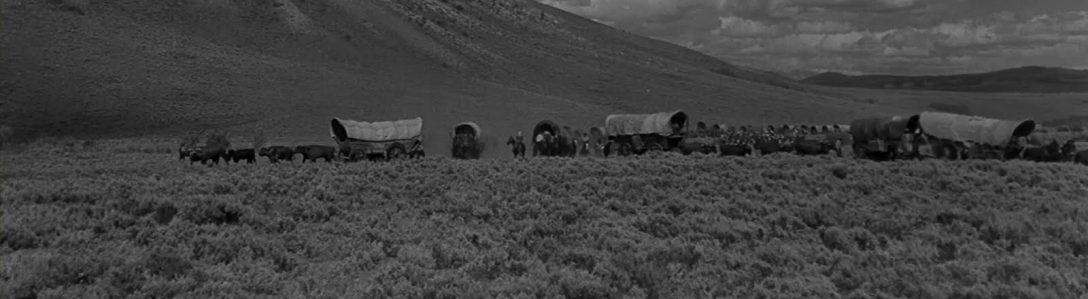
“1933, the height of the Great Depression. Hoboes roamed the land; riding the rails in a desperate search for jobs. Spurned by society, unwanted and homeless, they became a breed apart. Nomads who scorned the law and enforced their own. Dedicated to their destruction was the Railroad Man who stood between them and their only source of survival — The Trains.” – opening scroll of Emperor of the North
In Emperor of the North (1973) the Hobo and the Railroad Man are respective avatars of chaos and order, bloody abstractions who engage in a near-wordless duel to the death on a train rumbling through the Pacific Northwest. They have no back stories or personal motivation, they simply fight because it is in their nature, and the other one is there. Though the film is set in 1933 during the Depression, the story seems to take place outside history on a plane of pure hatred. Director Robert Aldrich expertly channels this hate in an elemental chase film in which stars Ernest Borgnine and Lee Marvin tear out chunks of each other’s flesh to perpetuate their mutually solitary ways of life. It was released last year on a pristine-looking Blu-ray from Twilight Time.
Originally titled The Emperor of the North Pole, the film had been developed by Sam Peckinpah and screenwriter Christopher Knopf for three years. Knopf was interested in the story of Leon Ray Livingston, a turn-of-the-century hobo who wrote a series of memoirs under the pseudonym “A-No. 1″, including From Coast to Coast with Jack London (1917), a remembrance of his tramping with the young author published after London’s death. This became one of the source texts for the script. Knopf’s screenplay is a streamlined machine that pits A-No.1 (Lee Marvin) against a militantly anti-hobo train engineer named Shack (Ernest Borgnine). Shack is known for never allowing a tramp to successfully complete a journey on one of his cars, thanks to a series of gruesome weapons including ball-peen hammers and lead pipes. A-No. 1 announces that he will ride Shack’s train, Number 19, all the way to Portland, OR. An uninvited guest appears in the person of the hobo-initiate Cigaret (Keith Carradine), which was Jack London’s moniker from his tramping days. Cigaret is a spindly hot-head who A-No. 1 reluctantly takes under his wing, until he realizes that wing is being burned off. Shack, A-No.1, and Cigaret are then involved in a pitched battle as they ride the iron horse into the northwest.
Producer Kenneth Hyman pulled the project away from Paramount and Peckinpah in 1971, and brought it to Aldrich and Twentieth Century Fox. Hyman had successfully worked with Aldrich on The Dirty Dozen a few years previously. Peckinpah wrote to Aldrich that, “I cannot say that I am happy about not doing it but I can say that I’m very happy that you are in charge. I have been a devoted fan of your pictures over the years and I feel that my adopted baby is in very good hands.” (quoted in What Ever Happened to Robert Aldrich?, by Alain Silver). Aldrich wouldn’t quite return the compliment. He said, “I think Peckinpah’s a fine director. I don’t think he’s as good as I am, but he’s a sensational director.”
Ernest Borgnine and Lee Marvin seem like permanent parts of the landscape, hatchet-faced phantoms doing battle between Railroad Man and Hobo for all eternity. Borgnine’s Shack is wound as tight as his trusty stopwatch, from his death-rictus grin to his face-stompin’ boots. He is a Fascist figure whose role is to keep the trains running on time. As described in his autobiography, Borgnine “developed a character based on the actor Jack Elam, who I’d worked with on Vera Cruz and Hannie Caulder. Jack was walleyed. Imitating him, I tried to keep one eye looking straight ahead and the other eye down on the ground.” This explains how pop-eyed he looks throughout the movie, as if his pupils were straining to escape his sockets. But the technique is appropriate for Shack’s high strung violence, his eyes looking to attack as much as the rest of his body.
A-No.1 is an equally tough S.O.B (he knocks a child out with a live chicken), though he has brief flashes of humanity, as when he deigns to teach Cigaret a few tricks of the hobo trade, like how slathering oil on the tracks can delay a train’s departure. These moments of openness swiftly close once any shred of his independence is being encroached upon, at which point he will disappear in the foliage, having hidey-holes constructed all around the country. He’s less a community hobo organizer than a paranoid separatist militiaman, perpetually concerned about any and all impingements on his freedom, regardless of how necessary. He dumps friends as easily as he downs a beer. Christopher Knopf spoke with Marvin before the shoot, and recalled, “I met Marvin in Bob [Aldrich’s] office on the Fox lot before filming began on location. There was that squint in his eyes and the so familiar baritone voice as he held court, dissecting his role. ‘The guy’s a philosopher, a disciple of Kant’s metaphysics and ethics, right?’ I nodded. ‘Bullshit.’ The man was already in character.”
Aldrich and his regular DP Joseph Biroc shot the film on location on the Oregon, Pacific and Eastern Railway (OP&E). The basic division of the frame is Borgnine in high angle, and A-No.1 coming in low, as Shack is constantly on lookout perches, while A-No.1 is crawling into tubes or hanging onto the undercarriage. There is a necessary balance here, and though they barely exchange ten words to each other, both men understand the essential role they are playing in this drama, and an unspoken respect goes along with this understanding. What A-No.1 cannot respect is Cigaret’s unbalancing presence. The jittery Cigaret gets bored with A-No.1′s lessons and starts improvising bum techniques, risking A-No.1′s life in the process. Cigaret is disrupting the natural process of Hobo vs. Railroad Man. For A-No.1, there is no bigger insult than, “Kid, you’ve got no class.” Class equals tradition, and Cigaret is not honoring the tradition of the hobo and engineer beating each other to death.
The trains would be running 25-30 miles an hour, and Aldrich had Borgnine and Marvin running up and down the roofs of the trains during their epic final fight, in which the two battered icons break each other’s bones with axe handles and two-by-fours. The autumnal greens and browns of the Oregon forest are a fecund backdrop to a life-draining fight, one which seems to give Shack and A-No.1 a euphoric high. These two extremists have never been happier than to be stuck in a duel on a moving train, their mouths bleeding and their knees buckling, their whole way of life on the line.
Since their inception the movies have been obsessed with fists hitting faces. In the testing phases of Edison’s Kinetograph in 1891, W.K.L. Dickson shot footage of sparring boxers, cementing the sweet science as one of cinema’s enduring subjects. Though the medium matured, its audience (myself included) did not, and the appetite to watch performers sacrifice their bodies for our amusement has never abated. For a century filmmakers have been trying to capture the perfect punch in action movies, whether it’s in globetrotting blockbusters with CGI blood spurts or no-budget brawlers with practical squibs. There were plenty of worthy efforts in 2015, and since it’s list-making season, below you’ll find my top ten action movies of the last year.
10. (tie) No Escape (directed by John Erick Dowdle) and Survivor (directed by James McTeigue)
Pierce Brosnan has entered his dissolute character actor phase, and it is glorious. The first glimpse of it was in John Boorman’s Tailor of Panama (2001), in which he took the piss out of his James Bond character by playing this secret agent as a lazy, decadent fool. As he transitions out of leading roles and into the background, his characters get more seedy. In the critically reviled No Escape, Brosnan has a small part as a sex tourist in Hawaiian shirt and puka shell necklace (or so it seems) who helps Owen Wilson and Lake Bell spirit their family to safety after there is a violent revolution in an unnamed Asian city. The movie is bluntly effective, as when the parents have to engage in some kid-tossing off of rooftops, or when Wilson has to learn to kill a man with an office lamp. Brosnan is the reason for seeing it though, with his oily, self-destructive swagger and perpetual five o’clock shadow, he is something like James Bond after his fifth stint in rehab. It’s a character going through the motions of heroism because it’s what is expected, but all he really wants to do is embrace the death he’s been courting his whole life.
Survivor is preposterous nonsense, but it’s MY kind of preposterous nonsense. Brosnan is a shadowy mad bomber called “The Watchmaker” who wears those tiny jeweler eyeglass things and occasionally has a mustache. If that wasn’t enough, he’s being chased by U.S. immigration official Milla Jovovich, who spends most of the movie panting in exhaustion. She is framed-up as being an inside woman for a terrorist group, and is in turn chased around London and NYC by Brits and Yanks alike. Cast also includes Dylan McDermott, Angela Bassett (!), Robert Forster (!!) and in his final performance (as a maniacal Romanian “pharmaceutical gases” scientist), Roger Rees.
9. Close Range, directed by Isaac Florentine
The latest collaboration of DTV dynamos Isaac Florentine and Scott Adkins is a simple showcase for Adkins’ ability to kick people very hard. Adkins is an ex-soldier and an ex-con whose niece is kidnapped by a Mexican drug lord. So Adkins does what he must, in a series of fights beautifully choreographed by Jeremy Marinas of 87Eleven Action Design. You can read my full review of the film here.
8. Redeemer, directed by Ernesto Díaz Espinoza
This Chilean revenge drama is straightforward pulp, superbly executed. It stars Marko Zaror as the eponymous avenger, a haunted man in a hoodie trying to expunge his past sins. He focuses his redeeming powers against an American Bro drug lord (a very funny Noah Segan), and a specter from his past known only as “The Scorpion”. Zaror is a physical freak (he is Adkins’ main opponent in Undisputed 3), and the fight sequences are very technical MMA-based grappling that proceeds at a slower speed than most fight films. This deliberate pace really allows you to see the development of the attacks and counter-attacks, making the film a reliable tension and release machine.
7. Wild Card, directed by Simon West
A laid back Jason Statham product that is a remake of Burt Reynolds’ Heat. This one debuted on VOD in January and swiftly disappeared without a trace. But it finds Statham playing around with his persona, trying on different poses that never quite stick: grouchy office worker, shooting-the-shit gladhander, and depressive, melancholy addict. When he snaps back into Statham the cannonball, the fight scenes are choreographed by the great Corey Yuen (The Transporter), and they do inventive, violent things with ashtrays and butter knives. I also wrote about this one at length over here.
6. Blackhat, directed by Michael Mann
An impressionistic smear of our hyper-connected age, with gunfights. Leonine Australian hunk Chris Hemsworth makes for an unconvincing hacker, but this is a movie in which the small details seem absurd but the grand gestures are entirely, overwhelmingly convincing. Hemsworth is an imprisoned hacker who is sprung loose to help the U.S. feds track down a cybercrime network around the world. As Hemsworth moves from city to city, country to country, the borders seem to blur along with Mann’s woozy images.
5. SPL2: A Time for Consequences, directed by Soi Cheang
This won’t be released in the U.S. until later this year (by Well Go USA), but it has been out everywhere in Asia and has screened in festivals throughout 2015. SPL2 is a sequel to SPL (2005, aka Kill Zone), although it bears no relation to the original. The main protagonists Donnie Yen and Sammo Hung are nowhere to be found, here replaced by Tony Jaa and Wu Jing. Wu Jing is an undercover police officer in deep cover inside a Thai prison, while Jaa is a guard at the prison. Both of them get entangled in the illicit organ trafficking operation of Louis Koo. This is an anxious film wracked with paranoia, and director Soi Cheang (of the Milkyway productions Accident and Motorway) sustains a tone of barely contained hysteria. People are profitable bloodbags for Louis Koo, and the movie continually emphasizes the brute limitations of the human body.
4. Mission: Impossible — Rogue Nation, directed by Christopher McQuarrie
This is the slickest entry on the list, a sinuous series of set-pieces that never bogs down in exposition. Tom Cruise gets stranger and more robotic each year, but the Mission: Impossible series keeps improving. I was particularly impressed with the assassination games during the opera, a complex minuet of overlapping POVs that provides one of the many tense standoffs between Cruise and Rebecca Ferguson, the MI5 agent whose motivations are at cross-purposes with the Impossible Missions Force. Ferguson slinks away with the movie, her lithe athleticism perfect for the film’s clockwork mechanisms.
3. Run All Night, directed by Jaume Collet-Serra
A chase film between two old men sapped of energy. Ed Harris and Liam Neeson play two buddies from NYC’s Westie gang who turn against each other because of the sins of their children. That is, Neeson’s son has murdered Harris’ son. Due to the personal codes of conduct buried in their genes, they must hunt the other down. Neither seems to relish it. Let’s call it a reluctant revenge film. So they trudge through the outer boroughs looking for a kill, and on the way pass through all their old haunts, which are also on their way out. It provides everything it’s title implies: speed, exhaustion and darkness. I went longer on this film over here.
2. The Taking of Tiger Mountain, directed by Tsui Hark
This Chinese epic has grandly orchestrated ski fights and tiger battles, while the framing story deftly deals with the slipperiness of historical truths. It’s about a Communist army unit who infiltrates a bandit gang and brings them down from within, an old-school adventure told with wit and feeling. But the framing story does much to question the propagandistic value of the film inside. It’s a complex, hugely entertaining film that was a massive hit in China and deserves a larger audience stateside. I would recommend reading Grady Hendrix’s highly informative article for further context.
1. Mad Max: Fury Road, directed by George Miller
To Godard’s quote that all you need to make a movie is a girl and a gun, I would add that you should also include a double-necked flame-throwing guitar.
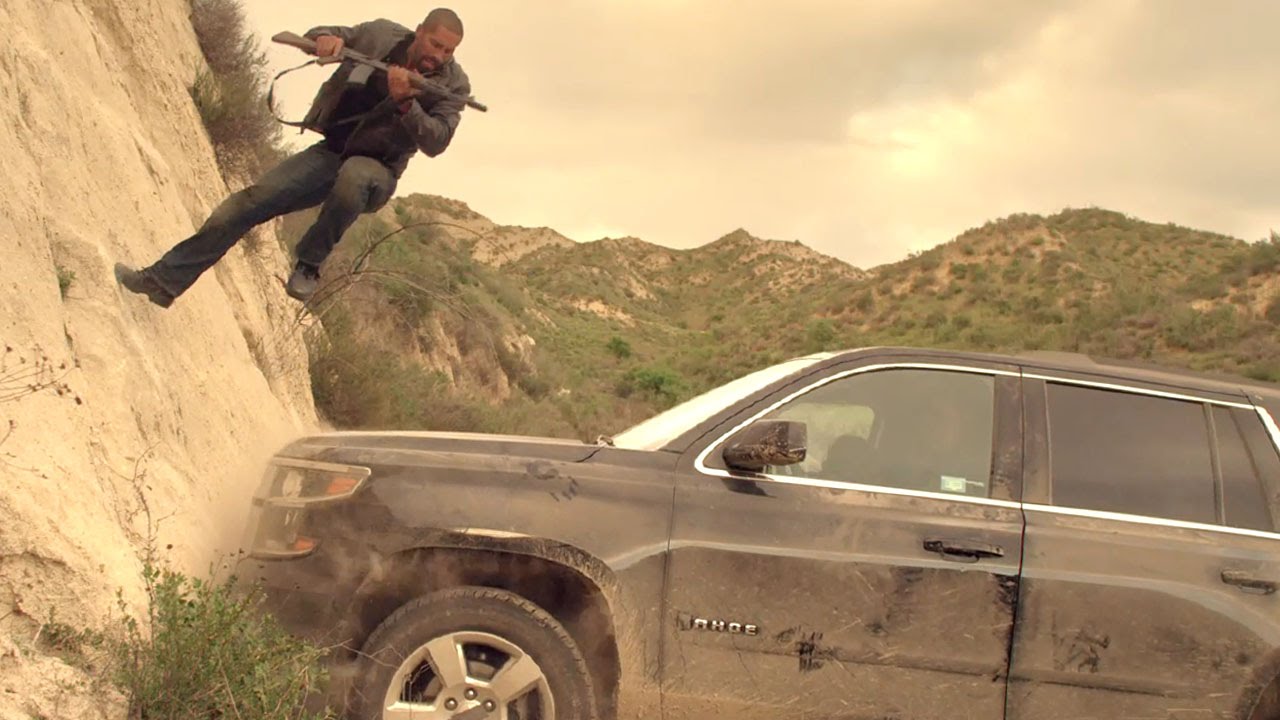
As with their blockbuster brethren, direct-to-video action movies thrive on previously existing brands. These cheaply made concoctions can’t afford to license comic books, so they market personas instead, whether it’s Van Damme, Lundgren, or even Cuba Gooding Jr. While their careers as major stars were brief, fight fans flock to the familiar, so these nostalgia acts are essential to secure production funds, even if they only appear in a scene or two. This doesn’t account for the burgeoning cult surrounding actor-director duo Scott Adkins and Isaac Florentine. Adkins is the rare performer who has made himself a bankable star inside of the DTV universe, despite having only landed bit parts in major films outside of it (The Expendables 2, the upcoming Doctor Strange). He is unknown among the general public, but Adkins and Florentine’s defiantly old-fashioned attitude regarding the shooting and blocking of fight scenes have made them cult heroes among the small but vocal DTV action film fanbase. Close Range is their eighth film together, and it is distilled down to the basics. A revenge drama set on the U.S.-Mexico border, it pits Adkins against a drug cartel, whom he dispatches in a series of increasingly bloody showdowns. The action takes place mainly along one rural dusty road where Adkins goes one-on-one with an SUV and one-on-dozens during an extended siege. Available on VOD and iTunes December 4th, with a limited theatrical run December 11th, Close Range is a satisfying back-to-basics brawler.
Ninja: Shadow of a Tear (2013) was the most recent Adkins-Florentine collaboration, a spectacular throwback to the martial arts films Cannon was producing in the ’80s. Close Range has more of a Walking Tall vibe, of corruption eating away at a small town until a principled psycho tries to clean it up. The script was written by DTV vet Chad Law (Van Damme starrer 6 Bullets) and Shane Dax Taylor, which sends sullen ex-soldier Colton MacReady (Adkins) on a mission to rescue his kidnapped niece Hailey (Madison Lawlor). She was nicked by a Mexican drug cartel led by Fernando (Tony Perez), who are using her as leverage to get money owed them from her stepfather Walt (Jake La Botz). During the rescue, Colton swipes a flash drive which contains all of the cartel’s records. So the gang follows him home, and the war will never end until one side is wiped out.
Adkins is still a work-in-progress as an emoter, but here he isn’t asked to do much other than glower and spin-kick, which is what the man was born to do. Trained in taekwondo and kickboxing, Adkins has the agility of a dancer, and once he gets those long-levered limbs going he is a joy to watch. Fight choreographer Jeremy Marinas is the one pulling his strings, one of the many great talents coming out of 87Eleven Action Design, the stunt rigging/rental/training organization led by Chad Stahelski and David Leitch, the directors of John Wick. Marinas has Adkins work a lot in close brawling combat here, playing off of Colton’s presumed training as a soldier. This is not a martial arts showcase, but exhibits fights that are going for the quick kill. This is evident in Marinas’ cameo as a hired goon whom Adkins dispatches with a flick of his belt knife, a necessary accoutrement for any aspiring vigilante.
Florentine is not a flashy director but a cogent one, wanting his films to be showcases for the stunt performers (he is a trained martial artist himself). He often films in long shot so no body part is chopped off by the frame. His most attention-getting sequence is placed at the beginning, a long take of Colton fighting his way through a hallway and into the cartel’s office. Adkins told the Action Elite site that they had half-a-day to shoot the sequence, managing to get six or seven takes. It is more elaborate than a similar shot in Ninja: Shadow of a Tear, in which Adkins hip-tosses his way through a dojo. In Close Range the action is more fluid, a less-mechanical hitting of spots. But I vastly prefer the more traditional fight sequences in Florentine’s films, in which mini-narratives emerge of strikes and counters. These single take fights are Adkins as battering ram.
Though he has found success in DTV, Adkins is openly critical of the limitations it places on Florentine and himself. In the same Action Elite interview, Adkins says:
It pushes you more but I don’t think it elevates your game. You get really tired and with that comes lack of focus and you can’t concentrate like you should be. The action stuff is not easy, it’s always hard because we are pushing to do great stuff but it’s something I know like the back of my hand, but then you have to go from spending ¾ of the day doing a really intense fighting sequence in the heat and then have to go and deliver as an actor at a time when you are feeling just shattered and just want to go to bed. I want to deliver the action as much as I deliver the drama and if it’s a low budget you haven’t got the time to always do that – I wish we had more time to deliver on both fronts but that’s also the charm of some of these films. We are almost nostalgic in the way we make these movies. They are like a throwback to the eighties and early nineties.
He also admits that they had trouble reaching the required minimum running time for the feature, necessitating an incredibly long sequence identifying each member of the drug cartel, despite most of them having no lines or identifiable characters. These films consist of an endless series of artistic compromises, but these are the allowances the DTV action film fan makes for any Adkins-Florentine production. There will be stilted supporting actors, threadbare sets, and hand-me-down plots, but once the fists start flying, their artistry becomes as undeniable as a kick to the kidney.



 R. Emmet Sweeney