EDWARDIAN COMEDY: S.O.B., VICTOR/VICTORIA, SKIN DEEP

May 29, 2012

Screen Shot 2020-02-03 at 5.06.13 PM

John Ritter’s spastic freak-out in a parking garage in Skin Deep is an archetypal Blake Edwards image. What characters repress or ignore will always be expressed through their bodies, with or without their consent.  The Warner Archive recently re-issued three Edwards comedies on DVD: S.O.B. (1981), Victor/Victoria (1982) and Skin Deep (1989). While new transfers of these visually elegant works would have been welcome, they gave me an excuse to watch them for the first time, so I’ll keep my complaining to a minimum. All three films involve varying levels of performance, and bodies that either accept or reject the facades imposed upon them. The most furious rejection occurs in S.O.B., a flesh-eating virus coated letter to Hollywood.

The origin of S.O.B. lies in the failure of Edwards’ 1970 Darling Lili, a WWI spy movie musical that went over budget and then under performed. A common occurrence, but one that Edwards was virulently attacked for due to some extenuating circumstances. In his critical study A Splurch in the Kisser, Sam Wasson writes that the Commonwealth United Corporation lent Paramount parent Gulf + Western “a certain humongous sum” to complete production that G +W were unable to pay back, so the studio was especially incensed. Wasson writes that head of production at Paramount Bob Evans said that Edwards was responsible “for the most flagrant misappropriation of funds I’ve seen in my career.” Licking his wounds, but still ambitious, Edwards followed it up with the epic Western Wild Rovers (1971), another big budget disappointment that was cut down by nearly 40 minutes by new MGM head James Aubrey, whom John Houseman had nicknamed “The Smiling Cobra”. After battling with Aubrey again over the medical thriller The Carey Treatment (1972), from which he tried to get his name removed, Edwards was a frustrated man. He moved to Switzerland, only to return to filmmaking two years later for The Tamarind Seed (1974), three Pink Panther sequels, and the enormous hit Ten (1979).

With Inspector Clouseau and Bo Derek’s slow-motion trot restoring him to studios’ good graces, he was finally able to get his savage satire, Hollywood S.O.B. funded. Something of a “secret legend” in town, according to Wasson, it was picked up and then ditched by Orion, before upstart Lorimar, transitioning from TV to film, agreed to back the title-shortened S.O.B., Victor/Victoria, and a sci-fi comedy Far Out that was never made. In an appropriate irony, Lorimar had recently made a deal with Paramount to distribute their films, the studio that S.O.B.is targeted at.

The film is set in motion by the attempted suicide of director Felix Farmer (Richard Mulligan), whose family friendly musical Night Wind tanks horribly. Left in a catatonic funk, his image conscious wife Sally (Julie Andrews, playing off her Mary Poppins persona) abandons him as he wanders his beachfront home clutching the trades, blaring headlines like, “NY CRITICS BREAK WIND”. Rings of PR maneuverings circle around him, from his assistants, to Sally’s team (led by a brassy Shelly Winters) outward to the studio’s, who sends out cynical fixer Tim Cully (William Holden) to corral Farmer and get him to re-edit the film. It’s three circles of self-obsessed hells, with Felix the ignored center. All three are oblivious to Farmer’s depression, and he wanders off to the garage to give himself a carbon monoxide cocktail. But his body betrays him, and he survives. Edwards frames him in backgrounds and corners early on, a wraith irrelevant to his life as an image. The entire film industry is out to defend or destroy his image, while the flesh and blood Farmer is out to polish himself off.

This is mirrored in another unobserved death, as an anonymous runner collapses on the beach outside his home – his body laying in plain sight of sun-bathers for days before he is identified as a corpse. The most sympathetic character in the movie is the dog who yelps for his fallen master (who turns out to be a character actor). Image trumps reality, and Farmer cracks under its pressure. Edwards arranges an ace menagerie of gargoyles to feast off of him, including Robert Vaughan as the cross-dressing vampire of a studio head, Robert Preston as an acidic drugged-up doctor, and Holden as the infernal ring leader, a grizzled vet so jaded he’s cynical about his cynicism.

When Farmer cracks through this PR babble, he changes roles from tortured artist to crackpot prophet, one he acts out with brio, preaching to the lowest common denominator: “We sold them schmaltz – they want sadomasochism!” He proposes re-shooting Night Wind and turning it into soft-core pornography, which Sally agrees to only after weighing the PR hit of a long lawsuit. No matter how much Farmer panders to the audience’s basest impulses, in the end the system returns him to the background, incinerated in a Viking funeral as that sympathetic dog yelps once more.

Victor/Victoria represents the inverse of S.O.B., Edwards’ ideal of performance, one in which identities can be perfected on stage, and the image and the man (or woman in drag), can become one. It is a remake of the Weimar musical comedy Viktor und Viktoria, directed by Reinhold Schünzel, about a down on her luck opera singer who becomes a star as a male drag queen, pretending to be a man pretending to be a woman. In Edwards’ version, it is one Victoria Grant (Julie Andrews) on poverty row, plucked from obscurity from recently fired nightclub singer Toddy (Robert Preston). Chicago gangster King Marchand (James Garner) is hot to book her at his club and into his bed – convinced she’s a woman.

The movie buzzes on a colliding series of contradictions, of which the gender bending is the most obvious. Victoria is an opera singer who makes money at burlesque; King is homophobic and in love with Victor; Toddy is gay but has to pretend to sleep with Victoria. Constructing the Paris of 1934 entirely on a backlot, Edwards has a controlled environment to run these experiments in the expansive 2.40:1 frame, chaotic in café and bar fights, a mess of arms and legs, and only unified on stage, in which Victor/Victoria and Toddy each get their moments of self-actualization. Victoria, after her scandalous debut in which she ripped off a wig to become a “man”, returns to womanhood and cedes the stage to Toddy, who becomes an unselfconscious queen in the raucously funny finale, more woman than Victoria could ever hope to be.

Skin Deep finds Edwards in more heterosexual terrain, as womanizing Pulitzer Prize-winning writer Zach (John Ritter) loses his wife, his career and his sanity. He is introduced as a torso leaning back on a barber’s chair, his head off-screen behind the entryway, as a blonde hairdresser undresses and mounts him in a very unprofessional manner. This is all seen in long shot, from the perspective of the first of many spurned lovers, who will soon have him in bed with a gun to his head. In these brisk opening minutes Edwards establishes images that show Zach as literally brainless, a human pleasure receptor and not much else.

Edwards will use off-screen space, as well as elliptical editing, to indicate Zach’s short attention span and disconnection from the world. In a rapid montage Zach will hear his wife’s divorce demands, and a few shots later, they will be enforced by the judge, his defense invisible, and his force of will indicated by Ritter’s slackjawed stare. Zach becomes more and more self-obsessed and debilitatingly horny, unable to write or maintain any emotional connections (except with an exceedingly understanding bartender, Barney (Vincent Gardenia)). The jokes play off of Zach’s spiraling disconnection, from waking up bleary eyed in a women’s aerobics class to wandering into a black tie party in an Aladdin costume. He even can’t get shocked into self-awareness: the top image shows him recovering from a session with her electric massaging machine. The most notorious joke is one in which Zach entirely disappears except for his erection – a glow in the dark condom provides for a new definition of sword fight. These tame gross-out moments seem to anticipate the Farrelly Brothers  – there’s even an unconscious dog gag that re-appears in There’s Something About Mary.

The ending of the film is disappointingly traditional, coming in the form of a deux ex machina tidal wave that sets Zach on the straight and monogamous path. The natural end for the repeated imagery of a mind-body split would be a beheading of one form or another, but I think it’s safe to say that wouldn’t get past the producers. In any case it is still a tightly shot and structured comedy whose laughs spin organically from Edwards’ mise-en-scene, of a man divided against himself. Maybe if he just watched Victor and Victoria he wouldn’t have had to go through all that trouble.
HOME VIDEO ROUNDUP: BELL, BOOK AND CANDLE and WESTWARD THE WOMEN

April 17, 2012

Screen Shot 2020-02-03 at 4.23.54 PM

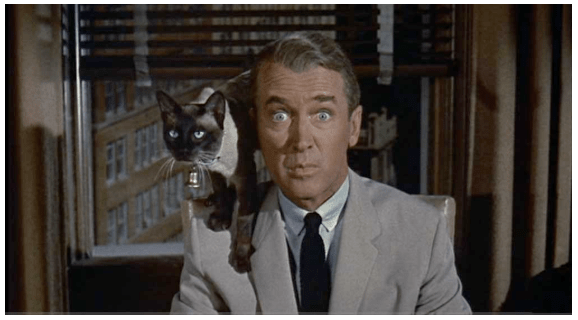
I had a similar reaction to Mr. Stewart when I watched Kim Novak purr her way through Bell Book and Candle, just released by Twilight Time on a gorgeous blu-ray.  He also might have been agog at Westward the Women (1951), the William Wellman femme-Western released in a well-appointed DVD from the Warner Archive, which includes an audio commentary from film historian Scott Eyman. They are two films that focus on female desire, a rare occurrence in the generally leering male gazes of post-code Hollywood (pre-code films were replete with sexually independent women – check out Baby Face (1933) for a bracing example). Bell Book and Candle is set in motion because of Novak’s uncontrollable lust for Stewart, and Westward the Women kicks off because of hundreds of ladies’ self-sacrificing desire for a better life out in California, a gender bending variation on Horace Greeley’s advice to, “Go west, young man”.

Originally, Bell Book and Candle was a stage play written by John Van Druten and produced by Irene Mayer Selznick in 1950. Although her divorce to David O. Selznick had been finalized in ’49, she sold the rights to him in 1953. He intended to cast his next wife, Jennifer Jones, in the lead, but the project never got off the ground, and the rights were eventually purchased by Columbia. After initially considering Rex Harrison for the lead, the studio and producer Julian Blaustein decided to re-team Kim Novak and Jimmy Stewart, who had both wrapped shooting on Paramount’s Vertigo in January of 1958. Since Columbia had lent Novak for that project, Paramount returned the favor in allowing Stewart to film the supernatural romantic comedy, which started shooting on February 3rd. The exuberantly talented Richard Quine (My Sister EileenIt Happened To Jane) was slated to direct, and the legendary James Wong Howe handled the indecently saturated Technicolor cinematography.

Reversing the polarity of obsession from Vertigo, in Bell Book and Candle it is Novak who is the stalker, Stewart the stalked. Novak plays Gillian Holroyd, a stir-crazy witch in the West Village of NYC who deals in African and Oceanic art as a lucrative front. Stewart is the endearingly uptight Shepherd Henderson, the editor-in-chief at an upscale publisher who lives above her storefront. Bored with her hep wiccan lifestyle spent at the Zodiac nightclub (where warlock Jack Lemmon plays the bongos), she yearns for something different. So indeed she indulges in some hoodoo and wraps Shep in her spell. When he finds out his attraction is not entirely natural, Gillian has some explaining to do.

Novak gives a smoldering performance, shooting looks at Stewart of devouring lust as she slowly pours herself onto the couch to accentuate each curve in her body. She even modulates her voice into a low purr, emulating the vocal rhythms of her beloved pet cat. Costume designer Jean Louis puts her in inflammatory red, from a bohemian-chic smock to a scoop-necked sweater, a siren intent on snagging her prey. The colors in James Wong Howe’s cinematography veritably pop off the screen, from those gleaming reds to the sharp pinks of Gillian’s mother Queenie (Elsa Lanchester) and the rich creams and grays of Shep’s sharply lined attire. Richard Quine, always a sharp caricaturist, lets Lanchester and Lemmon loose as the impish do-badders, providing islands of comedy amidst the torrents of Gillian’s pheromones, which course through this intoxicating Technicolor dream.

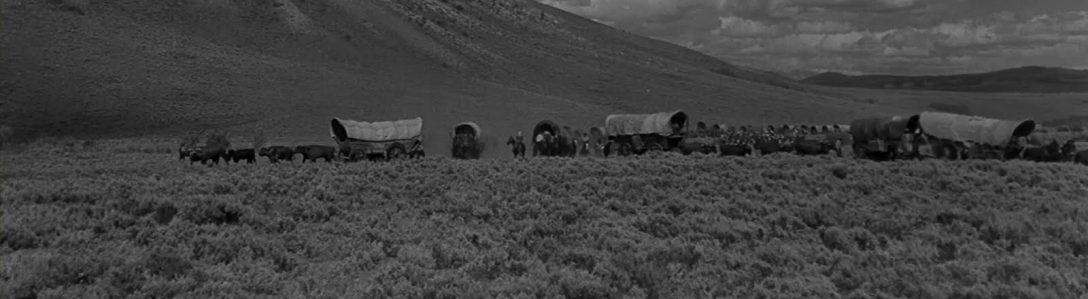
Where Bell is fantastical, Westward the Women (1951) is elemental. Based on a story by Frank Capra, it tracks the travails of hundreds of women traveling from Chicago to California, lured by the promise of hard-working husbands and the open air. According to Capra’s biography, he intended to direct the film with Gary Cooper to star, but eventually had to table it, and ended up selling the rights to his neighbor, William Wellman, who had recently finished his Clark Gable western, Across the Wide Missouri (also 1951).

Ostensibly the lead is Robert Taylor as trail master Buck Wyatt, but the film spends most of its time dutifully tracking the intense labor of the women on the drive, as early on most of the cowboys cut loose, unwilling to drive further into unforgiving territory. But the women endure, as Wellman depicts them in extended montages of work, seemingly inspired by the major drive in Raoul Walsh’s The Big Trail (1931), and perhaps an influence on Kelly Reichardt’s Meek’s Cutoff (2011), other Westerns obsessed with process. These processes are inevitably group efforts, lending these sequences a bit of communal proto-feminism, together doing the jobs of men with little fuss and unspoken teamwork. The gritty heart of the film is Patience (Hope Emerson), the Ward Bond of the movie, whose brute physicality inspires the rest of the ladies to self-abnegation and ultimate triumph, but who secrets a sensitive soul behind all the bluster. She is joined by a cross-section of personalities, from the sharpshooting farm girl Maggie, the still-mourning Italian widow Mrs. Maroni, and the two ex-prostitutes Fifi and Laurie, eager for some vision of country life.

Many women suffer and die, but the rest endure, the vast middle section is a grim kind of survival horror movie, as carriages crash and hostile Native Americans chase them down. Pared to the bone of back-story, the film operates by the familiar Wellman method (although only intermittently witnessed in his post-30s work), of showing character through action. All of the women in the film gain a personality through the attention Wellman pays to their faces, instead of lugubrious scenes of exposition.These roll calls of expressions (similar to the montage of faces before the cattle drive in Red River), intimate more in images of their lined brows than any speech could convey.

Never an emotional director, Westward the Women is nonetheless an unexpectedly moving film. When the women finally meet their prospective husbands in California, it’s a scene that could easily become droopingly sentimental, but instead is reticent and ambiguous, a skittish embrace of an uncertain future, one in which the freedoms of their drive West will likely disappear in their return to male dominated society. It is this melancholy undertone that makes Westward the Women a fascinating object, as the seams and contradictions in Hollywood’s depictions of womanhood poke through thanks to Wellman’s distanced, unvarnished approach. In a similar way, Novak’s voracious sexual appetite, that the movie never indexes as negative, undercuts the usual Madonna-Whore complex of romantic comedy that persists today (see, if you must, the dire What’s Your Number for a current example). Both these films are remarkable in that they show women who can fuck and fight with with the best of them, with no apologies.

MEN NOT AT WORK: THE THREE STOOGES AND THE DAY HE ARRIVES

April 24, 2012

Screen Shot 2020-02-03 at 4.14.31 PM

The mind needs structure. So when watching films in quick succession, unexpected linkages emerge, like the strange thematic similarities between Hong Sang-soo’s The Day He Arrives (in theaters now from Cinema Guild) and The Farrelly Brothers’ version of The Three Stooges, discovered while watching them back-to-back over the weekend. The first is a critically-acclaimed art film in limited release, the second the lowest of lowbrow comedies out everywhere, and yet they are both  episodic narratives about arrested male development, albeit in different stylistic registers. The Day He Arrives uses a teasingly complex script to lay out the alternate life paths its passive protagonist could have taken, hypnotically acted out with repetitive gestures and phrases. The Three Stooges, however, are active participants in their own destruction, eager to endlessly pratfall down the same road to get the eternally recurring nyuk-nyuk inducing result. Two versions of male stupidity, touchingly rendered.

The Day He Arrives is the latest generator of masculine regret from Hong Sang-soo, who has been mastering his elegiac deadpan mode since ’96, with increasingly fractured narratives. This one circles around ex-film director Seongjun (Yu Junsang), who leaves his exile in the country to visit his college friend Youngho (Kim Sang-joong) in Seoul. He says, “I’m not going to meet anyone but him”, which of course means that everyone on the street is a former lover or fan, forcing him to relive all the fumbling mistakes of his past. As Seongjun walks in circles, in a predetermined grid set up by the opening shot of an intersection, his past life starts repeating in the present. A rekindled relationship with an old flame from school is then re-enacted almost word for word with the owner of a bar named “Novel”. Seongjun learns nothing new, though,  keeping his distanced, faux-romantic pose as he once again cuts off personal contacts and retreats into his shell. Though he idly hopes that his films will be “re-evaluated after enough time has passed”, he never deigns to re-evaluate himself. It’s a bumbling, tragi-comic vision of Nietzsche’s eternal return:

“What, if some day or night a demon were to steal after you into your loneliest loneliness and say to you: ‘This life as you now live it and have lived it, you will have to live once more and innumerable times more’ … Would you not throw yourself down and gnash your teeth and curse the demon who spoke thus? Or have you once experienced a tremendous moment when you would have answered him: ‘You are a god and never have I heard anything more divine.’ -Nietzsche, The Gay Science

Seongjun is too oblivious to be aware of his endless circling , his flickering consciousness too self-absorbed  and far too passive to gnash teeth. Maybe he would make do with a clench, if it didn’t strain him too much.

The Three Stooges are also stuck in an eternal return, not just of the endless recycling of television characters, but of their insatiable need to beat the snot out of each other, a trio of sadomasochistic co-dependents. Seongjun burrows inside himself to escape the world, while the Stooges slap each other to do the same. The Farrelly Brothers have examined all kinds of physical and psychological maladies (Seongjun is heading in the direction of Jim Carrey’s severely repressed schizo in Me, Myself and Irene), but the Stooges are the most sociopathic characters in their careers. A stupider and more violent Dumb and Dumber, which means, yes, it is a stirring return to form.

The Farrellys  give the reborn Stooges an origin story, as babies dumped at an orphanage at the feet of the curmudgeonly Sister Mary-Mengele (a hilariously harrumphing Larry David). As amateur hell-raisers they are never chosen for adoption, and are spurred to action when the nuns are forced to sell the place unless they raise six figures in cash.

The trio of low-watt celebrities do a remarkably good job at capturing the staccato tempo of the original Stooges. Sean Hayes has a fine falsetto whine as Larry, Chris Diamantopoulos has the nasal a-hole Moe voice down pat, and Will Sasso does a nimble Curly, always the most balletic Stooge. Avoiding the baggage of the originally rumored stars (Carrey, Sean Penn and Benicio del Toro were all attached at one point), these anonymous performers are able to put the jokes center stage.

Sent off into the world, the Stooges are as helpless as Seongjun, although instead of re-living past failures they establish new ones, including starting up a free-range salmon farm that flops. They attempt to insulate themselves from the world through their friendship (as the conjoined-twin protags of Stuck on You do), but start to crack apart instead. They re-team because they have to, due to the demands of Hollywood narrative as well as their own natures – they eye-poke, therefore they are.

If posed with Nietzsche’s question, they would probably answer “never have I heard anything more divine”, fools in love with their own foolishness, and when peeking outside the edges of their slap-happy triumvirate, would eagerly agree to stay inside of it for eternity, free to create chaos and baby pee fights wherever they may roam. Seongjun, an alcoholic Bartleby, would rather not participate in life. His Cartesian saying would be: “I think, therefore I want to disappear.”

WARNER ARCHIVE ROUNDUP: LATE FILMS

October 18, 2011

last run

Every week the Warner Archive dusts off a bundle of forgotten studio productions onto DVD and hopes they find an audience. Recently they released a quartet of late films from veteran studio auteurs, and they all deserve to be seen. They are Robert Aldrich’s The Legend of Lylah Clare (1968), Richard Fleischer’s The Last Run (1971), George Cukor’s Travels With My Aunt (1972) and Blake Edwards’ The Carey Treatment(1972), all presented in handsome remastered editions. These are directors who had been weaned in the classical studio era, and who were now facing the reality of producer-brokered “package deals” and the escalating power of the lead actors. Many of these were fraught productions, and none will rank with the best of the respective director’s work, but they all, somehow, end up as solidly crafted entries on their brilliant resumes.

The Last Run was originally a project set up for John Boorman at MGM, who was to produce and direct. As the AFI Catalog reports, star George C. Scott requested that John Huston replace Boorman, as he had worked with Huston on The List of Adrian Messenger (’63). After three weeks of shooting, however, Huston quit the picture, “after arguments with Scott over rewrites”. Richard Fleischer became the third and final director on the project, and lead actress Tina Aumont was replaced by Trish Van Devere.  It is unknown if any of the footage Huston shot remains in the film.

It is clear that Scott exerted a lot of control, even marrying two of his female co-stars (he left wife Colleen Dewhurst for Van Devere after shooting), and yet Fleischer still imbues the film with the cool, clean lines that had highlighted his work since The Clay Pigeon and Follow Me Quietly (also in the Warner Archive) in 1949. He traced these lines along the well-worn track of the story, the starkly familiar tale of aging getaway driver Harry Garmes (Scott) accepting one more job, “to see if my nerves and brain are still connected.” He picks up escaped prisoner Paul Rickard (Tony Musante) and his girl Claudie (Van Devere), but it appears Paul was sprung in order to be assassinated. Harry has to decide whether to aid their escape, and risk his life, or return to his solitary life on the Portuguese coast. It’s an easy choice unless you are in an existential road movie, in which the death-drive trumps lazy afternoons in the gorgeous coastal city of Albufeira.

Scott was 43 at the time of filming, but he looks at least 60, with thinning gray hair, a prominent paunch and wrinkles carving up his sagging face. As Harry Garmes, you can see every indignity in his life manifest on his body. His son died at the age of 3, and then his wife up and left him alone with his car obsession. He is subsumed in feelings of loss, using work as an escape. The loveliest moment in the film occurs when Garmes is forced to sleep over in a room Claudie has just departed. Her bra, panties and pantyhose are sitting wet in the sink. With lugubrious patience he takes them out, unrolls them, and hangs them on the laundry line by the dresser. In his ashen face you can see the memories flickering by, of when this banal act was routine, of intimacy once taken for granted and now enshrined in an alien past.

Fleischer does an unobtrusive job in choreographing the love triangle, re-configuring the three jousting players around the frame as their power-relations shift and shudder. These cramped, sticky compositions are a stark contrast to the opening shots of Garmes on the road in his BMW, in which the edges of objects all point outside the frame, towards escape. Now the eye just circles inside low-lit hotel dives, the eye cycling around these three increasingly dour criminals, the only way out a bullet in the chest, to turn the triangle into a line.

***

George Cukor was still a prestige name in Hollywood in 1972 (the trailer included on the DVD trumpets his name), although he didn’t have a hit since My Fair Lady (1962). So when the intended star of Travels With My Aunt, Katherine Hepburn, was “frustrated by budget cuts and demanded several script alterations”, per the AFI, the studio declined her requests, and she quit. Maggie Smith stepped in, and was nominated for the Best Actress Oscar for her efforts.

The film is a buoyant adaptation of the comic Graham Greene novel, about milquetoast Briton bank manager Henry (Alec McCowen) who is whisked away on an international adventure by his dotty Aunt Augusta (Smith). Augusta is trying to acquire $100,00o by any means necessary to ransom one of her ex-lovers, Visconti (Robert Stephens, Smith’s husband until ’74), away from his kidnappers. In order to get this money, she re-acquaints herself with her multitude of formerly amorous companions (including North African fortune-teller Wordsworth (Lou Gossett)), as well as engaging in some minor money laundering and art theft.

This international romp (mostly shot in Spain) gets a lot of mileage out of Maggie Smith’s fluttering bohemian routine, but Cukor also manages to invest her character with a tragic sense of time’s passing. Augusta, who sucks life to the marrow, is a creature of the present tense (“I’ve always preferred an occasional orgy to a nightly routine”), but she is granted a powerfully moving reminiscence at “Le Train Bleu”, the Belle Epoque restaurant at the Gare de Lyon train station in Paris. She is speaking to Henry about her youth, and then the camera pans right, and suddenly the years have worn away, and it is a young Visconti who is walking towards a window. Outside a teenaged Augusta, in a schoolgirl’s outfit, exchanges giddy glances with him. She ditches her class and races inside, into a swirl of noise and movement, until Visconti lifts her away into light-footed waltz. It was a time of endless possibility, which has now shrunken for Augusta into re-living her past flings and scrounging for cash. This is the melancholy that underlies all of the film’s high-flying farce.

***

Director Blake Edwards  wanted his name taken off of The Carey Treatment (1972), an efficient medical thriller adapted from an early Michael Crichton novel (A Case of Need, by his pseudonym Jeffrey Hudson). Edwards was unhappy with the cuts MGM had made to the film, just as with Wild Rovers the year previously, but his name remained on the prints. I don’t know what was excised, but what remains is a solidly built contraption anchored by a smugly sexualized performance by James Coburn.

Coburn plays Dr. Peter Carey, a womanizing rogue taking up a new job as a pathologist in a Boston hospital. His adeptness at manipulating women becomes the recurring theme of the film, beginning when his erotic gaze is leveled Georgia Hightower (Jennifer O’ Neill), the clinic’s dietician. Carey’s seductive charm is later utilized in his independent investigation into the death of the hospital president’s daughter, after a botched illegal abortion. Carey’s friend David Tao (James Hong) is wrongfully tagged with the murder. Carey flirts his way through town, becoming more sexually aggressive until it turns to intimidating violence, as when he asks the victim’s old roommate if she is a virgin, and then nearly drives them into the ocean to scare her into talking. He discovers the killer through a bit of homo-erotic flirtation, receiving an aggressive deep-tissue massage from an intrigued meathead until he gets the information he was after.

It is difficult to locate Edwards’ personality, aside from the sardonic shot of a mouse stuck in a jar in the extreme right foreground, the faces that look into it distorted into gargoyles. It’s otherwise a workmanlike production, nothing more than a wonderfully acted episode of House, what with a harrumphing Pat Hingle and nervous Regis Toomey on board to support Coburn’s wildcat act.

***

Still riding the late career renaissance brought on by the camp theatrics of Whatever Happened to Baby Jane (1962), Robert Aldrich directed The Legend of Lylah Clare with even less consideration of good taste. A wild kitsch re-imagining of Vertigo, it invents tragic Hollywood star Lylah Clare (Kim Novak), who died before she was to marry her long-time director Lewis Zarkan (Peter Finch). 20 years later, Zarkan discovers an actress who looks strikingly like Lylah, the bespectacled Elsa Brinkmann (also Kim Novak). He decides to make a biopic of Lylah Clare’s life, with the unknown Elsa to star. Elsa, however, is prone to channeling Lylah’s husky tenor and mannerisms with disturbing accuracy, and Zarkan becomes entranced, his obsession leading him to make the same mistakes that led to Lylah’s death all those years ago…

Hallucinatory and ridiculous, Lylah Clare is an often uproarious send-up of Hollywood self-seriousness, with its menagerie of skulking gargoyle performances. Peter Finch is the head freak, a narcissistic blowhard who believes his genius trumps reality- he looks pretentious even after he shaves off his pointy devil goatee. He gets the best lines: “Stop poncing about like an oversexed dwarf!” and “You are moving like a deeply offended Tibetan yak!”Then there’s his brittle and viciously jealous assistant Rossella (Rossella Falk), the worm-like producer Bart (Milton Selzer),  Ernest Borgnine as the infectiously boorish studio chief Barney Sheehan, “I make movies, not films!”, and Coral Browne as battle-ax gossip columnist Molly Luther, plus a cameo by Dick Miller as a journalist!

Aldrich often freezes them inside Zarkan’s mausoleum of a house, standing rook still like slowly oxidizing statues. Unable to see life beyond the glories of years past, they try to recreate it with Elsa, who is too open to suggestion to withstand their entreaties. As her life dissolves into Lylah’s, the film gets more strident and less bitchy, ditching the satire for a dime store version of Vertigo’s doubled identities. The presence of Novak only highlights this film’s shortcomings at metaphysical speculations. While it’s not terribly deep, I still had great fun skimming along its sarcastic surfaces.

HIGH & LOW: HARUN FAROCKI AND JOHN LANDIS

September 13, 2011

Screen Shot 2020-01-31 at 5.48.13 PM

Two sixty-something masters of their domain have new work showing in the U.S. John Landis, a dean of the low farting arts, has his morbid comedy Burke and Hare playing cable-on-demand services and a limited theatrical run. Harun Farocki, of the high brow-furrowing arts, has a new exhibition at the Museum of Modern Art entitled Images of War: At a Distance. Landis has been tagged with artistic decline, something Hollywood directors have to deal with as soon as they sprout their first grey hair (Burke is his first narrative feature since 1998, was financed and made in the U.K., and released there in Oct. 2010). This kind of ageism doesn’t appear in the gallery world, where Farocki is now being embraced after decades as an experimental video artist. The MoMA exhibition is running his most recent work on a loop, Serious Games I-IV (2009-2010), but also providing nearby monitors that are showing nearly all of his previous videos (which they acquired for their library). As artists, they are similar mainly in their dissimilarity, but both have a deep and playful sense of film history.

Burke and Hare tells the frequently adapted tale of the two eponymous Williams, who murdered 17 people in Edinburgh during 1827-1828, and sold the corpses to an anatomy lecturer.  It is a production of Ealing Studios, that venerable institution of British comedy (famous for Alec Guinness’ multiple personality marvels like Kind Hearts and Coronets (1949)). Landis takes full advantage of the studio’s connections by hiring some of the great British stage and screen actors to fill out his cast. The leads are semi-familiar faces Simon Pegg (Burke), Andy Serkis (in the flesh this time as Hare) and Isla Fisher (Ginny Hawkins), but small roles are enlivened by Ronnie Corbett (from BBC’s long-running sketch show “The Two Ronnies“), stand-up comic Bill Bailey, Stephen Merchant, Tim Curry and Christopher Lee.

These casting decisions are not marketing filler, for each of these faces fills a particularly exaggerated space in Landis’ palette of caricatures. Serkis purses his lips to bring out the frogginess of his features, with the battered top hat adding to the impression of a dissolute Mr. Toad from Wind in the Willows. His Hare is the insatiable id of the duo, pushing them onward to more profitable indignities while remaining dutifully horny towards his equally greedy wife (Jessica Hynes). Burke is the apparently sympathetic one, Pegg’s kindly weasel features reluctantly acceding to Hare’s plans, as it’ll give him the cash he needs to wrangle Ginny, who wants to put on an all-female version of Macbeth. Isla Fisher is the most conventionally attractive, but her disconcertingly manic energy, and bizarre artistic ambition, place her with the freaks.

The supporting actors all provide comic accents to this unfortunate quartet. Corbett plays Captain McLintoch, of the Edinburgh militia, who is in charge of wrangling the local body snatchers. At 5′ 1″ and 80 years old, he waddles in front of his young recruits like an asthmatic Napoleon. His face squeezes into helmet and uniform reluctantly, jolly rolls of wrinkles unwillingly curling down his neck. Corbett is delightfully game, berating his charges with drill sergeant anger, and eager to flash his superiors a disarmingly adorable grin. He plays it straight and walks away with the movie. Then there is Tim Curry’s tortoise-headed scientist, Stephen Merchant’s stork-like dope, and the blustering Christopher Lee, who is no animal but simply himself, which is enough.

Landis lovingly arranges his menagerie into cleanly executed frames of clean executions (Bill Baily plays the sarcastic hangman and narrator). The jokes move swiftly, and the actors maintain a jittery pace that injects life into the material even when it sags. It’s the best comedy I’ve seen this year.

Harun Farocki’s videos aren’t funny, per se, but they are certainly playful. The centerpiece of the MoMA exhibition is Serious Games I-IV (2009-2010), which focuses on the military’s use of video games, but I immediately latched onto a few other video works. The first is On the Construction of Griffith’s Films (2006). This simple but brilliant short (2min. 30 sec.) splits D.W. Griffith’s use of shot-countershots into two screens, so you can see the eyeline matches line up next to each other. It begins with an example of a one-shot scene from The Lonedale Operator (1911), where “a door connects two shots, or separates them.” Then five years later Farocki broke down the varying camera angles and setups that Griffith innovated in Intolerance (1916), where there was “an exchange of glances, instead of words.” With close-ups and shot-countershots, actors could convey emotion without the use of inter-titles. Doorways still connect shots now, but the space has become elastic. Farocki shows a scene between Mae Marsh and Robert Harron, and a repeated sequence of shot-countershot. Farocki writes how cinema creates “structures of its own making, parallel worlds.” As you watch Marsh and Harron glance at each other in their little boxes, it’s possible to see Farocki’s fascination with two-channel video pieces, giving him the ability to have his parallel worlds communicate simultaneously, instead of the cuts made necessary in single-screen narrative cinema.

He brought this two-screen conversation to the fore in Counter-Music (2004), his version of a city symphony, set in Lille, France. This densely allusive piece uses Dziga Vertov’s Man With a Movie Camera and Walter Ruttman’s Berlin, Symphony of a City as comparison points against a modern metropolis. Instead of footage shot on the street, he re-purposes footage from a sleep study lab, security cameras, heat maps and CG modelings of car and train traffic. These are images made without a cameraman, capturing the daily life of the city without the intervention of an artist. It is, Farocki contends, something Ruttman and Vertov dreamed about.

One of the early connections Farocki makes is inspired by test footage pushing forward inside a sewer pipe, checking for the integrity of welds. In a deadpan voice-over, he he has “recollections of a film with Raquel Welch”, of the ship flying through a human body in Fantastic Voyage. To him, this shot of the sewage pipe shows, “man as a world, the city as a body”. These systems and constructions are extensions of human thought, and therefore our body. But what kind of body have we created?

This multiplicity of images would have stunned Vertov and Ruttman, but not the sterility of their content. In one evocative passage Farocki runs a clip of some of Vertov’s textile workers on the left channel, working balletically around a giant machine, while on the right channel a single modern office worker sits silently in front of a glimmering screen. The man and his world have been overtaken by his body. Another comparison: between circling traffic and loitering teens. As industry jobs decline, Farocki opines, we circulate to instead of sitting about, and whoever doesn’t move makes themselves suspicious. Sitting still is a kind of revolutionary act. Near the end, a boy in a sleep study, covered in sensors and wires, struggles awake and waves to the camera, happy to be conscious.

These are wildly divergent artists, but both draw from their obsessive cinephilia to fuel their art. Landis mines the history of British comedy to sculpt the physical comedy of his cast of grotesques, while Farocki uses Intolerance (and Fantastic Voyage) to define his approach to cinema and to the cities that we inhabit. Go see both, and ignore their brows.

LUCILLE BALL AT RKO

August 16, 2011

Screen Shot 2020-01-31 at 3.36.03 PM

To celebrate Lucille Ball’s 100th birthday on August 6th, Warner Archive released three films from her time as “Queen of the Bs” at RKO. She appeared in 21 films for the studio between 1938 and 1942, nabbing seven credits in ’38 alone. Made quickly and forgotten even faster, these occasionally flat farces are enlivened by Ball’s bracingly physical performances and the brisk pacing instilled by a trio of talented studio directors.  The Lucille Ball RKO Comedy Collection, Vol. 1,  includes Go Chase Yourself  (1938), Next Time I Marry (1938) and Look Who’s Laughing (1941).

After being let go from Columbia after a string of bit parts, Ball was brought to RKO upon the recommendation of producer Pandro S. Berman, who gave her supporting roles in the Astaire-Rogers musicals Roberta (1935), Top Hat (1935) and Follow the Fleet (1936). She continued in small roles in “A” pictures, memorably in Stage Door (1937), but with her salary bumped to $2,000 a week, RKO ramped up her schedule to include B productions in between her prestige jobs. The first of these was Go Chase Yourself(1938), a Joe Penner vehicle directed by veteran Edward F. Cline, who had started out with Mack Sennett and Buster Keaton.

Penner was a Hungarian-born comic who hit it big on the radio in the early ’30s. In Radio’s Forgotten Years Elizabeth Mcleod described his work as, “utter slapstick foolishness, delivered in an endearingly simpering style that’s the closest thing the 1930s had to Pee-wee Herman.” By 1938 his popularity had faded, and he would die of heart failure three years later at the age of 36.

His shtick does not translate well in Go Chase Yourself, in which he plays a gullible bank clerk who unknowingly gets mixed up in a robbery. He has a slow, mewling delivery that is out of step with the manic tempo, with scenes flitting by before he can land a punchline. And with his shy, shuffling gait he seems to recede into the frame. He is not helped by director Cline’s disinterest, composing everything in flat frontal shots.

Somehow Penner’s foundling has a wife, and Lucille Ball invigorates the drab proceedings with her lightbulb flashing eyes and brassy insouciance. Her character has had enough of the Penner character’s idiocies, understandably, and rails at him with superova-strength nags. It’s a small, thinly sketched role, but Ball enlarges her henpecking wife into somebody more righteous and destructive, an inkling of the chaos Lucy would later unleash.

She gets more room to stretch out in the charming It Happened One Night (1934) knockoff, Next Time I Marry (1938). In this class-jumping marriage comedy, Ball gets her first starring credit as Nancy Crocker Fleming, a dizzy heiress who has to marry an American to earn her inheritance. Her fiancee is the mincingly European Count Georgi (Lee Bowman), so Nancy looks for an All-American doofus to get the cash.

The eye-opening opener finds Nancy cruising by a WPA ditch-digging project in New Jersey, asking each worker if they’re married. She hits her jackpot with Anthony (James Ellison), a philosophical bum (he quotes Omar Khayyam) curious to see where this adventurous dame will lead him. He is friskier than she had expected, brandishing their marriage license and forcing her to go on an RV trip across the Southwest, with Count Georgi and the press corps on their tail.

Packed with incident and surprisingly rich characterizations, it’s a worthy imitator of the Frank Capra classic. The NY Times agreed, saying, “No student of the motion picture in its more thoughtfully budgeted branches can afford to miss it.”  Ball is given a juicy screwball character and she runs with it, flipping from an impudently immature socialite into a lovestruck klutz with aplomb. Both run on nervous energy, they just flow in different directions. James Ellison’s rough-hewn masculinity is a good foil for Ball’s machinations, the calm before her storm. Next Time I Marry was Garson Kanin’s second film as a director (he would be best remembered for his screenwriting career with his wife Ruth Gordon, which produced Adam’s Rib), and his work is swiftly paced and sensitive to his performers’ talents. In her biography Lucille, Kathleen Brady interviewed Kanin about the film:

She [Lucille Ball] was extremely inventive to the point I was surprised she didn’t want to write. Like most good actresses, she did not like to be directed. She did not need to be. She was her own self.

This self isn’t very evident in Look Who’s Laughing (1941), a radio star corralling exercise for ace director Allan Dwan. Ball is shunted into an admiring girlfriend role here, as Edgar Bergen and “Fibber McGee and Molly” take up most of the screen time. Here is Dwan in an interview with Peter Bogdanovich:

“M.C.A. wanted to get their people into motion pictures – they were beginning to build into this giant outfit they eventually became. And they did it by making packages. Instead of just representing people, they put people together. They had Edgar Bergen and ‘Fibber McGee and Molly’ – big radio stars – and they bought me away from my agent so I’d be one of their clients and part of a package. And so when they went to RKO, they supplied the whole works – stars, director and everything.”

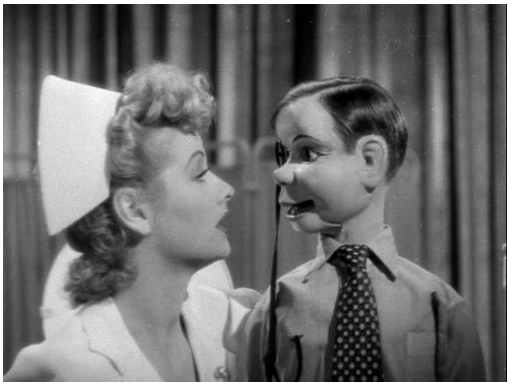
After the studios were divested of their movie theaters in the 1948 Paramount Decision, this became the normal way of doing business, and remains so today. The agency delivered RKO a package, and the studio agreed to fund it. Look Who’s Laughing is an excuse for viewers to see these still wildly popular radio personalities in the flesh, so the plot conceives a way for Bergen (playing himself) and his dummy Charlie McCarthy to crash the world of Fibber McGee and Molly in Wistful Vista, somewhere in the Midwest.

After wrapping up another season on the radio, with Lucille Ball as his loving assistant Julie, Bergen and McCarthy fly out on vacation, but crash land in Wistful Vista. Fibber McGee is scheming to get an airplane manufacturer into the town, and Bergen’s business contacts could be the deciding factor. But of course there are some backdoor shenanigans by the theatrically villainous Gildersleeve (Harold Peary), and it takes a bit of deceptive seduction from Julie to right the wrongs.

The leads were radio stars for a reason. The Charlie McCarthy doll has more screen presence than the mono-tonal Bergen (and says the best line, “What fools we morons be”, to a soda jerk), while  Fibber McGee and Molly’s gentle bickering couple routine is anodyne and forgettable, the template for so many of today’s sitcoms in which a incompetent husband is indulged by a wise woman (they are the real life husband and wife Jim and Marian Jordan). I have no doubt their work is stronger over the airwaves.

Lucille Ball, while given little to do except look alluring in a nurse’s outfit and yearn after Bergen’s dead-eyed stare, pushes against the boundaries in her character. As with the other titles in the box set, she was assigned a type and invigorated it, this time injecting a frank sexuality and clumsiness to the stock “His Girl Friday” character. Lucille said, “I started as a model because I looked like a model, and ‘the other woman’ or ‘the career girl’ because I have a deep aggressive voice that has no softness or romance to it.” She took the talent at her disposal, sharpened them, and then tripped over them for a laugh.

ESSENTIAL PRE-CODE: JEWEL ROBBERY (1932)

Originally published at Movie Morlocks, the official blog of Turner Classic Movies

July 12, 2011

Screen Shot 2020-01-31 at 2.29.09 PM

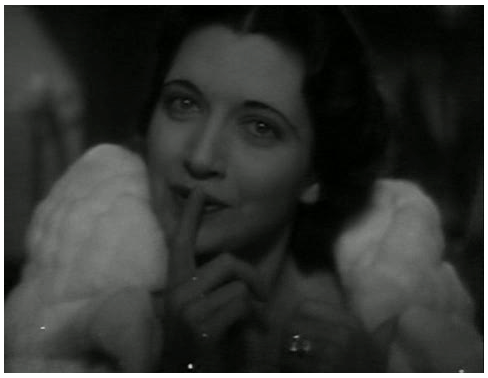
Kay Francis dreamily asks for your complicit silence. She is about to commit an illicit act, and it would be gentlemanly not to speak of it.   So I shan’t, although I will spill fawning words about the film that encloses her, William Dieterle’s Jewel Robbery (1932). It is screening as part of Film Forum’s Essential Pre-Code series (and airs on TCM on occasion), a near annual festivity of tough-talking immorality that begins this Friday, July 15th. Released the same year as Ernst Lubitsch’s similarly themed Trouble in Paradise (and double-billed with it on August 7/8),  Dieterle’s debonair crime fantasy was necessarily overshadowed, but should be reckoned with as a major work in its own right.

A play by the Hungarian Ladislaus Fodor (“Ekzerrabalas a Vaci-uccaban”, 1931), was purchased by Warner Brothers on February 8th, 1932, with production beginning less than a month later, on March 2nd (credit to Roger Bryant’s biography, William Powell). To lens this sophisticated charmer set in Vienna, the studio tapped their European emigre, the German-born William Dieterle. Dieterle, a prolific actor and director in the Weimar cinema, came to Hollywood to shoot German language versions of WB productions. His first original film for the studio, the Lost Generation drama The Last Flight (1931, which I wrote about here), was a success, and he went on an incredibly creative run throughout the 1930s (I would also recommend 6 Hours To Live (1932) and The Devil in Love (1933)).

For the leads, he was gifted William Powell and Kay Francis. $100,000 of the $291,039 budget went to Powell, more than a third of the entire cost. Francis received a comparatively paltry $27,000 (reported by Bryant). Powell plays the unnamed “Robber”, a fastidiously well mannered thief. Francis would get a supporting role in Trouble in Paradise later in the year, but here she is the slinky, shallow and slightly bored housewife Baroness Terri. Stuck with the wealthy but gout-ridden Baron Franz (Henry Kolker), she dreams of escape. Her fantasies incarnate when Powell swoops in to the jewelry store to relieve her of the “Excelsior Diamond” which she was about to squeeze out of the Baron. Entranced by his swaggering, well-coiffed masculinity, the robbery turns into a battling flirtation. Powell, equally intrigued, starts a game of break-ins into the Baroness’ quarters, forcing her to make a choice between comfort and passion.

Dieterle instills a martial rhythm, matching the military precision in which Powell’s Robber executes his heists. He cuts when a screen is filled or an action performed – no lingering on atmosphere. During production, reports Bryant, Warner executive Darryl Zanuck showed concerned about this speedy style. On March 26th he wrote producer Lucien Hubbard to, “keep your eye very close on the rushes of Dieterle…as he has a habit of shooting his most important scenes with the camera moving or sweeping around or going back and forth and you miss the most important point of all.” Ever the diplomat, he sang a different tune to Dieterle, on April 5th: “The rushes continue to be very excellent, and I like the manner in which you are continuing to put movement and action in all the scenes … Keep this up. This is very fine.”

In a rapid opening montage, Dieterle shows a series of safe doors shutting and locking. With equal precision, a group of jewelry shop employees scuttle to line up diagonally across the frame. Dieterle repeats this line-up image in the next two sequences.  As soon as the last man enters the frame, he cuts to the pretentious owner bragging about the new security system. Of course, a few seconds later, he is robbed.

Screen Shot 2020-01-31 at 2.32.02 PM

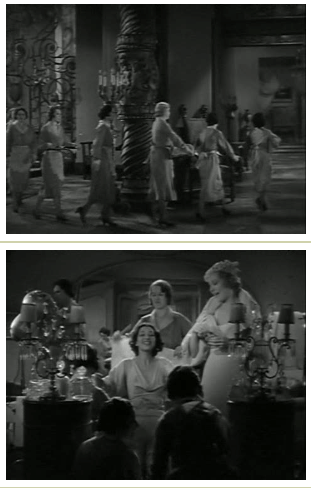
The next lineup occurs in the Baroness’ home, as a who army of maids tromps down a grand staircase to minister to her needs. In the first scene, the line of men was protecting a diamond, in the second, the line is pampering Kay Francis. This jewel/Baroness metaphor continues when one of her helpers carries her into a massage chair to be buffed into beauty – a delicate object cleaned up to be presented to the world.

Screen Shot 2020-01-31 at 2.32.09 PM

Powell’s men form the third line-up, a dapper parade of black-suited shysters. And they are here not to protect, but to steal. As the Baron, Baroness and friends try to escape the store, a group of top-hatted criminals enter from the back, doff their caps in unison, and aim guns at chests. It is this shift in the line-up pattern that that then shifts the narrative. No longer coddled, Baroness Teri is shocked out of her comfort zone, and into one of romantic fantasy.

Screen Shot 2020-01-31 at 2.32.19 PM

Powell’s perfection has an air of unreality about it, a charming, un-threatening adventurer conjured out of Teri’s imagination. After he frisks a revolver out of a lovely pearl-inlaid box, he tells the stunned patrons, “Would you kindly put up your hands”. And then, to calm their troubled nerves, he gives them all some pot to smoke (a joint is later passed to the police department, who fully investigate its possibilities). The idea that this is just a beautiful dream of Teri’s continues when she is whisked away, or willingly kidnapped, to his ornate apartment getaway, which is filled with his ill-gotten gains. As they sit down for dinner, she asks him for his name, and he gently refuses. To admit to a name would pin down his identity, and snuff out the mystery which fuels her desire. He is anything she wants him to be. I don’t think I’ve seen a film that portrays female fantasy with such sensitivity.

***

The other must-sees, or at least, the titles I’ve been most obsessed with recently, are three early stunners from Raoul Walsh:  Me and My Gal (1932), The Bowery (1933) and Sailor’s Luck (1933). 1932 was a good year. I wrote my first post here at Movie Morlocks on Me and My Gal, and lets see if it embarrasses:

Walsh shot the film in a scant nineteen days, and he doesn’t even mention it in his rakish autobiography, Each Man In His Time.

Perhaps it’s the speed of the schedule that led to its inventive, magpie spirit. Plenty of material needed to be created on the spot (there was obviously little pre-production time), and the film is flooded with ideas (some borrowed, some new) – ideas for pratfalls, camera movements, parodies. The movie contains direct addresses to the camera (by a tight J. Farrell MacDonald), self-reflexive voice-overs, and endless bits of comic business, from Will Stanton’s drunk act to the stinging bon mots flung from Bennett to Tracy.

A little sloppy, but not bad. The movie, as always, astounds. The Bowery is a more personal project for Walsh, revisiting the street that he used to rubberneck at as a curious upper-middle class kid in New York. In his autobiography he writes about how he cast real winos and bums to fill the backgrounds of his shots, in which he experiments with deep focus, a technique he would investigate the rest of his career. Then there’s Sailor’s Luck, which sets a giddy land-speed record for sexual innuendo and bumptious ethnic humor.

AN EVENING WITH ELAINE MAY (AND ISHTAR)

May 24, 2011

Screen Shot 2020-01-29 at 4.13.37 PM

It is hard to separate a film from its context. This becomes especially clear with Ishtar (1987), Elaine May’s notorious flop that is known more as a punchline than a movie. Last week, 92nd Street Y in NYC screened the “Director’s Cut” of Ishtar,  followed by a rare discussion with May (a Blu-ray of the film was announced, then delayed, by Sony, but hopefully this cut will see release by year’s end). This is the first time I have seen the film, and cannot say what differences appear in this cut.

In a much needed reversal, May was delivering the punchlines while Ishtar the movie was talked about more than its account books. The coverage before its initial release fixated on its $55 million budget, with the Los Angeles Times repeatedly referring to it as “Warrensgate”, imputing both Watergate criminality and Heaven’s Gate excess to its cost overruns. An epic New York Magazine profile from March 16, 1987, reports on the doomed casting of a camel, and that May shot 50 takes of one scene, “with three cameras rolling at all times”. And this was from a writer seemingly sympathetic to the project. Ishtar was eclipsed by its own production history before it hit screens.

Watching it outside of the media maelstrom, it seems a natural extension of May’s other films, a nimble comedy about the thin line between attraction and revulsion in friendships and love affairs. Intense identification inevitably boomerangs into pity and contempt in May’s universe, with her performers utilizing a fidgety physicality to wriggle uncomfortably under their admirer’s gaze. In A New Leaf, Walter Matthau’s fastidious aristocrat plans to murder his wife (played by May) as she praises him for instilling her with a new found confidence. The purer her intentions, the more vicious Matthau gets, his smooth patter reduced to sputtering rage. In The Heartbreak Kid, Cybil Shepherd treats Charles Grodin’s obsession initially as a flattering lark, and then as a perplexing challenge. Her early, brittle laughter at his clumsy advances changes to a look of beatific confusion as Grodin refuses to give up the chase. Mikey and Nicky might be the purest distillation of this push-pull rendered in gestural uncertainty, as Peter Falk and John Cassavetes weigh friendship against self-preservation.

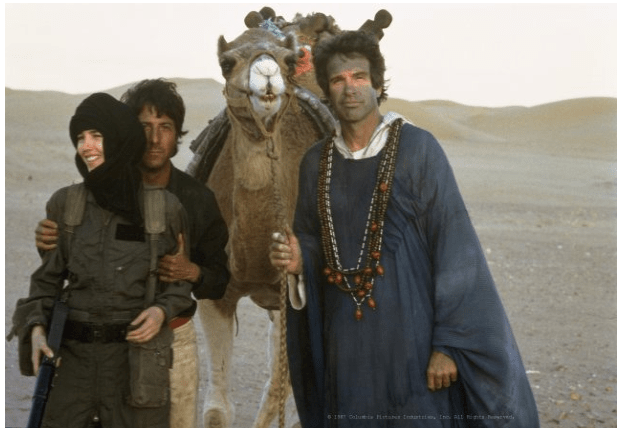
Ishtar places the central friendship on a grander scale, in the middle of a Cold War Hope-Crosby movie crawling with counter-intelligence officers. Dustin Hoffman and producer Warren Beatty star as the impossibly awful songwriting duo of Clarke & Rogers, who are shocked when, “That A Lawnmower Can Do All That” and “Wardrobe of Love” don’t lead to fame and fortune. So they take a gig at a nightclub in Morocco to live out the string of their dream. They are swiftly enmeshed in spy games, however, as Hoffman is drafted by Charles Grodin’s CIA agent, while Beatty is charmed by an attractive revolutionary (Isabell Adjani). Inadvertently acquiring a map that could inflame tensions in the neighboring country of Ishtar, they are chased, cajoled and seduced by secret agents from all over the world. It’s all showbiz to Clarke & Rogers, who work the levers of justice to release their art to the world.

May and cinematographer Vittorio Storaro reportedly clashed on the set, with Peter Biskind writing that, “Storaro was designing shots with an eye to their composition, their beauty, whereas she was composing for comic effect.” Whatever their professional relationship was like, it produced a comedy of rare visual logic. Early on, Warren Beatty is shot recessed into the frame, most notably in a bar where Hoffman tells him he wants to be alone. So Beatty sits at the far back right corner, with Hoffman in the left foreground. Instead of cutting in to Beatty sitting alone for a cheap reaction laugh, May and Storaro keep it in long shot, emphasizing Beatty’s absurd isolation from Hoffman, and setting up their long-distance conversation punchline. This shot encapsulates the Clarke & Rogers team, with Hoffman’s Clarke striving for a kind of hipster depressive cool while Beatty’s Rogers is dopey and supportive, although more honest about his secondary role in life – a background singer comfortable in his own clumsy skin.

Hoffman conveys his contradictory love and disdain for his puppy-dog pal throughout with self-lacerating self-loathing. Clarke clearly hates himself, dolling himself up in Boss bandanas and ska skinny ties, he’s a man without a personality, and attempts suicide early on. He desperately needs and intensely pities and loathes Roger’s affection, a dichotomy that plays out when they are pinned against each other in the Cold war intrigues.

Early on, Beatty seems to be laboring over his Stan Laurel-esque dope, underlining every inanity with a too broad smile not aided by the cartoonish wardrobe of floppy hats and kitschy sweaters. But as the film rolls on he eases into a rhythm, underplaying the punchlines like a pro. His obliviousness as a blind camel knocks down passersby is an uproarious scene aided by his deft obtuseness. In the discussion, May compared the two performances to the rejected contestants on American Idol, noting “how touching they are” in their unbowed belief in their non-existent skill. She also compared them to Ronald Reagan, whom she had met previously. He was a big fan of her act with Mike Nichols, and could recite their “Telephone” sketch from memory. She said he was “an amazingly naive, charming guy, who really cared about show business”, clearly a model she used for both leads.

May was in fine form, as if she had been workshopping her material in clubs the previous week. Received to extended applause, she deadpanned, “Either you like the movie or I’m very sick.” Referring to herself as a “nightclub comedian”, she ran through the Ishtar scrum with a residue of anger, venting at then-Columbia president David Puttnam for releasing the budget figures and publicly attacking Hoffman and Beatty. Essentially, she said, “the entire studio committed suicide”, and Coca-Cola sold Columbia to Sony in 1989, soon after the debacle. But the main focus was on her work, and the instinctually humble May was clearly uncomfortable at all the hosannas floating her way. When asked if Ishtar was ahead of its time, she quipped, “No, that’s impossible. Even with string theory.”

DVD ROUNDUP: 11 HARROWHOUSE (1974) AND LUCKY LADY (1975)

January 25, 2011

ll

Two reviled flops from 20th Century Fox have finally made their way to DVD on the brave shoulders of the Shout! Factory label. Charles Grodin adapted and starred in the heist film 11 Harrowhouse after the  success of his turn in The Heartbreak Kid (1972), only to be met with critical and audience indifference. Lucky Lady is the more infamous failure, the product of agent-turned-producer Michael Gruskoff’s ability to game the Hollywood system (both DVDs come out next Tuesday, February 1st.). Formerly the representative for screenwriters Gloria Katz and Willard Huyck, he bought the rights to their script for $75,000, and then sold it to Fox for $450,000. An impressive profit over the 10% he previously made from their services. By investing that kind of scratch, Fox had to inflate the story into a blockbuster, signing up Liza Minnelli, Gene Hackman and Burt Reynolds to star, and Stanley Donen to direct. It received vitriolic reviews, many noting Gruskoff’s ploy, and failed to make a profit (although Jonathan Rosenbaum indignantly reported in Movie Wars that it came close, with $12,107,000 in rentals, a half-million less than its budget, due to Fox’s forcing theaters to keep it for extended runs if they wanted it at all.)

Despite all of these shady backdoor dealings, I rather enjoyed both of them, the “bumbling and stupid romp” (Pauline Kael, New Yorker) 11 Harrowhouse and the “mirthless trumpery” (John Simon, NY Mag) of Lucky Lady. Seeing them outside the torrent of negative publicity both received upon their initial release, it’s easier to judge them on their own limited but amiable merits.

11 Harrowhouse was based on a novel of the same name by Gerald A. Browne, for which Grodin received the ambiguous “adapted by” credit, while Jeffrey Bloom is named as the screenwriter. It’s unclear how much input he had into Bloom’s script, but it at least indicates his investment in the material. Directing duties were handed to Aram Avakian, who had filmed another comic heist, Cops and Robbers, in 1973. Harrowhouse is deeply marked by Grodin’s laconic personality, delivered through his sarcastic voice-over that coolly belittles the events on-screen. It’s an odd distancing device that was apparently removed from some home video releases, turning it into a more conventional thriller. The new Shout! Factory DVD contains the original voice-over, thankfully, and the video transfer is strong. The original film element shows some wear, and the colors are slightly faded, but it shows nice texture and sharpness, probably the best it could look with the material they had. The only extra is the theatrical trailer.

Grodin plays Howard Chesser, a small-time gem trader hired by business tycoon Clyde Massey (Trevor Howard) to steal an enormous cache of uncut diamonds in London. With the help of his scrappy heiress girlfriend Maren (Candice Bergen) and Watts, their man on the inside (James Mason), they engineer a robbery of Rube Goldberg-esque intricacy. The owner of the fleeced diamond exchange, the fastidious Meecham (John Gielgud), is understandably peeved, and Chesser and Maren try to escape with the jewels and their lives.

The material is not a good fit for Grodin’s deadpan sad sack routine, which is presumably why the caustic voice-over was added. But the narration is so cutting it undermines the usual genre pleasures of the heist film. When Chesser’s voice drops out and the narrative picks up, the jaunty tone disappears and we’re back inside the thriller mechanics, which Avakian runs through at a dulled pace. This tension between tones drains the film of any suspense, as we are now viewing the actions through Chesser’s retrospective disdain. It’s an odd, discomfiting viewing experience, an experiment in POV that implodes its own narrative.

But there is plenty to savor amid the debris (see the grizzled faces above). While Grodin and Bergen both seem cold and affected for their supposedly suave characters, the supporting cast is superb. The three Brits inject reptilian evil (Gielgud), blowhard narcissism (Howard) and a weary nihilism (Mason) into their preciously scant screen time. These are actors who can evoke entire backstories with an inching up of an eyebrow. Mason’s aging diamond appraiser quietly shuffles off with the film, secreting tragedy in the midst of the procedural. Watts has been under the employ of Gielgud’s Meecham and suffered his silent censures, whether dismissive hand waves or a skeptical lip curl, for a lifetime. Mason is a mound of regret, with a slightly haunched back and a slow-motion manner. The way in which he delicately eats a sandwich in a secret meeting with Grodin expresses everything about him – his professionalism and exactitude as well as his fatalism, as  might be the last lunch he ever has. (Reviewers of the time also singled out Mason’s performance, including Kael, Stanley Kaufmann, and the NY Times’ Nora Sayre).

No saving graces were allowed for Stanley Donen’s Lucky Lady:

Pauline Kael: “an agent’s picture – everybody’s rip-off” (compiled in When the Lights Go Down)

Jonathan Rosenbaum: “conspicuously overproduced and under-nourished.” (quoted in Movie Wars)

Vincent Canby: “it’s ridiculous without the compensation of being funny or fun.” (NY Times)

The ever-misogynistic John Simon:  “As for Miss Minnelli, she is herself a perfect menage a trois in which lack of talent, lack of looks, and lack of a speaking voice co-habit blissfully. Donen sensibly concentrates on her best feature, her legs, but he unfortunately can’t wrap them around her face.” (New York Magazine, Dec. 29th, 1975)

And yet, I found it companionable and amusing, despite the vaseline-gauzed cinematography and the cramped framings necessitated by shooting everything on real boats at sea (it is, in terms of press, the Waterworld of its time). According to one of the two promotional shorts included on the DVD, the production took “a full year to make”, because of the stars’ schedules and the endless problems of shooting on rocking vintage boats. Fox also required re-shoots to include a happy ending (as Joe Baltake outlines here). But as important as production history is to criticism, it is no substitute, and I found Donen’s disaster to be a rather fleet and funny (albeit over-designed) vehicle that teased out the idiosyncracies of his actors.

Liza Minnelli (as Claire, a flapper), Burt Reynolds (as Walker, the dandy) and Gene Hackman (as Kibby, the hobo wiseacre) start up a rum-running business during Prohibition, running their boats up from Mexico. This cuts into the mob’s market, and soon they’re in a shooting war over territory.

The script is slangy and self-conscious without being arch, a pastiche of Jazz Age argot that the actors are able to thrum to life. The set-design is overstuffed art-deco, suffocating the already cramped spaces Donen has to work in, and the decision to use heavy soft-focus filters throughout the film is a failed attempt to go nostalgic, ladling every image over with a soupy haze (the DP was Geoffrey Unsworth, who also shot Liza in Cabaret).

In and around these production snafus the actors excel. Minnelli, the critics punching bag, is quite touching here as the dizzy dame love interest of both leads. Minnelli plays Claire, the intended bombshell, more like an antic Jean Arthur than the Harlow clearly intended. She’s the feather boa-clad ball of energy bouncing off the deft comic work of Burt Reynolds, who exhibits his flair for self-deprecating slapstick (Another bizarre John Simon sidebar, on Reynolds:  “[his] face looks like an armored car made, inexplicably, out of meat.” If someone can parse this, please let me know). Hackman has the knockabout trickster role, the gruff kind of asshole he could play in his rum-induced sleep. Together they form an improbably fun trio, and form one of the few successful polyamorous relationships on film.

The DVD of Lucky Lady is a fine anamorphic presentation, the soft image resulting from the original material (it’s remarked upon in the original reviews). The two vintage featurettes feature interviews with the cast and crew, and there are three theatrical and TV trailers.

ADVENTURES IN VOD: NORMAN LEAR AND COLD TURKEY (1971)

December 21, 2010

cold turkey

That’s a lot of Van Dykes. This rather frightening menagerie was arranged by Norman Lear, who wrote and directed the slapstick satire Cold Turkey in 1971. A cult item that used to circulate solely on out-of-print VHS tapes, now MGM has released it through Amazon on a burned-on-demand DVD as well as through their video-on-demand service (rental is $2.99, purchase is $9.99). It’s amazing how quickly a film can go from rare to ubiquitous these days.

Lear had transitioned from variety show gag-man to more full-length narrative work by the time of Cold Turkey, which was shot just before he became an institution with All in the Family. His entry into show business had been greased when Jerry Lewis saw a blind date sketch he had written, and he was hired to produce material for the Martin & Lewis run on the Colgate Comedy Hour (1950 – 1953).  These extraordinarily raucous 60 minutes buzzed on the improvisatory bravado of the actors, but Lear set them up in scenarios primed for chaos. In one opener, a ballroom dance descends into a brawl when Jerry spritzes ink on a brute’s white shirt. An irate wife arm-drags Lewis to the ground, and then Dean socks her down with him. Then the whole set degrades into a brawl.

There’s a feeling the show could collapse at any moment, as Martin & Lewis constantly break character, inserting snide self-reflexive remarks in the middle of the sketches. In one bit, Lewis has trouble moving a suitcase through a doorway, so he simply steps off the stage set and around to the next room, breaking the fourth wall and delighting the audience. It’s unclear whether it’s staged or improvised, but it could be either in the anything goes atmosphere created by Lear, co-writer Ed Simmons and the actors. Many of these episodes are up on YouTube, as well as on a variety of public domain DVDs. A number are also on Netflix Instant, in faded prints.

Afterward, Lear bounced around variety shows, including The Martha Raye Show (1955) and The Tennessee Ernie Ford Show (1957-1958). Bud Yorkin was a producer on the latter, and he and Lear formed the Tandem production company together. This led to their coup of casting Frank Sinatra in their film adaptation of Neil Simon’s Come Blow Your Horn (1963). Yorkin directed and Lear wrote it, along with their follow up, Divorce American Style (1967). After being loaned out to William Friedkin for The Night They Raided Minsky’s (1968), Lear was handed the director’s job for the first and only time on Cold Turkey. In an interview with the Archive of American Television, Lear said Yorkin was busy with other projects, so he took the gig.

The story was adapted from a novel, I’m Giving Them Up For Good, by Margaret and Neil Rau, and it centers on an outrageous contest put on by a major tobacco company. Bob Newhart, as flaccid publicity flack Merwin Wren, has the inspired idea to offer a city $25 million dollars if every resident would agree to quit smoking for 30 days. Feeling confident no town could possibly succeed, it was an easy way to leverage public opinion in the tobacco business’ favor (herein lie similarities to the dire Thank You For Smoking).

One depressed Iowa town, Eagle Rock, takes up the challenge, however, led by Reverend Clayton Brooks (Dick Van Dyke), the golden boy former track star. He riles up the crowd with dreams of gleaming office buildings and all sorts of government cheese. Van Dyke plays him with stuttering obliviousness. He’s a do-gooder blind to his own ambition. Only his wife, the secret smoker Natalie (Pippa Lee) sees through his facade. As the town closes in on the prize money, it becomes a media sensation, bringing in tourist money and documentary film crews from across the country.

Filmed on location in Greenfield, Iowa, using many local residents in the cast, Lear aims for a wide angle take-down of corporate and small-town pieties. Newhart’s glad-hander is as officious as the mini John Birch Society clone, here called the Christopher Mott Society, that the Reverend placates by hiring to inspect cars for smokes as they enter the city. An especially aggressive older lady investigates for Commies, too. Money talks to all walks of life, and Lear’s favorite visual device is the grotesque close-up of citizens’ and CEOs’ greedy grimaces.

The touchstones seem to be Wilder and Altman. The bitter caricature of media exploitation is straight from Ace In the Hole, and the multi-character scope of the narrative, and clothesline compositions (TM Dave Kehr) seem reminiscent of MASH, which was released a year earlier (a few unreliable sources like Wikipedia say Cold Turkey was filmed in 1969 and held for release until ’71, out of concern for its box office potential, which would pre-date MASH).

Lear uses the close-up as a punchline constantly, often taking the air out of a slow-burning joke, not giving things adequate time to build. In his opening sermon, the Reverend reads from his notes, and starts mouthing the copy from a Peruvian tourism ad, an antecedent to Ron Burgundy’s instinctual reading of the teleprompter in Anchorman, but Cold Turkey muffs the setup. As the Reverend reads, it just scans as non-sequitur. But after the service, the joke is explained to be the mistake of his wife, who was transcribing when reading a magazine. If there was a slower setup before the speech, this could have killed, but instead it opted for ex post facto explanations, slowing the story in the process.

But because of its sprawl and the sheer volume of jokes, there’s plenty to get distracted by. There’s Randy Newman’s score (his first), Robert Downey’s slapstick work as second-unit director (where parents slap their babies), Bob Newhart’s reaction shots (sublime) and the endless list of  character actors: Edward Everett Horton in his final role as a flatulent mute cigarette king, Jean Stapleton as a harried wife, M. Emmet Walsh as a rabble-rousing socialist, Tom Poston as a drunk and Paul Benedict as a Buddhist therapist.