LESLIE NIELSEN, 1926 – 2010

Originally published in Movie Morlocks, the official blog of Turner Classic Movies

November 30, 2010

leslie

Leslie Nielsen always played off the beat. Before he delivered a punchline, there was a hitch, a pause, a dumbfounded look off-screen – that made him a devastatingly funny actor. When he finally delivered the deadpan kicker it was in a sonorous tenor drained of emotion, a hollow thud of obliviousness. With his granite-jawed, silver-haired good looks he could say any absurdity with a straight face and a straighter vocal tone, and in collaboration with non-sequitur artists like the Zucker brothers and Jim Abrahams, he created some of the most ingratiating buffoons in film history. And this after a long and overshadowed career as a genial and arrogant leading man on television.  Mr. Leslie Nielsen passed away yesterday at the age of 84, while being treated for pneumonia.

Frank Drebin (The Naked Gun) and Dr. Rumack (Airplane!) are the twin monuments of my youth. Their commitment to ignoring the outside world is so intense it is almost saintly, and I worshiped them with religious fervor. Without the distractions of other human beings, Drebin and Rumack misinterpret every conversation, translating it through their simple-minded narcissism. In The Naked Gun, when Ricardo Montalban offers him a cigar, Drebin takes it as a personal question of ancestry: “-Cuban? -Ah no. Dutch-Irish. My father was from Wales.” Nielsen clips off the words quickly, with the blithe assurance that every query concerns himself. The speed in his response belies a majestic false modesty: everything is about him, but he’ll rush through it to prove he doesn’t care.

Then there’s the legendary “Don’t call me Shirley” bit from Airplane, which results from a similar misinterpretation of an innocent turn of phrase, “surely” to “Shirley”, from the descriptive to the personal. And what makes the line canonical is Nielsen’s stone-faced line-reading, an immobile expressionless mask of  vapidity. It’s hard work to be that straight, and at NPR Marc Hirsh quotes Nielsen’s Saturday Night Live monologue from 1989 to prove the point:

He didn’t understand why he had been asked to host a comedy show, because he was neither a comedian nor a comic. A comedian, he explained, was someone who says funny things. A comic was someone who says things in a funny way.

Nielsen, on the other hand, was someone who said unfunny things in an unfunny way, and for some reason, people laughed. To demonstrate this, he delivered an innocuous line – something along the lines of “Mr. Jones, sit down, I’d like to talk to you about your son” – twice. The first time, he said it as though he were in a drama, and the response was muted.

Then he told us that he was going to say the exact same unfunny line as Lt. Frank Drebin, in an unfunny way, and he did exactly that, and the audience exploded. It wasn’t just indulging him as prompted, either. Without actually tilting his delivery in that direction, Nielsen made it genuinely funny. To underscore his point, he then broke character with a look of happy exasperation and basically said, “See?”

He didn’t sell jokes or wink to the audience, but played it blank. He’s the nowhere man of dramatic acting, working to disappear into banalities until his voice is a low purr and the sound of words becomes more important than their meaning. You pay attention to the surface of things with Nielsen’s jokes, the way he harrumphs and says “Well” before a police car bursts into flame in the distance, or the hard emphasis he puts on the “p” in “poopy pants” (from an epic verbal duel with Robert Goulet in Naked Gun 2 1/2).

But the arc of Nielsen’s career is so much vaster than his sublime work with ZAZ and the later parodies (all of which are underrated to some degree, especially Dracula: Dead and Loving It); I had to delve into his TV work to see where he began. The usual line is that Nielsen was a rather bland handsome leading man until ZAZ tapped his natural talent for deadpan. But there are some raucous early performances that tend towards paranoid men suffering from quiet desperation. Even when he went prematurely gray and became a stock network guest star he gives his roles edges of self-absorption and arrogance.

Tales of Tomorrow is an early gem, a science-fiction anthology show that aired live on ABC from 1951 – 1953. Nielsen acted in six episodes, three of which are available on the site. In “Ghost Writer” (1953) he’s a struggling novelist who takes a gig polishing stories for a successful author. Then his tales start coming true.  “Appointment On Mars” (1952) finds him on the red planet struggling to contain the paranoia of his crew and his own madness as Uranium deposit riches loom (it’s Treasure of the Sierra Madre in space). And “Another Chance” (1953) casts him as a desperately poor husband who steals a valuable brooch and then undergoes a memory erasure procedure to start life anew. In all of them he’s on the edge of madness, which the cramped sets and long takes of the live TV medium really enhance.

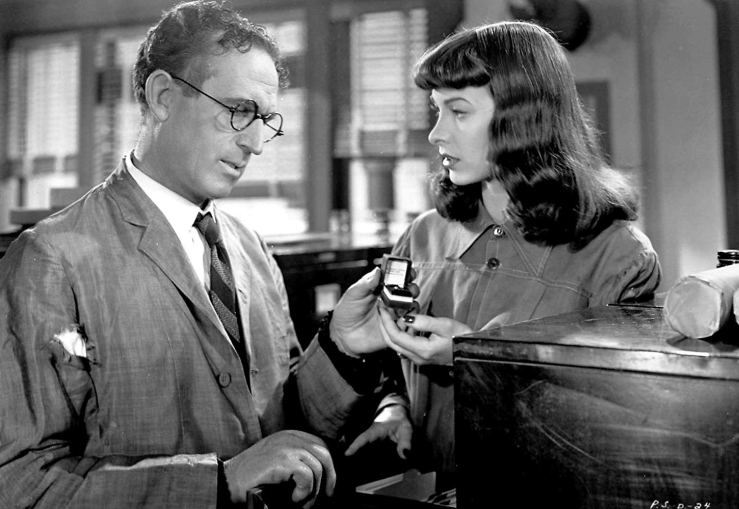
He’s only a few years out from his NYC training at the Neighborhood Playhouse, which was under the sway of Sanford Meisner’s version of Stanislavski’s “system”, now known as the Meisner Techniqueand similar to Lee Strasberg’s famous “method”. Nielsen’s tight, raging performance in  “Another Chance” is the closest to the method he’d ever get. It’s a bracing, moody piece where he’s knocking back liquor in the first shot and gets more disoriented from there, until he gets his mind wiped by a supercilious doctor. Eventually his repressed past starts drilling back into the present, with Nielsen’s language expertly slipping into the names and places of his former life. It’s a mannered but powerful performance in this surprisingly complex forerunner of  Eternal Sunshine of the Spotless Mind .

Even the lax Hitchcock Presents episode, “The $2,000,000  Dollar Defense” (1958), finds Nielsen self-destructing. Here he’s a cuckolded husband accused of murdering his wife’s lover. The method intensity has worn off, and the cool Nielsen persona is setting in, introducing hints of snobbery and elitism to his emerging suave demeanor. A similar scenario pops up over 20 years later in George Romero’s Creepshow (1982, the same year as his comedic breakthrough with ZAZ, Police Squad). In this theatrical horror anthology (he’s an unsung hero of the form), Nielsen plays another husband with revenge on his mind. This time he buries Ted Danson in the sand, hoping to drown him in the tide. In keeping with the self-reflexivity of the whole enterprise, he hams it up, whistling “Camptown Races” as he leads Danson to his doom, and bitchily snapping off lines like “She’s waiting for her knight in shining corduroy” before watching W.C. Fields on TV.

But that’s not nearly as jolting as his appearance on Rod Serling’s horror anthology Night Gallery in 1971 (“A Question of Fear”) as an eye-patched and mustachioed war veteran challenged to spend the night in a haunted house. Claiming to have never felt fear, Nielsen’s hyper-masculine Colonel swashbuckles his way into an old dark house. There is very little dialogue as he navigates soldier-ghosts with burning hands, swinging blades and probable poisons. The final act is expository lard, but the Colonel is another example to place in Nielsen’s hubris-filled menagerie.

There were undoubtedly instances of the stoic network hero during his long TV career, like on the Disney show The Swamp Fox, but they are not readily viewable. But what is available shows that he played far more than just the “earnest heroes” that the NY Times described early on in his career. Even the most straight-laced roles, like his two guest spots on Murder, She Wrote (both on Netflix Instant), contain hints of self-absorption and menace. In “My Johnny Lies Over the Ocean” (1986),  he plays a cruise liner captain with barely contained arrogance, hitting on the intrigued Jessica Fletcher with intransigent persistence. Then, in “Dead Man’s Gold” (1986), he plays a former flame of Jessica’s, but one profligate with money and in hock to a pair of well-mannered loan sharks. With a charismatic swagger barely masking his self-destructive tendencies, he gives Jessica a romantic kiss-off.

Nielsen’s genius was codified in Airplane!Police Squad and The Naked Gun, but there’s a whole swathe of work to happily sift through if we want a fuller picture of his career. In the shift from the method theatrics of Tales of Tomorrow to the suave horniness of his Murder, She Wrote cads lies the DNA of Frank Drebin, a process of wearing down to the essential blankness of the Hollywood leading man, and to a deadpan for the ages.

STANLEY DONEN’S DOUBLE BILL: MOVIE MOVIE (1978)

November 9, 2010

moviemovie

The Film Society at Lincoln Center is wrapping up its superb Stanley Donen retrospective this week, and beyond the established masterpieces like Singin’ In the Rain lie charming curiosities like 1978′s Movie Movie. I missed the screening, but fortunately it is available to purchase from Amazon On Demand for $9.99. Structured like a 1930s Warner Bros. double bill (the on-screen production company is “Warren Brothers”), it pairs two hour-long features: the boxing melodrama “Dynamite Hands” and the backstage musical “Baxter’s Beauties of 1933″. Scripted with loving exaggeration by Larry Gelbart (still cranking out MASH episodes at the time) and Sheldon Keller (a veteran TV writer who started with Sid Ceasar), it’s both a parody of and an homage to the Golden Age of Hollywood. Complete with faux flyboy trailer for “Zero Hour” (“War at its best!”), it’s a similarly nostalgia-soaked recreation of past movie-going experiences as Grindhouse, with an equally poor reception at the box office.

It received generally positive reviews at the time, from Richard Schickel at Time Magazine (“an expert send up”), Pauline Kael at The New Yorker (“a pair of skillful parodies”), Vincent Canby at the NY Times(“sweet, hilarious and very witty”) and Dave Kehr at the Chicago Reader (“clever, insightful and genuinely funny”). The only negative response I could find is from Variety (“a flatout embarrassment”). But after its limited release in November of 1978, it disappeared from cultural memory, existing as a marginal cult item (the VHS is selling for $55 on Amazon, and good luck finding any images on-line). But as with Quentin Tarantino’s vastly underrated Death ProofMovie Movie is ripe for re-evaluation.

The actors, led by a mis-cast but game George C. Scott, play everything with earnest intensity. There is no eye-winking to stifle the comedy. “Dynamite Hands” has Scott portraying grizzled boxing coach Gloves Malloy, who targets wide eyed, pretty boy slum kid Joey Popchik (Harry Hamlin) as his next star. Luckily for Gloves, Joey’s sister Angie needs $25,000 for eye surgery (Joey: “You know what they charge for an eye? An arm and a leg”), and the plot machinery clangs wondrously into motion. Subplots proliferate, including the schemes of a shady promoter (Eli Wallach) and the designs a mobbed up Barry Bostwick has on Angie. It even finds time to morph into a rapid fire courtroom drama. It combines and amplifies every cliche in the genre’s life, since The Champ kicked it off in 1931.

The dialogue is the star, a barrage of contorted working class argot, producing winners like, “Funny, isn’t it? How many times your guts can get a slap in the face.” Many of these, wrung out by Hamlin with an angelic straight face, wouldn’t seem out of place in a Zucker Brothers comedy – Leslie Nielson could wring similar effects from the lovingly absurd script. Another gem comes from the femme fatale, Troubles Moran (Ann Reinking, a dancer making her debut here, she appeared in All That Jazz the following year): “Joey, after a girl’s had a taste of mink, she can’t go back to pastrami.” Words to live by.

Donen pushes the pace relentlessly to mimic these Warner quickies, and is very sparing with close-ups, keeping the camera at the waist-up  distance favored by classical practitioners. It’s questionable whether his use of zoom-ins are truly authentic for the period he’s aping, but the effect is hoky enough, along with the irises in and out, to fit the overall light comic tone.

The “Zero Hour” trailer is a delirious bit of WWI propaganda, with George C. Scott’s heavily waxed moustache playing power games with Eli Wallach, as Art Carney’s “priest with a heart” gives bad advice at home.

Then the segue into a Busby Berkeley-esque backstage musical, 42nd St. spliced with Gold Diggers of 1933. Barry Bostwick plays the Dick Powell role with what Kael called Powell’s “candied yam cheerfulness”, and Rebecca York takes on the small-town aw shucks innocence of the Ruby Keeler part. Scott plays the Warner Baxter role of overtaxed, death courting director Spatz Baxter, a flamboyant character not really in his macho wheelhouse, but his caked on makeup carries him through. Art Carney’s doctor tells Baxter that he has “6 months to live…from your last visit 5 months ago.” Wanting one last hit to guarantee a future for his estranged daughter, he employs a promising unknown to write a score: Bostwick’s gangly klutz Dick Cummings. Replete with showgirls in undergarments, last minute catastrophes and a drunken, difficult lead actress, it has all the hallmarks of those snappy Busby Berkeley classics.

Bostwick does a fine bumbling job as Cummings, a slapstick version of the Powell character, all arms and legs careening through the frames. His voice isn’t as sturdy and true as Powell’s, but he makes up for it in pratfalling intensity. Troubles Moran gets a mini-nightclub number in “Dynamite Hands”, but Donen really cuts loose in the finale of “Baxter’s Beauties”, in which him and the great choreographer Michael Kidd (whom he worked with on Seven Brides for Seven Brothers (1954)) and DP Bruce Surtees do their version of a Berkeley routine, complete with a birds-eye view of a human roulette wheel. They bring back the impossible spaces of his routines, sets which could not fit on a stage and perspectives that audiences could never see. The cut-ins to the programs, supposed to connect one back to reality, only go to show how spectacularly unrealistic the dance sequences are. And in this, Donen and Surtees honor their subject admirably: an energetic erotic spectacle that any Depression-era viewer would gladly plunk down their money for.

For a negative take on the film, David Cairns wrote a straight up pan for his great Shadowplay blog.

CHAPLIN AT KEYSTONE

November 2, 2010

keystone

Flicker Alley has just released a monstrously funny box set of all extant shorts that Charles Chaplin made at the Keystone Film Studios. It is poetically titled CHAPLIN AT KEYSTONE, and is now available for your perusal. The sketches housed therein are mean-spirited little scenarios of controlled chaos. Chaplin swats down the elderly and the teething with equal aplomb, playing drunks, con-men and resentful working class joes. Bricks are the weapon of choice, available in suspiciously convenient abundance. There is plenty of interest for those looking for evidence of his artistic development, from his control of narrative to the introduction of pathos to his work, but the real joys here are tumbles down stairs and unexpected blows to the face. The Keystones were the JACKASSes of their time.

The ringleader was Mack Sennett, who when Chaplin joined his company explained the Keystone method: “we get an idea, then follow the natural sequence of events until it leads up to a chase which is the essence of our comedy.” That is, there was no script, just a concept strung out with with improvisational business to get to the chaotic close. This was, as biographer David Robinson notes, not reassuring to Chaplin , who was “accustomed to the months of polishing that perfected the teamwork of a Karno sketch.” Fred Karno was Chaplin’s previous employer, a music hall peformer and director who formed “Fred Karno’s Speechless Comedians”, a hugely popular pantomime act that also produced Stan Laurel. They workshopped their sketches on the road for months until every last gag was milked for maximum hilarity. Now here he was in Hollywood with Sennett, completing a film in an afternoon with little time for tweaking.

It’s little surprise Chaplin clashed with his directors. On his first film, Making a Living, Chaplin was outraged at Henry Lehrman for cutting out some of his favorite gags, and he was famously chuffed at having to take orders from the younger Mabel Normand on some outings. Eventually his need for Karno-like perfection inevitably led to his taking the directorial reigns. His growing control of the material, and introduction of more dramatic elements, can be seen in The New Janitor (1914), in which Chaplin’s bumbling custodian almost tips out of a window but still manages to foil a robbery in progress and catch the eye of the secretary in distress. There is a dramatic and emotional arc to this piece absent in the earlier work.

But mapping an evolutionary arc on this point of his career would be a mistake. His development as a dramatic artist is not better, but simply marks a different path in his career. For pure comedy, I prefer the early fly by night Keystones, jury-rigged giddy contraptions of pure id. Later this week at Movie Morlocks David Kalat will single out Kid Auto Races at Venice, California (1914) as one of his favorites, and I concur whole-heartedly. It’s the first film in which audiences saw the “tramp” costume, although Mabel’s Strange Predicament was filmed first it hit theaters later. The Keystone team often filmed bits around live events in town, and for this scene Chaplin cavorts next to the second annual “Pushmobile Parade”, a children’s car race held on January 11, 1914. Allegedly filmed in 45 mintues (according to Jeffrey Vance’s DVD notes), it finds the Tramp continually blocking a news camera’s view of events as it pans right, variously posing and taunting the director of photography. His casual incursions into the frame build and build until he gives the lens the stink-eye in an extreme close-up.

What is equally interesting to the loose improvisation of the film is to watch the spectators reactions to the Little Tramp, whom they are seeing for the first time. Their reactions range from non-plussed to confused towards the shoddily dressed maniac who nearly avoids getting clipped by a toy car and incites a mini-riot with the newsreel crew. It is a loose, brilliantly executed bit of slapstick as well as a documentary depicting the birth of Chaplin’s skeptical but curious worldwide audience.

A similar routine is run through in A Busy Day, which was directed by Mack Sennett. This time they film in Wilmington on April 11, 1914 during a dedication ceremony and parade celebrating the Los Angeles Harbor expansion (from Vance’s DVD notes). Chaplin cross-dresses as the rather ill-tempered young wife of Mack Swain, who has a gigantic wandering eye. But she begins by obstructing another camera crew, posing mock seductively until someone tries to forcibly wrench her away from stardom. Her dream is forever deferred as she executes some limber kicks against these evil interlocutors before being tossed against the bandstand. Then her ire returns to her husband and a battale royal escalates to the pier and a final somersault into the water. From the start Chaplin is playing with ideas of fame, which he would wait to fully explicate until Limelight (1952).

While structurally something like Dough and Dynamite is a masterpiece, I found the blunt insanity of The Fatal Mallet to be more my style. A fever dream of male jealousy, Chaplin and Mack Swain battle over the hand of the always delightful Mabel Normand, at least until another guy comes along to divert their wrath. There are no character details beyond the cliche of their physical type, and it is structured around endless brickbats to the head. In its insistent refusal to acknowledge physical reality, it is both hilarious and sublime, a fusillade of cinderblock poetry. The men move to deathly lengths to subdue the others, as Normand looks on with increasing disinterest.

It is a box set to savor, for the minor moments of improvisational genius (like how he uses pliers to tip a girls head his way in Laughing Gas), as well as the gains in narrative and spatial coherence that clearly point to his feature length greats. Essential viewing.

LEARNING TO LOVE RAOUL WALSH

August 17, 2010

Screen Shot 2020-01-24 at 5.17.16 PM

Raoul Walsh was nothing if not adaptable. As a teenager, he tagged along with his uncle on a trading mission to Cuba and Mexico. The schooner was damaged in a storm and had a long layover in Vera Cruz. It was there, Walsh claimed, that he learned roping from a man he only knew as Ramirez, whom he paid in Cuban rum. He stayed ashore when the ship returned to NYC, and was soon hired as a cowboy to drive cattle into Texas. His accidentally gained expertise landed him a horse riding gig on Broadway (in a version of THE CLANSMAN, later filmed by D.W. Griffith as THE BIRTH OF A NATION, in which Walsh played John Wilkes Booth), and later got him hired at the Pathe Film Studios, who also needed a horseman. Once he was primed to break out as a leading man in IN OLD ARIZONA, a jackrabbit flew through his windshield, and the glass shards gouged out an eye (he was replaced by Warner Baxter). Hence his eyepatch, and his practically-minded move behind the camera.

Dave Kehr commented on on his blog, relating to his NY Times piece on the Errol Flynn Adventures box set that TCM released with Warner Bros., that “for me Walsh belongs with Ford and Hawks as one of the Big Three American directors, but there has been surprisingly little of substance written about him in English or in French.”  I felt I should be as practical as the director and take this as a sign to dig further into Walsh’s work. There was further discussion of how little he’s esteemed in the under-30 crowd, of which I’m a member for the next few months. And it’s undeniably true. I’ve never had a conversation about Walsh with anyone of my own age group.  So until I hit that magic number in February, I’ll be assessing and re-assessing his work, to find my way through Walsh’s massive filmography and hopefully spark further discussion about this major figure in film history.

Kehr’s erudite readers also took up the challenge, especially Blake Lucas, who wrote an essay-long breakdown of Walsh’s career. Spring 2011 promises a flood of material, with an essay on Walsh in Kehr’s eagerly awaited collection When Movies Mattered, and a forthcoming biography, Raoul Walsh: The True Adventures of Hollywood’s Legendary Director(University Press of Kentucky), by Marilyn Ann Moss. I’m adding my rather undigested thoughts here, and will contribute more in the coming weeks the more I see. I watched The Big Trail  (1930), The Strawberry Blonde (1941), Battle Cry (1955), and The Tall Men (1955) in quick succession with comment below, and my bits on Me and My Gal (1932) and Colorado Territory (1949) are here and here.

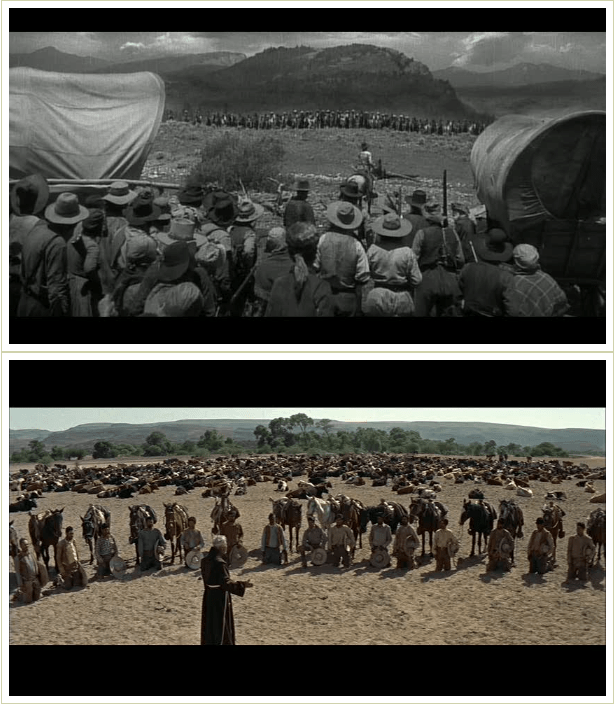
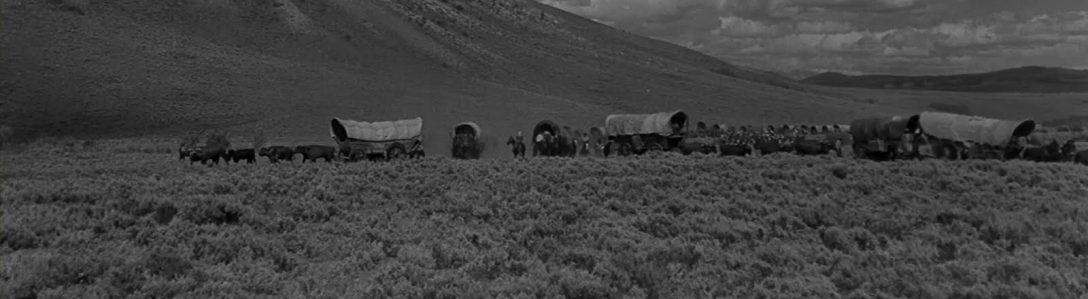
Walsh’s dynamic visual sense was as equally pragmatic as his upbringing. The stills above are from films 27 years apart, but his mastery of widescreen composition remains, whether in the 70mm Fox Grandeur format of The Big Trail, or the CinemaScope of The Tall Men. He composed in depth in arcing lines, framing his images to fit the horizontals of the format, instead of the more vertically oriented Academy Ratio that preceded and followed the box office failure of The Big Trail. The vertiginous conclusions of White Heat, High Sierra and Colorado Territory attest to his expertise in the latter. But when he had wide aspect ratios to deal with, he adapted: in his ‘Scope films his people die sideways. This might seem intuitive, but the clunky framings of early Scope experiments like The Robe, made 23 years after his commandingly wide Big Trail, shows how ahead of his time, and downright experimental his creatively practical approach was. These are images of beauty but also of narrative tension. John Wayne traverses the middle ground in the top image from Trail, caught as he is between his Native American friends and the covered wagon train he’s leading to Oregon. The crowds look like massed armies, and the centered mountain provides an ominous roadblock. But Wayne’s bright beige buckskin outfit cuts a deal and a way through.

The image from The Tall Men is less dramatic, a minor aside before the big drive to Montana. The group of vaqueros that Clark Gable hired takes a moment to pray as the cattle nap in the background. If Walsh’s heroes are “sustained by nothing more than a feeling for adventure”, as Sarris claimed, or what Kehr calls “runaway individualism”, this shot displays what this recklessness and freedom has put at stake: the lives of these pious men are on the line for these indolent cows. It is a tossed off moment of nobility for these nameless workers, whom Gable leads on an impossibly dangerous journey through Oglala Sioux territory. His Civil War colonel turned stick-up artist is once again a leader of men, and it brings riches and death.

Walsh’s men are truculently free spirits, and look for women of similar combativeness. For romantic relationships are as central to Walsh’s world as reckless  individuality. The tension between the two motors most of his work, echoing a quote from Johannes Brahms: “It is my misfortune still to be unmarried, thank God!”  The Strawberry Blonde and Battle Cry are almost exclusively concerned with this dilemma. James Cagney gives another irascible fireplug performance as Biff Grimes, a dentist and perpetual black-eye wearer. Giving remarkable detail to the speech (“that’s just the kind of hairpin I am”), clothes and bearing of lower middle-class immigrant strivers in the gay ’90s (the only richer milieu Walsh created was the 30s lower East Side of Me and My Gal), Walsh presents Biff as an all-American loser, and is one of his (and Cagney’s) most beautiful creations. Biff is quick to fight and quicker to hold a grudge, a mulish sap who contains deep reserves of dignity. He loves his lusty father, but falls hard for the measurable charms of Rita Hayworth’s social climber. Roped into being a wingman for his huckster-entrepeneur friend Hugo, he’s hooked into a date with Amy (Olivia de Havilland) instead, a budding suffragette who talks women’s rights on the first date, and who prefers to get just as frisky as the men. They are both odd fits for society, two weirdos who love running their mouths, getting into scrapes, nursing, and dentistry. So the most romantic scene in the film concludes in a tooth pull without anesthetic. It’s a hilarious, vengeful moment against Hugo, but also an inadvertent revelation of his own happiness with Amy. Love is laughter and the restraint of murderous impulses. I now place it alongside Me and My Gal as my favorite Walsh film.

Battle Cry is a war film that’s almost entirely about love affairs. Walsh keep eliding battles in order to return to town where Aldo Ray and Tab Hunter get entangled with conflicted ladies in San Diego and Wellington, New Zealand. It is a very strange film, a big-budget spectacular that eschews spectacle for moments in-between the fights. There are more shots of men sitting than shooting. It’s a case study for what Jean-Pierre Coursodon has called his “basically leisurely approach to filmmaking.” He slackens the normal pace of this WWII propaganda picture, made with the support of the U.S. Marines, to dig into one-night stands and poignant love affairs. Coursodon continues in his “American Directors” essay:

“when confronted with a war picture, and therefore a predominantly male cast, Walsh uses the flimsiest pretexts to sneak in as many women as possible. Most of Battle Cry’s 149 minutes’ running time is devoted to the likes of Mona Freeman, Nancy  Olson, Dorothy Malone, and Anne Francis pleasantly cavorting with their boyfriends in blissful oblivion of whatever is meant by the film’s title.”

It’s a film about raucous canteens, maudlin bars, and the chatter that fills it up. James Whitmore’s Captain complains that he couldn’t read Hamlet, because “he reminds me of an uncle of mine in Dayton.” Then there are the mournful wives, girlfriends, mothers and one-night stands who populate their off-hours, replacing the ghosts of their sons and lovers with the lonely, eager visages of new recruits. Some live and some die, there are break-ups and weddings, and Walsh doesn’t linger on any of it.

“The great traffic cop of the movies”, as Manny Farber called him, kept things moving, as the world went ahead without them. One of the most expressive shots for me was in The Big Trail, in which a covered wagon gets ripped downstream as it tries to ford a river.  There are no close-ups or dramatic music swells or star actors, just a family losing all they own. Then there’s a cut, and our hero must move on.

THE 30TH ANNIVERSARY OF AIRPLANE!

August 20, 2010

Screen Shot 2020-01-24 at 4.49.53 PM

On July 2nd, 1980, AIRPLANE! was released in the United States. For its 30th anniversary, the Film Society at Lincoln Center held a screening and a Q&A last night with directors and writers David Zucker, Jim Abrahams and Jerry Zucker (hereafter known as ZAZ). Ever since I stumbled out of THE NAKED GUN (1988) as a giddy seven-year-old, the ZAZ initials have been emblazoned in my consciousness, their screenplays replacing large chunks of my grey matter. I am not an impartial observer. But it wouldn’t be hyperbole to say that ZAZ’s peak equaled those of the Marx Brothers and Mel Brooks in the density of quality jokes-per-minute. Their approach was unique in that these comedies didn’t use comedians. Their laughs came from the cognitive dissonance of watching handsome leading men spout intricate absurdities. All of the performers play the straight man, while the writing is the star.

As Zucker put it, it was “as if we were taking real movies and re-dubbing them.”  (From my main source,  Robert J. Emery’s The Directors: Take One, Vol. 1) It is a constricted style, with little room for characterization or pathos. We are always laughing at these characters, rather than with the complicit guffaws of a Duck Soup. If the jokes fail, there is nothing left. But the ZAZ team was so relentlessly creative within these limitations that the strain never showed until Naked Gun 33 1/3 (1994), which I still treasure anyway.

Jerry and David Zucker grew up in the suburbs of Milwaukee, where their mother, David said, would “talk back to the TV and criticize what was going on. That’s kind of where the satire comes from.  She was an actress from the time she was five.” When they went to college, they started making jokey Super-8 movies, including one “about Jerry running around campus trying to find a place to leak.” (I urge Paramount to spend large amounts of money restoring this). After graduation, they hooked up with childhood friend Jim Abrahams, and in 1971 started up the Kentucky Fried Theater in the back of a Madison, Wisconsin bookstore.  Their blend of live improvisation with film and video skits landed in Los Angeles a year later, and became a cult hit.

Airplane! was the first screenplay ZAZ wrote, but they couldn’t sell it, so they adapted their stage show to the screen, and the Kentucky Fried Movie (1977), directed by John Landis, became a considerable success. Airplane! was next, the result of a fortuitous night of television:

We used to leave the video tape recorder on overnight just to catch the late movies and to get the commericals so we could re-dub later and spoof them in some way. One night we recorded a movie called Zero Hour. It’s a 1957 movie starring Dana Andrews, Linda Darnell and Sterling Hayden. It was one of those “airliner in trouble” movies.

With the series of Airport films topping the box office, ZAZ took Zero Hour as their template for a parody, making a remarkably faithful adaptation. At the Q&A ZAZ said they even mimicked the camera setups, needing all the shortcuts they could get as first-time directors.

Originally the structure was going to be the same as Kentucky Fried Movie, with spoof commercials breaking up the main feature, an airline disaster film. But the feature was getting such a positive reaction, they cut everything else out. Intent on making a film with the same feel as Zero Hour and other late night flicks they were watching, they hired Joseph Biroc as their DP (Robert Aldrich’s long time lensman, he would shoot …All the Marbles the following year), and Elmer Bernstein to do the score. When they told Bernstein that they wanted a B movie score, he deadpanned, “so you think I’m the right one for it?” After he guffawed throughout the test screening, David remembered, they knew they had the right man.

Next came the casting. David Zucker:

We were watching these Airport movies and thinking, “Charlton Heston is just too funny.” The trick was to cast serious actors like Robert Stack, Leslie Nielsen, Peter Graves and Lloyd Bridges. These were people who up to that time had never done comedy. We thought they were much funnier than the comedians of the time were.

Paramount originally pushed Barry Manilow for the Ted Striker role, but then reluctantly agreed to ZAZ’s plan for the leads. As a compromise, Paramount insisted on casting name comedians (Bill Murray, Chevy Chase, Robin Williams) in supporting roles.  During the Q&A at Lincoln Center, Jerry Zucker talked about how they kept this from happening. Their producer, Howard Koch, supported their decision to go with dramatic actors, so he would intentionally bomb the pitch, telling the comics that the script was “shit”. Jimmie Walker was the only star to sneak through their defenses: he cleans the plane’s windows before bouncing off the fuselage.

The actor most closely associated with ZAZ is Leslie Nielsen, but his part was originally offered to Vince Edwards, who turned them down, irrevocably changing the course of Nielsen’s career and my childhood (Jerry Zucker said they also pursued Charlton Heston and Jack Webb for different roles, to no avail). At that time, Nielsen was taking anodyne TV roles, and the studio told Zucker that he’s “the guy you hire the night before.” But Nielsen was eager to sign, telling his agent, “I don’t care if you have to pay them. I want to do this movie.”

Graves was the most reluctant, unsure of why he was being cast in a comedy. Here was Zucker’s pitch:

We told him it was going to be a new kind of comedy that didn’t rely on comedians but relied on the jokes and the seriousness of the characters and the absurdity of the situations. And the straighter he could play it the better it would be.

While this group of old professionals may have been wary, they got the job done, as usual. Of all of the straight men, Lloyd Bridges’ work still stands out. His air traffic controller, McCroskey, spoke with the speed and bravado of Lee Tracy from a 30s newspaper film like Blessed Event. It’s a performance of controlled mania that ZAZ gifts with some of their greatest riffs, including the “I guess I picked the wrong week to stop drinking” routine that Bridges snaps off with a growling panache. He’s also superb in the ZAZ spinoff Hot Shots as the absent-minded President, whose endearing idiocy now looks like a model of Will Ferrell’s buffoonish take on George W. Bush.

One of the greatest unsung performances in the spoof pantheon is Stephen Stucker’s Johnny, Bridges’  flamboyant assistant who is always ready with a sarcastic retort. In deference to his wit, ZAZ let Stucker, a Kentucky Fried Theater alum, write all of his own lines  – which still generate some of the biggest laughs in the movie. A whirligig of transgressive jollity, he could turn a weather map into a pterodactyl and impishly unplug the runway lights before an emergency landing. He’s a force of nature, the only actor ZAZ allows to be a comedian, mocking the proceedings from the inside. A legendary character, he was a classically trained pianist who showed up to his Kentucky Fried Theater interview in two-toned leather hot pants. Tragically, he was one of the first actors to announce he was suffering from HIV. He died in 1986 at the age of 38.

The other sublime work here is by Leslie Nielsen, as Dr. Rumack. He is perhaps the straightest man in film history. He paralyzes his facial muscles as much as his immovable silver hair – there is not even a hint of a smile or a glint of emotion. His eyes are glazed and serious, and rarely looks at anyone in the face. He prefers to tip his head up to gaze dramatically off camera. It is a turn of extraordinary woodenness, a solid oak of uninflected speech and metronomic movement. It is the Platonic ideal of ZAZ performances. Nielsen’s commitment to looking oblivious is unshakable, and that kind of perfection is beautiful, and forever funny. He would be nominated for an Emmy for a similarly flawless routine in Police Squad! (1982), ZAZ’s short lived cop show spoof that was canceled by ABC after six episodes. They were able to revive the concept for The Naked Gun six years later, which taught me how to boil a roast: “Very hot. And awfully wet.”

At the end of his late 90s interview with Robert Emery, David Zucker says, “I guess the test is if the movie still works twenty years later. We’ll see in a couple of years if it’s still funny.” Now it’s been over 30 years, and it’s still cracking me up.

Postscript: Top Secret (1984) is incredible too.

JERRY LEWIS TAKES MANHATTAN

November 24, 2009

errandboy-5-723120

The nasal whine of Jerry Lewis is slowly screeching it’s way back into the American consciousness. He won the Jean Hersholt Humanitarian award at the last Oscar ceremony, and he’s returning to Broadway as the director of a musical version of The Nutty Professor, set for the 2010-11 season. And over the past few weeks, Anthology Film Archives held a retrospective of his directorial work, from The Bellboy through Cracking Up (aka Smorgasbord). The series was timed with the release of Chris Fujiwara’s concise study of his style published by the University of Illinois Press. It’s been a crash course in Lewis’ comedy, as I only have a passing knowledge of his movies, specifically the ones with Frank Tashlin (Artists and Models first and foremost). What became immediately clear is his astonishing technical command.

Regardless of whether I was laughing (which was about half the time), I was struck by the precision of his staging and the intricacy of his sound design. He’s adept at both crowding the frame with detail and locating a joke in the chaos (in the crowded elevator scene in The Errand Boy), or emptying out spaces and placing the gag in long shot (in the setting up the chairs bit in The Bellboy). His use of sound is just as fascinating, as he’ll often expose the mechanics of the film itself. There’s the sequence in The Ladies Man where he unplugs a microphone and the screen goes silent for a sequence of exaggerated pantomime, or the dubbing gag in The Errand Boy, where he loops his voice over a singing starlet.

As Fujiwara notes, “A main principle of Lewis’s films is not to fill in everything…”. His sets are spacious and garish,always calling attention to their artificiality, as in the dollhouse-like set of The Ladies Man (image right) , or in the “overhead crane shot in Kelp’s laboratory in The Nutty Professor, the camera reaches a distance hard to reconcile with the presumed real dimensions of the space, letting us know explicitly that this is a fantasy space, a movie set, a space of experimentation with identity.” He creates a theatricalized space to fit his constantly performing characters, and “Identity in Lewis is always performed; there is no private self.” And what an identity.

The Lewis “idiot” character is an empty vessel, either completely silent, as in The Bellboy, or a creation of studio hacks (The Errand Boy and The Patsy). His characters rarely have complete arcs, as he structures his films around a series of disconnected vignettes, bits of business that have little to do with the ostensible plot. The Bellboy is the extreme instance of this non-narrative approach, which so spooked the studios they tacked on an introduction explaining the concept (Jerry Lewis is a bellboy who wanders around doing nutty things). The Nutty Professor is his only film to crack into the national imaginary, probably because it  has the strongest story arc – he’s trying to win over Stella Stevens. His other films raise “problems”, only to discard them later, as with Lewis’s fear of women in The Ladies Man. He gives these plot devices little notice, content to construct elaborate gags around his invisible man.

The theme that inevitably emerges throughout all of these films is of the construction of Lewis’s own fame, and the unreality of his life. In The Bellboy he appears as himself, and The Errand Boy and The Patsy echo Lewis’ own rise to fame. It’s this overpowering sense of self-regard that turns off so many of his detractors, but his obsession with his identity springs organically out of his candy-colored style, so intent on revealing the artifice behind his own films’ making.

But is he funny? Well, your mileage may vary, but yes, absolutely. His “building-block” structure results in a lot of failed gags, but since they bump into each other in a quick profusion, there’s something to please everybody.  I’m not partial to his rubber-faced reaction shots, which bury his punchlines into the ground, but adore some of his slow-burn conceptual bits, such as his dressing down routine with Buddy Lester in The Ladies Man, where a simple hat adjustment ends up destroying Lester’s psyche.

His physical humor can also grate, as his long-take style pulls out a gag like taffy. A large suitcase doesn’t have handles, and he spends minutes sliding and tumbling trying to get a handle. This simple bit should hit and move on, but he holds it for every variation of physical degradation. It’s both admirable and exhausting, although some build from such unpromising material into a mad delirium. Take the dinner scene in The Patsy. Lewis takes one joke, he doesn’t know when to stop tipping, and keeps hammering it until he’s unloading his entire wad to a school of hovering violin players (see below). This is where the slow burn pays off, where one simple gag leads to Lewis repeatedly topping himself, instead of the stolid repetition of the suitcase bit.

The truly wonderful thing about Lewis’s work, though, is that even if a particular joke is tanking, there are always beautiful compositions and resourceful actors to fall back on. Lewis had a penchant for casting old Hollywood types in his films, guys who hadn’t worked regularly in years but he respected (he talks about this in a candid extended interview in Fujiwara’s book – in which he memorably describes his “steel balls”). Just look at some of the faces in The Patsy: Everett Sloane, Peter Lorre, George Raft (as Lewis’s reflection) Keenan Wynn, and John Carradine.

This could have been a silent film and the faces would have told the story. This is another aspect of Lewis that elicits criticism – his sentimental streak. And for the most part, it’s warranted, as he inserts stilted speeches about the power of innocence and beauty in the mouths of his female protagonists. But at certain moments, emotion arises naturally out of the action, either through his love of an actor or himself. Two moments stick out in particular. One in The Ladies Man, where Lewis and Raft do a soft-shoe in the living room. Lewis refuses to believe Raft is Raft, and to prove it, George twirls them around the impromptu dance floor. Lewis goes to a high angle, darkens the room, and isolates them in a spotlight, an absurd and surprisingly sad image of Raft dancing into the twilight of his career.

The other occurs near the end of The Errand Boy, when Lewis wanders into the prop room and starts chatting about his emotions with a southern belle duck puppet who calls herself Magnolia (see the top image to this post). She’s possibly the most fully realized of his female characters, which doesn’t say much for his writing for actresses, but speaks volumes for this improbably moving scene. It is played as straight drama, as Jerry tells her the story of his life, his childhood in Jersey, his dreaming of Hollywood, and his disillusionment upon getting there. Then he discusses the pain behind all of his pratfalls and screw-ups, “I’ve done nothin’ but cause everybody trouble.” Then he pulls himself back, and wonders why a puppet is talking to him. Poised between sentimentality and idiocy, with an undertow of sadness, it manages to condense Lewis’s cynicism about show business, his penchant for proliferating identities, and his childlike belief in the power of imagination into one insane and beautiful sequence. He’s one of a kind, for better or worse.

PRESTON STURGES GOES INDEPENDENT: THE SIN OF HAROLD DIDDLEBOCK (1947)

August 25, 2009

MV5BNjEwOGQwMGUtNGZmMC00Y2ZlLWE5ZjMtZjE0Y2EyZGQ0YjI0XkEyXkFqcGdeQXVyMjIyNjE2NA@@._V1_SY1000_CR0,0,1450,1000_AL_

In 1944, Preston Sturges had his first flop for Paramount. After numerous battles with production executive (and storied songwriter) Buddy DeSylva, The Great Moment was released in a studio-mandated cut, which Sturges said

was a bitter story about the discovery of anesthesia which I intended to sweeten a little with some funny moments. The studio decided that the picture should be cut for comedy. As a result, the unpleasant part was cut to a minimum, the story was not told, and the balance of the picture was upset….  I was certain the picture would have a mediocre and shameful career in that form and with that title [he wanted it to be called Triumph Over Pain], a guaranteed gilt-edged disaster that would do neither me nor the studio any good.

He was right, of course, and Moment was the only film in his Paramount run to lose money. Negotiations over a new contract collapsed over Sturges’ request that he have a two-week period after each production to annul the deal. He wanted leverage in case of future studio meddling, but he was rejected outright. Thus ended one of the greatest Studio-Director runs in Hollywood history.

He spent the next few years in the independent picture business, when an eccentric millionaire straight out of The Palm Beach Story, Howard Hughes, offered him a job later in 1944. Sturges claims that Hughes wanted someone to run his movie interests so he could focus on aviation, and so the California Pictures Corporation was born. With Sturges’ artistic and commercial pedigree tied to Hughes’ deep pockets, there were high hopes for the company. Manny Farber stated in The New Republic that “it would be likely to cause the large studios surprise and worry”, while Sturges laid down an optimistic statement of purpose: “to invest full authority in young writers, directors, and producers to act on their own initiative.” He wanted to give directors the freedom he found ever so briefly at Paramount. Unfortunately Hughes’ eccentricities soon torpedoed this optimism.

Two productions were on the table. Sturges was to direct The Sin of Harold Diddlebock, a comedy luring Harold Lloyd out of retirement, and he hired Max Ophuls to direct his screenplay for Vendetta, an adaptation of Prosper Merrime’s Colomba (read Lutz Bacher’s Max Ophuls in the Hollywood Studios for a more in depth history of this troubled production). Things fell apart quickly on Vendetta. Bacher claims that Sturges pushed Ophuls out of the director’s chair because of his perfectionism, only wanting to see his vision on the screen. In his autobiography, Sturges claims that Hughes fired Ophuls because “he didn’t like foreigners and didn’t want them working for the company.” In any case, Hughes dissolved the partnership in 1946, citing cost overruns.

Both films were later re-edited and re-shot by Hughes. Diddlebock bombed in a brief release in 1947, so Hughes pulled it back within a few weeks. He did some re-shoots (including a scene with a talking horse), and released Diddlebock as Mad Wednesday through RKO in 1951.  Vendetta was hacked apart even more, with nothing of Struges’ script remaining. Stuart Heisler completed principal photography, and then Mel Ferrer was brought on to do further re-shoots (he received the sole directorial credit). It was released through RKO in 1950 and sunk like a stone. Luckily, Sturges’ version of Diddlebock still exists, and it’s the version that airs on TCM (next time on Oct. 19th at 11:30AM).

It’s an unfairly neglected work in Sturges’ career, cited only as part of the “decline” narrative that defined this part of his filmography, and which Yacov Freedman outlined earlier today. Its interest lies first with Harold Lloyd, who hadn’t appeared in a film since 1938′s Professor Beware. The film functions as a sequel to Lloyd’s The Freshman, following that film’s hero through the twenty years following his improbable college football heroics. Sturges boldly opens the film with the final quarter of  The Freshman‘s championship game, inter-cutting it with new footage of E.J. Wagglebury in the crowd (Raymond Walburn), an ad executive who later offers Diddlebock a job.

This bit of film history leads to a beautifully bittersweet sequence of workplace inertia. After Wagglebury promises Diddlebock the fruits of the American dream, he installs him as a bookkeeper, and Sturges shows the Presidential calendar fly by from Harding to Truman. The camera pans over to Diddlebock, still hunched over the same desk, his ramrod posture gone stooped and haggard. This sarcastic sequence is not only a biting comment on the idea of upward mobility, it also acts as a metaphor for the fate of the silent comedian. Harold Lloyd had fared better than most, due to some wise investing, but in reprising his most famous silent character, he acts as a stand-in for the faded Hollywood stars of Keaton and Arbuckle and the rest. Chaplin would do similarly bitter-nostalgic work in Limelight in 1953.

But that’s just the opening sequence. There are a few classic Sturges runs regarding Diddlebock’s decline, including  Lloyd’s monologue  on his crushes on a succession of sisters, seven in all, from Hortense to Harriet, who ran away with a headstone salesman. Further emphasizing Diddlebock’s entropy and passivity (he’s tossed over for death), Sturges quickly charts the intervening years as a series of lost loves and a rapidly disappearing future (in a timely aside, his pension is piddling because he lost most of it in the Crash). Lloyd’s Diddlebock just seems lost. Sturges axiom Jimmy Conlin notices his empty stare, needles him for some cash, and promptly jolts this teetotaler full of booze. In an elegant bit of vaudeville, the bartender (“the king of the slow burn”, Edgar Kennedy), peppers him with esoteric questions in order to concoct a deadly cocktail, The Diddlebock. He soon blacks out, and the increasingly chaotic narrative attains the character of a dream.

The plot kicks into gear with a bit of capitalist carnivalesque, as a drunkenly placed $1000 bet leads to a cascade of money and the purchase of a debt-laden circus. Aghast at the actions of his id, he goes a little mad, gloriously, grabbing a lion by the tail and dangling off of a rooftop, barely escaping death. Clad in a Franklin Pangborn special (see top photo), he whizzes around the city, reconstructing his drunken evening and desperately trying to sell this big top money pit. His life literally becomes a carnival and it trails along with him wherever he goes as he gleefully turns Madison Ave. into riotous display of animal anarchy. With such publicity, the bankers can’t help but line up to take the zoo off his hands. It’s a wild send-up of capitalism and a loving tribute to Lloyd and the silent film tradition.

Lloyd complained afterward about their clashing comedy styles. Sturges focused on the verbal, Lloyd on the physical. Lloyd claims they shot two versions of every scene, one to please each of them, but the director inevitably won in the editing room. Lloyd eventually sued Howard Hughes over his billing on the re-release. Whatever their differences, the sweet chaos of their work is up there on the screen. Take a look.