JAPAN CUTS: THE NEW YORK FESTIVAL OF CONTEMPORARY JAPANESE CINEMA

July 10, 2012

Screen Shot 2020-02-04 at 2.58.55 PM

For the sixth year running, the Japan Cuts film series in New York City presents an eye-opening glimpse of contemporary filmmaking from across the Pacific, the vast majority of which will never receive distribution in the United States. Programmed in concert with the ongoing New York Asian Film Festival (which I covered for Film Comment), it runs from July 12 – 28 at the Japan Society, and will screen 37 features and two shorts. The normally sober-minded fest has gone pop this year, booking a slate bubbling with hyperactive rom-coms and sci-fi extravaganzas, but there is also a sidebar of films responding to the Fukushima nuclear disaster, as well as a tribute to the expressively stone-faced actor Koji Yakusho, who will appear in-person for the screening of The Woodsman and the Rain (2011).

Japanese studios wring established brands as dry as any Hollywood outfit with a superhero license, as the caffeinated pleasures of Love Strikes! (2011) can attest. It’s a manic romantic comedy adapted from a hit TV show (Moteki, 2010), which was in turn the small screen version of a blockbuster manga comic book by Mitsuro Kubo. Toho, the largest Japanese production and distribution company, dominates the native box office with re-dos such as these, especially the endless iterations of anime behemoths Pokemon and Doraemon.

Love Strikes! was a solid hit in 2011, and it is a cross-promotional machine, playing clips from what seems like every J-pop band of the last twenty years. But instead of a bubblegum-tween romance, it’s pitched towards an older crowd, aiming for the instant nostalgia of the early-30s set. The main character is Yukiyo Fujimoto (the mousy Mirai Moriyama), a 31-year-old virgin who quotes Goethe and reads way too deeply into teen pop lyrics. He gets a job at an internet culture magazine, but is thrown through a loop when the perky hip chick Miyuki (Masami Nagasawa) responds to his music nerd musings on Twitter (Yukiyo: “Someone register her as a world heritage site”). Director Hitoshi Ohne (ported over from the TV show), slathers the screen with scrolling Twitter pages and karaoke lyrics, topped off with Fujimoto’s self-doubting voice-over.

The highlight of this ADD-cinema is an impromptu music video featuring girl group trio Perfume, who dance through Tokyo with Yukiyo to their hit “Baby Cruising Love”, enacting his budding self-actualization. I was largely won over by this shock and awe pop assault, deluded male fantasy though it is, thanks to its witty screenplay by Ohne and an energetic performance by Nagasawa (justly deserving of the festival’s Rising Star award), who injects her thankless object-of-nerd-lust role with an unexpected aggressiveness and spunk. The third act devolves too far into passive male wish-fulfillment, but Ohne keeps the visuals popping around it.

The Closing Night film of the festival is another Toho-stravaganza, the sci-fi spectacular Space Battleship Yamato (2010), a live-action adaptation of the much beloved 1974 animated series. Directed by visual effects specialist Takashi Yamazaki, director of the Japan Academy prize winner Always, it pushes the limits of Japanese FX technology, sometimes to the breaking point. The story is ultra-nationalist, pushing themes of self-sacrifice to self-destructive lengths (the Yamato was the lead Japanese battleship in WWII). It follows one-time rebel Susumu Kodai (Takuya Kimura), who learns to love the military after the country is attacked, and about to be decimated by, the alien Gamilas. With a $29.4 million dollar budget, it is a major production, but the scale of the film needs Hollywood-style cash, and some of the alien worlds lack detail and dimensionality, giving them a video-game flatness. The film has a lack of self-consciousness in its propaganda, kind of Starship Troopers played straight, which to be honest has a refreshing pulp quality to it, as men speak in clipped moralistic phrases and rush around feverishly blinking panels.

Koji Yakusho doesn’t need flash to sell tickets. With his prominent cheekbones, piercing stare, and air of calm reserve, he could be a model, an assassin, or a model assassin, but instead he has chosen roles of subtle dramatic gradations, including the rumpled detective in Kiyoshi Kurosawa’s Cure, or the crusty old patriarch in  Chronicle of My Mother (2011), another Toho-hit, in which he grapples with the growing senility of his mother. It’s a solid family drama, the kind of well-crafted multi-generational weepie even second-tier Japanese directors like Masato Harada can churn out with ease. Although not on the level of Yoji Yamada’s About Her Brother (2010) or Hirokazu Kore-eda’s Still Walking (2008), Harada uses distanced camerawork and detailed 50s era art direction to emphasize the distance he has set up between his own family members. Kirin Kiri is endearingly batty as his equally withholding mother, and their inevitable emotional breakthrough is underplayed so well that Yakusho’s grin has the same impact of a full-throated sob.

Yoshihiro Nakamura is a director who deals with Toho but has been able to maintain an individual artistic identity. While making cash-grabbers for Toho like last year’s dreadful-looking Eiga Kaibutsukun (watch the trailer – if you dare) he has also pursued a productive collaboration with mystery novelist Kotara Isaka , whose twisting Rube Goldberg narratives Nakamura has adapted multiple times over the years. His breakthrough film in the West was the briskly entertaining Fish Story (2009, available on DVD and streaming on Netflix) in which a long-forgotten punk song from 1975 inadvertently prevents the Earth from getting creamed by an asteroid in the present. Then in 2010 Nakamura adapted Isaka’s Golden Slumber (2010), a rather plodding conspiracy narrative that piles on subplots without Fish Story’s fleet pacing. Golden Slumber was Isaka’s first novel translated into English, with the title changed to Remote Control.  Last year found Nakamura take a break from Isaka’s work, and made his simplest and most affecting film, A Boy and his Samurai (aka Chonmage Purin, 2010). A sweetly sentimental fish out of water comedy, it plops a time-traveling samurai into modern Japan, who promptly becomes a master pastry chef.

This year has Nakamura return to Isaka’s work, adapting one of his short stories for Chips (aka Potechi, 2012), a svelte 68 minute comedy that combines the deadpan humor and narrative web of Fish Story with the naked emotionality of A Boy and His Samurai. Partly funded by the Sendai Miyagi Film Commission, Chips was shot in Sendai, and was recruited to help bring business back to the city, so devastated by the earthquake and subsequent tsunami of 2011. That is why Chips is included in the Japan Cuts sidebar, “Focus on Post 3.11 Cinema”, which consists of four fiction films attempting to respond to those events, including Toshi Fujiwara’s No Man’s Zone and Masahiro Kobayashi’s Women on the Edge. You can read more about them in Dennis Lim’s NY Times piece here.

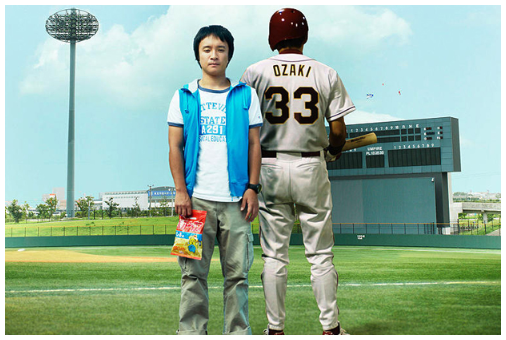
Chips begins with Imamura (Nakamura regular Gaku Hamada) and Kurosawa (Nao Ohmori) watching an empty stage in the park. Imamura is the funny one, and Kurosawa the serious one, playing off the personas of their famed director namesakes. Their circuitous actions will fill the stage of the screen, set in motion when Imamura answers the phone during one of his petty thievery jobs, one of those small actions that has epic existential effects in Nakamura’s world. The girl who answers is threatening to commit suicide. He talks her down, but then the two of them are sitting during another robbery, and another phone rings. This time they are ensnared in a blackmail ring involving the baseball player Ozaki. Stories sprout new stories, all of them tinged with loss, from the prospective suicide to the final revelation, which opens up doubt about Imamura’s own identity. Imamura’s life becomes doubled with Ozaki’s, ending at a baseball game that unfurls with the compressed ritual intensity of kabuki theater, one that will shake the two men’s destinies apart. It is a wildly melodramatic and deeply sad conclusion, which pushes Imamura into a place where he is cheering for the destruction of his own identity. All this is accomplished with an unobtrusive fixed camera, usually focused on Hamada’s slackjawed moon face, which looks as if it is in a perpetual state of stunned surprise, which is a decent description of Nakamura’s audience as well.

Toshiaki Toyoda has staked out a less accommodating stance with the studios, and has become persona non grata since his arrest for drug possession in 2005. His new film Monsters Club is an unsettling re-telling of the Unabomber story, complete with a mail-bomb POV shot, from construction to explosion. Shot over two weeks without a script in snow clogged mountains, its method of shooting was as mad as its main character. Although it opts for rote pop-psychology explanations by the end, the visuals are far more unsettling, especially the hallucinations of colored shaving cream covered swamp people designed by transgender Japanese artist Pyuupiru.

This year’s Japan Cuts holds fascinating insights into how the Japanese commercial cinema works these days, which is not too far off from our own much-maligned Hollywood model of the necessity of “brand-awareness”. As Love Strikes! shows, though, these pre-digested products don’t have to be creatively diluted, as long as they fulfill their promotional duties first. Yoshihiro Nakamura is the most intriguing figure here, one who seems to be able to float back and forth between Toho-blessed A-pictures and his own little curios, much like the soon to be retired Steven Soderbergh. It will interesting to see how long he can survive the balancing act, before getting burned out and frustrated like his American counterpart.
FILM COMMENT SELECTS 2012

March 6, 2012

Screen Shot 2020-02-03 at 12.00.04 PM

The 12th edition of Film Comment Selects concluded this past week at Lincoln Center, having screened 32 films from all over the cultural map. The stoned dropout to the New York Film Festival’s Ivy League grad, the films chosen by Film Comment magazine’s editorial staff tend towards the spectacular and the underground, and occasionally underground spectaculars. Plucking from the festival scene (Hirokazu Kore-eda’s I Wish), genre titles (Alexander Zeldovich’s Target) and experimental multi-projection performances (J. Hoberman’s Land Passion War of the Dead Christ Worlds), it has something for everyone. That is, if everyone was a creepy cinephile shut-in.

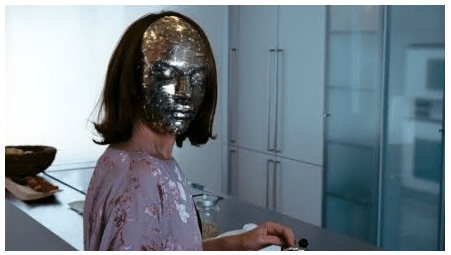
The selection of Target (2011) encapsulates the mission of FCS, a Russian sci-fi film too genre-bound to make the NYFF, and too arty to pick up mainstream distribution. The film is conceptually simple but dramatically sprawling, pulling from influences as disparate as  Stalker and Gattaca. The year is 2020, and China has emerged as the dominant super-power, its culture seeping into every corner of Russian daily life. The Mandarin-speaking minister of Natural Resources, Viktor (Maksim Sukhanov), is tiring of his sterile marriage to Zoya (Justine Waddell), a feckless beauty who spends her mornings getting her face un-wrinkled by a nano-bot infused death-mask. Longing for the days when the felt something resembling emotion, they light out for the mountains of Central Asia, in which an abandoned astrophysics laboratory is rumored to emit cosmic rays that grant eternal life. They are joined by Zoya’s hyperactive TV-host brother Mitya (Danila Kozlovskiy), the thuggish customs agent Nikolai (Vitaly Kishchenko) and Anna (Daniela Stoyanovich), the dreamy narrator of a Chinese-for-Beginners audiobook.

As with Stalker’s Zone, the astrophysics site seems to have a consciousness all its own, with the guides referring to it as “The Thing, The Detector, The Target”, both an active agent and a receptacle for divine radiation, an elusive and contradictory force.Viktor and his entourage ignore this ambiguity, and approach it as just another slumming self-help adventure, the simple rural living distracting them from all those riches. But then the site has its effects, and immortality ain’t what it’s cracked up to be. The radiation makes them act younger and more impulsive, as if slightly buzzed. The movie shifts from sci-fi futurism to melodramatic fucking and fighting, as the group turns into an overheated brat pack of randy adolescents. Eternal love in this situation becomes not a promise, but an existential threat.

The films of director Alexei Balabanov present another kind of threat, not of the banality, but the deadpan absurdity of evil. His relentlessly black comedies eviscerate the Russian state apparatus in stories of institutional incompetence and sickeningly casual violence.  A Stoker is a return to contemporary Russia after the early 20th Century detour of his Bulgakov adaptation  Morphia (2008,selected for the 2010 FCS). Skryabin (Mikhail Skryabin) is a native Siberian Yakut who was shell-shocked in the Afghanistan war and never recovered, spending his days in the boiler room fueling the furnace, and typing away at a novel he’s been writing obsessively for decades. His face is a placid mask, and his reactions sluggish, as if instructions were dropped into him down a deep, cobwebbed well. Balabanov shows this garlanded hero as a zombie of Russia past, lobotomized into a cog in the mob’s death machine, as he burns up assassinated corpses in his furnaces. It is only when his daughter gets caught up in that same machinery that he dodders back to life, adding a few more drops of blood into his country’s vast reservoir, before drifting back off to sleep.

Also easing into the land of dreams is Sara Driver’s Sleepwalk (1983), a hypnotic nocturne set in the Lower East Side of Manhattan. Agitated typesetter and single mom Nicole (Suzanne Fletcher) agrees to translate a sheaf of Chinese nursery rhymes to make some extra cash. Her life is already filled with everyday surreality, from her perpetually bleeding finger to the trance-like rhythms tapped out by her sullen workmates, but with these translated tales reality entirely escapes her, and she is left circling through a laid-back nightmare. Everything gets repeated, from a child’s obsessive street-crossing to the elevator’s insistence on stopping at every floor. Shot with the languorous long takes of DP Jim Jarmusch, Driver’s film approximates the feeling of half-sleep, when the day’s events are cycling through your head but your body is shutting down, your consciousness slipping away.

There is nothing sleepy about the wide-eyed adorability of I Wish (2011), the latest family drama from Hirokazu Kore-eda (Nobody Knows). Returning to more commercial ground after his experiment with latex love in Air DollI Wish was partly financed by Kyushu Railway Company, whose bullet train provides the central plot point of the film. It’s a simple tale of a family split by divorce. The two sons split, with Ryonosuke (Oshiro Maeda) living with the father (Joe Odagiri) in Fukuoka, while the older brother Koichi (Koki Maeda) stays with their mother in Kagashima. They vow to cut class and meet at the midpoint between their two cities, believing that when the new bullet train passes that point, their dreams will come true. A saccharine set-up, but Kore-eda leavens it with such melancholy and lightness of touch, it ends up indelibly moving. This is in no small part to the charismatic kid leads, real-life brothers who perform as the manzai (comic duo) act Maeda Maeda (according to Mark Schilling in the Japan Times). Already professional comedians, they have impeccable timing and rapport, with Koki playing the straight man and Oshiro the loudmouth madman. That this routine works despite their being separated for the majority of the film is a testament to their rhythm, as well as the fine parallel editing of Kore-eda’s team.

Film critic J. Hoberman (now of Blouin Art Info) does some editing of his own in Land Passion War of the Dead Christ Worlds, his multi-projection spectacular that layers Passion of the ChristWar of the Worlds (2005) and Land of the Dead on top of each other in an orgy of martyrdom and Hollywood pizzazz. This special presentation grew out of Hoberman’s college lectures, in which he experimented with Passion as well as Rocky, playing all five (at that time) in the series at once.Passion was projected on film in its entirety, stretched vertically from its original Scope ratio to fit into the fatter 1.85, giving the characters, as Hoberman said, “an El Greco look”. Then scenes from War of the Worlds, and all of Land of the Dead were projected digitally over it, and hidden affinities began to emerge. It calls attention to the cookie-cutter manner of Hollywood screenwriting, in which “beats” all occur in the same spots, regardless of whether it’s Jesus’s crucifixion or a zombie rebellion. Then there are the smaller bits of serendipity, with Satan’s snake slithering towards a cowering Tom Cruise, or fireworks blooming over Pontius Pilate. As Hoberman admitted, it was more of an installation than a crafted work of deconstruction, and encouraged wanderings in and out. I remained lodged in my seat (with no booze nearby), so I let my mind wander instead, grazing over each layer of action, waiting for moments of convergence, after which I oohed as if wooed by the latest blockbuster, which, at Film Comment Selects, it most certainly was.

Click to read what I previously wrote about FCS selections Despair (1978) and Almayer’s Folly (2011).

FIRST LOOK: AN ADVENTUROUS NEW SERIES AT THE MUSEUM OF THE MOVING IMAGE

January 3, 2012

Screen Shot 2020-02-03 at 11.10.50 AM

Since I’m not stinking rich just yet, my plan to go on a heavily medicated tour of international film festivals has been put on indefinite hold. Luckily, the Museum of the Moving Image has purloined 13 new features from all over the world, most without U.S. distribution, for their inaugural “First Look” series (Jan. 6-15), bringing the best of the fests to NYC. Since distributors continue to lose money on any film not in English (or, occasionally, French), it’s something of a miracle that any foreign titles reach our shores at all. This leaves a huge glut of films without any stateside release, left as rumors of masterpieces in the words of the few industrious critics and curators able to send word back to us in the sticks. “First Look” was programmed by some of these proud few: Dennis Lim, the editor of Moving Image Source, Assistant Curator of film Rachael Rakes and Chief Curator David Schwartz. It’s a small but impactful series, with invigorating entries from old masters like Chantal Akerman and enchanting young voices like Gonçalo Tocha.

The opening night slot is given to Akerman, who will be in person to present Almayer’s Folly (2011), her impressionistic rendering of Joseph Conrad’s first novel. As with her adaptation of Proust’s The Captive (2000), Akerman eschews textual faithfulness in order to establish a specific atmosphere. In The Captive it is of airless enclosures, as Simon (Stanislas Merhar) creeps at the edge of the frame, seeking to imprison Ariane (Sylvie Testud) within his own paranoia, subtly shifting the narrative center of Proust’s story over to the woman. It owes as much to Vertigo as Proust, and Almayer’s Folly is  equal parts Tabu and Conrad, using the story as a loose outline to contain images of luxurious colonial decay. It is filled with shallow-focus tracks through greenery and static shots of Almayer’s arthritic stumbling around his crumbling kingdom. Almayer (again Stanislas Merhar, equally opaque and vainly controlling as his Simon) is a Dutch trader who seeks his fortune in Malaysia (the film was shot in Cambodia). He marries a local, Zahira (Sakhna Om) because his mentor, Captain Lingard (Marc Barbé), believes the woman’s family owns land on top of a gold mine. The plan fails, and Almayer is marooned in a combative marriage on a dilapidated farm, his only respite his daughter Nina (Aurora Marion), whom Lingard enrolls in a strict French boarding school. As Almayer and Zahira slowly decompose into their surroundings, nurturing mutual resentments and growing manias, Nina increasingly occupies the center of the frame and the narrative, Akerman’s camera fixated on her placid, inquisitive face. This shift is signaled in the opening scene, in which an adult Nina is a backup dancer to her sometime lover Dain, as he lip-synchs to Dean Martin’s “Sway”. After an unknown attacker carries Dain off, Nina is left alone on stage, still dancing, seemingly oblivious to the world around her. Then, she takes the center in a close-up, and sings a gorgeously melancholic version of “Ave Verum Corpus”. A Eucharistic hymn to the redemptive power of Jesus’ suffering, it turns Nina into a martyr before the narrative proper begins, a grievous angel who pays for the sins of her father.

The protagonists of Christoph Hochhäusler’s The City Below (2010) live in a world without God and sin, but plenty of greed, as they sleepwalk their way through the global financial crisis. It premiered at the Cannes Film Festival in 2010, but was never released in the U.S.. A co-editor of the German film magazine Revolver, and associated with the loose cadre of “Berlin School” filmmakers, Hochhäusler is a precise technician, as his follow-up, One Minute of Darkness (2011, part of the Dreileben trilogy) shows. The City Below follows two empty suits: bank president Roland Cordes (Robert Hunger-Buhler) and Svenja (Nicolette Krebitz), the bored wife of one of his employees. Svenja is exhausted from constant re-location (from Hamburg to Houston to Frankfurt) and desperate for a way out of her modern glass-walled life, which Hochhäusler frames with geometrically precise right angles. His tracking shots use frequent jump cuts, however, irruptions in style that neatly echo the characters’ fissuring psyches. In the first shot, Svenja sees a woman wearing the same blouse as her, so she follows her steps, even ordering the same Danish (and spitting it out), desperately trying out a new life.  Cordes is equally eager for escape, fiercely identifying with (and gaining voyeuristic pleasure from) heroin addicts, as well as an employee in Indonesia who was kidnapped and killed. Cordes pretends that the victim’s childhood was his own – a lie he acts out for Svenja during their mutual seduction. It is a union of split, hollow personalities, who continually break-up and reunite in increasingly violent fashion, as if they were a rapidly multiplying microbe, set to take over and infect the world.

Phillipe Garrel’s mindset is still set squarely in the ‘60s, no matter what year his films are set in. His newest work is That Summer (2011) an earnestly affecting relationship drama in which its characters discuss revolution as if the May ’68 riots where happening right outside their doors. But no, it is set in the present day, and Phillippe’s son Louis plays Frederic, a mercurial, adulterous painter still passionately in love with his movie star wife, Angele (Monica Bellucci). When he invites his friend Paul (Jerome Robart) and girlfriend Elisabeth (Celine Sallete) to stay in their Paris apartment, they are there to witness the spectacular flameout of Frederic and Angele’s love. Garrel lovingly cultivates the star personas of Bellucci and and his son – Louis is insanely sensitive and brooding, Belluci imperiously cold and beautiful, more mythic archetypes than human beings. Frederic is all Dionysus with no Apollo, an artistic, atavistic soul not fit for the world, and so he departs it. Bellucci, who has never stood out to me in a film before, is wonderful as the herder of Frederic’s untrammeled emotions – and when her Olympian reserve cracks, it does so spectacularly in an uninhibited dance with a stranger, which Garrel shoots in a generously long take.

The standout title in the First Take series, though, is Gonçalo Tocha’s It’s the Earth, Not the Moon (2011), an absorbingly inventive three-hour documentary about the smallest island in the Azores archipelago, Corvo, population 440. Tocha spent parts of two years on the island, and attempted to film everything he could: knitting, cheese curdling, lock-making, accordion-playing, sitting, standing and dancing. Tocha is a restless social historian, trying to capture every tradition and personality on the island before they disappear – lending the film its joyous and elegiac qualities. He gets Ines Ines (a name she married into) to knit him an old-style beret, the retired cheese maker to make him some wheels of cheddar (“you have to take care of them just like babies”), and the 94 year old Uncle Pedro to play his accordion that he hadn’t brought out for ages. Tocha explores not just the people, but the volcanic landscape which produces the almost unearthly neon greens of the caldera vegetation, and the rocky shores that are nightly attacked by rising waters. The locals track these waters like sacred texts, producing a photo book of the highest wave crests. A former whaling port, the population has the ocean in their blood, even if it no longer provides a living. One of the former lookouts says of the whales, “I still dream with them”, before backtracking (“You want more lies?”). Tocha’s Corvo is not simply a necropolis sliding into the ocean, though, but a town, like any other, struggling to adapt to brutal new economic realities.

First Look is an essential new series, bringing together a cross-section of styles and approaches impossible to see in your neighborhood arthouse. And I haven’t even mentioned (or seen) the other entries in the program, including Johnnie To’s financial crisis drama Life Without Principle and Raya Martin’s Super-8 road trip freakout, Buenos Noches, Espana. With the number of films exploding and distribution channels shrinking, I hope this First Look is one of many to come.

TO SAVE AND PROJECT: THE MOVIE ORGY (1968) AND AFRAID TO TALK (1932)

October 25, 2011

the movie orgy

For nine years running, MoMA’s To Save and Project international festival of film preservation has showcased the latest celluloid surgery jobs by archives the world over. It’s the one place where film stock is still a fetish, each new print ogled with the entitled leer of a sozzled Miss Universe judge. So I was sent to my oft-used fainting couch when it was announced that a digital restoration would open this year’s fest (which runs through Nov. 25th).   This prestigious pole-position was granted to Joe Dante’s The Movie Orgy (1968), a delirious mash-up of pop culture detritus, from psychotic b-movies to baffling Bufferin commercials.

Dante and Jon Davison edited the entire feature by hand, splicing in new scenes when intriguing material passed their way. Eventually the project ballooned to 7 hours, but with its broad humor, broads, and critique of the military-industrial complex, it toured college campuses under a Schlitz beer sponsorship. By the end of its run the print had more stitches than Frankenstein’s monster, without the salve of Karloff’s soulful stare. It would be unlikely to survive another trip through a projector. So Dante shoved the benighted thing through a film-to-tape transfer, and after some screenings on the West coast has finally brought his beast to the East. Now at a svelte 4 1/2 hours, it’s a marvel of gonzo editing. It contains an actual narrative, collapsing the apocalypses  of a bunch of sci-fi/teen rebel/horror cheapies into one mega-Armageddon, while finding time for mini-comedies and grace(less)-notes in between.

For this main narrative, I spotted the following titles: Speed Crazy (1959), Attack of the 50 Foot Woman (1958), Teenagers From Outer Space (1959), College Confidential (1960), The Giant Gila Monster (1959), Earth Vs. The Flying Saucers (1956), and Beginning of the End (1957). There are many more I couldn’t identify, but these images of nuclear paranoia are spread throughout, until Dante and Davison edit them together in a blaze of melodramatic parallel editing that would make D.W.  Griffith a little nauseous.

W.C. Fields, George Burns and Groucho Marx act as a bemused chorus during the chaos, used in reaction shots in response to whatever absurd travail Dante places before them (maybe Peter Graves gunning down locusts or Andy Devine singing “Jesus Loves You” with a cat and a gerbil). It’s the Kuleshov effect used for juvenile laughs, which I fully endorse. Dante uses this gag in other forms, once in an Eisenstinian montage, cutting from a dog training short to one for the Marines, or equally bluntly, from kids setting up a projector to a striptease. Dante is in full control of the editing-as-joke mechanism, and he wrings some hilarious bits out of it. Another routine worked through multiple variations is condensing an entire feature into a descriptive one-shot. In a B-dog-movie called (something like) “Rusty Comes Home”, he shows one scene of a dog running to a boy. “You came back!”.  Cut to “The End” credit.

Then there are the insane commercials, including a mind-melting series from Bufferin, in which a military recruiter sends a kid to war and a landlord evicts an elderly couple. Both use the pill to ease their guilty consciences. In the latter a building implodes behind the landlord as he pops his aspirin. These play more like parody than ad copy. The true star of Dante’s opus though, is Brett Halsey, the star of Speed Crazy (1959). Under the sensitively absent direction of William Hole, Jr., Halsey furrows his brow and strangles out his motto, “Don’t crowd me!”, thousands of times. Whether he’s chatting up a gum-smacking dame (in which crowding would seem to be the point) or stabbing a square authority figure, he repeats the phrase incessantly, as if Halsey forgot the rest of his lines. But he had already appeared in 20 movies, the absurdity of his repetition a likely result of compressed shooting times and a thin script. By the end, the audience was erupting in scattered cheers whenever Halsey appeared on-screen, as I would like to do for this entire low-brow masterpiece. Because of its endless copyright infringement, The Movie Orgy will never appear on home video, so rush to see it if it ever plays near you.

***

The other highlight of the festival for me was Edward L. Cahn’s Afraid to Talk (1932), a brutally despairing corruption drama, based on the play Merry-Go-Round by Albert Maltz and George Sklar. Made during the depths of the Great Depression, it exhibits a totalizing distrust of authority, with Chicago city officials displayed as more comprehensively criminal than the gangsters they are ostensibly supposed to pursue. Jig Skelli (Edward Arnold) kills kingpin Jake Stranskey (Robert Warwick) to take over his racket. When he’s rousted for the crime, he simply flashes Stranskey’s records, which implicate every major  Chicago official as on the take, from the DA’s office to the Mayor’s. Needing a scapegoat, the cops pin the murder on bell boy Eddie Martin (Eric Linden), almost beating him to death to force a confession.

Cahn and DP Karl Freund (Metropolis) visualize the back-scratching corruption of the government through shifting group shots. At police chief Frank Hyers’ (Ian Maclaren) well-appointed pad, the top officials often gather around the table to pop champagne and talk jubilantly of their double dealings. Hyers is framed to his left by the Mayor (a red-faced Berton Churchill) and Assistant DA Wade (Louis Calhern). On the right District Attorney Anderson (Tully Marshall) and a rotating cast of underlings. They are framed in long shot, with a receding hallway behind them. Down that hallway comes an indistinguishable mass of Fedora’d newspapermen, walking in lockstep, resigned to regurgitate the party line.

This grouping of power is contrasted to configurations of weakness, specifically in the initial interrogation of Eddie, who is the point of a triangle between Wade and Anderson. Later in this sequence Eddie’s wife Peggy (Sidney Fox) is subjected to an intensely close two-shot, in which Wade leans over her prone body as she rests her head in her hands. These different figural arrangements reach a climax in Eddie’s second interrogation, when his confession needs to be forced. There the cops, after flicking the overhead lamp to tick-tock over their heads, converge to make an airtight boundary around him, the image just one hulking mass of black wool suit. In this shot all of Eddie’s subjectivity is erased, to be halfway restored in the still-pessimistic conclusion. The governmental pack is thinned out, but the structures that allowed for Eddie’s blotting out are still firmly in place, as the news ticker trumpets another mission accomplished.

THE 2011 NEW YORK FILM FESTIVAL, PART 2

October 4, 2011

nyff 2011 2

The 49th New York Film Festival is strutting into its first full week, rolling out red carpets and doling out free espresso to its star and art-struck audience. As posh as the whole experience is, this shouldn’t hide the adventurousness of the programming, which is rivaled in NYC only by Migrating Forms and the New York Asian Film Festival. I will try to capture the scope of the event with a bunch of short reviews (as opposed to my longer appreciation of DREILEBEN last week). Luckily, almost all have U.S. distribution, so they should eventually be available at a Netflix queue near you.

This is Not a Film (2011, directed by Jafar Panahi and Mojtaba Mirtahmasb). Screens Oct.  13 at 6PM. Distributed by Palisades Tartan.

The film of the year is an unassuming thing, shot on an HD digital video camera (and an iPhone) in Jafar Panahi’s apartment. In December 2010 Panahi was arrested and charged with “harming national security and anti-Islamic Republic propaganda.” He is now under house arrest while appealing a 6 year prison sentence and 20 year ban on traveling or making films.  This movie’s existence is a miracle, smuggled into the Cannes Film Festival in a cake, but perhaps more miraculous is its aesthetic rigor. What in the film looks like an afternoon was shot over four days, Mirtahmasb saying in the NY Times, “I refer to Godard, who said if you want to make a documentary you should automatically go to the fiction.”

It is an interpretation of Panahi’s daily life, as he putters about his apartment, bickering with a neighbor’s dog and his daughter’s invasive pet iguana. These amusing slices of life about the banalities of home imprisonment are pushed against by two major set-pieces, impeccably staged and performed. The first is Panahi acting out a scene from his new script, which the government will not allow him to make. He stops and starts, alternately inspired and despairing as he blocks the movements of his young female character, using masking tape to mark off a blueprint of the set. It is a tour-de-force of creative power and destruction, constructing a film in our heads and then letting it disappear. The closer has Panahi enter the elevator with the janitor’s relative, who is taking out the trash. This young man was in the apartment when Panahi was arrested, and tries to tell the story of that night. But he is continually interrupted by his job, ringing doorbells and corralling garbage. Panahi follows him all the way outside, but the young man never finishes his story, subsumed by his job (which Panahi is filming with his iPhone, breaking the law of his house arrest) and the sound of the fireworks outside, part of the Persian New Year festival which Iranian authorities have tried to outlaw for its Pagan origins. The sequence is a heady nexus of how work is art and art is culture and all of it is silenced.

***

Le Havre (2011, directed by Aki Kaurismaki). Screens Oct. 5 at 9PM. Distributed by Janus Films.

Bela Tarr: “[Le Havre] is deep, sad and full of jokes, but every joke is very painful. That’s what I like.” I like it too. The swift-moving sadness of aging and the succor of community are the two poles of the latest charming cinephile-bait from the Kaurismaki factory. Set in an anachronistic present of fedoras and analog cameras, Le Havre tracks the stooped steps of Marcel Marx (Andre Wilms) as he tries to nurse his wife Arletty (Kati Outinen) back to health and help illegal African immigrant Idrissa (Blondin Miguel) get to London. Marcel is a shoe-shiner, staring downward at the parade of Converse sneakers that refuse his services. His age and his skills are now both cruel (but funny!) jokes. He and his neighborhood snap to life when they learn of Idrissa’s case, working off the sense memory of all the French Resistance movies they’ve seen (as well as Marcel Carne and Arletty’s Children of Paradise (1945) made during the Occupation). Their lined faces (and what faces!) spark to life as they get a chance to act the hero for once in this benighted cutesy town. What begins in the cold reaches of Jean-Pierre Melville-ville ends in pure Hollywood-land, a place for miracles.

***

Once Upon a Time in Anatolia (2011, directed by Nuri Bilge Ceylan) Screens Oct. 8th at 5:30PM. Distributed by The Cinema Guild.

An epic ramble through the Turkish criminal justice system and the ethical brambles of a doctor and lawyer, Anatolia moves from macro to micro with elegance and astonishing formal control. Roughly speaking, the first half deals with physical illumination, the second with mental. It opens with a group of law enforcers: cops, the D.A., the coroner and their lackeys, driving suspected murderers around to find the corpse of their confessed victim. This takes all night and into the day, requiring a ballet of lights to illumine the plowed ground. The first shot is a slow zoom into a smudged window, indicating that there will be no clear sights of the truth. The captain (Yirmaz Erdogan, fuming and stamping “like a handful of bees”), continually reorients his truck’s search lights for the right angle, while a quick thunderstorm produces other revelations, not under investigation. As the doctor pees, lightning flashes, and an ancient statue stares at him, another, more permanent, judge of their actions. This play with light culminates in a stopover to a small village, in which the electricity goes out. The mukhtar, or village chief, has his daughter light lanterns and bring tea to the civil servants, and her face is the ultimate revelation. Each stares, agog, at what is clearly an angel come to Earth, another vision of the infinite during their trudge towards the irreducibly mortal. After the corpse is retrieved, everyone comes down to earth, engaging in uncomfortable bureaucratic wrangling and the reality of the lives they left behind.

***

You Are Not I (1981, directed by Sara Driver). Screens Oct. 6th at 9PM. No Distributor.

This maniacally creepy independent, an adaptation of a Paul Bowles short story, was thought lost after a leak in a New Jersey warehouse destroyed the negative. But wait! A print was found in Bowles’ holdings, and is now restored in its high-contrast grainy B&W glory (Jim Jarmusch was the DP and co-screenwriter). A nervous mental patient (Suzanne Fletcher) escapes her hospital, and wanders past a horrific car crash en route to her sister’s house. She desperately wants to eject her frazzled sibling and replace her, to create space for the patient to live alone in her own head. Driver sets a mood that is dreamlike and elliptical – the crash is a pile-up of abstracted forms on grass, and the corpses are lined up like dominoes. We are witnessing the world through the patient’s frazzled brain, so every image is unreliable. The closer is Erasherhead-hysteric, with trembling old ladies and the buzzing non-score by Phil Kline. It’s a authentically disorienting experience.

***

Twenty Cigarettes (2011, directed by James Benning). Screens on Oct. 9th at 9PM. No Distributor.

A minor but enjoyably playful video from the minimalist master James Benning. Last year’s festival brought his debut on digital, Ruhr, a massively beautiful meditation on duration. Twenty Cigarettes is more of a lark, a way for him to work and hang out with his friends at the same time, kind of an avant-garde Ocean’s 11. Benning shot portraits of twenty subjects smoking a cigarette. He cut only when they completed, at their own pace, with cigarettes as a timepiece. They are all positioned in front of flat backgrounds (except for filmmaker Sharon Lockhart, who is framed in front of sky), and the fun is in detecting personalities in the style of smoker. So you have the reluctant smokers, the speed demons, and the ones, usually older, who luxuriate in their cigs and extend the movie”s running time (it’s 99 minutes).  It’s in conversation with Andy Warhol’s Screen Tests, although Benning’s subjects are not performers, but fellow artists and friends. Warhol’s films have the sense of a happening, of a communing with wild spirits, where Benning’s film is just companionable, a sitting down and getting back in touch with friends you didn’t know you had. Which is not a bad way to spend a night at the movies.

THE 2011 NEW YORK FILM FESTIVAL, PART 1

September 27, 2011

nyff 2011

The 49th New York Film Festival begins this Friday, September 30th, with a main slate of 27 features and an abundance of sidebar and retrospective screenings, including a massive survey of Nikkatsu Films. All of my favorite entries so far share an obsessively detailed sense of place, locations that subsume central characters and emerge as active agents of memory, myth and fate. Dreileben, a group of three features made for German television, is set near the Thuringian Forest, folkloric heart of German culture, and former home to Wagner, Schiller, Bach and Goethe. Ancient fables are invoked as templates for the tragic circlings of the unlucky few who come in contact with a man-made monster.  The Turin Horse utilizes a perpetually wind-thwacked dust bowl as a bluntly metaphorical vision of the barren, anxious souls of its poverty-stricken leads, while Two Years at Sea follows the hermit and former merchant seaman, Jake Williams, as he goes his silent bearded way in the beatific and lonely Caingorm Mountains of Scotland.

Dreileben began as a series of e-mail exchanges between directors Christian Petzold, Dominik Graf and Christoph Hochhäusler, which were published in Revolver magazine in 2007. All three men are grouped under, or have pushed back against, the “Berlin School” of German cinema. Marco Abel wrote in Cineasteabout the genesis of this somewhat misleading description: ” The label, coined by German film critic Rüdiger Suchsland, originally referred to what is now known as the first generation of the Berlin School: [Angela] Schanelec, Christian Petzold, and Thomas Arslan. All three attended and graduated in the early 1990s from the Deutsche Film und Fernsehakademie Berlin (dffb)…and were taught by avant-garde and documentary filmmakers Harun Farocki and Hartmut Bitomsky.” The style is associated with cool, restrained dramas that analyze the minute psychological dramas of everyday life, and are generally ignored by local audiences.  Hochhäusler was part of a second wave of directors, who studied at the Hochschule für Fernsehen und Film München, along with Benjamin Heisenberg (The Robber) and Maren Ade (Everyone Else). The turn to genre subjects (The Robber and Arslan’s In the Shadows), as Dennis Lim (NYFF programmer) notes in a Cinema Scope piece, could be “partly a reaction to the marginalization of the early films.”

Dominik Graf has criticized the Berlin School for their avoidance of emotion, as he told Abel in an interview in Senses of Cinema“This is part of my debate with the Berlin School directors. I tell them that I have the feeling—not always!—that they are not doing anything in order to move away from their glass-like, distanced position towards the world and feelings.” Dreileben is the extraordinary result of this generational debate.The three films circle around one motivating event: the escape of convicted killer Frank Molesch (Stefan Kurt) from a mental hospital. The first film, Christian Petzold’s Beats Being Dead, profiles a bitter affair of one of Molesch’s young potential victims. The second, Graf’s Don’t Follow Me Around, follows a police psychiatrist around anyway, who is on the case of pursuing Molesch, but also gets entangled in a decades old love triangle. The closer, Hochhäusler’s One Minute of Darkness, tracks the killer as he stumbles through the Thuringian woods, a gentle monster roused to violence by the fumblings of the humans around him.

Beats Being Dead is the zombie-like love story between Ana (Luna Mijovic), a working class Serbian immigrant, and Johannes (Jacob Matschenz), a brilliant medical student screwing around for a summer, working at an empty hospital (which Molesch eventually visits). Petzold based the story on the German myth of Ondine, the water nymph who would lose her immortality if she bore a mortal man’s child. Ana and Johannes meet, in various states of undress, by the water. They gravitate to each other instantly, magnetically, their mutual seduction occurring during a series of hypnotic walks to and fro, down the tree-lined paths that separate them physically and economically. The spectre of money and class is never far from the surface in Petzold’s films (see his Postman Always Rings Twice adaptation, Jerichow), and here it is the key that wakes them both up from their trance. Ana, with mascara streaming down her face, has been felled from the euphoric heights of love and made human. Johannes, less than that.

Don’t Follow Me Around is Graf’s play for a communicative cinema, shot in soft, sun dappled 16mm, shifting from the hard-edged 35mm and HD of Petzold and Hochhäusler. In it, police psychologist Johanna (Jeanette Hain), travels to the forest to investigate Molesch’s disappearance, and stays with her old friend Vera (Susanne Wolff) and her husband Bruno (Misel Maticevic). During long nights of wine-fueled reminiscence, they discover they had both loved the same man before they met, sending them deeper into the past. The presiding myth here is of Emperor Barbarossa, mentioned by Johanna’s father before she leaves. He says that Emperor Frederick of Barbarossa, “and all his soldiers have been sleeping for 1,000 years in the mountains, waiting for Germany to finally become an empire again.” Johanna’s father says this as a historian’s idea of a joke before her departure, but what Graf’s story awakens is not an ancient leader but repressed memories. Johanna’s lost love emerges as a ghost by her side, an unwanted guest to eliminate with as much prejudice as Molesch, still roaming the countryside.

The trilogy comes to a brooding close with One Minute of Darkness, in which the forest emerges fully as a character – magical, threatening and aloof. Here Molesch is Barbarossa, stumbling into a tourist’s bedroom that contains maps of the Emperor’s caves and a book of “Wagner’s Thuringen” on the desk. He faces the myths, and he goes on to embody them. His gambol through the verdant wood has him hallucinate a masked creature and tend delicately to a young runaway, as sympathetically as Karloff’s Frankenstein. In Hochhäusler’s patient thriller, Molesch is cross-cut with lumpy inspector Marcus Kreil (Eberhard Kirchberg), the man who had imprisoned him the first time on circumstantial evidence. The jumps between Molesch and Kreil are between incantatory fantasy (the shape-shifting forest, a satanic inferno) and banal reality (a family BBQ). These two strands, woven throughout the whole series, come thudding tragically together as Ondine comes undone, the immortal brought down to the cold earth.

***

The Turin Horse and Two Years at Sea are two disparate versions of the solitary life. In the first, the outside world is a face-wrinkling terror that is best seen through a window, the dividing line between a father and daughter and encroaching obsolescence. In the second, there is no difference between outside and inside, as winding branches and tall grass take over lounge chair and an RV is magically lifted in the arms of a tree. Bela Tarr claims that The Turin Horse is his last film, and it acts as a summation of his work. It begins with the story of Nietzsche’s last sane days, written by frequent collaborator László Krasznahorkai. Nietzsche sees a horse being beaten by its owner. He rushes to stop the abuse, weeping. He would spend the rest of his days as an invalid. The narrator goes on, “of the horse, we know nothing.” Thus begins the Old Testament penitence of the father and daughter. The silvery B&W cinematography by Fred Kelemen begins – a low angle of the bedraggled horse, with matted hair like a stray dog, pulling the carriage of Ohlsdorfer, the father (János Derzsi, whose craggy bearded visage has the perpetually stunned look of oncoming senility like Richard Bennett in The Magnificent Ambersons). Thus begins a murderous daily routine in gale force winds, with Ohlsdorfer returning home to his gouged-out shack, with walls that look like they’ve been gnawed on by muscular beavers. His already wizened daughter (Erika Bók) undresses him, cooks him his nightly scorched potato, and shuffles off to bed.

This is their entire life, both of them perpetual work machines chipping away at their life expectancy one day at a time. Tarr sets up the visual dichotomy early on, of inside/out. The camera, and the characters are constantly peering outside its frame, denoting an absolute otherness to the nastiness outside. The daughter sees their first guest, a nihilist philosopher-drunk over to buy some palinka (a Hungarian fruit brandy), depart through the precious window. His thunderous presence dissipates to a shadow seen through glass, his sub-Nietzchean pronouncements (twisting Nietzsche’s “beyond good and evil” and death of God pronouncements into a world of eternal subjugation – similar to how the Nazis perverted his work) already forgotten. Ohlsdorfer had already called “rubbish” on him anyway. Their only purpose, their only thoughts, are geared towards work. And once the horse stages a quiet rebellion, refusing to eat or move, their lives of sullen, productive enervation now become entropic and drawn to dissolution. Eventually they go through the looking-glass, and become the travelers on the other side of the window, searching for an escape. Presumably finding only worse deprivations on the other side of the hill, they return, irrevocably changed. The camera, for the first time, shows the outside of the cabin, and the daughter looking out, trapped.

Jake Williams, the subject of Ben Rivers’ Two Years at Sea (in the Views from the Avant-Garde) program, is totally, frighteningly free. Living alone in the Scottish mountains, he is shown cleaning, reading, chopping wood and sleeping – without saying more than a few words. His living quarters have become intertwined with the nature around him, birds and plants and insects have as much a foothold on his property as he does. Shot in anamorphic B&W (although projected on compressed video, sadly), the film is immersive and cordial. It’s clear that Jake wouldn’t mind if you napped along with him, lulled along by his blissed out existence. The pacing gets so gently buzzed it’s no surprise when his mini-RV gets raised heavenward by unseen hands (or winches). The film consists of staged re-enactments of Jake’s daily life, with hints of his past appearing in photos lying on a desk. Stills of children, a woman, an old man shoveling snow, these are the narratives and mysteries that clang around in Jake’s head that we don’t have access to. We project stories onto his invitingly open face, or at least I did, of a wife who couldn’t hack the back-to-nature bit and hustled her kids back to civilization. Or maybe the photos were simply (likely) planted by Rivers to enact such fevered speculation. Whatever the reason, it is a film that encourages such idle thoughts and wild guesses. Filled with flickering light and the squiggles of processing stains, Rivers is playing with the form as well as narrative expectations, mirroring the play of light on leaf with light through film. This comes to the fore in the astounding final shot, a long take of Williams’ face as he nods off in front of the fire, his eyelids and the flames both fluttering, closing to another day and to my prying eyes.

THE 2011 NEW YORK ASIAN FILM FESTIVAL AND JAPAN CUTS

June 28, 2011

mov_68FFCI_20110106174616_4

If you’re suffering from the summer blockbuster blues, there’s no greater pick-me-up than the New York Asian Film Festival, an invigorating potpourri of the finest in creative Eastern bloodletting. It marks its tenth decadent year with 45 features from nine different countries, unspooling at the Film Society of Lincoln Center from July 1st – 14th. 11 of those films are co-presented with Japan Cuts, the NYAFF’s more studious (if no less ambitious) five-year-old sister festival, held at Japan Society from July 7th – 22nd. Including the 21 other titles in Japan Cuts, there are 66 Asian movies hitting screens in July, most of which will never receive distribution in the United States (although many will be obtainable at Asian DVD retailers).

Surveys of national cinemas are usually funded by state organizations (i.e. Rendezvous With French Cinema at Lincoln Center is “supported by” the French embassy’s Cultural Services department), turning them into bland diplomatic exercises. The movies selected veer toward middlbrow arthouse or sophisticated-seeming romantic comedies – presenting how these countries want to be seen. The NYAFF and Japan Cuts buck this trend by culling movies from every genre and budget size, from popular hits (Reign of Assassins) to 4 1/2 hour indie experiments (Heaven’s Story).

NYAFF is funded by a gaggle of cultural services and corporate sponsors (scroll to the bottom of the home page to see which ones) but beholden to none, while Japan Cuts is underwritten by The Japan Foundation, a government-created cultural exchange entity that became an independent administrative institution in 2003. These benefactors continue to give ace programmers Grady Hendrix (NYAFF) and Samuel Jamier (Japan Cuts) space to select titles both lowbrow and high, sketching a more wide-ranging portrait of Asia than you’ll likely read in the newspaper.

It’s impossible to cover everything on display (including a great Tsui Hark mini-retro), but most of the revelations in this year’s slate came in the NYAFF sidebar, “Sea of Revenge: New Korean Thrillers”, so I’ll focus there. Park Chan-wook re-invented the ax murder in his wildly popular vengeance trilogy, but it wasn’t until the runaway success of Na Hong-jin’s The Chaser (2008) that a new cycle of revenge films got kicked off in Korea. The only inkling we’ve received stateside of this wave was the release of Kim Jee-Woon’s fantastical sadism duel,  I Saw the Devil (2010, Magnolia Pictures), earlier this year. The titles in the sidebar are perversely pessimistic thrillers that repeatedly take aim at Korea’s governmental institutions. It is no coincidence that the cycle began in 2008, the year which ushered in our continuing economic crisis (almost all the others landed in 2010).

The Chaser stars the plump and harried Kim Yun-Seok as Jung-Hoa dirty ex-cop who runs a second-rate prostitution ring that is bleeding cash. Two of his girls have fled, and another has quit, so he forces a feverish Mi-Jin (Seo Young-hee) out on a job. Then he notices the address, which is the same location where he sent the two girls who disappeared. His vestigial detective instincts kick in, and he begins a frenzied investigation into the john, Ji Young-Min (Ha Jung-Woo)who is soon revealed to be a mild-mannered serial killer.

The tone begins as grimly comic noir, as Jung-Ho’s short-tempered capitalist pursues the mystery out of base self-interest. He initially believes Ji has merely sold his whores, and becomes a P.I. only to save his business. When the extent of Ji’s crimes become clear, his focus sharpens and his defensive cynicism falls away. He literally runs down clues through the streets of Seoul as Na’s jittery camera struggles to keep up. The pace relentlessly carries the film through its operatically tragic conclusion. The few moments of humor are reserved for the incompetent police force, who are occupied by a protestor who threw shit in the mayor’s face (hapless Keystone Korean Kops are a recurring presence in the series). Hoarding its resources into handling that PR fiasco, sad-sack Jung-Ho is tasked with being a hero, a role he is ill-suited to execute.

Na followed this up with The Yellow Sea, NYAFF’s closing night film and a selection in the 2010 Cannes Film Festival’s Un Certain Regard section. It’s bigger and bloodier but equally swift and despairing as his boffo debut. He takes on the phenomenon of the “joseonjok“, Chinese citizens of Korean ancestry who illegally sneak back into Korea to get work. Na reverses the actor polarities from The Chaser: this time Ha Jung-Woo plays the beaten down anti-hero (Gu-nam) and Kim Yun Seok is the  mercilessly violent Chinese gang boss Myung-Ga. Gu-nam borrowed 60,000 yuan to get his wife a visa to work across the border, and he hasn’t heard from her since. Hassled by loan sharks and fraying at the seams beneath a stoic stone-face, Myung-Ga offers him a mountain of cash if he kills a man in Korea – while also giving Gu-nam the opportunity to track down his wife.

In the opening voice-over, Gu-nam speaks of his childhood. In his village, a dog infected with rabies killed its mother. Later he saw it wobble toward him and die from malnourishment. The village elders ate the corpse, and the disease spread throughout town. It is an original sin of a sort, his people cursed because of the desperation brought on by poverty. Gu-nam spends the film in atonement for this sin, enduring unspeakable physical abasements, although there is no transcendence on the other side.

With terse efficiency, Na depicts the Gu-nam’s journey across the Yellow Sea in a junk ship, hiding in a hull with the other illegals, dumped like netted lobsters on the Korean coastline. The scenes in which Gu-nam cases his mark’s home are object lessons in creating tension through narrative withholding, as we are restricted to his POV as he wordlessly pieces together the routines of the building. The aftermath of the murder opens up the narrative scope, as the POV expands from Gu-nam up to the corporate and criminal leaders who ordered the hit. He becomes merely part of a tapestry of corruption.

The cops, as in The Chaser, are comically inept, this time to a Keatonian level. In Gun-nam’s escape after the killing, he evades hundreds of police offers on foot, carrying a knife. The scene, with police cars flipping past him and baton-wielding ninnies yelling at him to stop, is a direct descendent of the Keystone Kops. It’s a spectacularly sarcastic scene, one with echoes throughout, including a cowardly local cop who accidentally shoots his partner. There is no faith in official institutions – everyone is on the take or just stupid.

I should also note the heavy use of blade violence [the following has been updated after a colleague alerted me to South Korea’s gun laws]. There are no guns in this movie – everyone gets stabbed or bludgeoned by an axe-handle, mostly by Myung-Ga – and there are some epic battles here. With South Korea’s highly restrictive ownership laws, even the underworld has trouble obtaining firearms. Without shoot-outs, each death becomes more personal, because you have to get close and smell the sweat of your opponent before taking their life. It is a ritual bloodletting to rid the world of the infection of humanity. Somehow this is getting released by 20th Century Fox, release date unknown.

The other major director in the sidebar is Ryoo Seung-Wan, a cheerier exponent of vengeance whose films have a pulsating rhythm. Represented by City of Violence (2006), The Unjust (2010) and Troubleshooter (2010, which he produced but did not direct), Ryoo churns out sleekly absorbing actioners with more self-reflexive panache than Na. City of Violence pits childhood friends against one another, pivoting on shady real estate deals (two years before the crash!), climaxing in fight scenes of comic-book abstraction. Clearly influenced by the ironic japery of Kill Bill, its centerpiece blowout is an exuberantly over-the-top homage to The Warriors. With The Unjust  he gets serious(er). A twisty, multi-layered corruption drama, it squares off a power-hungry detective and a power-hungrier prosecutor as the entire Korean justice system is jauntily sketched out as on the make. The detective, Captain Choi (Hwang Jung-Min), is tasked to frame a fall guy for the murder of a young girl, after the main suspect was unjustly killed by the police. The prosecutor (Ryoo Seung-Bum, the director’s brother) finds out, and thus begins an escalating game of blackmail that spreads throughout the city. Ryoo finds expressive uses for the slow zoom, moving from micro crimes to macro institutional corruption in one shot.

Kwok Hyeok-Jae helmed Troubleshooter (2010) which Ryoo produced and co-wrote. A hectic menage of the Bourne films and Hitchock’s The Wrong Man (or less hyperbolically, The Fugitive), it frames P.I. Tae-Sik (Sol Kyung-Gu) for murder, and he has to outrun the cops and prove his innocence before he gets his head blown off. Set to a backbeat of corruption news on his car radio, he dons disguises and endures betrayals with a breezy disregard. The busy visuals, a lot of screens within screens and flash editing, is tiresome after a while, but Sol is an amiable and ably physical performer, and the pace never flags. As for the other entries, The Man From Nowhere is a passably diverting Eastwood gloss, and I didn’t have time to watch Bedevilled.

Japan Cuts is studded with gems of its own, although the spurting bodily fluids they elicit comes from the tear ducts rather than the jugular. The most ambitious is Heavens Story, a four and a half hour labor of love for director Takahisa Zeze, the former “King of Pink” (Pink films are the softcore porn of Japan). An independent project that took him five years to make, it follows a group of characters dealing with the aftermath of a series brutal murders. It reminded me most strongly of Shinji Aoyama’s Eureka (2000) a similarly epic reckoning with grief, although their approaches are much different. Aoyama’s B&W long take naturalism is a far cry from Zeze’s blunt symbolism, but both reach to evoke the stasis induced by unutterable emotional pain, that netherworld between grieving and living. Zeze’s clumsy DV framings often fail to reach the heights he’s groping for, but there are plenty of striking images that blaze through, including an existential death match in an abandoned mining town, and the magical closing Kabuki performance that offers an escape from the cycles of violence. Another, more assured multi-character tale is Kazuyoshi Kumakiri’s Sketches of Kaitan City (2010), which documents the decline of an industrial port town in intersecting vignettes. Its highly detailed soundscape of clanging bells and alarm clocks seem to be counting down to the city’s demise.

One of the biggest surprises is Masahiro Kobayashi’s Haru’s Journey, a gentle drama about aging starring the legendary old lion Tatsuya Nakadai (High and Low, Ran et. al.). Kobayashi had been a maker of challenging festival films, including Bashing (2005) and the remarkable endurance test that is The Rebirth (2007). But here is his ode to Tokyo Story, a mainstream melodrama about Nakadai and his granddaughter, asking each of his siblings if he can live with them, and repeatedly being rejected. It’s a showcase for Nakadai, who is charmingly irascible throughout, his demeanor embodied in his lame leg, giving him a herky-jerky walk that is a warning to fellow pedestrians.  Kobayashi’s visuals are calmly controlled, often using extreme long shots to evoke this family’s emotional distance, proving he can handle melodrama with aplomb. Haru’s Journey is a lovely and bittersweet, anchored by Nakadai’s resolutely unsentimental performance.

Another unexpected departure is A Boy and His Samurai (2010), in which NYAFF and Japan Cuts regular Yoshihiro Nakamura diverts from his comic-paranoiac mode (as in the punk rock apocalypse of Fish Story (2009)) into a sweetly satisfying family film. Yusa is an overworked single mother whose child, Tomoya (Fuku Suzuki), is suddenly visited by an inadvertently time-traveling samurai named Kajima (played by Japanese TV heartthrob Ryo Nishikido). Without a clue how to live in the modern age, Kajima stays inside and becomes a super-dedicated housemaid, and eventually a world-class pastry chef.  With its gentle fish-out-of-water humor and its unassuming investigation of gender politics, it’s a preposterously entertaining  and intelligent movie.  It’s all wonderfully absurd, and put across with conviction by the engaging cast, especially the cherubic Fuku Suzuki, who just might be the cutest kid on screen since Jackie Cooper.

Considering the evidence on display, Asian cinema is as resourceful and inventive as ever, with an especially vibrant genre scene happening in Korea.  With I Saw the Devil pushing the revenge genre toward self-reflexiveness and closer to parody, the last stage in any stylistic cycle, it’s possible the next creative spurt has already started elsewhere. Maybe the exploitation action movies of the Phillippines and Thailand (like this year’s wondrously chaotic BKO: Bangkok Knockout) are hiding even more treasures.  I’ll have to wait until the next NYAFF and Japan Cuts to see what develops.

THE 2011 MIGRATING FORMS FESTIVAL

May 31, 2011

Screen Shot 2020-01-29 at 4.32.46 PM

For the Migrating Forms festival, now in its third year at Anthology Film Archives, a moving image is a moving image. Whether it’s a supercut on YouTube or a gallery installation, programmers Nellie Killian and Kevin McGarry have their antenna up for playful, provocative work regardless of origin. This edition, concluded on Sunday night, presented films and videos from 49 artists from 15 countries, along with 12 retrospective screenings and one-off events. It’s impossible to reduce this multiplicity of material (culled from museums and film festivals and viral videos), into a unified theme, but it’s this very impossibility that gives Migrating Forms its vibrancy and its mission.

First, the astonishing OXHIDE (2005) and OXHIDE II (2009). Young Chinese tyro Liu Jiayin was only 23 years old when she wrote and directed the first of these fictions starring her family in Beijing (both will be available on DVD in the educational market through dGenerate Films). Shooting in DV entirely in their apartment, it is composed of 23 static long takes that slowly fill in the back-story. Her father Zaiping is a struggling retailer of leather purses, which he makes and designs at home with his wife Huifen. Jiayin plays herself, nicknamed “Beibei”, who is mainly concerned about her short height.

Information is doled out through the intricately arranged compositions, in which there is a constant play with the frame lines and the surface of the image itself. The emphasis is on “play”. For such an intense formal experiment, it’s great fun, with often hilarious inter-family bickering emerging organically from the impeccable compositions.  In the second shot, you get a sense of her mastery of off-screen space. In this high-angle shot, the camera looks down at a close-up of a desk, with the edges of a picture frame, pen holder, and a printer poking into the frame, with the center of the image a bare brown wood top. On the audio track, Zaiping is instructing Beibei to type something, although it’s impossible to tell what from the context. Zaiping is mulishly stubborn, and Jiayin endearingly indulgent, until finally he is satisfied. Then, where the printer mouth peeks over the edge of the frame, an ad for a purse sale slowly emerges downward, unsettling the balanced composition and revealing the content of their conversation.

The other major motif is surfaces. Most of the setups are in shallow focus, with characters and objects shoved right up to the lens, with no depth to the image. This is pushed to an extreme with a bird’s eye view of some leather that Zaiping is working on. The brown material fills the entire frame, with the father and mother’s hands ranging over it, rubbing in oils to smooth out imperfections. The surface of the leather is the surface of the frame, the parents trying to smooth out the image for us with their expert hands. But they fail, as some indentations are too deep to fix, an admission by Jiayin that she cannot control every aspect of her constructed frames. Reality seeps in, and Zaiping’s money anxieties have him stare wide-eyed into the night as the credits roll.

Oxhide II extends these puzzle box shots into chunks of pure duration. In this 132-minute film there are 9 static shots, each one rotating over 45 degrees (as David Bordwell notes) around a work table as the family makes dumplings. Now working in HD, the images bustle with even more detail in the increased duration, and Jiayin’s  sound editing becomes more complex. It’s a rigorously orchestrated piece, which again shows off her parent’s remarkable digital dexterity. It begins with Zaiping stretching out a large piece leather. This is in a long shot in which his whole body is visible, the work table stretching from left to right, mirroring the length of the frame. He strains against the material. He pauses to straighten a picture, and Huifen enters, with the vegetables for the dumpling recipe. Ending his workday, and transitioning the table into a food prep site, he turns the table towards the camera, with the end perfectly lining up with the bottom frame line. This is one of the first wow moments, which continues in the dinner prep, when the sound of Huifen and Zaiping’s chopping recalls Steve Reich’s “Clapping Music”. Zaiping later dazzles with a lesson in dough kneading, his meaty paws magically shucking off dumpling-sized spheres while his fidgety daughter struggles to learn his method. Above all, these are films about familial love, observed through work and the manner in which lessons are imparted and absorbed, no matter how slowly by the deliberate Beibei. If one approaches Jiayin’s films with a similar patience, the rewards, while not as satisfying as a homemade dumpling, are immense.

Not as much patience is needed for Laida Lertxundi’s Cry When It Happens, a 14 minute impressionistic short that I first saw at last year’s NYFF, but only came into focus with last week’s screening. In the abstract, it’s about enclosures and open spaces, and more specifically, about being lonely in California. Shot in luminous 16mm, it opens with a shot of two women spooning each other in boredom, followed by a bright blue sky impinged upon by a bar of sunlight. The basic inside/outside binary is established here. Then the shot of the sky is repeated, but it’s on a tube tv in a dingy hotel room, with a black bar scrolling down the frame. Imagery of boxes and enclosures proliferate. In the room, a wordless woman slowly presses her box-shaped accordion and eases out a few tones. An exterior shot of the hotel finds L.A.’s city hall reflected in its windows, trapped. When Laida returns to the shot of the real sky, the chorus of The Blue Rondos’ “Little Baby” plays on the soundtrack: “Little Baby/I want you for my own/I need to see you/See you alone.”  There is a yearning for escape from these box shapes, and a need for human connection, expressed in the bouncy 60s Brit-pop tune. Then, a shift – the hotel TV is plopped outside a mountain range, the sky and the Rondos both enclosed in the plastic enclosure. It is freeing, but ominous. It’s like the movie turned itself inside-out, the interplay between freedom and enclosure never resolving. They need each other, after all.

Moving to the retrospective screenings, Migrating Forms booked an evening of Georges Perec-penned films, with the opener being Serie Noir (1979), a particularly nasty adaptation of Jim Thompson’s Hell of a Woman. Directed by Alain Corneau in gun-metal blues, it is a showcase for lead actor Patrick Dewaere, who gives a charismatically schizo performance as small-town nobody Franck Poupart. Lured into a robbery by a young, near-mute prostitute, Poupart is a fast-talking braggart who can’t manage to say no to anyone, with predictably disastrous consequences. Dewaere has a mop of stringy hair ringing a domed bald spot, a skeletal face hiding recessed weasel-beady eyes, and a chin cleft, like a tree ring, marking the time of his former handsomeness. He walks with a gangly stop-start, as if he only has control of one appendage at a time, and his speech abides by the same skittery pattern. At one point he flashes a smile as fast as a blink, as if a doctor had poked the right neuron. When he has his manic episodes, usually alone in his car in an abandoned lot, the words carom and pick up speed until he reaches a conclusion with a spectacular curse. Then he acts, usually irresponsibly. The movie is boilerplate noir nihilism, and the doting wife and manipulative whore characters are tiring in their offhand misogyny, but Dewaere’s live-wire act is constantly surprising. At a few points he reminded me of a violent Will Ferrell, with the way he never gets his body to work- especially his hands. Compare Dewaere’s use of his hands in hugging the prostitue Mona with Ferrell in Talladega Nights giving an interview. They both hang off at odd, rigid angles, unclear of how to use them in human company.

***

As I’m sure no one has read this far anyway, just a few brief notes on other titles:

Brune Renault (2009, Neil Beloufa): A clever experiment. A car sits still on a set, but Beloufa creates the illusion of speed by moving background props and having lights wash over the driver, like in Pierrot le Fou. Diminishing returns, but I didn’t mind.

The Observers (2011, Jacqueline Goss):  Goss takes her 16mm camera to the Mount Washington Weather Observatory in New Hampshire. Loosely based on the Hawthorne story, “The Great Carbuncle”, Goss recreates the solitary work weather observers do every year. With static shots she captures the lonely grandeur of the job and the location, establishing the hypnotic rhythm of daily routine in a space outside of society, and it seems, outside of time. When tourists arrive in the summer it feels like aliens have landed.

TRIBECA FILM FESTIVAL: DETECTIVE DEE AND THE MYSTERY OF THE PHANTOM FLAME (2010)

April 26, 2011

Screen Shot 2020-01-29 at 3.54.20 PM

The Tribeca Film Festival still exists. Having succeeded in its intent to help revitalize the economy of lower Manhattan after 9/11, the festival has spread out across the city, and has maintained its commerce-over-art stance. As a business venture it seems like an unqualified success, and has gained a little more respect as a market for distributors along the way. But as for the films themselves, it’s always been a bit of an embarrassment. Heavy on celebrity directorial debuts (this year: Billy Corgan and Vera Farmiga) and slumming stars in sub-Sundance “indies”, the movies are essentially waiting lines for the after-parties. With a festival this huge, there is always something to be salvaged, usually in the shorts or genre programs. But in recent years I haven’t been willing  to pay the price (Steve Dollar in GreenCine and Matt Singer and Stephen Saito at IFC News are two doing such yeoman’s work). The only title in TFF’s program I was aching to see was Tsui Hark’s Detective Dee and the Mystery of the Phantom Flame (2010), and as it was already available on DVD and Blu-Ray in Asia, I watched it at home instead of braving the beautiful crowds.

Detective Dee is the 50th film produced by Tsui Hark’s Film Workshop company, and has been hailed as a return to form by no less a Hark expert than Subway Cinema guru Grady Hendrix. A madcap mixture of Sherlock Holmes, steampunk, martial arts and historical melodrama, it’ll be sure to top any gargantuan Hollywood entertainment this year for most invention per square inch of screen space. It hearkens back to Hark’s salad days of Shanghai Blues (1984) and Peking Opera Blues (1986)  hyperkinetic magpie films that combined the classical art forms of his youth with high (and low)-flying action. Detective Dee is subdued by comparison, but still manages to pack in a trilogy’s worth of twists and turns. After his failed attempt to ape Johnnie To’s sleek geometrical violence in the omnibus film Triangle (2007), it’s an unmitigated delight to see him return to his wild pseudo-historical mode – “nationalism on speed”, as Stephen Teo described it in Hong Kong: The Extra Dimensions.

Detective Dee is based on the Tang Dynasty official Di Renjie, who was immortalized in an 18th Century Chinese detective novel entitled The Celebrated Cases of Judge Dee. The Dutch diplomat and writer Robert Van Gulick translated it into English, and then modeled his own crime series on the character of Judge Dee, which ran from 1946 – 1967. From 2004 – 2007, the CCTV network of China ran a drama series based on the stories of his life, entitled Amazing Detective Di Renjie, which stimulated the interest for the big screen adaptation.

It is A.D. 690, and Wu Zetian (Carina Lau) is about to be coronated as Empress, the first and only female ruler of China. However! Two of her subjects burst into flames while working on the erection of a 66-story high Buddha statue. On the advice of the Imperial Chaplain (who appears as a talking deer, naturally), the Empress releases the legendary Detective Dee (Andy Lau) from prison, who had been jailed for opposing her rise to the throne. Dee was close to the Empress’ husband, the Emperor, who died under suspicious circumstances. Assisted by the albino swordsman Minister Pei (Deng Chao) and the Empress’ security officer Jing’er (starlet Li Bingbing), Dee uncovers an intricate conspiracy that relies on phosphorous emitting beetles and a face-morphing doctor named Donkey Wang.

Jumping from setpiece to setpiece, Tsui never lets the pace flag, although the set design shifts from the brilliantly gothic “Phantom Bazaar”, a foggy netherworld of rotting wood and noxious swamp, to the cartoon-y CG of the group shots outside the Empress’ mansion. In the first edition of Planet Hong Kong (2000), David Bordwell described Hark’s style as, “an exercise in extremes – manic knockabout, brutal violence, sentiment, irony, in-jokes. Period detail jostles superhero fantasy, lush costumes are swathed in fake fog, dazzling special effects are compromised by banal wirework. This is the man who told his scriptwriters to make something new happen every three minutes.” It is exhilarating and exhausting, inventive and chintzy. Even Sammo Hung’s fight choreography in Detective Dee swings from extremes – there is the “banal wirework” that Bordwell complains about, but also a strikingly original fight scene set in the Phantom Bazaar. The Imperial Chaplain shows up as a spectre in a brass-mask, a malevolent monster from a Peking Opera, perhaps. Filmed in menacing low light, the three investigators pin down the shape-shifter, only to have it wriggle away and morph into more nightmarish forms, from Opera villain to a glowing stingray-like beast, and then ultimately into a Ray Harryhausen-esque stop-motion death-bird.

That I had to conceive of such phrases speaks to the child-like joys present in Detective Dee. It’s the kind of serial style adventure that George Lucas and Steven Spielberg have been attempting to recapture for decades. Dee lacks their polish, but makes up for it with its delirious imagination and complete lack of self-consciousness – an eager-to-please delight that would slot right in next to a screening of The Adventures of Captain Marvel or Daredevils of the Red Circle. There is no higher compliment.

FILM COMMENT SELECTS 2011 (PLUS A NOTE ON UNKNOWN)

February 22, 2011

Screen Shot 2020-01-28 at 4.59.07 PM

In its 11th year, the Film Comment Selects series at Lincoln Center, which runs February 18th – March 4th, is as staunchly idiosyncratic as ever. The slate is chosen by the venerable magazine’s contributors and editors, with an assist from the Asian genre aficionados at Subway Cinema, who are co-presenting three features. Pulling from brows both high and low, they open with the historical excavations of Jia Zhangke’s I Wish I Knew and close with the horror kicks of James Wan’s Insidious and the  morbid comedy of John Landis’ Burke and Hare. In between lies an entire range of obscure festival titles (El Sicario), forgotten repertory gems (Fassbinder’s I Only Want You to Love Me, Peter Yates’ Robbery) and the latest philosophical doc from Werner Herzog, the 3D Cave of Forgotten Dreams. Herzog’s film is one of the few with U.S. theatrical distribution (from IFC Films), so for many of these titles this series is the only opportunity to see them on the big screen.

I’ve seen five films in the program so far, and Jia Zhangke’s I Wish I Knew stands out. As Tony Rayns reported in CinemaScope, Jia was commissioned to make a film about Shanghai for that city’s World Expo in April 2010. As with his last documentary feature,  24 City (2008), Jia uses personal histories to explicate the wider story of his country, from the communist revolution through the introduction and explosion of capitalism. 24 City focused on the industrial city of Chengdu, in which the lifeblood of the town, Factory 420, was being torn down to build a gigantic condominium complex. In the midst of the documentary interviews he introduces a fictional story about the factory, starring Joan Chen.

I Wish I Knew deals with a wider canvas, examining the Shanghainese diaspora created by the Communist victory in the Chinese Civil War. Jia talks to survivors in Shanghai, Hong Kong and Taiwan, whose entire lives were uprooted or destroyed, nationalists and communists both. Woven in between these interviews are wordless shots of actress Zhao Tao, Jia’s frequent collaborator, strolling through the ruins of old Shanghai, as skyscrapers get erected all around her. This is an extension of the Joan Chen sequence in 24 City, but also of Jia’s entire corpus, extraordinary documents of living history in which China’s economic miracle inevitably buries and denies the history of the country. From Platform on, Jia has been trying to capture the last breaths of bulldozed and drowned neighborhoods and memories  before they disappear under steel and glass.

The people Jia interviews are natural storytellers. There is Yang Xiaofo, whose father, leader of the Chinese Civil Rights Alliance, was assassinated upon the order of Chiang Kai-Shek. Yang remembers the days when he and his dad would stroll down Nanjing Road and look for coffee shops. Jia then takes his camera and strolls down the modern-day strip, slowly weaving his way through a cafe, until  he settles upon Zhang Yuansun. Zhang informs us his father was a hugely popular Peking Opera performer, and owned a yacht.  But during the Cultural Revolution, the Red Guards declared him a reactionary, ending his career and forcing him to live in poverty. Then Zhang attends a senior dance, twirling to Dick Haymes’ “I Wish I Knew”.

There is an endless list of lost fathers. The most devastating is the story of Wang Peimin, whose dad was executed by firing squad by the KMT weeks before her birth. She has photos of him shortly before his death, handled by impossibly young-looking guards, and with a beatific look on his face, defiantly proud. And despite all of the impossible trials of their youth, all of the subjects share this  stubborn refusal to give up on life, and Jia honors their incredible perseverance. Zhao Tao wanders through the rubble-strewn streets of their past, now abandoned by the city, as the film itself tries to inscribe these spaces back into history. The film is currently without U.S. distribution, but there is a Region 3, English subtitled DVD available at outlets including YesAsia.

***

Cave of Forgotten Dreams was the hottest ticket, as seeing Werner Herzog’s mischievous mug in three dimensions is apparently too provocative to miss. I even spied David Bordwell and Kristin Thompson in attendance, which hopefully means an extended blog post from them both looms in the future. But of course the main pull was seeing the 32,000 year old paintings that cover the interior of France’s Chauvet cave, which the government rarely opens to non-specialists. The spectacle of these ancient masterpieces can be overwhelming, especially the ingenious way in which they were adapted to the undulating surfaces of the walls. Many compositions were arranged in circular groups that lead the eye around the crevasses, imparting a sense of motion. This kinetic aspect appears in the figures themselves, as Herzog notes a bison drawn with eight legs, conveying an idea of speed, which he describes as “proto-cinema”, but which is more proto-Futurism, which is still pretty mind-blowing. The 3D image gives a wondrous sense of depth and curvaceousness inside the cave, but the large segments of interviews with scientists and researchers are a drag in the format. Herzog’s patented mystical madman commentary is pushing into self-parody, but in this case the footage alone is worth the price of admission.

***

QUICK TAKES

The Silence (2010) is a heavy-handed but refreshingly downbeat police procedural from Germany, directed with precision by Baran Bo Odar. A little girl is murdered in the same spot as another child was 23 years earlier, and a jowly retired detective with his burnt-out former partner try to link the two cases. The characters are thinly drawn, but the actors are superbly worn-down, committing completely to the ornately doom-laden scenario.

Sodankyla Forever (2010): this is only part one of four segments from Peter von Bagh’s history of  the Midnight Sun Festival in Finland, but it makes me want to watch the whole thing. Each section culls from the voluminous director interviews von Bagh has conducted over the years.This section focuses on a variety of directors’ experiences of war, with a lot of emphasis on Eastern Europe, with many pointed comments from Milos Forman, Jerzy Skolimowski and Ivan Passer, who all attended the same boarding school with Vaclav Havel. There was also a striking exchange between Krystof Zanussi and Dusan Makavajev as they discuss their refusal to attend a screening of Battleship Potemkin (those who celebrate it haven’t lived through its philosophy). Also, plenty of prime Sam Fuller.

I Only Want You to Love Me (1976): this little-seen Rainer Werner Fassbinder TV movie is an occasionally entrancing exercise in style. The narrative is a failed allegory about a kid who can never please his parents, and so in his marriage he constantly buys his wife presents, running up their credit and driving them into poverty. It’s poised between absurdism and realism but never settles into a coherent tone. He builds a house for his parents, and they forget about it two weeks later, a blackly comic sequence. But then the rest of the film is a starkly realist portrait of a working class family sliding into the poorhouse. It’s held together by Fassbinder’s dynamic compositions, lots of angled mirrors, smoked glass and foreground/background interaction, but in the end it feels like a test case for his future triumphs.

***

Unknown (2011): This is not a part of Film Comment Selects, but Jaume Collet-Serra’s sleekly beguiling thriller certainly belongs with that ragtag group. Following up the cold precision of his ace horror flick Orphan, Serra again churns out a film of with strong compositional lines and an entertainingly ridiculous scenario. What stands out this time is his tactile sense of place, a multi-cultural Berlin of five-star hotels and seedy flop-houses. It’s a huge improvement on its model, Taken, the previous Liam Neeson Euro-sploitation outing, which was directed by Pierre Morel. While that film took place in a world of Eastern-European stereotypes and chopped its action sequences to bits, here the city still seethes with racial tension (a taxi dispatcher blames the city’s perceived decline on immigrants), but Neeson is assisted in his quest by a Bosnian cab driver (played convincingly by Diane Kruger) and her African immigrant pal named Biko (a nod to South African activist Steve Biko, played by Clint Dyer). As with Orphan, its actions sequences are concise bits of legible brutality . Bruno Ganz steals the movie as a proud former Stasi member who aids Neeson in his quest for identity. In what is surely to be one of the finest scenes of the year, Frank Langella swings by to cradle Ganz in his arms, as they discuss how to die with dignity.