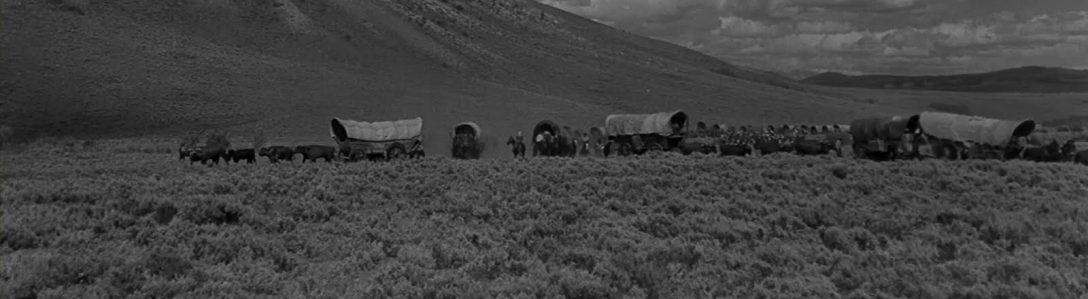
SOMETHING TOUGH: BODY AND SOUL and FORCE OF EVIL

July 31, 2012

Screen Shot 2020-02-05 at 12.40.26 PM

“According to materials contained in the PCA [Production Code Administration] files in the AMPAS Library, PCA director Joseph I. Breen objected to ‘the completely anti-social basic theme of this story, which presents wrong as right and right as wrong, in violation of both the letter and spirit of the Production Code.’” –Force of Evil entry, American Film Institute Catalog

In 1946, John Garfield’s contract with Warner Brothers expired. Instead of re-signing, or moving to another studio, Garfield signed on with the independent Enterprise Productions. Bringing together a group of artists who were communists, or communist sympathizers, Enterprise made an inflammatory group of nine films before folding, after which many of its members were blacklisted, including directors Robert Rossen and Abraham Polonsky. Two of their features, Body and Soul (1947) and Force of Evil (1948), respectively, ended up in the Republic Pictures library, and are being released today on Blu-Ray from Olive Films, in strong transfers. Garfield was eager to make a statement with Enterprise, telling PM Magazine in this period that:

I want to make pictures with a point – I know I gotta continue to appear in pictures like Postman [The Postman Always Rings Twice, 1946]. I know I gotta retain my position of value at the box office, but I also want to be available in between for the kind of picture that’s harder to do but may turn out to be more interesting. Maybe in the next few years I’ll make so many mistakes I’ll kill my career. I can afford the chance. There’s fear in Hollywood about tackling dangerous subjects, difficult subjects. I feel I owe it to myself to be available when some enterprising people want to try something tough.

Enterprise productions was formed by David L. Loew, Charles Einfeld, and silent partner A. Pam Blumenthal. Loew was a son of MGM founder Marcus Loew, and left the studio to pursue an independent producing career in 1935, working with directors like Jean Renoir (on The Southerner (1945)) and Albert Lewin (The Moon and Sixpence (1942)). Einfeld was the former advertising and publicity director at Warner Brothers, and therefore familiar with Garfield, while Blumenthal helped them garner a $10 million line of credit from Bank of America to finance their first six films. Garfield and his business partner Bob Roberts set-up their Roberts Productions shingle under the Enterprise banner.

It was an idealistic endeavor, which actor Norman Lloyd described as “Nirvana”, and then-Assistant Director Robert Aldrich judged that, “For about two and a half or three years before it went down the drain, I would guess that it had a better esprit de corps, and more interest and excitement going for it among the employees, from the laborer to the star, than any place in Hollywood.” Garfield and Roberts’ first film at Enterprise was Body and Soul (1948), and the talent on-board is staggering. Along with Aldrich as AD, it attracted Rossen as director, Polonsky as screenwriter, James Wong Howe as cinematographer and Robert Parrish as editor. Dialogue director (and later a director period) Don Weis told Garfield biographer Robert Nott that “I was amazed that everyone in the company with the exception of [cameraman] Jimmy Howe was involved politically. Every day they [Polonsky, Roberts and Garfield] would come down from the office with a petition for us to sign, for good things like housing for the poor, and I signed everything. “

Garfield bought the rights to the life story of Barney Ross, a Jewish boxer and decorated WWII soldier who was born on Rivington St. in the Lower East Side of NYC, just like Garfield. Ross was born Dov-Ber Rosofsky, son of a Talmudic scholar, while Garfield was originally named Jacob Garfinkle, born to a clothes presser and part-time cantor. It was a deeply personal story to Garfield, although the story’s ethnic character was drained by the PCA, who even objected to showing bouts between a black and a white fighter, although the fight between Garfield and Canada Lee remains in the film. The script had to be heavily revised by Polonsky in any case, telling a profoundly sad version of the familiar rise and fall boxing narrative, as Charley Davis (Garfield) spurns his neighborhood sweetheart and family for the lure of big money promised by mobbed up promoter Roberts (Lloyd Gough). Charley’s Jewishness is never stated directly, but is strongly implied by a neighbor who states that, “over in Europe, Nazis are killing people like us, just because of their religion. But here, Charley Davis is champion.”

The previous winter the N.Y. State Boxing Commission investigated bribery charges, to much publicity and little results, which inspired the powerfully damning depiction of corruption in the Roberts character. His money instantly degrades, as seen when punch-drunk Ben (the civil-rights activist Canada Lee) refuses to take the bills Roberts contemptuously throws onto the ground at his feet. Ben refuses, but Charley picks it up and forces him to take it, telling him that cash has no memory.

This off-hand character moment in Body and Soul becomes the central theme of Force Of Evil (1948), in which the phrase is turned around into, “money has no moral opinions”, and capitalism exists as a pit of despair in which all of the film’s characters sink. J. Hoberman writes in An Army of Phantoms that “The threat in this openly anticapitalist gangster film is the system itself.” Both written and directed by Polonsky this time (adapted from Ira Wolfert’s 1943 novel Tucker’s People), it retains many of Body and Soul‘s crew, including Aldrich and Weis, although now George Barnes would handle the cinematography’s canted angles and haunting chiaroscuro. The compositions often look like they are for a horror film, with the monster around every corner. The largest bogeyman in this stretch of Wall Street is Tucker (Roy Roberts) a mobster looking to take over the numbers rackets in town, aided by Joe Morse (Garfield), a convictionless lawyer. Tucker even wants to absorb the Mom and Pop bookie service run by Joe’s brother Leo. This relentless amassing of power, with little regard for the welfare of its workers, is the bluntly drawn and bleakly devastating metaphor for the post-war capitalist system that Polonsky and his collaborators were agitating against.

They lost. Enterprise Productions’ largest production, Arch of Triumph (1948), was a box office disaster. Set among refugees in pre-WWII Paris, they again attracted great talents, including Ingrid Bergman and director Lewis Milestone, but their investment went bust. So just as Force of Evil’s indictment of capitalism was hitting screens, Bank of America was seizing the assets of Roberts Productions, after their failure to make their loan payments. Garfield, Polonsky and Rossen were called before the House Un-American Activities committee in 1951, refused to name names, and were blacklisted. Garfield then died of a heart attack on May 1st, 1952.

HATE BINGES: THE BIG HEAT AND THE LAWLESS

May 22, 2012

Screen Shot 2020-02-03 at 4.55.38 PM

The post-WWII economic expansion exploded in 1950, as the GI Bill’s low mortgage rates stoked a housing boom and pent-up consumer demand propped up retail. Success was there for the taking, but not for all. Two early 50s films that are hitting home video in impressive transfers,  Joseph Losey’s The Lawless (1950, on DVD 5/29 from Olive Films) and Fritz Lang’s The Big Heat (1953, now out on Blu-Ray from Twilight Time), documented some of the anxieties caused by this enormous upheaval in American life, what would be the start of the greatest stretch of economic growth in U.S. history. More money meant more crime, and The Big Heat is a nightmare rendering of the American Dream, as good cop  Glenn Ford loses his nuclear family and just goes nuclear. The Lawless is an earnest morality play about the plight of migrant fruit pickers in Southern California, doing the work Americans left for office gigs (by 1956 a majority of U.S. workers held white rather than blue collar jobs).

The Big Heat is premised on a divide, the one between Detective Dave Bannion’s middle class abode, a blandly utilitarian ranch house, and the glittering homes and hangouts of the criminal class, like hired muscle Vince Stone’s (Lee Marvin) plush penthouse apartment. As Tom Gunning wrote in his seminal Films of Fritz Lang, The Big Heat, “moves through this contradictory environment whose smooth surfaces mask the fissure  between the good life for the few and the cramped and hectic worlds of the mass of people”.

It was based on a novel by William P. McGivern, originally serialized in the Saturday Evening Post. The script was written by Sydney Boehm before Fritz Lang was officially hired on to the project in mid-February of 1953. Lang biographer Patrick McGilligan notes that Boehm was a police reporter on the New York Evening Journal, and that “his specialty was crime…”. The script he delivered was a spare, unflinching tale of corruption, that which kills the wife of Detective Dave Bannion (Glenn Ford), and leads to his vigilante-like quest to take down Mike Lagana’s (Alexander Scourby) crime syndicate. Lang renders Boehm’s straightforward revenge tale with an abstracted intensity, the cold open suicide rendered in massive disembodied close-up of a hand on a revolver, followed by an off-screen gunshot. Lang does not use an establishing shot, breaking the film into pieces that Detective Bannion will struggle to re-connect.

Ford is unduly stressed throughout, on the perpetual edge of exhaustion, his speech clipped into little shotgun blasts of bile that anticipate Charles Bronson’s monotonal delivery a decade or so later. Even when in possession of his nuclear home, he seems uneasy, the jollity forced. His wife, played by Jocelyn Brando, emits a generic housewifely cheer, as if Bannion just wandered onto the set of the Donna Reed Show (which wouldn’t premiere until 1958, but please indulge me). When Bannion’s home is emptied out, it feels more like reality, and the middle-class fantasy the dream. Seeing the rage in Bannion’s eyes, an ex-partner on the force tells him, “you’re on a hate binge.” And so he is, blithely stampeding into Lagana’s nightclubs and mansion, more locales in which he doesn’t belong, with his old dark trenchcoat and faded fedora, suspicious of everyone and belonging nowhere. It is with the entry of Debby Marsh, that childishly erotic creation of Gloria Grahame, that Bannion finds another lost soul, uncomfortable in furs and then in her own skin, when Vince Stone famously scars her face with a pot of coffee (off-screen, like the suicide). Their bond is brief but intense, as each have been ripped away from their place in society. Debby tells a fellow female schemer that they are “sisters under the mink”, but she and Bannion are comrades in hate.

The Lawless was the second film Joseph Losey directed in Hollywood, and he would only be able to make three more before he was blacklisted and had to move overseas. He followed up the anti-war fable The Boy With Green Hair (1948) with this socially conscious drama, which he shot on location in Marysville and Grass Valley, CA in 18 days. He would continue to exploit real locations in his work, used to spectacular effect inThe Prowler (1951) and his remake of Lang’s (1951), in which Southern California becomes a tomb of broken American dreams.

The script was written by Daniel Mainwaring (using his  pseudonym as a mystery novelist, Geoffrey Homes), who would also come under some scrutiny by HUAC, although he was able to work sporadically during that period. Mainwaring’s script hearkens back to the social-realist films of the ’30s, like King Vidor’s ode to communal living, Our Daily Bread, within a completely different political landscape. Anything that smacked of Communism was suspect, so the film’s plea for racial tolerance, and unflattering portrayal of the local police force, came under scrutiny from the Production Code Administration’s Joseph Breen. Here is his amazing note to the film’s distributor, Paramount, as reproduced in the AFI Catalog:

The shocking manner in which the several gross injustices are heaped upon the head of the confused, but innocent young American of Mexican extraction, and the willingness of so many of the people in your story to be a part of, and to endorse, these injustices, is, we think, a damning portrayal of our American social system. The manner in which certain of the newspapers are portrayed in this story, with their eagerness to dishonestly present the news, and thus inflame their readers, is also, we think, a part of a pattern which is not good. The over-all effect of a story of this kind made into a motion picture would be, we think, a very definite disservice to this country of ours, and to its institutions and its ideals….This whole undertaking seems to us to be fraught with very great danger.

However great the danger, Paramount did not greatly alter the film, in which circulation-obsessed newspapermen rile up the public into a frenzy around the story of Mexican “fruit tramp” Paul Rodriguez (Lalo Rios), accused of killing a cop. Already convicted in the court of public opinion, only the stalwart editor Larry Wilder (MacDonald Carey) stands to defend the kid, inflaming the populace to ransack his office. It’s a scene of destructive power, one of the few instances where the theme is illustrated by action rather than static speechifying. This reckless, irrational demolition of a newspaper office, fueled by race hatred, dwarfs the liberal pieties of the rest of the film, which turns Wilder into the hero at the expense of Rodriguez. In plotting action, mostly in long takes, Losey proves he could express his social critique through more subtle means, which he would succeed at in the haunting machinations of The Prowler, one of the great films of 50s middle-class malaise, right alongside The Big Heat.

EDWARD L. CAHN’S YOU HAVE TO RUN FAST (1961)

April 10, 2012

Screen Shot 2020-02-03 at 4.11.33 PM

Edward L. Cahn directed 11 films in 1961, and You Have to Run Fast was one of them. MGM recently released it on their DVD burn-on-demand service in a crisp transfer, making it easy to appreciate the thriller’s tight construction and  open-air location shooting. The AFI Catalog lists no production dates but it was undoubtedly completed in a week or two before Cahn and producer Robert E. Kent moved on to the next programmer (17 of which are now streaming on Netflix). I was tipped to Cahn’s work by Dave Kehr’s “Further Research” column in the November/December 2011 Film Comment, where he says, “Cahn…seemed to embrace the aesthetic of speed with a passion and personal commitment not always apparent in the work of his more feverishly productive Poverty Row peers.” Cahn reportedly filmed “an astonishing 40 setups a day”, but as You Have to Run Fast clearly shows, they flow with an ironclad visual logic, and establish a moral equivalency between a mob boss and the innocent he is tracking down.

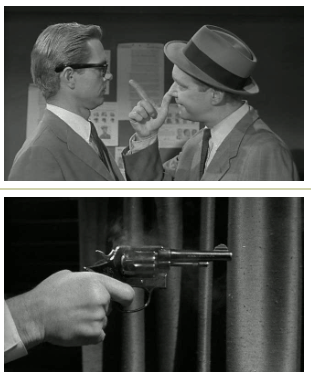
Dr. Roger Condon (Craig Hill) is at the wrong place at the wrong time, although that tends to happen when you run a private “Day and Night” medical service. Two goons dump a pummeled detective at his feet, who then dies moments later. Condon is now the only eyewitness to the two killers, whom he IDs to the police. Unwilling to be put into protective custody and close down his practice, a guard is assigned to him, who is promptly gunned down in the next sequence (see top images). Accurately appraising the skill of the cops, Condon changes his identity and leaves town. Authorities rarely come off well in Cahn’s work – an entire city is for sale in Afraid to Talk (1932) – resulting in what Kehr describes as Cahn’s worlds of “cruelty and callousness”. Condon shaves his ‘stache and turns up as “Frank Harlow” in quiet Summit City, where he counts down the hours before killer kingpin Craven (Grant Richards) tracks him down.

Not as fatalist as the Depression-scarred Afraid to TalkYou Have to Run Fast offers the possibility of starting anew. In Summit City (shot somewhere in woodsy Northern California) Condon forms a makeshift family with wheelchair-bound Colonel Maitland (Willis Bouchey) and his smitten daughter Laurie (Elaine Edwards). The Colonel is a Korean war vet who lost his legs from a mine and is eager to be useful again, while Laurie is going stir crazy as a pacifist in a hunting town. Condon allows the Colonel to exercise his hibernating machismo (rifle lessons), while offering Laurie some much-needed intellectual (and the possibility of physical) stimulation.  As Craven has trouble finding Condon, he notes matter-of-factly that, “there are a lot of guys hiding out in this country”. Condon is part of a nation of dissemblers hoping their next lie will lead them to the land of milk and honey, and he, for the moment, has found it.

As Craven hides from the police, Condon hides from Craven, and Cahn merges them closer together visually through match cuts. Both men are entrapped by events and enclosed in spartan accommodations.  Cahn rhymes images of them pensively reading the paper and snapping at their respective lady friends, and Condon is shown spying on the thugs who  spent the previous scene trailing him. Regardless of how they began on the moral spectrum, they become more and more alike. They are only “hero” and “villain” by the necessities of the plot; character-wise Cahn flattens their differences as much as possible, even having Craven apologize to Condon in the final shootout, in which they wear matching plaid hunting gear.

Cahn’s instinct for upending genre archetypes leads him to create the most entertaining characters in the film, Craven’s bumbling hired goons Bert (Shepherd Sanders) and “Toothpick Stan” (John Apone). Instead of sadistic mercenaries, they are an inquisitive if dense kind of comedy duo, with Bert playing the epicene straight man and Stan the mealy-mouthed punchline. Stan works his cheeks like a bellows before squeezing out lines like, “Why would the doc pick a jerkwater burg like this to hide out?” Bert then has to explain the whole concept of “hiding out”, his pinched gerbil face overactive at the effort. When they exchange their dunce parlance You Have to Run Fast becomes a downright light-hearted escapade, with Cahn’s dark worldview only peeking back in with the main narrative line.

The finale wraps up every little thematic nugget in resoundingly efficient fashion. The Colonel is tasked to return into action with his sniper rifle, Condon declares his love for Julie, and Craven is magnetically attracted to his double, arriving in Summit City and inevitably breaking down the door of the Maitland’s cabin, finally occupying the same diegetic space as Condon (who is hiding in the basement below). Obviously only one of these men can survive, now seeming like split parts of the same personality, and the big gunfight is framed in an abstracted long shot, the men dots in a  pointillist frame. When they finally converge, in the backseat of a sports car, Condon is the one holding the gun, so he gets to play the hero, get the girl and occupy center stage. In Cahn’s universe though, a hero is just a villain with an assumed name (and vice versa), giving this black & white cheapie an unsettling worldview that is assuredly shades of grey.

LOOK HOMEWARD, STANWYCK: NO MAN OF HER OWN (1950)

March 27, 2012

Screen Shot 2020-02-03 at 4.08.45 PM

Onscreen, Barbara Stanwyck was rarely the nurturing type. She became an icon because of her persona of fearsome independence, her justifiably shameless arrogance next to godliness. So it’s jolting to investigate the byways of her career, in which she played off type, including her elegiac performance in Mitchell Leisen’s noir, No Man of Her Own (released on DVD today by Olive Films). Playing the vulnerable and doomed Helen Ferguson, Stanwyck exhibits a touching passivity in the face of a world continually conspiring against her.

The movie was based on a Cornell Woolrich short story, “They Call Me Patrice”, that he published under the pseudonym William Irish in Today’s Woman magazine. He later expanded it into a novel entitled I Married A Dead Man. Optioned by Paramount, it was adapted into a script by Sally Benson. Leisen later claimed he rejected Benson’s version, and wrote an entirely new screenplay himself, with help from Catherine Turney. Benson and Turney receive the only on-screen credit, since Leisen was not a member of the Screen Writer’s Guild. In the American Film Institute’s notes on the film, it is stated that the PCA refused to approve the script, as supposedly Helen was a prostitute in the original. It would only be passed if Leisen agreed to kill her off at the end, to pay for her “sin”, so instead any reference to her streetwalking was eliminated.

Helen Ferguson is pregnant and penniless after getting dumped by her playboy boyfriend, Stephen (Lyle Bettger), his parting gift a train ticket out of town. The train crashes, and in the confused aftermath Helen is identified as Patrice Harkness, a pregnant newlywed who died in the disaster with her husband. Desperate to start a new life for her child, Helen pretends to be Patrice, whom the Harkness family had never met in person. She passes off her ignorance as trauma from the crash, which raises the suspicion of Bill Harkness (John Lund), Patrice’s brother-in-law. When Stephen reappears and begins blackmailing Helen, she will have to choose between revealing the truth – or remain forever in his oily grip.

Stanwyck exudes helplessness and inertia from the opening frames, as she speaks in resigned tones in a voice-over, with the camera slowly dollying forward toward an idyllic home. “Summer nights are pleasant in Caulfield… But not for us. Not for us.” The camera continues to track through the interior of the home, its progress slow and funereal, the empty, shadowed hallways as quiet as a mausoleum. In the first glimpse of human life, Stanwyck stills her face into the soullessness of a wax figure, while Bill is sweatily reading Thomas Wolfe’s Look Homeward, Angel. Stanwyck: “I love him, and he loves me. I know he does. But someday he’ll pack and leave.” She says these lines with calm resignation, accepting her role as the plaything of fate, her tragedy as destiny.

To initiate the flashback which will describe how she came to this state, Leisen blacks out the screen except for her tired eyes. Stanwyck is always on the edge of exhaustion, moving slowly and deliberately, approaching everything with circumspect weariness. Leisen emphasizes this with the dreamy unreality of his style, which truncates scenes with enigmatic ellipsis and pumps up background noise to unreal levels, the world constantly having its say over the characters in its sway, the rattle of the train tracks insinuating themselves into Helen’s skull.

With the crash, what had been a tragedy turns also to nightmare, with Leisen’s imagery becoming more unhinged. The camera twirls 360 degrees upon the smash-up,  enters  Helen’s unconscious POV as she is anesthesized before giving birth, from which she will awake as Patrice, and a rich woman. Bill tells her, “You were born the day I met you”, but as what? For Helen/Patrice, the mask continually slips, and it’s unclear whether she’d want either face anymore, one a poor wastrel and the other an anxiety-ridden liar. Stanwyck’s passivity shades into nihilism, the turn coming when she realizes that her only way out of her predicament is cold-blooded murder, which she accepts with equanimity. The too-happy ending absolves her of these crimes, but the glint in Stanywck’s eye is far more troubling than what the Production Code Administration presumably censored.

In his New York Times review, the reliably condescending Bosley Crowther said that, “This sort of female agonizing, in which morals are irresponsibly confused for the sake of effect, makes diversion for none but the suckers, we feel sure.” Count me among the suckers. It is a profoundly unsettling film, and proof positive that Stanwyck could play crumbling facades as well as gleaming monuments.

DVD TUESDAY: LATE LANG

May 3, 2011

Screen Shot 2020-01-29 at 4.00.19 PM

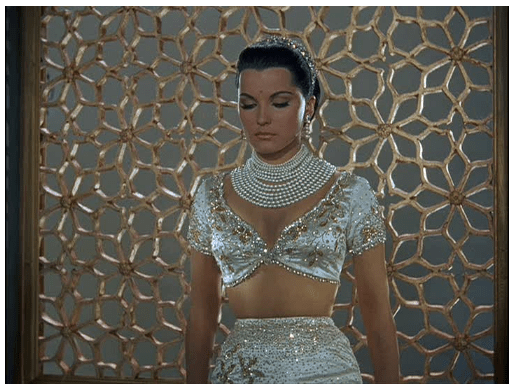
In a bit of home video serendipity, the films Fritz Lang made in Hollywood and Germany from 1956 – 1959 were all recently released on DVD. The Warner Archive put out re-mastered versions of his last two Hollywood films While the City Sleeps (1956) and Beyond a Reasonable Doubt (1956), while the UK Masters of Cinema label produced a luminous edition of his two-part Indian epic, The Tiger of Eschnapur (1959) and The Indian Tomb (1959). All four films snare their main characters in webs of malevolent fate. The first two pin their characters inside geometrically arranged compositions, granted the illusion of motion in a world constantly boxing them in. This is garishly illustrated in the Indian Epic, as seen above, with elaborate imagery of imprisonment emerging from the set design. They use strikingly different methods to pursue similar ideas of fate and desire, from threadbare pulp to embroidered imperialist myth.

After the financial failure of the astonishing Moonfleet (1954), which had his highest Hollywood budget at $1.9 million,  Lang was finding it difficult to attract studios’ attention. So when producer Bert Friedlob offered him a modest two-picture deal with distribution through RKO, he accepted. The two titles were prepared simultaneously, according to Lang biographer Patrick McGilligan, and the director split his time between the screenplays – working with Casey Robinson on While the City Sleeps and Douglas Morrow on Beyond a Reasonable Doubt. Both were shot in SuperScope, and the Warner Archive is releasing them in a 2:1 aspect ratio, which looks just about right to me.

Both plots contain what Tom Gunning called “a double goal, in which the main action the characters undertake is given a double motivation by an authority figure.” For While the City Sleeps, the main plot follows a serial killer, in which the sexually repressed mama’s boy Robert Manners (John Drew Barrymore) is tracked down by the investigative reporter Edward Mobley (Dana Andrews). The double goal is given by the petty new newspaper owner Walter Kyne (Vincent Price), who dangles a new executive manager position to whomever can crack the case. The reporters’ betrayals and insane drive to scoop the story often overshadow the killer plot, and seem almost more inhuman.

In Beyond a Reasonable Doubt, the Dana Andrews character Tom Garrett is on trial for murder. The shadow story is that his former news editor Austin Spencer hatched a plan to manufacture circumstantial evidence for the trail, in order to get a conviction. Once convicted, Spencer would reveal the ruse, proving that innocent people could be condemned to death without a smoking gun.  As Gunning writes, in his indispensable study The Films of Fritz Lang, “in both cases suspenseful stories of crime and punishment are framed within journalistic investigations.” Both films interrogate their own premises through these creator figures that, like Lang, initiate stories they soon discover they don’t have control of.

Walter Kyne, played with an oily buffoonery by Vincent Price, inherits the company after his father’s untimely demise. Clearly a pampered, narcisstic creature, he promptly chooses to use the newspaper as his own private penny dreadful theater, siccing the reporters against each other in his perverted “contest”. Lang sets out the space of the office as entirely open and visible – everyone can see each other’s performances at all times. In an early sequence the manager of the wire service, Mark Loving (George Sanders) is seen whispering into his secretary’s ear. They are framed in a glass window as if on television, and Mobley is watching them from across the room. He calls her to break it up. Everyone is the center of their own panopticon, everyone in the office having the all-seeing powers of a previous Lang mastermind like Dr. Mabuse.

As the reporters race around to save their future inside these all-public spaces, the killer Manners still stalks the streets. Mobley lures him into town with a baiting television broadcast – the televisual as another kind of all-seeing eye boring into even the psycho’s shabby apartment. Let out into the open, Manners stalks Mobley, and stumbles into another space of hyper-visibility, the bar down the street. Stumbling downstairs, he finds the ace investigative reporter and TV personality canoodling with the woman’s advice columnist Mildred Donner (Ida Lupino). Even the killer cannot escape this public theater that Kyne has introduced.

Beyond a Reasonable Doubt flattens the theatrical world of While the City Sleeps into strips of men standing next to walls. Where there was depth in the newspaper office, here there is nothing but static two and three-shots, everything pushed close to the foreground of the frame. It is so pared down it amounts to the characters simply standing and telling the story to the camera, as in the modernist distancing of Manoel de Oliveira’s Francisca, in which his characters stare at the camera and read the dialogue from Agustina Bessa-Luís’s 1979 novel Fanny Owen. Jacques Rivette saw something similar in his review of the film for Cahiers du Cinema in 1957:

The first point that strikes the unsuspecting spectator, a few minutes into the film, is the diagrammatic, or rather expository aspect instantly assumed by the unfolding of the images: as though what we were watching were less the mise en scene of a script than simply the reading of the script, presented to us just as it is, without embellishment.

[…] No concession is made here to the everyday, to detail: no remarks about the weather, the cut of a dress, the graciousness of a gesture; if one does become aware of a brand of make-up, it is for purposes of plot. We are plunged into a world of necessity…

This world of necessity was partly brought about by the low budgets Lang was working with, but he turned that to his thematic advantage, the spartan set decoration and limited set-ups illustrating the mechanics of the crime thriller itself. The editor and writer are shown planting evidence and documenting the planting of this evidence, authoring their own crime movie in the middle of a crime movie. Eventually they get caught in the machinery of their construction, and the brutal ending shows a man lost inside of his own story.

Where Beyond a Reasonable Doubt is spartan, the “Indian Epic” is overstuffed, a lavish spectacle that is beloved (and screened) at the same level as It’s a Wonderful Life in Germany, according to this article in Rouge (Lang’s is the third version of the film. He was slated to direct the first version in 1921, scripted by his future beau Thea Von Harbou, but producer Joe May took the reins instead to great success. Tom Gunning has written an exemplary essay that includes all this and more in the Masters of Cinema set). A German architect named Harald Berger (Paul Hubschmid) is contracted to expand the made-up fortress city of Eschnapur in India. He soon falls in love with the religious dancer Seetha (Debra Paget), whom the Crown Prince Chandra (Walter Reyer) is madly in lust with. This love triangle pulsates for over three hours in various permutations of escape and capture.

As a representation of India, the movies are ridiculous, a hodgepodge of sparkly costumes and wild misrepresentations of religious ceremonies. But as a lesson in how visual style can convey inner tensions, it’s rather wonderful. It begins in the set design of Willy Schatz, who helped create the never-ending web imagery that will snare every character in turn. In one telling sequence, Seetha has been corralled by the Prince into one of his chambers. She is kneeling in front of a gold cage, the imagery more than obvious. But the next cut is to the Prince leering through one of the web-like grates in the wall, looking more imprisoned than Seetha, who is situated outside the cage. But the Prince is tied by heredity to this intricately designed fortress-mansion, and is doomed to love a woman who will never love him back.

These set patterns weave their way throughout the film, with geometric shapes filling the space behind the Prince’s head during Berger’s arrival, a real cobweb that hides a fleeing Berger and Seetha, and the high-angle shots which turn regular courtyards into clashes of giant rectangles. The fortress contains prisons within prisons, until Berger is stashed below the surface of the mansion, in a deep well in a network of catacombs located beneath the mansion. The space envelops everybody, rendering them mute and impotent against their implacable fate. The happy ending involves another escape, but since the film is based on a cyclical rhythm of freedom and capture, perhaps Lang just elided their eventual return to this venus fly trap of cities, which wraps the characters in its vise-grip jaws, never letting them go.

FOR THE LOVE OF FILM (NOIR) BLOG-A-THON: THE SOUND OF FURY (1950)

February 15, 2011

Screen Shot 2020-01-28 at 4.54.52 PM

The For the Love of Film (Noir) Blog-A-Thon began yesterday, and it’s my turn to jump in. The monster-sized Lloyd Bridges stomping on a panicked populace gives my subject away: The Sound of Fury (aka Try and Get Me!, 1950).  This whole event is raising money for the Film Noir Foundation’s efforts to restore it. Cy Endfield’s 1950 scorcher about a botched kidnapping job and the mob frenzy that follows is available to watch now on Netflix Instant, so everyone can see how important it is to get pristine 35mm prints of this back into circulation.

Jo Pagano adapted his own 1947 novel, The Condemned, into the screenplay, which is a fictionalized version of the  murder of Brooke Hart in 1933. The same incident was also the basis for Fritz Lang’s Fury (1936). Hart was the son of a successful department store owner in San Jose, California.  Thomas Harold

Thurmond and John M. Holmes drove Hart to the San Mateo-Hayward Bridge, hit him over the head with a concrete block, and tossed him into the San Francisco Bay. They then called Hart’s parents, demanding $40,000 for his release. After they were caught, the local papers spread the news that Thurmond and Holmes would plead insanity, enraging the populace. The Lindbergh Baby fiasco occurred the previous year, part of a wave of ransom kidnappings that hit Depression-scarred America, and people were in a vengeful mood. On November 27th, an angry mob stormed the jail, pulled out Thurmond and Holmes, and hung them until they were dead.

The Sound of Fury centers the story on one of the kidnappers, here named Howard Tyler (Frank Lovejoy). In Cy Endfield’s hard-bitten world, everyone is in it for the money. Howard is an out-of-work father, who moved his family to California with the hopes of hitting it big. Instead he drinks by himself at a bowling alley bar in the afternoon, where he spies Jerry Slocum (a styling Lloyd Bridges) knocking down pins. Jerry, smelling desperation, hooks Howard with the promise of a job offer. In a scene of startling homoeroticism, Jerry brings Howard to his apartment and shows off his rippling pectorals, urges him to feel his silken shirts, and then drops the offer to be his wheelman on some gas station robberies.

Howard reluctantly agrees, with the shadow of poverty inching over his unshaven visage. He starts coming home flush with cash, promising his wife a TV of their own and a full bag of potato chips for his son, who is startled at such abundance. It soon becomes clear that Jerry is equally desperate, running on cologne fumes and his own braggadocio. He’s filled with class resentment, a clotheshorse who can’t afford the best.   He comes up with the kidnapping scheme, partly out of greed, but also malice. When their victim says he gets his suits tailored in NYC, the look of apoplectic rage on Bridges’ face is overwhelming. Later, when he snaps and smashes a guy’s face in with a cinder block, it’s no surprise.

These two petty thieves are contrasted with Gil Stanton (Richard Carlson), an upwardly mobile newspaper columnist whose outdoor BBQ would feed Howard’s family for weeks. It’s his columns that stoke the city’s rage regarding Jerry’s crime, including their possible insanity defense. Endfield’s repeated emphasis on economic issues makes Gil’s world almost grotesque. He only agrees to cover the case because his editor promises him a bonus, and the editor is chasing the story because blood moves papers. Everyone is corrupted, but because of his upbringing Gil doesn’t have to choose between crime and starvation.

Once Howard and Jerry are imprisoned, the film’s POV shifts to Gil, who undergoes a moral conversion upon seeing the violent rage his columns have provoked in the public. This section is problematic, simply a series of moralizing speeches about the humanity of everyone, even killers. The rich atmospheres of the first two-thirds give way to Gil’s tasteful living room. Endfiled was clearly not as invested in Gil’s milquetoast character, or the middle-class milieu he inhabits. The richly drawn, neurotic characters of Jerry and Howard are let go for cardboard cut-outs of moral propriety.

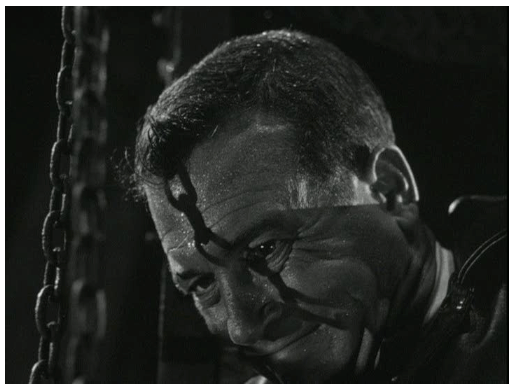
But thankfully this is just an interim, for the kicker is the nerve-jangling lynching scene, shot with little dialogue and unflinching brutality. In roiling chiaroscuro, the mob tears through the ineffecutal puffs of tear gas and battles their way into the jail cells. Lloyd Bridges wrenches his face into a beaming psychotic grin, an act of stunning bravado in the face of certain death, as the lynch mob ranges closer. Frank Lovejoy, as Howard, had played it quiet and morose throughout, as if he were already beaten in the opening frame. When they drag him away, past the mute, beaten faces of Gil and the police officers, there is no one left to help, and no cash to set him free.

MGM MOVIES-ON-DEMAND: 99 RIVER STREET (1953)

February 8, 2011

Screen Shot 2020-01-28 at 2.47.21 PM

With little fanfare, MGM re-started its moribund DVD burn-on-demand service last month. MGM originally offered 27 titles through Amazon’s CreateSpace service in early 2010, only to encounter complaints about cropped aspect ratios. Then last November, it was quietly announced that they were switching to Allied Vaughn’s MOD technology, and making it available to a variety of retailers (now including Movies UnlimitedOldies.comScreen Classics, and Amazon). It’s unclear whether the original MOD titles released in non-anamorphic or cropped versions (like Cold Turkey), will receive updates, but to be safe, I’d stick to the new releases and check the Home Theater Forum for news. The initial release slate is 50, with “an expansion plan to release more than 400 new-to-DVD titles within the next 18 months” (press release here). The first batch of these were rolled out in January, so to get a sense of this promising new venture’s quality, I picked up director Phil Karlson’s caustic film noir, 99 River Street (1953).

(Note:  The For the Love of Film Noir Blog-a-thon, hosted by Ferdy on Films and The Self-Styled Siren, takes place Feb. 14th – 21st to raise money for the Film Noir Foundation‘s efforts to restore Cy Endfield’s The Sound of Fury (1950). I’ll be contributing next week, so consider the following a teaser.  Donate here.)

Presented in a fine progressive transfer from a pristine inky black print, it’s clear MGM is taking their MOD program seriously this time around. [UPDATE: DVD Beaver found the transfer to be interlaced. I didn’t notice this in playback, but they’re always right about these things]. There are no extras. Amazon is offering it at a slight discount for $17.99, while the other sites have it pegged at $19.99.

Made a year after Karlson and lead actor John Payne teamed up for Kansas City Confidential (1952, where Payne’s ex-con is set up to take the fall for an armored car robbery), 99 River Street is a story of failure and provisional redemption. In this version Payne plays Eddie Driscoll, a washed up pug who ritualistically watches the highlights of his championship bout defeat, in which his eye was permanently damaged, hoping for a catharsis that never comes. Repeatedly shown in oblique angle close-ups, his right eye twitches like a maggot in a slab of beef. His wife Pauline, played with icy disdain by Peggie Castle, is a cinched-up former showgirl who yearns for the high life and sees an out in the machinations of  thief Victor Rawlins (Brad Dexter).

Eddie’s meat-headed obsessiveness and Pauline’s extravagant boredom are set up in the opening sequence. It begins on the title bout, a barrage of low-angle jabs that ends with Eddie knocked bloody, his face caressing the bottom rope. Then Karlson cuts to a close-up of the TV, the announcers talking about “The Great Fights of Yesterday.” The camera then dollies back to get the full TV on-screen, then swiftly pans to left to Eddie. Now robbed of his physicality, this has-been still winces at every blow. Kalrson then cuts to a reverse angle, revealing the rest of the shabby room, with Pauline, ignored, seething at the dinner table. Their eyes don’t meet until she turns off the TV, finishing the announcer’s phrase, “Next week…Driscoll will be driving a taxi.” Her words drip with venom, and understandably so, but she ends up in the arms of Rawlins, a reptilian creep who seems to devour her whole with his eyes.

Enraptured with visions of escape from her working class life, Pauline falls for Rawlins’ sordid designs. His attraction to her becomes increasingly sadistic, which only become clear in rhyming images of her scarf, at the beginning and midpoint of the film.

The cuckolded Eddie does drive that cab, barely making ends meet, and hangs out at a diner with another failure, an out-of-work actress played by Evelyn Keyes with intentionally grating brilliance, whose whole life revolves around performance. Her overactive eyebrows eventually sucker Eddie in to be an unwitting co-star in an elaborate performance. It’s an incredible sequence that pivots on a long take, close-up monologue of Keyes re-enacting a murder she claims to have committed, which Driscoll believes to be real. Then the hoax is revealed – it was all an an audition to convince a play’s backers of her skill – and Driscoll’s subterranean rage bursts, knocking out the play’s director and a few of its producers. Keyes, staring at the camera, was acting out a murder for the audience, which is then revealed to be an act. She spends the rest of the film trying to make amends for this betrayal.

99 River Street is a tale of middling talents who can never catch a break, having to repress their natural skills just to get by. Without the physical outlet of boxing, Driscoll is a man in the process of mastering his rage and never quite getting there. In the final showdown, when Driscoll is facing up to the scummy Victor Rawlins, a voice-over intrudes for the first time in the film, as Payne, shot in the arm and fading fast, repeats the mantra, “I have to get him”. It’s the climax to all of those intrusive close-ups showing his decaying exterior,  a jarring device that peeks into the mind of a man who defines himself by his body.

MAGNIFICENT RUIN: SECRET BEYOND THE DOOR(1948)

September 14, 2010

secret

Before I start this week’s blather, I wanted to acknowledge the passing of the great Claude Chabrol at the age of 80. Dave Kehr’s NY Times obituary is here, the AP’s is here, and David Hudson has an exhaustive collection of links at MUBI. His filmography is massive (near 70 titles), and I’ve barely made a dent, but from what I’ve seen his impish deconstruction of bourgeois morality is a joy to watch. I saw La Ceremonie for the first time this year (Jonathan Rosenbaum re-posted his review of the film today), and its perfectly controlled, distanced cinematography masks a wholly degraded moral universe. He unveils hypocrisy with every cut, making films you peer underneath with trepidation. And through it all he’s a supremely funny guy – just check out his bumptiously perverse turn in Sam Fuller’s Thieves After Dark. Now it’s time to watch more…

Next Monday, September 20th, TCM is airing a 24-hour marathon of restorations performed by the UCLA Film & Television Archive. I’d recommend the entire block, from The Exiles through Killer of Sheep, but today I’m focusing on Fritz Lang’s 1948 curiosity Secret Beyond the Door. An unmitigated disaster at the box office, it led to the dissolution of his production company (Diana Productions), which he had established with Joan Bennett and Walter Wanger. Their short-lived success on Scarlet Street ended in back-biting and recriminations after Secret tanked. And yet it is one of Lang’s most beautiful films, shot by Stanley Cortez in sharply angled shadows.

Lang was against hiring Cortez, as Patrick McGilligan writes in Fritz Lang: The Nature of the Beast. He wanted to work with Milton Krasner again, who shot Scarlet Street, but the scriptwriting process dragged on, and Krasner took another job. Cortez was under contract to Wanger, and having already shot the atmospheric interiors of The Magnificent Ambersons, seemed to be an inspired choice for this very architectural film. But Lang clashed with him immediately, as Welles did on Ambersons, complaining about his slowness in setting up shots.  Regardless of their personal relationship, the results on-screen are mesmerizing. It is a film of shadows in corridors, with Joan Bennett etched into narrow enclosures, endlessly searching for masked entrances and exits. The film is made up of these portals, which open into Bennett’s psyche (displayed in repeated shots of mirrors) and her neurotic husband Mark’s (symbolized by a locked door).

As Tom Gunning details in his essential study, The Films of Fritz LangSecret arrived in the middle of a series of Gothic women’s dramas kicked off by Hitchock’s Rebecca (1940). The introduction of Freudian elements was also common. Gunning: “Using Freudian themes as new plot enigmas and as an excuse for dream sequences with Expressionistic or surrealistic visual elements were aspects the popular women’s film and the new art house fare shared in such films as John Brahms’ The Locket of 1946, the British The Seventh Veil of 1947; or most influential of all, Hitchcock’s 1943 SpellboundSecret is firmly in this tradition.”

The script by Sylvia Richards (adapted from a serial in Redbook by Rufus T. King) tells the dream-like tale of Celia(Joan Bennett), who falls in love with the quixotic architect Mark Lamphere. They quickly marry after an intense flirtation in Mexico, and Celia soon discovers that Mark was previously hitched, and has an erudite, distant son named David. David accuses Mark of killing his mother, and Celia soon suspects that she could be next.

It is heavily influenced by Rebecca and Spellbound, and fails to match those films on a narrative level. The motivations of the supporting characters in Mark’s imposing household are never clearly mapped out, and the psychoanalytical interrogation of Mark is reduced to, as Gunning says, “simply a matter of clearing up false impressions.” Reveal the repressed memory, and Mark will be healed. This is pop-psychoanalysis, but if one is able to separate the images from the overwrought plot mechanics, it is hypnotic, troubling work. The visuals tell the story of Bennett gaining control over her own consciousness, as Gunning convincingly argues. This is traced to the use of voice-over, one of the major bones of contention in post-production work on the film.

Lang originally recorded Bennett’s voice-over with a different actress, intending to convey the idea that one’s unconscious is a completely different person. As relationships broke down after shooting ended, Wanger and Bennett (who were married at the time), decided to re-record the track with Bennett’s voice, making Lang’s film more conventional (this idea of representing a woman with two different actresses was later pulled off brilliantly in Luis Bunuel’s That Obscure Object of Desire (1977).

In any case, the voice-over is used repeatedly in the first 3/4 of the film, with Bennett intensely questioning Mark’s true feelings, as well as her own. It is a tentative, insecure and deeply neurotic voice. The disconnect she feels is visualized by Cortez and Lang through a series of shots in which Mark’s back is turned during conversations. It is his gestural defense against the intrusion that Celia’s love continually presents, a bulwark against female intrusion.

Her self-doubting voice-over stops, however,  when she finally breaks into Room No. 7, the locked door Mark would not allow anyone to enter (entering the Bluebeard fable as another major influence). Mark is a collector of “felicitous rooms”, in which he reconstructs the boudoirs of murders, using as many original elements as possible. He believes that there is something about the structure of these rooms, and their things, that pre-determined the murders, in all of which men kill women. For Mark, architecture is a bloody destiny, an attitude Lang is clearly sympathetic to (i.e., his obsessive mapping of imprisoning city blocks in M). Celia is initially attracted to this death-drive of his, as they first meet watching a bloody duel and exchange erotic gazes. That their dual psychological issues could be solved like a whodunit is silly, but the power of the images often transcends the flimsiness of the material. As Gunning wrote, “One might describe Secret Beyond the Door as the ruin of a great film, or the ruin of a great filmmaker. Through its collapse, structures are revealed that are more astonishing than the more structurally sound edifices of lesser filmmakers.”

INTRODUCING OLIVE FILMS

July 27, 2010

Screen Shot 2020-01-24 at 1.45.40 PM

Like a herd of cattle ready to run down a restive kidnapper, Olive Films bursts into stores today with a phalanx of five DVDs licensed from Paramount Pictures: Union Station (1950), Appointment With Danger(1951), Dark City (1951), Crack in the World (1965), and Hannie Caulder (1971). A wholesale distributor and retailer of independent and art-house releases, Olive is now expanding its own acquisitions slate, starting with this brawny group of  genre titles. With multiple studios now experimenting with the mixed blessings of burn-on-demand technology (more releases, but higher prices and less quality control) for their library titles, it’s encouraging that a company is still willing to put out fully authored discs, in strong new transfers.

With the forthcoming, and essential, Josef Von Sternberg collection coming from Criterion, it’s clear that Paramount is becoming more aggressive in licensing its material.  Olive will release 27 Paramounts over the next year or so, including Nicholas Ray’s The Savage Innocents, Otto Preminger’s legendary and fascinating flop Skidoo, and Ingmar Bergman’s Face to Face. I spoke with the Director of Acquisitions and Sales at Olive, Frank Tarzi, and he confirms that much more is on the way. Olive has closed deals with multiple studios, and their future slate shows off adventurous and eclectic taste, with Tarzi confirming the following: Robert Aldrich’s Twilight’s Last Gleaming, Billy Wilder’s Fedora, Rainer Werner Fassbinder’s Despair, The Stationmaster’s Wife (uncut), and I Only Want You to Love Me (uncut), Abel Gance’s J’Accuse, Claude Chabrol’s Ophelia, and, most exciting of all, Jean-Luc Godard’s complete Histoire(s) du cinema.

But enough of the tantalizing future.  Union Station is a taut, architectural noir from Rudolph Maté, the ace Polish cameraman who lensed Carl Dreyer’s Passion of Joan of Arc and Vampyr. His career in Hollywood never reached those aesthetic heights, but he was a consummate craftsman with an eye for visual detail. Here he’s given a police procedural about the kidnapping of a blind girl, and although set in Chicago, much of it was shot at Los Angeles’ Union Station (Thom Anderson pinched some scenes for Los Angeles Plays Itself, his history of L.A. on film).

Maté maps out the station with a near 180 degree pan, taking in the information booth and the crowds before settling on the STATION POLICE HEADQUARTERS sign. In the same shot, he then tilts up to a filigreed window which houses the station’s security services, where William Holden barks irritated orders to his indolent staff. Knowing every inch of his turf, he seems to blend into the walls when peering around corners for the jowly perps he’s tailing. The attention to spatial detail turns the film into a documentary of Union Station, with the plot just an excuse for exploration.

Holden’s expertise is gained through repetition, and he looks appropriately bored throughout. It’s just his job, after all. In the study that essentially defined “film noir”, Raymond Borde and Etienne Chaumeton’s Panorama of American Film Noir, 1941-1953 (first published in 1955), the writers compare it unfavorably to He Walked By Night, but find some saving (violent) graces:

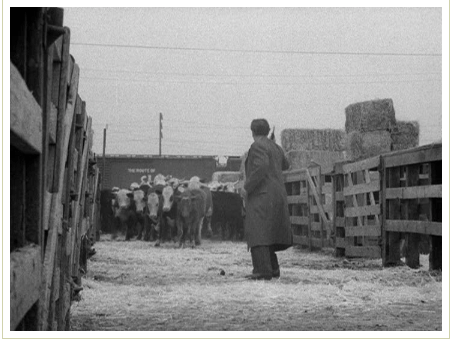
“The film is interesting, though, for showing how the security services of a big train station work. Aside from the ill-treatment inflicted on a blind girl by her kidnapper, there are two scenes of momentarily authentic noir cinema: a gangster flattened during his escape by a stampeding herd of steers maddened by gunfire [top image]; the pressing invitations to spill the beans exercised by the cops on an untalkative accessory to a crime. After giving him a working over using state-of-the-art methods, they drag him onto a platform overlooking the railroad track. “Make it look accidental,” the police inspector orders. When a train passes beneath, they grab hold of the “tough boy” and make as if to push him off [see left]. The guy immediately screams that he’ll “talk,” and he’s led away distraught, ready to sell out father and mother alike.”

Dark City is an altogether seedier affair, a story of greedy low-lifes who bilk a sucker out of his cash, driving him to suicide. No big deal, except the dead man’s psychopathic brother targets them for strangling. Charlton Heston, in his first starring role, is the most sympathetic low-life, Danny. But when the competition is Jack Webb at his sleaziest, playing a dirtbag named “Augie”, it’s not much of an accomplishment. Directed by Hungarian emigre William Dieterle in looming close-ups and dramatic chiaroscuro from DP Victor Millner (who has an incredible resume), it’s a woozy, sluggish and occasionally haunting noir about guilt, failure, class and forgetting. Danny is a college grad and army vet, and so, the police captain tells him, he has no excuse to live the life he does, not like the street boys he runs with.

Heston plays him as somnolent and dreamy, his every line pulled out with stubborn slowness, like Robert Mitchum on vicodin. It’s a hypnotically effective performance, of a man who no longer wants anything to do with his body. He repeatedly tells his ignored girlfriend Fran (Lizabeth Scott), of his need to be alone, but she still loves him anyway. James Naremore, who has written the best recent book on noir, More Than Night, offers an adolescent memory of the film in his introduction“What I remember best are the fetishized details – Lizabeth Scott’s unreal blondness and husky voice in Dark City, or Edmond O’ Brien’s rumpled suit as he runs desperately down the crowded street in D.O.A. [directed by Rudolph Maté]“. To that I’ll add one more: Harry Morgan’s fake upturned nose, a physical marker of his pugilist past and the cause of his punchy good humor. He’s been knocked silly once too many, but Morgan’s ebullient and melancholic turn makes him much more than a punchline.

Appointment With Danger re-teams Webb and Morgan, the future Dragnet partners, and this time they’re both hoods. They are planning a heist with the heavy-lidded Paul Stewart, but an errant corpse spied by a nun sets the plot machinery in motion. Alan Ladd is the cynical motor, an expressionless slab who is smart enough not to impede the snappy dialogue by Richard L. Breen (who would later pen the Dragnet movie) and Warren Duff (“Love is between a man and a .45 pistol that won’t jam”). He plays a postal inspector, one of the raft of government employees feted in procedurals of this era (including Holden in Union Station).

I relinquish the rest of this review to three separate pieces from Manny Farber:

“Appointment With Danger is a fascinating textbook on the Average American Flop – his speech, mien, sage misanthropy, doubt. It is also a well-done report on the geography of Gary, Indiana, a place that seems crowded with failures.”

***

“Tight plotting, good casting, and sinuously droopy acting by Jan Sterling, as an easily had broad who only really gets excited about – and understands – waxed bop.”

***

“A YMCA scene that emphasizes the wonderful fat-waisted, middle-aged physicality of people putting on tennis shoes and playing handball.”

***

And I will note one last notable occurrence: Harry Morgan’s quavering face as he gives a speech about his estranged son, protesting that he will not run off to St. Louis to avoid the heat of being named to the cops. His features are close to collapsing, but he re-harnesses them in a flush of machismo. He mentions his son’s bronzed booties. Webb than takes one of them and beats Morgan to death.

THE WOMAN ON THE BEACH (1947)

April 27, 2010

wotb2

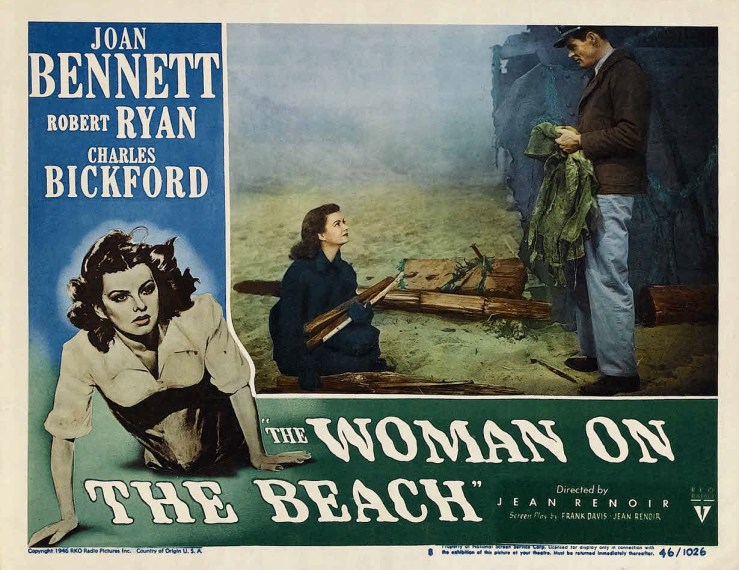
While the TCM Classic Film Festival was wrapping up out in L.A., I was pursuing my own personal Jean Renoir festival back in NYC. The Brooklyn Academy of Music is currently exhibiting a must-see retrospective that will hopefully tour a city near you. My personal highlight of the series so far is The Woman on the Beach, his last production in Hollywood, and by far his strangest, a somnabulist’s vision of a violent love triangle.  Its peculiar, almost abstracted plot was aided by extensive re-shoots after a disastrous preview screening, which trimmed out the exposition, leaving only the trio of lovers’ impulsive, and occasionally inexplicable actions.  Renoir had already pushed the visuals  in an oneiric direction, foggy, emptied-out landscapes of hollowed-out hulls and vertiginous cliffs. He even challenged his sound man to record the dialogue at an unusually low level, to emphasize the characters’ loneliness.

The pared-down result of the studio interference then, actually reinforces Renoir’s stylistic choices, and quite possibly made it a better film. This is exactly what Janet Bergstrom argues in her superb production history: “Oneiric Cinema: The Woman on the Beach”, which she published in the Film History journal in 1999. It is my main source for this post.

The story concerns a shell-shocked Navy vet, Scott (Robert Ryan), whose recurring nightmares of being torpedoed keep him in a constant state of anxiety. Attempting to banish these neuroses, he quickly proposes to his girlfriend Eve (Nan Leslie). After her skittish response, in which she is clearly shaken by his unhinged intensity, Scott begins a flirtation with Peggy Butler (Joan Bennett), who has been scarred by violence in her own manner. During a fight with her husband Tod (Charles Bickford), a painter, she accidently severed his optic nerve, blinding him for life. Bonding over their mutual traumas, they engage in a furtive affair, while Scott still manages a combative friendship with Tod. Ultimately driven to the brink of madness by their insecurities, Scott and Tod come into conflict…

Renoir recognized the strangeness of his conception of this film, describing it as “the sort of avant-garde film which would have found its niche a quarter of a century earlier, between Nosferatu and Caligari.” And emphasizing that its “subject was the opposite of everything I had been working toward in the cinema up to that point.” He went on:

The Woman on the Beach was a perfect theme for treating the drama of isolation. Its simplicity made all kinds of development possible. The actions of the three principal characters were wholly stripped of colourful detai; they took place in empty landscapes and in a perfectly abstract style…In all my previous films I had tried to depict the bonds uniting the individual to his environment…now I was embarked on a study of persons whose sole idea was to close the door on that absolutely concrete phenomenon which we call life.”

Renoir closes this door when he uses a dream sequence to introduce Robert Ryan. He begins as a nightmare. With the strains of “Home on the Range” ironically cooing in the background, Ryan imagines himself on a ship – followed by a massive explosion. He sinks to what looks like the bottom of an aquarium, where Eve is waiting for him in an evening gown with open arms. Right before he embraces her, there is another explosion. His war experiences are explicitly blocking him from a life with Eve, and dooming him to one of apparitions and hallucinations. He is like the character of Cesar from Caligari, motoring through his inexplicable deeds without a will of his own.

So when he begins to obsess that Tod is lying about his blindness, or insist upon a fishing trip in a rainstorm, he is operating solely on his unconscious drives – the neuroses engendered from battle. Peggy is on a similar path, wracked with guilt over stealing her lovers’ sight, and destroying his successful career as a painter. She is filled with hate for herself and with Tod, which can exhibit itself in improbably nurturing ways. As always with Renoir, “everyone has their reasons”, and it’s impossible to pin any of the characters down as the villain. All show flashes of sympathy and rage – Peggy snuggling on the couch with Tod, reminiscing about their youthful days in NYC, or Scott snapping from protective lover to vengeful cuckold. All three actors are fascinating to watch, and Renoir carefully balances their power relations in his fluid compositions [the most explicit is the interior boat shot above, where Scott and Peggy embrace inside while Tod is isolated in a separate plane outside the porthole].

Ryan is earnest and bereft, all-too-aware of his crumbling psyche and his inability to heal it. He has a seaman’s bearing that bends under the weight of the Butler household’s demands. Bickford is prickly and condescending as Tod, a bellowing ironist with an uneasy gait, his vast array of ascots unable to hold back the bile he irresistibly spews, mainly at his wife, who he delights in harming. Bennett is enigmatic and cold, her love of Tod turned to hate, but who still recognizes its original provenance. She shares her husband’s sarcasm and cynicism, but stays in the marriage because of an unshakable nostalgia and loyalty. With her melancholy eyes mixing pity and desperation, she casts the most elusive portrait of the three. Bennet was the one who demanded Renoir direct the film, after producer Val Lewton recommended Jacques Tourneur and Robert Wise, among others. She remained steadfast.

The film was first finished on July 1946, and a preview screening took place on August 2. The reaction was so negative that major revisions took place. The second version of the film was not released until June 8, 1947. Early in the pre-production process, the Production Code Adminstration (PCA) demanded the removal of any explicit reference to a “sex affair between Peggy and Scott and to omit any of the passionate kisses indicated in the present story.” Renoir reluctantly obliged. As Bergstrom notes:

“when ‘human desire’, as Lang would call it in his 1953 remake of La Bete Humaine, could not be acknowledged as the dominant theme, Scott’s neurosis because of his war experiences had to carry much more weight in his abrupt turn from the stability of his life with Eve toward his unsettling, moth-to-the-flame meetings with Peggy and Tod.”

Along with this repression of the sexual theme, Renoir dropped some boilerplate sub-plots that turned Peggy into a generic femme fatale.

Following some re-editing,  RKO solicited suggestions from other directors. John Huston “recommended that the film tell one story and that Scott’s neurosis should be eliminated.” Mark Robson advised “going back to Renoir’s original version because the film as it now exists is too confusing and choppy to make much sense.” Neither suggestion was agreeable to the studio, so RKO hired writer Frank Davis to re-work some scenes, beginning on September 23, 1946. Renoir greeted him with hope: “I have found my ideal collaborator.”

With Davis, a great deal of footage was re-shot. Renoir tells Pierre Lestringuez that it was nearly half the film. Nine years later he told Rivette and Truffaut that it was a third of the film, “essentially the scenes between Joan Bennett and Robert Ryan.” For unknown reasons, they also re-cast the role of Eve, replacing Virginia Huston with Nan Leslie, necessitating re-shoots for all of those scenes as well. It was a laborious and inevitably annoying process, but one with curiously positive results. As Bergstrom writes, and I agree, the film becomes almost Langian in its determinism and sparseness, rare for Renoir, but an appropriate reflection of his alienation from the studio system at this time. What was originally going to be a routine melodrama of sex and death becomes something more mysterious, where a trio of damaged lovers work out their unconscious drives on-screen, turning it into a  bewitching kind of trance film.

The Woman on the Beach is available in a Region 2 DVD from the French company Editions Montparnasse. Glenn Kenny reviews the disc here.