DIGGING INTO THE WARNER ARCHIVE: THE LAST FLIGHT (1931)

April 13, 2020

Screen Shot 2020-01-21 at 5.02.13 PM

To celebrate their one-year anniversary, the Warner Archive held a decent sale last month, netting five discs for $55. One of the titles I snapped up is The Last Flight,  William Dieterle’s 1931 film about disillusioned WWI fly-boys on a European bender.  French director and critic Nicolas Saada called it “possibly one of the greatest films ever made” over at Dave Kehr’s site, while filmmaker and blogger David Cairns posted an enthusiastic review at his Shadowplay journal. Along with a hearty endorsement from a friend who’s a Richard Barthelmess buff, I had high expectations for this rather unknown early talkie.

The Last Flight was Dieterle’s first Hollywood production, after a varied career in Germany, which was highlighted early on in his stint with Max Reinhardt’s theatrical troupe, starting in 1919. He switched to film in ’23, and later co-directed Reinhardt’s silver-screen adaptation of A Midsummer Night’s Dream (1935). His varied resume from this period includes directing and acting alongside Marlene Dietrich in Man By the Roadside (1923), performing in F.W. Murnau’s Faust (1926), and starting up his own production company with his wife Charlotte Hagenbruch (for whom he made Sex in Chains (1928)).

He made the leap to Hollywood by directing German versions of American films. He spoke to Tom Flinn about this period:

I was hired to make synchronizations. Sound had just come in, and Hollywood was afraid of losing foreign markets. So they hired German, French and Spanish units to make foreign versions of important features…. The four films we were to make had already been completed. All the sets were still standing and dressed – we used the same costumes and everything. The big difference was that we had just ten days to make each picture.

His work on these foreign-language quickies must have impressed the suits at Warner Bros., because he was soon hired on to direct The Last Flight, which John Monk Saunders adapted into a screenplay from his own novel, Single Lady (1931) (Moira Finnie wrote a detailed history of the writer’s life and career here). Saunders had already won an Oscar for Howard Hawks’ The Dawn Patrol (1930), and had provided the stories to Best Picture winner Wings (1927, William Wellman) and critical favorite The Docks of New York (1928, Josef von Sternberg).  A fellow-traveler with the Lost Generation despite living in the U.S., Saunders was broken-hearted over spending WWI as a flight instructor in Florida, and his ex-wife Fay Wray described him as someone “who wanted to live dangerously and die young.”  He acted out his untapped aggressions on the page, and The Last Flight is heavily influenced by Hemingway’s The Sun Also Rises – it’s a boozy portrait of post-war disillusionment and decadence.  Instilled with a snarky, slangy, and deflective dialogue, the tremors of violence in The Last Flight are repressed under layers of protective irony.

This was a challenging, rather prestigious debut for the German emigre to take on, but Dieterle succeeds skillfully. Instead of anchoring Saunders’s script with heavy symbolism, he glides along the surface just like the characters, employing rapid-fire montages, agile tracking-shots, and close-ups as punctuation. Every other shot seems to be an exclamation, punchy and precise. The way they order martinis is accompanied by a smooth track to the left, each man’s intonation rising in a barbershop quartet of mockery. After finding out a dame’s name, Dieterle repeats the shot from a more frontal angle, and he glides left as they repeat her name, with the same mocking tone. This establishes their unity as a comedic team, and sets the template for their deconstructive use of language. Every word has a double-meaning, twisted into a sarcastic punchline. This glossy, fast-paced style allows the fliers’ grim reality to creep in through the corners. Dieterle doesn’t find a way to leaven some of Saunders’ clunkier metaphors – like their army doctor’s intoning about how they are “spent bullets” – but this draggy thematic exposition is the exception rather than the rule.

The story revolves around four friends from the Air Force, recently discharged after suffering physical and mental trauma in WWI. Richard Barthelmess plays Cary Lockwood, the informal leader of the trio, a tremulous and reckless pilot who burned up his hands upon a crash landing, who would die rather than accept pity from a stranger. Then there’s Shep Lambert (David Manners), whose gift from the war is a twitching eye, which he can only combat by constantly getting drunk (asked what his plans are, he says, “Get tight.” After that? “Stay tight.”) Bill Talbot (Johnny Mack Brown) runs on adrenaline, constantly proving his masculinity on the new battlefield of the city, tackling horses and then meeting his final fate in a bullfight. Lastly there’s Francis (Elliott Nugent), a meek wallflower type who’s tasked to babysit some turtles. He only comes alive with a gun in his hand.

They form a circle around Nikki (Helen Chandler), a flighty socialite who speaks in nonsense rhymes that hide a spiky intelligence, or, as Lockwood describes her, “the kind of girl who sits down on phonograph records.” Chandler is a revelation here, ditzy and distant, chin pointed up as she floats around rooms in a dream-like state of childish denial and innocence. She’s introduced as a woman apart, standing alone with a cup of tea, oblivious to the tuxedoed airmen staring at her from across the room. But what Chambers eventually makes clear through her coded speech and slow-motion gestures is that her distance is a choice, and a kind of defense mechanism. Her words keep the humorously wooing men at a distance:  “anyone kisses me too hard…it’ll split my lip.” Chambers is radiant and inscrutable, as hard-hearted as the men but seemingly more wise.

The whole setup feels like a Howard Hawks film – what with the group of professional-minded men struggling with their self-respect while jousting with an independent-minded woman – and it even acts as a kind of prequel to the more loving fly-boys in Only Angels Have Wings (1939), where Barthelmess plays another disgraced flier clumsily groping for redemption. But unlike in Hawks, there is very little hope for the survival of the group. These are, as Saunders sometimes over-emphasizes, broken men, with little hope of re-integrating into society. They drink and drink until they crack-up, camaraderie the only thing keeping them alive.
THE PROWLER (1951) AND THE UNREALITY OF THE AMERICAN DREAM

March 23, 2010

the-prowler

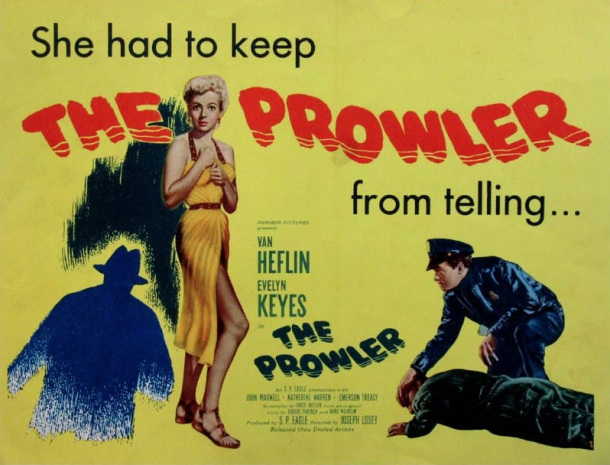
The Prowler was made by disillusioned men. Director Joseph Losey, screenwriter Dalton Trumbo, and visual consultant John Hubley were all eventually blacklisted by the House Un-American Activities Committee. Trumbo was already tarred, so his writing credit was given solely to Hugo Butler – while Losey and Hubley were pushed out of Hollywood soon afterward (Losey made one more film, The Big Night, before moving to Europe, while Hubley turned to uncredited work in commercials). Every major American institution is treated with a disdainful eye in The Prowler, a despairing document reflecting the state of the political Left in 1951, making it one of the bleakest film noirs ever made. James Naremore quotes Losey in describing the Hollywood liberal that year:

The Left in Hollywood was utterly demoralized by Truman, the atomic bomb, and the HUAC investigations, and it was beginning to recognize “the complete unreality of the American dream”.

The protagonists of this sleazy little drama are Webb Gardner (Van Heflin), an oafish cop fueled by class resentment, and Susan Gilvray (Evelyn Keyes), a plasticine blonde bored with her milquetoast husband. Or, as Manny Farber described them, “an amoral rookie cop” and a “hot, dumb, average American babe.” Either way, they were born to torment each other. In the opening shot, Susan stares off camera, shrieks, and pulls down the shades. There’s a prowler outside, and we’re out there with him. After this self-reflexive jape, literally putting us in the shoes of a voyeur and jokingly incriminating the whole movie-going enterprise, Losey pulls back to the larger narrative.

Susan calls the police to investigate the prowler, and Webb arrives along with his folksy, contented middle-class partner, Bud (John Maxwell). Sweeping the grounds outside, Webb circles around to the window in her bathroom. In a reversal of the opening shot, the camera is placed inside the window looking out, and Van Heflin takes our offending place where the peeper was first spotted. It establishes his perversity – he’s got a smarmy grin on his face – and re-enforces the possibility of ours. It’s the first of many shots where Webb is shown in transitional spaces – doorways, hallways and windows. The problem is that he always gets closer.

When he returns later that evening, she allows him in her living room, which the script described as “comfortably and tastefully furnished in Barker Brothers’ more expensive style of four years ago. There are overstuffed chairs and a couch; two bad landscapes on the wall” (quoted in “Un-American” Hollywood by Frank Krutnik).

Susan lives in one of the knockoff Spanish Haciendas favored by the upper middle classes in L.A. following WWII. The design is bland, second-hand, and forgettable. In a sly bit of set design, Diego Rivera’s The Flower Carrier [left] hangs over her dining room table, an artwork depicting labor exploitation tamed and turned by middle class apathy into mute wallpaper. Krutnik weaves a whole interpretation around the placement of the painting, which is available to read in his book’s Google preview.

This is the life Webb had been seeking, a life of quiet contentment in a “tastefully furnished” apartment, with a well-dressed blonde at his side. Over coffee, his class resentments come pouring out. He mews that being a cop is no better than a ditch-digger, money being his only bottom line. Susan ignites his jealousies further by revealing how she grew up in Indiana, in the same town as Webb, only she came from a wealthier family on a well-tended street.

It is this revelation that turns Susan into a prize – the ivory tower hidden from him because of his station in life. He becomes aggressive, animal, relentless. Susan resists meekly, than gives herself over entirely. Her own American dream, of raising a family, foundered in her husband’s infertile loins. Reduced to the life of a cloistered housewife, Webb’s meaty pawing feels like freedom. The husband only lives as a voice on the radio, as he’s the host of a popular nighttime music show, and an unwelcome presence during Webb’s ungainly seductions. In a small note of resistance, Losey cast Trumbo as the husband’s voice, his nasal tenor a ghostly presence even before his body gets knocked off in the Double Indemnity– inspired plot.

The Prowler spreads its sarcasm over the entire roll-call of American myths. Marriage, small-town life, the police force, and even capitalism itself are shown as empty, repressive forces. Susan and Webb are driven to each other, and then self-desctruct, all because of their unrequited love of the American dream. They want a perfect middle-class life, and Webb is more than ready to kill for it.

Van Heflin and Evelyn Keyes provide two sterling performances of American indolence and greed. Heflin is especially mesmerizing, his wide-set eyes, gangly limbs, and lasciviously parted lips looking like a grotesque caricature of masculinity. His arms and legs seem to flail out of sequence when he stalks around Susan’s home like an uncaged gorilla, and his apartment is a bubbling cauldron of 50s macho-ness. There’s a target practice sheet on the wall, muscle mags on the desk, and an electronic razor incessantly buzzing around his reddened mug. Then when Susan calls seeking reconciliation for one of their flaps, he strokes the phone’s receiver around the edge of his mouth, his eyes burning with a look of sexual ecstasy. It becomes clear later that he’s been planning a murder. Evelyn Keyes has less to work with. Andrew Sarris describes the dilemma of the actress in a Losey film (thanks to Glenn Kenny for pointing me to this quote in his blog post on The Prowler):

The feminine role in Losey’s world is strictly subordinate because of the histrionic hysteria of his actors. Men simply cannot cope with their lives and social institutions, and they crack up with very lyrical results. Meanwhile the women stand by to pick up the pieces. They cope because of their ability to compromise with reality, an ability Losey frankly admires. Unfortunately, the best roles are the least stable. Hence, Losey’s actresses are usually denied the great scene-stealing moments of psychic dissolution.

This is all true for The Prowler, with Keyes having to swing between lassitude and disconsolate passion – no emotional match for Heflin’s demoniac dissembler. But in her own minor key, she is superb. In her cool apathetic demeanor she delivers lines with a lack of affect, as if her personality had been worn down over time. Her personal desires have been co-opted by those of her society, hence her bizarre decision to hook up with Webb and start a family on the edges of the world they so desperately wish to enter.

By the end they are pushed out of the middle-class suburbs and literally start to disappear. They are forced to go to a ghost town abandoned after a gold rush, where they enact a grim parody of the social roles of husband and wife – she does the dishes, he gets the food – and there’s a baby on the way. This section of the film is heightened both visually and narratively, as the events become more overtly symbolic and hallucinatory. The “door” to their room is a sheet that is beaten down by a raging storm. Webb has no other boundaries to cross, and now he simply wants the world to stay away. But the wind and rain keep busting in, and a simple country doctor brings their whole pathetic existence to a close – climaxing on a long climb up a short hill.

SHUTTER ISLAND’S ANCESTORS

March 9, 2010

Screen Shot 2020-01-20 at 5.24.08 PM

In the flurry of interviews Martin Scorsese granted running up to the release of Shutter Island, he rattled off a long list of movies he screened for his cast, including Laura, Out of the Past, Cat People, I Walked With a Zombie, and The Seventh Victim. The first two were studied by DiCaprio and Ruffalo to look good in a rumpled suit (thanks to Dana Andrews and Robert Mitchum), while the last three, of course, were churned out by Val Lewton’s miraculous horror unit at RKO, a remarkable run of terror keyed off of the suggestion of violence rather than the blood and guts themselves. But the main wellspring of Scorsese’s recent box-office champ are two later Lewtons, which he also mentions: Isle of the Dead (1945) and Bedlam (1946) [Spoilers abound below].

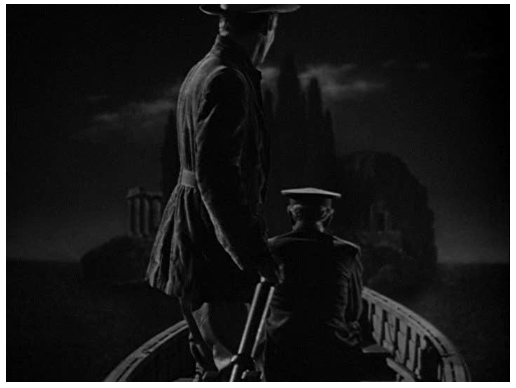
the-isle-of-the-dead-1886.jpg!LargeThe screengrab above is from an early shot of Isle of the Dead, a dead-ringer for Leonardo DiCaprio’s opening journey towards a ghostly island of his own in Shutter Island (the model for both of which is Arnold Böcklin’s series of “Isle of the Dead” paintings, the 1886 version is seen to the left). Greek General Pherides (Boris Karloff) and reporter Oliver Davis (Marc Cramer) row over to a cemetery to lay flowers on the grave of Pherides’ wife. They discover an empty coffin, and stumble upon the bizarre household presided over by Albrecht (Jason Robards, Sr.), an archaeologist who ordered peasants to go grave robbing. Now repentant, he lives on the island and offers shelter for any lonely wanderers. Then one of the guests dies of the plague, and Pherides and Davis are stuck quarantined inside, along with superstitious maid Kyra (Helen Thimig), consumptive wife Mary (Katherine Emery), her young nurse Thea (Ellen Drew) and stuffy husband Aubyn (Alan Napier).

Karloff’s Pherides is a clear influence on DiCaprio’s Det. Teddy Daniels. Both are violent men of authority who are driven to paranoia and madness, linked to romances past. As the days of confinement continue, Pherides falls under the spell of Madame Kyra, who accuses Thea of being a “vorvolaka”, an evil spirit who sucks the life out of her victims. Her evidence is Thea’s employer Mary, who has been slowly dying for years. Karloff’s eyes begin to bug out as Pherides clings to this fantasy as the true solution to their predicament – kill Thea and the “plague” will dissipate. Daniels is also imprisoned, but in an insane asylum, as he attempts to solve the mystery of a missing inmate during a biblical thunderstorm. DiCaprio plays it queasy and sweaty, while Karloff goes for a more operatic insanity, but they are both dangerous obsessives driven to insanity by the horror in their own souls.

Why I think Isle of the Dead is a scarier film, if not necessarily a more coherent one, is a result of Lewton’s visual understatement, with the aid of director Mark Robson and DP Jack MacKenzie. The film contains ultra low-key lighting, and when the supposed “vorvolaka” does appear, in a harrowing sequence of live burial, fleeting tulle garments, and tridents shoved into chests – it’s conveyed through terrifying glimpses.

It’s miraculous the film has the power it does, considering the difficulties during production. Karloff required spinal surgery after eight days of shooting, shutting down the production for months. In the interim, Lewton knocked off the delightful Body Snatcher, and when the shoot picked up again, the script was scrapped and re-made somewhat on the fly. No one on the production was happy with the finished product (future Lewton-ites aside), until perhaps the notices came rolling in, when James Agee called it “one of the best horror movies ever made.” It also affected a young Scorsese, who in an oft-recalled anecdote, remembers running out of the theater as a kid in sheer terror before the end, too scared to continue.

In any case Karloff and Lewton were a good match, as Karloff’s intro to the short story collection Tales of Terror attests:

The mightiest weapon of the terror tale is the power of suggestion – the skill to take the reader by means of that power into an atmosphere where even the incredible seems credible.

That could have been the Lewton team’s motto, and the two were to work again for the last time on Bedlam one year later. This film has an even closer relationship with Shutter Island, as it focuses on torturous treatment in an insane asylum, and the lead character’s incarceration. Lewton modeled the film off of plate 8 of William Hogarth’s series of paintings and engravings, “The Rake’s Progress”, which depicted subject Tom Rakewell’s final degradation at Bethlehem Hospital (aka Bedlam). Almost too slavish to Hogarth’s engraving, Lewton and director Mark Robson dissolve in and out of stills of the artwork before each new sequence, adding a static element to Lewton’s usually sinuous works. It’s a weird film in any context, though, with lead Nell Bowen (Anna Lee) a whitewashed reference to the Restoration England actress (and probable prostitute) Nell Gwyn. In this film, Nell is merely a kind of jester for the rich Lord Mortimer (Billy House), and tags along at the “loony” show George Sims (Karloff) mounts for the Lord’s pleasure. Sims runs the “Bedlam” insane asylum, allowing the inmates to rot in a barnyard atmosphere of scattered hay and the constant threat of death. Nell’s conscience is pricked by the earnest young Quaker Hannay (Richard Fraser), who sees a spark of pity in her.

The closest analogue to Karloff’s sadistic Sims in Shutter Island is probably Max Von Sydow’s malevlolent-seeming Dr. Naehring, who is intimated to have a Nazi past and moves with the same stiff bearing as Karloff’s schemer. The inmate population is the same however, a menagerie of terrifying grotesques, erudite madmen, and flailing arms in dimly lit, humid hallways. While Bedlam’s tone varies rather wildly from Restoration comedy to moralist grandstanding to atmospheric horror, it is never safe – and there are some agelessly wonderful bits, including the loony lawyer inmate who dreams of projecting his flip book onto a screen, only “It’s because of these pictures that I’m here.” That is, the cinema made him to madness. A truth Mr. Scorsese, Val Lewton and myself can certainly relate to.

THE BEST PICTURE NOMINEES FROM 1943: PART 2

February 23, 2010

MV5BZGI0NjBjNjgtZjUxNi00OTgzLThlMjAtMjZmNjE2YzY0YjMxXkEyXkFqcGdeQXVyNjc2OTM5MTU@._V1_

Last week I looked at six of the Best Picture nominees from 1943, the last year the Academy nominated ten films for Best Picture, until they expanded the category once more in 2010. Today I’ll look at the remaining four titles, with James Agee and Manny Farber again providing perspective with their reviews from the period. The idea is to approach these films with fresh eyes, outside of the reputations (or lack of) that have accrued over time.

Madame Curie (1943, directed by Mervyn LeRoy)

Sadly, the production history of this turgid biopic is far more fascinating than the film itself (most of this history comes from Christopher Frayling’s Mad, Bad and Dangerous?: The Scientist in Cinema). After their success with The Story of Louis Pasteur in 1936, Warner Bros. was circling Marie Curie’s story as a follow-up, with the Pasteur combo of director William Dieterle and actress Josephine Hutchinson penciled in for the project. But in 1937, Eve Curie’s biography of her mother was published, and interest in the story skyrocketed. Universal snagged the rights, intending Irene Dunne to star. Unable to produce an agreeable script, Universal sold the rights (along with Show Boat) to MGM in 1938 for $200,000.

MGM found it equally difficult to hammer out a script, taking five years and hiring 18 screenwriters before settling on the pages. Two of those 18 were Aldous Huxley and F. Scott Fitzgerald. The dream version of the movie had Huxley as writer, George Cukor as director, and Greta Garbo as star. Garbo was motivated to play the lead, but Huxley turned in a 145 page draft that was eventually tossed for being too “scientific”, as Tom Dardis quotes in his Some Time in the Sun.

Producers Bernard Hyman and Sidney Franklin then turned to Fitzgerald. His story, according to Frayling, wanted to focus on Madame Curie’s role as a “modern woman”. He expressed his interest to Zelda in a letter:

Madame Curie progresses and it is a relief to be working on something that the censors have nothing against…. The more I read about the woman the more I think about her as one of the most admirable people of our time. I hope we can get a little of that into the story.

Fitzgerald was fired after 18 months of work. The final writing credit was given to Paul Osborn and Paul H. Rameau, who turned in a more conventional script that focused mainly on the love story between Marie and Pierre Curie. Revisions continued right up to filming, and director Albert Lewin was replaced by Mervyn LeRoy soon before the start of production. These years of work produced some tantalizing what-ifs, but the finished product is a rather dire simplification of a remarkable life. The first half of the film finds distinguished scientists Marie Sklodovksa (Greer Garson) and Pierre Curie (Walter Pidgeon) toss moony looks at each other through gauzy lighting, while the second half compresses a lifetime of scientific discovery into a few anxious stares and lots of shouting. Neither section is convincing, aside from the small sections with Robert Walker’s obsequious lab assistant (with whom Marie Curie was rumored to have an affair). Agee is with me: “A smooth, rather horrible romanticization of a subject I am sorry to see romanticized.”

***

The More the Merrier (1943, directed by George Stevens)

A manic, strained, but rather irresistible screwball comedy that makes light of the Washington D.C. housing shortage during WWII. Connie Milligan (an uptight Jean Arthur) rents out a room in her apartment to Benjamin Dingle (a mischievous Charles Coburn), who can’t help but set her up with a strapping special ops soldier, Joe Carter (Joel McCrea), even though she’s engaged to the banal Mr. Pendergast (Richard Gaines). Already treading on Milligan’s last nerve, Dingle rents out half of his room to Carter, creating a full house and many opportunities for face-pulling farce. The scenario is so cute as to be cloying, but the actors have a ball, rendering it an amiable, although far from flawless, laffer from the period. Arthur’s obsessive-compulsive act pinballs off of Coburn’s jaunty ironist to create a crackling tension, while McCrea just looks happy to be there.

Which he wasn’t. In her biography of Stevens, Giant, Marilyn Ann Moss reveals that McCrea wasn’t comfortable at the first cast reherasal. He went so far as to have his agent call up and try to get out of the movie, but he soldiered through, and his easy, engaging demeanor is the perfect counterpoint to to the amped up Coburn-Arthur battle. The film is packed with incident, a pile-on of mistaken identity, misdirection, practical jokes, and general madcappery. There is so much stuff happening that there’s little time to flesh out the characters. They are vessels for the jokes and pratfalls, but never pop out of the story as more than silly names. Dingle is a walking plot device, instigating and solving the movie’s problems with an insouciant twinkle in his eye.

This works as long as the jokes keep hitting, but it’s impossible to sustain that paceand eventually it winds down with a dully romantic clincher lifted from The Awful Truth, and some unbelievable deus-ex-Coburn from the impish old man. Regardless of these problems, Arthur, Coburn, McCrea, and Stevens are often able to make this creaky material sing (look at the lead photo and try not to crack a smile), which is some kind of accomplishment. And as Stevens said: “There was something about the times…you know you might as well have some fun because you might not be around too long.”

Agee: “The film as a whole is a tired souffle, for unfortunately Stevens doesn’t know where to stop. Farce, like melodrama, offers very special chances for accurate observation, but here accuracy is avoided ten times to one in favor of the easy burlesque or the easier idealization which drops the bottom out of farce. Every good moment frazzles or drowns.”

Farber: “This product is like an air conditioner, in that on the hottest day of the year it is better than no conditioner at all. There is a certain foolproof quality about it: each line produces some kind of smile, even if it takes all the smart dialogue writers in Hollywood. …Director Stevens’ troubles always arise in a comedy of this sort where his compassion collides, head-on, with slapstick. This gums the last half of the picture with tendernesses that fall flat, and laughs that break wrong.”

***

The Song of Bernadette(1943, directed by Henry King)

This is all about Jennifer Jones, who passed away last December at the age of 90. The film is not much worth discussing without her. The story of Bernadette Soubiros, the child who saw visions of the Virgin Mary at Lourdes, is told with no particular skill by Henry King. The tension between state and religion is raised and dropped halfway through, and the mix of studio artificiality and location landscape is jarring. For a story about attaining grace through deprivation, there sure is a lot of money present on-screen – in all of the garish sets and artistically muddied poor people. But Jones is defiantly radiant throughout, exuding an ascetic purity through her wide-set, almond eyes that startles with its intensity. Aside from the reliably oily performance by Vincent Price as the imperial prosecutor (his decadence represented by the ever-present hanky touched to his lips), hers is the only convincing performance, the only one to hint at what religious fervor might actually look like. For Agee, she “impossibly combines the waxen circumspections of a convent school with abrupt salients of emotion of which Dostoyevsky himself need not be ashamed.”

Farber, on the other hand, writes a hilariously insightful pan: “The script for this modern religious movie epic is uninspired to the point of tedium, and has been produced as though the entire picture were on trial before the Catholic Church. It is so cautious that near the end the whole production appears to be turning to stone: when people bend they creak, lifetime associates meet and come together with all of the recognition of ambulating sculptures, and they look at each other with paralyzed faces. ” He doesn’t spare Jones either, who he says “has been directed to be retiring to the point of evaporation.”

I think he is devastatingly correct on all counts, except for Jones’ performance. In every other way the film is a grim theme park ride through Lourdes.

***

Watch on the Rhine (1943, Herman Shumlin)

This faithful adaptation of Lillian Hellman’s play is graced by Paul Lukas’ Oscar-winning performance, and is a valuable document of what the stage version must have looked like. But as cinema, it is unremarkable. Part of a wave of anti-Nazi films Warners was releasing in that period, it presents the Muller family, Kurt (Lukas), Sara (Bette Davis), and their three preternaturally intelligent children. Kurt, a German, is a faithful member of the anti-fascist underground, bouncing around Europe in a fruitless attempt to halt the Nazis’ rise. They escape to visit Sara’s mother in Washington, D.C., only to be ensnared by an opportunistic Fascist sympathizer, a Romanian named Teck (the Mercury Theater’s George Coulouris), who’s eager to give up names to the Nazis.

Adapted by Hellman’s lover Dashiell Hammett, and later polished by Hellman herself, it is said to hew very close to the original production. Hellman also brought along the director of the stage version, Herman Shumlin, to helm the film, his first (he would direct one other movie, Confidential Agent, in 1945). The slavish attention paid to the original saps the life out of the movie, consisting of a series of drawing room scenes, shot as if on a proscenium from the earliest days of cinema. Shumlin mainly has his characters stand and deliver their lines, with no dynamic choreography to goose the power relations. There is no visual correlative to the dialogue, rendering it inert. For Farber, the dialogue “has a cold, triple-duty nautre, that doesn’t seem to come out of the people who deliver it, and it is enunciated as to an audience that might not hear in the back rows of the gallery.”

Hellman’s story is an unblinkingly tough one, examining the moral compromises Kurt must make in order to defend his ideals. He diminishes himself for the cause, and his ethics go down with them. Paul Lukas renders this compromise with his trembling hand matching his ever-compassionate eyes. He underplays it all, while still conveying that he’s coming apart at the seams. No one is in doubt at Lukas’ accomplishment here. Agee calls his performance “superlative”, with Farber has a longer piece that praises it as “sufficiently mobile for the screen, and where the mobility, as expressed in pantomime, is always natural and understandable for the character played.”

THE BEST PICTURE NOMINEES FROM 1943

February 16, 2010

Heaven-Can-Wait-1-750x400

The big news at this year’s Oscar ceremony is the expansion of the Best Picture category from five nominees to ten. After the near shutout of THE DARK KNIGHT from major awards in 2009, it’s an effort by the Academy to shoehorn some money makers onto the show to goose ratings. And while the world-devouring AVATAR would have been nominated in a field of one, hits like DISTRICT 9 and THE BLIND SIDE certainly benefited from the change. This is no innovation however – there were ten best picture nominees from 1937 – 1944 (it varied between 3 – 12 before then). They cut it down to five nominations in ’45 for the first national radio telecast on ABC, perhaps to trim a few seconds off the program. Over the next two weeks, I’ll watch all the nominees (except for the out-of-print HUMAN COMEDY), from immortal classics to forgotten curios. It’s an attempt to take the pulse of mainstream film-making of the era with fresh eyes. The list of nominees is after the break.

CASABLANCA (1942), directed by Michael Curtiz [WINNER]

How to approach a film as ingrained in cultural memory as this one? By the time one arrives at a movie-going age, the film has been parodied, copied, and praised into oblivion. It’s impossible to watch free of the encrustations of its reputation, the “greatest” of this or that. But how did people see it upon its original release? I consulted my trusty James Agee and Manny Farber collections for some insight. Agee:

“Apparently Casablanca, which I must say I liked, is working up a rather serious reputation as a fine melodrama. Why? It is obviously an improvement on one of the world’s worst plays, but it is not such an improvement that that is not obvious.”

“Casablanca is still reverently spoken of as (1) fun, (2) a “real movie.” I still think it is the year’s clearest measure of how willingly, faute de mieux, people will deceive themselves.”

Farber:

The “Casablanca” kind of hokum was good in its original context in other movies, but, lifted into “Casablanca” for the sake of its glitter and not incorporated into it, loses its meaning. Thus, Sydney Greenstreet’s velvet gesturing and suave cruelty were vitally necessary to “The Maltese Falcon,”…whereas in this picture he’s not even needed. He’s there merely for Sydney Greenstreet.

“Casablanca” is as ineffectual as a Collier’s short story, but with one thing and another – like Bergman, Veidt, and Humphrey Bogart – it is a pleasure of sorts.

I would recommend reading both reviews in full, but both are measured in their praise and engaging in some amiable push-back against its canonization. Agee’s short blurb goes after some of the clunky dialogue he “snickered at”, while Farber has a longer, in-depth consideration of its faults, while still praising its “political intelligence” and the performances of Bergman (“noble and utterly clear”) and Bogart’s mouth (“which seems to be holding back a mouthful of blood”).

Neither review uses much space on director Michael Curtiz, with Farber slamming his “incapable scissors” and Agee questioning his tracking shots with an esoterically phrased metaphor: “the camera should move for purposes other than those of a nautch-dancer.” “Nautch” is a style of Indian popular dance, so presumably he thinks Curtiz’s camera movements are too showy. I would disagree with both. After watching Warner Bros.’ dazzling new Blu-Ray, the cutting appeared precise and well-paced, while the tracking shots effectively map the various shady nooks of Rick’s Café Américain, where the parade of stellar character actors tilt up their heads.

The devious, doomed performances of this procession often transcend the flimsiness of their roles: Peter Lorre, Sydney Greenstreet, Marcel Dalio, Conrad Veidt, Claude Rains, Dooley Wilson, and S.Z. Sakall imbue their caricatures with flashes of mordant wit, frazzled humor, implicit violence, and a variety of other tones. But there are so many subplots and characters that everything feels rushed – “the picture has more acts than it knows what do with for truth and beauty”, says Farber, and I agree. It slows down for minor diversions (the young couple searching for a visa) while making short shrift of Lorre’s fastidious and fascinating black-market whiz. The political subtext chugs along (isolationist slowly convinced to fight) effectively, and the cumulative impact of so many expressive faces (Bogart and Bergman paramount among them), and Curtiz’s powerful use of close-ups, echo in the memory far longer than its overstuffed narrative.

***

FOR WHOM THE BELL TOLLS (1943), directed by Sam Wood

This film needs no such equivocation. It’s a puffed up, hollowed out bore by any estimation, drained of any hint of politics or emotion. Agee and Farber both take healthy chunks out of its hide. Agee:

If you are not careful, you may easily get the impression that Gary Cooper is simply fighting for the Republican Party in a place where the New Deal has got particularly out of hand.

Farber:

For Whom the Bell Tolls is a failure – perhaps Hollywood’s most exasperating refusal to fulfill any of its obligations.

Interestingly, both writers criticize the Technicolor photography as well, with Agee saying “it still gets fatally in the way of any serious imitation of reality”, and Farber seconding, “I myself find it difficult to take seriously a movie made in technicolor.” I would say this lack of “realism” has more to do with the exaggeratedly “arty” lighting scheme (lots of silhouettes, impossibly angled shadows) and the stodgy compositional sense Sam Wood brings to the table. Everything is group shots cut in to gigantic close-ups. It’s impossible to nail down the geography any given space, and the set-design is bloated, polished, and glaringly artificial. Farber rightly says the rebels’ cave looks more like a cafe. As with all technical innovations, the right artist had to come along to make critics get over Technicolor’s seemingly garish tones (Douglas Sirk, Vicente Minnelli, among others), as Hollywood hopes James Cameron has done with 3D.

***

HEAVEN CAN WAIT (1943), directed by Ernst Lubitsch

My favorite movie of the bunch, and the one that used color “with sensitiveness and wit, I thought, for the first time.” So says Agee. He sees it as an echo of the great films of Lubitsch’s past (he idiosyncratically cites Forbidden Paradise and Three Women), but “not up to his best.” Farber writes a straight pan, attacking what he perceives as its “pictorial sterility” along with the censorship that de-fanged Don Ameche’s wolf in sheep’s clothing. These are two of Farber’s favored polemical points here, but his target is far more subtle than he’s giving credit for. In short – he’s completely wrong.

It’s true that Ameche plays a sensualist, and that none of his conquests are shown on-screen, but the film’s focus is on the uncertain adaptation of these impulses into married life, their attempted domestication into old age. Lubitsch’s short-hand of infidelities (a teenage hangover, a receipt for a bracelet), leave more room to examine the unintended consequences of his actions. The film is a warm, wise, and oft hilarious fable about the push-pull between love and lust, between aging bodies and raging libidos. It’s pulled off with a light touch under a cool palette of blues and grays (Gene Tierney’s dress, the hair at Ameche’s temples), creating a placid surface underneath which Lubitsch works his emotional magic. Ameche is effortless suavity, with a legitimate sparkle in his eye every time he spies Tierney, who exudes a world-weary charm. As they age together, spar together, and fade away together, Lubitsch has created one of the truest portraits of marriage I’ve seen on-screen. It’s a patient, funny, and inordinately wise. Add a blustery Charles Coburn and you get a masterpiece.

***

THE HUMAN COMEDY (1943), directed by Clarence Brown

Out of print, aside from $80 VHS tapes on e-bay. I haven’t seen it, so my words are from TCMDB: “A small-town telegraph boy deals with the strains of growing up during World War II.”

Agee: “The picture is mainly a mess, but as a mixture of typical with atypical failure, and in its rare successes, it interests me more than any other film I have seen for a good while.”

Farber: “If you tried to imagine the most gruesome result of a collaboration between William Saroyan and MGM, to both of whom life tends to be a chocolate soda made out of words, you couldn’t have approached the disaster of ‘The Human Comedy.’

***

IN WHICH WE SERVE (1942), directed by Noel Coward and David Lean

A stirringly effective, and surprisingly downbeat, WWII propaganda film from Noel Coward, it presents a cross-section of British society as seen through the eyes of the crew of a bombed British destroyer. The HMS Torrin is sunk at the Battle of Crete, and as the sailors hang on a lifeboat, a series of flashbacks detail their lives immediately preceding their deployment. It’s an elegant structure that packs a lot of story information in a compressed time frame, ratcheting up tension while presenting thumbnail sketches of the survivors at once. Coward plays the Captain with stone-faced dignity, and the rest of the cast underplays with equal aplomb. Celia Johnson is his long-suffering wife, eyes welling up with tears as she sends him off on yet another tanker, while his crew gets married, argues with mother, and dreams of the future.

It was one of Agee’s best films of 1942 (it opened late in ’42, not made eligible until ’43 for the awards), and Farber was also a huge fan: “There is unusual respect for the ordinariness of people’s behavior; so that they come out stronger, more admirable for being natural.”

***

THE OX-BOW INCIDENT (1943), directed by William Wellman

Unlike with Heaven Can Wait, in The Ox-Bow Incident Farber finds a Hollywood film untainted by censorship. It had its say “without losing a scene, a character or a line of dialogue to the Hays Office, the studio or the box office.” For him, this makes it an unqualified triumph, and a “thrilling experience.” This seems to be the critical consensus of the period, as Agee agrees that it was “remarkably controlled and intelligent”, although he felt that it contained a “stiff over-consciousness” that drained the film of “its own warmth and energy.” In any case, it is clearly one of the most important films of the year.

This morality play, about the lynching of three men at The Oxbow, Nevada, in 1885, is surprisingly dark as well as overtly “arty” in its intent. The main stage is an expressionist tinged clearing with a gnarled tree at its center and studio-artificial scrub brush surrounding it. Three men are caught and accused of murder, with a string of circumstantial evidence tying them to the crime. A group of locals band together for a lynching – led by a tyrannical Confederate soldier and a bloodthirsty Jane Darwell (otherwise known as Ma Joad). The liberal faction attempts to stall the slaughter and fails.

Shot by Wellman and cinematographer Arthur Miller in a spare, heavily shadowed, overtly symbolic style that he would push to delirious lengths in the great Track of the Cat, it’s a triumph of mood. The shadows distort the lynchers’ faces into rictuses of fear and terror, as if out of a Kirchner or Munch painting. It is a self-conscious work of art, almost stilted in its artificiality, but the quality of the craftsmanship is high, and Henry Fonda’s wounded gait has carried lesser films.

***

Next week I’ll take a look at the rest of the nominees:

MADAME CURIE (1943), directed by Mervyn LeRoy

THE MORE THE MERRIER (1943), directed by George Stevens

THE SONG OF BERNADETTE (1943), directed by Henry King

WATCH ON THE RHINE (1943), directed by Herman Shumlin

MY SON JOHN (1952)

February 2, 2010

MYSONJOHNLC5

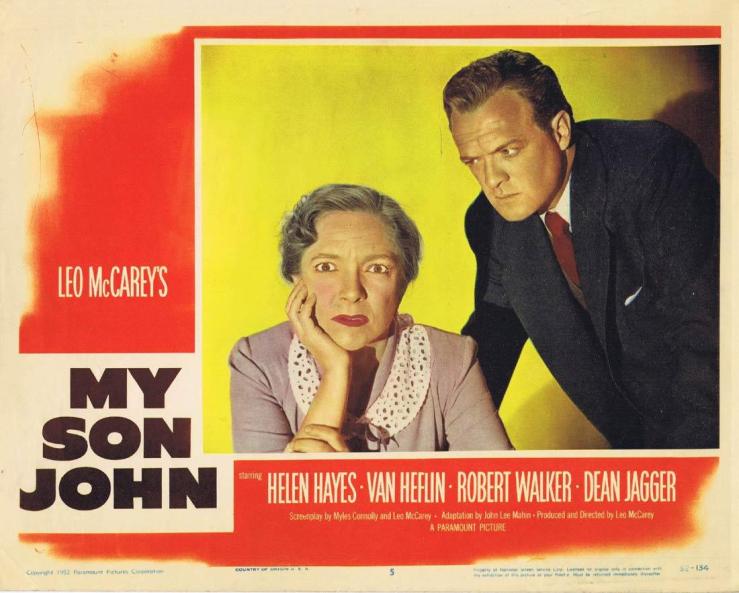
Last Wednesday, TCM presented the first television screening of Leo McCarey’s My Son John in decades. It screened as part of the “Shadows of Russia” series, which tracked Hollywood’s depiction of the country from Tsarist times through Soviet rule. Programmed by the NY Post’s Lou Lumenick and the Self-Styled Siren‘s Farran Smith Nehme, it offered a wonderful chance to catch up with McCarey’s underrated rarity. The reason for its obscurity lies in its politics. Produced during the height of the House Un-American Activities Committee (for which McCarey was a friendly witness), it is strongly anti-communist, and has been dismissed in many corners as mere McCarthy-era hysteria. As Robin Wood wrote in Sexual Politics and Narrative Film, the film is generally presented in a condescending manner: “typically introduced with an apologetic chuckle signifying, ‘Nowadays, of course, we can laugh at this.’” The usually sage Robert Osborne adopted this attitude in his introduction to the telecast, referring to it as an embarrassment, and our own astute Morlock Jeff emphasizes the “hysteria” over its other virtues in his article on the movie.  I have to respectfully disagree with my colleagues.

To reduce the film to a kitschy red scare product ignores the complex dynamics occurring in the family unit. Dean Jagger plays the father, Dan Jefferson, an earnest American Legion member who can’t conceive of a world outside his small-town newspaper. He’s an ingratiating buffoon with a quick temper and a taste for the beer barrel at the Legion hall, likeable enough until he starts singing nativist jingles and tossing his son across the room. He is an intentionally ridiculous character, as McCarey told Peter Bogdanovich in Who The Devil Made It?, as unbending in his conservative beliefs as John is with his communist ones. Personally, McCarey may have gravitated more to the father’s view, but his artistic temperament, which cherished improvisation and spontaneity, would never allow a such a monolithic man to be a hero (hence Renoir’s famous quote that McCarey understood people better than any other Hollywood director). Instead he is thrown through a series of farcical scenes – the song, a drunken rant, an absurd whack of the bible – that display his child-like pettiness and his inability to adapt to the times. His paranoia is proven accurate, but this does not alter the boorish nature of his character. His wife Lucille is the one who uncovers her son’s secret, and is the true dramatic center of the film.

Lucille, played spiritedly by Helen Hayes after a 17 year absence from the screen, is the pragmatic one, calming Dan’s fears, enduring his rages, and attempting to understand John’s point of view. She is patient with her husband but also fiercely independent, evidenced when she secretly dumps the pills he foists on her for her “anxiety”. She coddles him like an impudent pup, with a condescending kind of love. He provides the bombast, but she is in control of the relationship. Hayes’ performance is a bit of a high wire act, managing swings from manic energy to swooning depression with a few broad strokes – her darting eyes and sing-song voice ease the way down to the tragic conclusion. I think she succeeds wonderfully, evincing a rock-ribbed faith in God (in the eyes), paired with a mischievous sense of humor (her staccato laugh).

There is an especially moving scene where John is describing the world’s duty to help raise up the poor, and she finds a connection to Catholicism’s similar tenets to tend to those living in poverty. The joy in her face at this empathetic moment is beautiful and devastating , because she has yet to understand the basic incompatibility of their world views, and hence their imminent separation (and also because of the intensity of McCarey’s close-ups). Her inability to transcend the barrier between these ideologies turns her into the central tragic figure of the film, and is why Dave Kehr calls it McCarey’s most “emotionally demanding movie after Love Affair“. Her capitulation to Dan, when she tells him he was right about their son, is another scene of devious power, with Lucille’s ashen face on a different plane from Dan’s obliging attempts at apology for his drunken antics the night before. It is a drama of generational feuding and familial fissure more than anything else, as Martin Scorsese has also noted.

John is played by the incredible Robert Walker with icy disdain, a callow kind of condescension that college boys convey upon returning home from their first few philosophy classes (I recognized a bit of myself in him). It ended up as his final performance. Walker died near the end of the shoot, necessitating a total rewrite of the final sequences, and some awkward matte work which included some shots from the final carousel sequence in Hitchcock’s Strangers on a Train. It is these final scenes that have marred the reputation of My Son John more than anything else, as John’s dramatic turn away from communism had to be cobbled together out of scraps of old footage and stand-ins, rendering this already difficult arc impossible to pull off. Without an actor to improvise off of, the subtleties of McCarey’s character work fall away, the family drama fades into the background, and McCarey’s staunch anti-communism dominates, turning the last act into more of the straight propaganda film its critcs claim it is. But it still contains echoes of the emotionally wrenching work that came before, in the few shots of Helen Hayes’ eyes.

McCarey claims it could have been his best film if Walker had survived, perhaps an impossible claim with The Awful Truth and Make Way for Tomorrow on his resume, but it lies at the center of his thematic world – at the nexus of personal freedom and familial responsibility that winds through his greatest work. It may not be his best film, but it is an essential one.

LIST: U.S. FILMS OF 2009

December 22, 2009

informant-watching-recommendation-videoSixteenByNineJumbo1600

My lists for the top films of the year and of the decade have been posted over at Indiewire, so feel free to rush over there and criticize my choices in the comments back here. Only two English language films made my year-end roundup (The Informant! and Orphan), but there was a whole slew of valuable work churned out in the States that I’d like to recognize in this dusty corner of the internet. The lag time in distribution means that the finest in international cinema arrives in waves – the highlights of three years of festivals hit all at once (Aleksandr Sokurov’s The Sun took four years to reach theaters, for example).  I highlighted many of these on my list (go check out The Headless Woman, my topper, just out on DVD from Strand), but it necessitated knocking out a number of strong Hollywood films that were actually made in 2009. So, here’s my favorite local product:

1. The Informant!, Directed by Steven Soderbergh

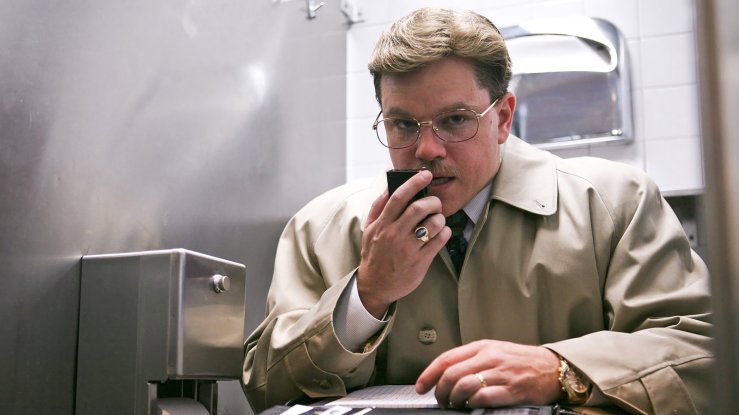
An ebullient little character study of a small middle manager and his penchant for charmingly embroidered lies. Soderbergh and screenwriter Scott Z. Burns’s ingenious use of voice-over has the wiseacre Mark Whitacre constantly digressing from the drama in his life (whistleblowing on Archer Daniels Midland, among other things) in order to establish his monumental self-denial. It’s a clever device that pays off brilliantly in the end, when his interior monologue finally matches up with his actions – and Whitacre’s face turns ashen. Matt Damon pulls this tricky act off without a hitch. His Whitacre is a smiling gladhander,  a lumpen edifice of Midwestern charm impossible to dislike despite his endless faults. Damon is surrounded by a stellar cast, led by Scott Bakula and Joel McHale as trusting FBI agents, and supported by a potpourri of comics playing straight including Patton Oswalt, Paul F. Tompkins, and both Smothers Brothers.

***

2. Orphan, Directed by Jaume Collet-Serra

An elegantly designed horror movie with a whiff of satire, it has been clanging around my cortex for most of the year. The premise is from the genre 101 playbook: a rich bourgeois couple adopts a child. She turns out to be a murderous psychopath. Her insidious actions uncork the husband and wife’s long simmering insecurities, unleashing her alcoholism and his unbending passivity and wandering eye. There are so many deliciously macabre notes in the film: her “outsider art”-type watercolors that hide bloody massacres in the margins, the sides of beef being unloaded in the background during marriage counseling, and the entirety of 12 year old Isabelle Fuhrman’s performance – which is astonishing in its ferocity. She kills you with a dead-eyed stare and glacial smirk, just a bit of business before dinner. The satire is aimed at the conspicuously consumptive parents, who have built a modern box in the boonies to escape themselves and the holes in their souls that money can’t seem to fill.  In any case, a total delight.

***

3. The Fantastic Mr. Fox, directed by Wes Anderson

Another bauble in Anderson’s closet of exotic objects. This is perhaps his most detailed and expressive, since he can control all of his subjects down to their whisker hair. Every little detail holds a clue to these character’s personalities, from Ash’s train set to Mr. Fox’s bandit mask. Ash is caught in childhood, desperate to break out but still in love with play. Mr. Fox is caught between family and his essential fox-ness, that is, his need to steal and kill chickens. Both characters are torn between maturity and playfulness, and each will have to find a balance between the two that allows them to function in their makeshift society. That they succeed is due to the love of their lives – Meryl Streep’s graceful, stubborn and wise Mrs. Fox. It’s one of his most finely wrought family tales, impeccably (voice) acted.

***

4. Armored, directed by Nimrod Antal

A late entry that snuck in under the wire. Has the constrained feel of a legit 40s B-movie, steeped in sweat and work and a heist gone bad. A group of armored truck drivers led by Matt Dillon plans on faking the heist and taking the money for themselves. Sounds smart until a homeless man and a curious cop send the ethically curious in the crew into revolt. Once the deed goes sour, there is an extended showdown between Columbus Short (the moral one and Iraq war veteran) and the rest of the goons. He locks himself in a truck and Dillon starts to pound the hinges out with steel pipes. The insistent clanging marks off the time until one of them dies. It’s inevitable, but still they work, grunt, curse and bleed. Laurence Fishburne grunts better than most, but Dillon growls with authority, Skeet Ulrich’s wispy beard matches his weaselly cowardice, and Short exudes nice-guy calm. A refreshingly well-rigged little thriller.

***

5. The Limits of Control, directed by Jim Jarmusch

Dreamy patterning, etched on the sharkskin suits of Isaach de Bankole, as he traverses the cities of Spain. I forget the color coding, but suit-jacket, shirt, and pants re-combine shades at each location, as he listens to the pseudo-philosophical treatises of his contacts. Jarmusch recombines his cinematic idols with equal panache. de Bankole is an assassin in the mold of Alain Delon in Jean-Pierre Melville’s Le Samourai, concerned with the purity of his own code, which is impenetrable to the long-winded talkers he gets his instructions from (Tilda Swinton, John Hurt, Gael Garcia Bernal, among others). But along the way there is a lot of opaque game-playing straight out of the Jacques Rivette of Out 1, clues that lead nowhere, a mystery only about mystery. The cinematography of Christopher Doyle is sleek and intoxicating, the words are alternately maddeningly self-indulgent and engagingly inquisitive. Movies don’t come more rewarding or frustrating than this.

***

Now we enter the speed round:

6. Funny People, directed by Judd Apatow

Creativity as utter loneliness, rendered with a fusillade of dick jokes. And good ones.

***

7. Up, directed by Pete Docter and Bob Peterson

Of love and talking dogs, but more of the former, thankfully.

***

8. Me and Orson Welles, directed by Richard Linklater

A lovely re-imagining of Welles’ Broadway production of Julius Caesar. Christian McKay is incandescent as Welles, and inside it’s lilting rhythms is a rather dark portrait of the creative process.

***

9. Invictus, directed by Clint Eastwood

A lesson in structure. The divisions in South Africa rendered in Mandela’s security team, in his personal relationship with his daughter, and then through rugby’s world cup. Sports as politics.

***

10. A Perfect Getaway, directed by David Twohy

Clever. Screenwriter as main character in honeymoon gone awry chase film. Hammers home metaphor that writers cannibalize subjects for their own purposes. But with humor, which saves it. Timothy Olyphant wins the day as yammering special forces specimen.

Honorable mentions: Drag Me to Hell, The Box, Pandorum, Gamer, Crank: High Voltage, Star Trek, Adventureland

Special Note: I did see and admire some aspects of The Hurt Locker (i.e., the sniper scene) but have been baffled by the overwrought praise sent its way for this otherwise rote war movie. So as an act of spite, it’s not on this list.

MEN ARE SUCH FOOLS (1938), AND THE USES OF TWITTER

December 15, 2009

menaresuchfools-ft

Twitter has its uses, including its function as cinephilic program guide. I follow an eccentric crew of film writers and scholars on the service, and often something like the following will pop up:   “DVR alert: TCM, 10:15 am Eastern, Men Are Such Fools”  rare Busby Berkeley, 1938, non-musical, w/Bogart; never seen it.” This was posted by The New Yorker’s film editor, Richard Brody, under his handle @tnyfrontrow (I go by @r_emmet). Noting that the film was starting in minutes, I dialed up my unnaturally understanding wife, who heroically hit the record button on this esoteric nugget with seconds to spare. If you read the right people, you’ll get a handful of idiosyncratic tips like this each day, a kind of TV Guide poetry to go along with links to their writing  and other pieces they admire. There’s also plenty of pointless chatter (dinner plans, puns, and hyperbolic opinionating), but those are easy enough to filter out with an impassive unfollow click. Some essential feeds to read: MoviesOnTCMThe Auteurs DailyDavid Lynch, and Indiewire. They’re a good place to start anyhow, and then you can radiate out out from there, depending on your tastes.

Men Are Such Fools is more of a curiosity than anything else – as Brody noted, it has a small Bogart appearance in one of Berkeley’s rare non-musical films. The central drama is dry and unconvincing. Warner Brothers was trying to push Priscilla Lane and Wayne Morris as romantic leads, having paired them earlier in the year in Love, Honor and Behave, in which Morris played a milquetoast husband tested by Lane’s more assertive wife. The Warner publicity team cooked up a romance between the two, filming them at nightspots to build any kind of buzz (this according to Daniel Bubbeo’s The Women of Warner Brothers). The two dated briefly, but the flirtation didn’t last long.

Wanting to push them quickly, they paired them with Berkeley in this adaptation of a Faith Baldwin story, who was eager to show off his skill set outside of the musical: “I wanted to prove,” he later said, “that I could handle a straight dramatic assignment…, and that is why I did films like Comet Over Broadway[1938], They Made Me a Criminal [1939], Fast and Furious [1939], and Men are Such Fools. I had done dramatic work during my period of working on the stage back east and knew that I could do a good job with dramatic or comedy films.” (Bob Pike and Dave Martin, The Genius of Busby Berkeley, quoted in Jeremy Arnold’s article for TCM) Motivated or not, Men Are Such Fools looks like a job for hire. It’s a blandly put together bit of drama that sings for seconds at a time due to a fine roster of supporting players.

Lane is an appealing performer, with flickers of aggression animating her bright eyes and sweet demeanor. She’s an ambitious secretary at an advertising agency, bucking for a promotion on the lucrative fruit extract deal while her suitor, Morris, is an overbearing goon with a monstrous inferiority complex. A fraternity dolt with too much time on his hands, Morris browbeats Lane into marriage with a charming combination of physical intimidation and boyish whining. There was not much appealing to the the character as written, but Morris’ plasticine features and gangly athlete’s body emphasize its most retrograde aspects, as he looms over her with goofy intimidation tactics that come damn near spousal abuse. But Lane convincingly grins her way through it – as if she was enduring it for a secret plan of her own. Not that she is innocent – for Lane clearly is a careerist, flirting her way to snag the extract account and into the upper echelon of the company. But how this aggressive, selfish, and likeable loner could fall for a mouth-breather like Morris’ character strains credulity.

But while this romance generally rankles, there are some side players that lifted it out of the normal run of B-movie fodder. First and foremost is Mona Barrie, who slinks her way into the role of Bea Harris, an acid-tongued copywriter who aids Lane on her way to the top. She looks at the world with her eyebrow askance and poison pen at the ready like a dimestore Dorothy Parker. She leans into her bon mots with delectation, savoring each insult like she was sucking on a Jacques Torres caramel. Before she tells Lane that “all men are polygamists”, she speaks of her past as a battered wife and then lonely divorcee with an offhand cynicism that is breathtaking. She built herself up from nothing into a management position and she dashes it off like another puff of her cigarette. It’s a lovely, layered performance that adds a whip-smart intelligence to the film, for the few minutes she’s in it.

The second sterling turn here is contributed by Bogart, who has the unforgiving role as the other man to the Morris-Lane couple. Tagged as a womanizing entertainment tycoon type, he swoops in with a disarming honesty, “I’m probably a cad. Are you by any chance a weak woman?”, and ends up winning the audience over, if not Lane, by tipping into love with his enigmatic employee. He’s intended to be a bit of a bastard, but he’s clearly a more interesting, and oddly warmhearted cad than Morris’ overgrown man-child. Bogart knew he deserved larger roles, and Berkeley concurred:

“Bogie was never any trouble to me at all,” recalled Berkeley. “He felt, and I agreed with him, that he should be working in better films, but whatever discontent he felt, he took out on the bosses, not on the people he was working with. As far as I know, he never refused to play a part. His credo was to keep working, and I agreed with him on that point, too.” (Tony Thomas, The Busby Berkeley Book, quoted by Arnold)


Without an impulsive tweet, I wouldn’t have been able to add these distinctive performances to my own character actor pantheon. Now I’ll be able to track Mona Barrie wherever she pops up on the TCM schedule. Let me know if any of you have further recommendations for films with Ms. Barrie, as I’m developing a furtive crush.

THE SAMUEL FULLER COLLECTION

October 20, 2009

it-happened-in-hollywood.117025

For the next two weeks I’ll be knee-deep in The Samuel Fuller Collection, a seven-disc set being released on October 27th by Sony Pictures, in association with Martin Scorsese’s heroic film preservation organization, The Film Foundation. It’s a doggedly auteurist production that traces the contours of Fuller’s entire career, presenting five of his writing gigs (It Happened in Hollywood (1937), Adventure in Sahara (1938), Power of the Press (1943), Shockproof (1949) and Scandal Sheet 1952)) along with two lesser-known directorial efforts (The Crimson Kimono (1959) and Underworld, U.S.A. (1961)). In this marketplace it’s downright courageous to release these later subterranean slices of Fuller, and just about saintly to include some of his early writing jobs. As the juvenilia of other great artists like Picasso are studied in the context of his life’s work, so should the early scribbling of this brusquely unique American. Without an institution like the Library of America to preserve and present a director’s work in the proper context (instead of being thrown to the wind in various star-themed sets), it’s up to studios to flog their geniuses, and their priorities clearly lie elsewhere. So much of the credit to this release must lie with Scorsese and his Film Foundation, who also released the essential Budd Boetticher Collection last year, and produced the Columbia Pictures Film Noir Classics set due November 3rd.  In convincing Sony to release these films in cleaned-up masters, he’s keeping the spirit of serious film appreciation alive.

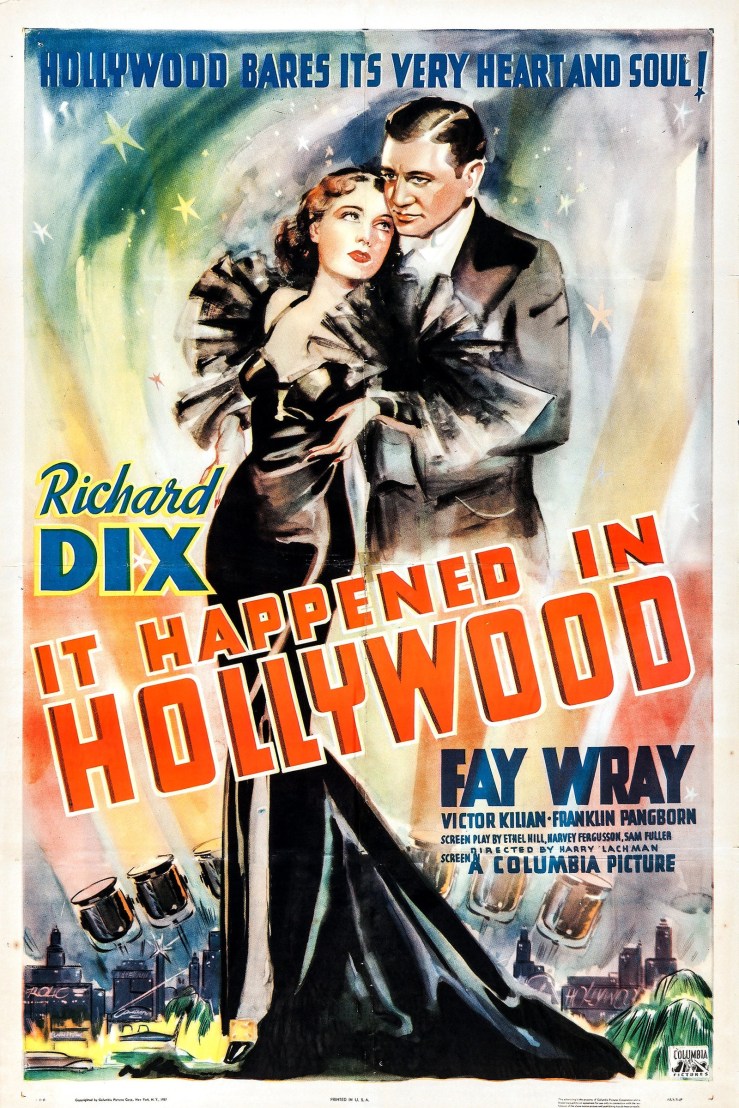
The earliest film in the set is a sprightly little comedy spiced with melancholy, It Happened in Hollywood(1937). It was Fuller’s second credit in Hollywood, after he wrote the scenario for Hats Off (1937), an elaborate bit of slapstick he conceived for Boris Petroff, who directed Mae West’s variety shows on Broadway. In his autobiography, A Third Face, he says about Hats Off that, “the finished film had just about nothing to do with my original story. Petroff fashioned a movie that made people forget about their problems. I’d wanted to expose man’s foolish belligerency.” That characteristic, foolish belligerency, is what pops up again and again in these early screenplays, regardless of the damage done to his scripts by the studios. Each film in the set, to varying degrees, contain a vague anti-authoritarian streak, whether the conservative mulishness of Richard Dix in It Happened in Hollywood or the violent resentment of Paul Kelly in Adventure in Sahara. But let’s start with the former, which is one of the minor delights of the set.

Directed with studied reserve by Harry Lachman, it’s a self-reflexive bit of Hollywood fantasy. He wrings a couple of surprising effects out of the material. The first is the opening, which shows Dix rescuing Gloria Gay (a luminous Fay Wray) on his noble horse Toby. It’s unclear that this is a film-within-a-film until the laughter and cheering of kids fill the audio track. Then the camera slowly pulls back from the screen and into the children’s hospital where Bart is holding court to an enraptured crowd. This clever shot establishes the construction of Bart’s image, how it is shaped by the frame and his fans outside of it. He is not a free man.

Based on the career of Tom Mix, it follows Tim Bart (Richard Dix, drawling as if his tongue were bathed in molasses), a hugely popular silent Western star who flops upon the transition to sound. With his ranch about to be sold, the only thing rooting him to Hollywood is the adoration of his sole remaining fan, an infirm boy who calls himself Billy the Kid. In a wild attempt to make Billy’s wish come true and meet all of his silver screen heroes, Bart gathers a menagerie of celebrity stand-ins and arranges a faux star-studded bash, a clever bit of burlesque celebrating Hollywood’s unseen working class. The affected hauteur of the Marlene Dietrich impersonator while rejecting a morose fake-Clark Gable is particularly amusing.

Lachman achieves a surreal carnival effect at the stand-in party, especially on a slow tracking shot down the dinner table, as W.C Fields, Charlie Chaplin, and Victor McLaglen impersonators cavort and mug as if they were in an old vaudeville routine. Fuller’s touch is all over this film, especially in its skepticism towards the idea of heroism and the idealizations that surround it (Fuller’s original title was Once a Hero). Tim Bart’s heroism is a clear construct, a virtue built by the studios and disposed of when technological advances make other stories more appealing. His aura is built by the production machine, and just as easily destroyed. There’s a devastating montage of all of Bart’s paraphernalia getting incinerated, cardboard cut-outs and sheriff badges going up in flames. That it was based on the story of Tom Mix gives the whole enterprise a feel of a low-budget valediction, and Bart’s improbable resurrection as a star at the end can be forgiven as a kind of wish-fulfillment fantasy for that faded star. Fuller is credited as screenwriter on the film along with Ethel Hill and Harvey Fergusson.

Adventure in Sahara is an altogether different story, a dire little tale of mutiny in the French Foreign Legion. C. Henry Gordon plays a sadistic commander who drills his soldiers to death. Jim Wilson (Paul Kelly) hears of his brother’s death at this fascist’s hands, and enlists to seek revenge. He succeeds in leading a mutiny, kicking the officers out into the desert. But Gordon returns, and someone will have to pay… The film was directed rather anonymously by D. Ross Lederman, and the script was written by Maxwell Shane, as Fuller receives only a story credit. Aside from Wilson’s anti-fascist, anti-authoritarian bent, very little of Fuller’s personality shines through. The film twists itself in knots trying to show respect for military protocol as well as individual freedoms, and it turns into ideological mush. Gordon gives a deliciously hammy performance however, answering all questions with a beady eye and a crick in his neck. Fuller’s anecdote about his inspiration for the story is more entertaining than the movie itself:

He [Sam Briskin, head of Columbia] asked me if I could write an adventure movie for the studio. He may as well have been asking me if I could bake a seven-layer cake…. I took out a cigar and slowly prepared to light it, buying a few moments to figure out a way out of this mess. Briskin never took his beady eyes off me. I lit the cigar, blew the smoke out of my mouth, and proudly announced, “William Bligh meets Victor Hugo!” ‘Who the hell are they?’ snarled Briskin.

While working on his novel, The Dark Page, Fuller was knocking out scripts on the side to make a living. One of these was 1943’s Power of the Press, directed by Lew Landers, original story by Fuller, screenplay by Robert Hardy Andrews. This film stands as a curious precursor to his ode to journalism, Park Row(he was previously a crime reporter for the New York Evening GraphicThis film, mediated by Landers and Andrews, replaces his snarling wit with a series of moralistic speeches about the perils of isolationism. It is about a publishing magnate, John Cleveland Carter, who has a late change in heart about his yellow journalism practices, which threatens the domain of an oily fifth-columnist, Rankin. Gangland killings ensue, and after the dust settles, it’s a mild-mannered power battle between Rankin and Guy Kibbee, who plays a Horace Greeley worshipping small-town editor with whom Carter endowed his paper.

There are an endless number of comparisons to Rankin and his goons with Nazis. They run the place “like the Gestapo”, Rankin’s assistant is “a Himmler” and so on. The flavorful performances, Lee Tracy’s soulless managing editor first and foremost, prettify the propaganda machinery, but it eventually grinds to a halt with a series of static monologues about free speech and the dangers of isolationism. Fuller’s politics were probably similar at the time, but he would have never staged them so slowly or humorlessly. The only character with a whiff of Fuller’s life force is Eddie (Gloria Dickson), Carter’s secretary and the brains behind Kibbee’s goal to clean up the New York Gazette. She bulldozes through the publisher without a thought to her status or role, simply following her impulse.  Gloria is a little stiff as a performer, but if you squint hard enough, you can see the outlines of Barbara Stanwyck in Forty Guns.

Next week I’ll (hopefully) have an interview with Christa Fuller, Sam’s wife, as well as a discussion of the remaining titles in the set.

THE LATE FILM: RED LINE 7000 AND EL DORADO

May 26, 2009

s-l1600

In introducing El Dorado at the Brooklyn Academy of Music, Andrew Sarris bemoaned  Howard Hawks’ future. He peered silently at the sparse crowd, and declared that the turnout was unsurprising. The recent class he offered on Hawks at Columbia University, he told us, was the least popular of all his auteur courses. Where have all the Hawksians gone? Well, I’m right here, and BAM tried to draw them out in their recently concluded program, “The Late Film”, which screened Red Line 7000 and El Dorado on consecutive nights, a crash course in late Hawks and a lesson about what cultures decide to preserve and forget.

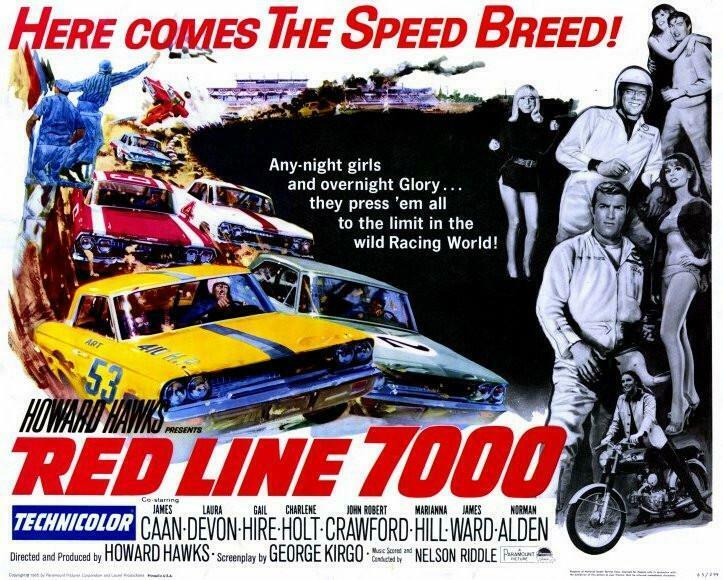
Buried on a double-bill with the youth-baiting Beach Ball,  Hawks’  Red Line 7000 completely tanked upon its release in November of 1965. It quickly disappeared from popular culture’s memory, despite the best efforts of Hawksians like Robin Wood. Production on his follow-up, El Dorado, began in October of the same year, the fastest turnaround between projects in his career (principal shooting on Red Line ended in April of ’65).  This thinly-veiled Rio Bravo remake was a box office hit upon its release in 1967, and has been a staple of cable channels and home video re-packagings ever since (the latest DVDcame out last Tuesday). Red Line 7000 has remained incredibly difficult to see, aside from the ever-present fuzzy bootleg videos.

The forgetting of Red Line 7000 was enabled by Hawks himself, who slagged the film over multiple interviews. In 1971: “I don’t like it.” In 1974: ” I didn’t like it, I thought it was awful.” In 1975: “I think it’s lousy.” His main complaint has to do with the narrative construction, which tries to weave together three different romances:

Just when you get people interested in one story, you jump to another story. Just when they’re interested in that, you jump to another. By that time they’ve forgotten the first one. They’re all mixed up and they say, “The hell with this thing!”

The nominal lead is James Caan as Max Marsh, an ace driver with deep neuroses regarding the purity of his girlfriends. He’s both attracted and repulsed by Marianna Hill as Gabrielle, an uninhibited racing fan who recently broke up with another driver, Dan McCall (James Ward). After their amicable parting, McCall pursues Holly (Gail Hire), a superstitious, mournful type who blames herself for the deaths of her three previous lovers. The third story is more tangential: that of the tomboy daughter of the crew chief (Laura Devon as Julie) in love with the strapping young driver Ned (John Robert Crawford).

Robin Wood called Red Line 7000 “the most underestimated film of the sixties”, partly because of the structure Hawks so derided:

The fact that the Ned/Julie relationship is so little integrated in the main action is not really the structural fault it at first appears. The other two relationships are parallel: in both, a strong, mature partner (Dan, Gaby) helps someone whose development has been arrested (Holly, Mike); the threads of plot continually interweave. The Ned/Julie relationship offers a contrast, and Hawks keeps it separate. Here, both partners are immature.

I believe Hawks and Wood are both right, that the film is both “lousy” and “underestimated”. The structure has interest, as Wood indicates, but it doesn’t have the performers to put life into its motions. Actors are incredibly important to Hawks, as so much of his script is improvised or written on the set with their participation. Without their engagement, his lived-in community of professionals becomes a cold line-up of earnest-sounding mannequins.

Gail Hire is the most embarrassing here, her labored rasp a caricature of Bacall’s rumbling bass in To Have and Have Not. It’s so ridiculous the audience I saw it with broke out into laughter, and I couldn’t blame them. James Ward and John Robert Crawford  are just blond-haired, blue-eyed blanks, showing none of the charisma or camaraderie essential to Hawks’ work. As Todd McCarthy states in his exemplary biography, he “labored to make the story and the actors come alive. Because of his case members’ limited experience, Hawks got much less creative input from them than he normally liked, and he had to deal with burgeoning egos.”

The film only comes alive in the Caan-Hill sequences, which show the combative sparks of his greatest romances. Hill’s insouciant sexuality baffles Caan’s repressed straight-arrow, and their mutual attraction can only be consummated on the race track. In a beautiful sequence where action replaces exposition, their combustible sexuality is revealed when he lets her take a spin around the track. Through his studied direction, she flawlessly takes the turns, until she spins out joyfully at the end, laughing violently. She tells him it was like “taming a lion”. Having to control Caan’s unstable boy is her dangerous task for the rest of the film. Hidden like a pearl for eager auteurists, this scene both confirms Hawks’s directorial hand and stands as a reminder of what the majority of the film was missing.

El Dorado is something else entirely. It has the feel of a valediction, a re-telling of Rio Bravo (1959) that takes aging as it’s central theme. John Wayne returns to the Hawks fold as Cole Thornton, an old gun-for-hire who rejects a job from corrupt landowner Bart Jason (Ed Asner). Robert Mitchum plays the town’s alcoholic sherriff, J.P. Harrah (the Dean Martin role in Rio). James Caan and Arthur Hunnicut round out the group of ragtag heroes, who try to protect the MacDonalds, a local farming family, from the predations of Jason’s acquisitive clan. Mortality is brought to the fore immediately, when Cole shoots down a MacDonald kid out of self-defense. Mortally wounded, the boy kills himself to end the pain. This random act haunts the rest of the film – it leads to the bullet lodged in Cole’s back and in J.P.’s leg, persistent reminders of their physical degradation.

If it is not as perfect as Rio Bravo – one certainly misses the presence of Walter Brennan and Angie Dickinson – for me it is as equally affecting, especially when viewed in the context of Hawks’ and Wayne’s career. As they slowly pirouette through the well-worn jokes one more time (Dry out the drunk, patronize the kid, prod the old coot), it is tinged with sadness – the bullet pressing closer to Cole’s spine with every move. It’s impossible to overstate the grace of John Wayne’s performance here, the hint of grief he exudes when Caan is searching for a gunman, the stoic regret he portrays after he kills the MacDonald kid, and the luxurious slowness in which he moves, whether simply sliding off a horse or leaping off a carriage, he carries the weight of his age with him. It’s a beautiful performance. There’s no grand send-off at the end, just a couple beaten old men, wobbling down the main drag and soaking up every last light of the moon.