THE 50TH NEW YORK FILM FESTIVAL, PART 1

September 25, 2012

Screen Shot 2020-02-05 at 4.57.45 PM

The 50th New York Film Festival, which runs from September 28th – October 10th, marks the end of an era. Richard Peña, the Program Director of the Film Society at Lincoln Center, as well as the Festival’s Committee Head, is retiring after 25 years, to be replaced by the well-respected critics and curators Kent Jones and Robert Koehler. This year’s main slate, made up of 32 features from around the world, presents directors that Peña has long championed, including Alain Resnais (You Ain’t Seen Nothing Yet) and the late Raul Ruiz (Night Across the Street), but also features artists poised to take their place in the fest’s firmament. Christian Petzold makes his long overdue main slate debut with the meticulously stunning Berlin Wall-era drama Barbara, while the astonishingly productive image-grabbers from Harvard’s Sensory Ethnography Lab make their second main slate appearance, following  Sweetgrass (2008) (Foreign Parts was a sidebar selection in 2010), with Lucien Castaing-Taylor and Verena Paravel’s immersive fishing documentary Leviathan . Also making his second appearance is Leos Carax, with his weary ode to cinema Holy Motors, his first feature since Pola X (1999), which was his NYFF debut. Petzold is a classicist, the Ethnography Lab a group of experimentalists, while Carax is a bit of both – a provocative trio to kick off this year’s festival.

Barbara is the most unassuming feature of the three, a slow-boil suspense film in which the most action occurs in the eyes of actress Nina Hoss. She plays the title character, an East Berlin doctor in 1980 who is banished to a country hospital after being incarcerated for an unknown crime. Even at this distant outpost she is hounded by the police and forced to endure humiliating searches, as she plans to escape with the help of her slick West Berlin boyfriend. Only the attentions of the sympathetic wreck Dr. Andre (Ronald Zehrfeld), and the decrepit state of a teen girl abused at the Torgau workhouse crack her determination to leave.

Petzold presents a world that is manifesting Barbara’s justifiable paranoia, one that constantly pokes and prods at her inviolable wall of privacy. He generally frames her in medium shot, with Hoss placed in corners, her eyes slathered in mascara so they pop out of her pale face, looking with the same intensity as the doctors in the reproduction of Rembrandt’s The Anatomy Lesson of Dr. Nicolaes Tulip that hangs in Dr. Andre’s office. She is alert and pensive, scanning a mise-en-scene that is rebelling against her. Her apartment’s electrical outlets blow out, the doorbell sounds like a clattering death rattle (and usually portends worse), and her bike’s tires pop at regular intervals. Then while at the office, she has to aid Dr. Andre in a lumbar puncture – with work the only place she can project her fears outward. Otherwise she is in constant surveillance of her environs, woman as prison-guard tower. Nina Hoss presents Barbara as an imposing edifice, a stone-faced sphinx who speaks in brief bursts, transmitting as little information as possible. But her eyes tell the tale, climaxing in an ecstatic close-up in the hospital, in which encrustations of anxiety fall from her face, and Barbara is ready to accept her fate.

The fate of the fish in Leviathan is never in any doubt. They will end up on our tables and in our bellies. Filmmakers Lucien Castaing-Taylor and Verena Paravel are interested in how they get there – not the facts of it, though, but the experience, and from every conceivable perspective. The duo used waterproof digital cameras and tied them to fisherman’s heads, shoved them into a pile of the writhing new catch, and dipped them underwater on long poles off the coast of New Bedford, Massachusetts. Herman Melville worked as a whaler in New Bedford, and used the town as a model for Moby Dick, in which great whales are called “leviathans”.

This association reflects on the changing industry in New Bedford, which was the number one dollar value fishing port for the 12th consecutive year, thanks to the sea scallop industry, although it’s a long way from the dominant whaling port it was at the turn of the 20th century. But while the fish are smaller, the sense of awe is still present, as Castaing-Taylor, Paravel and sound designer Ernst Karel cut between the brute reality and industrial noise of life on the boat with the awesome beauty and gurgling solitude of the nature outside of it. When the cameras bob up and under the surface of the water, catching flickering visions of seagulls manifesting out of the dark, it looks as if the world is being created before your eyes. The filmmakers told Dennis Lim in the NY Times that while Melville, as well as philosopher Thomas Hobbes (“life is nasty, brutish and short”), were the original touchstones of their work, it was the original, biblical sense of leviathan as sea monster that ultimately animated their vision. It is a primal, visceral and overwhelming work, one of those artistic breakthroughs that intimates what it might have felt to view the Lumiere’s train riding towards you for the first time.

If Leviathan feels like something bracingly new, Holy Motors is obsessed with the old – with old films, old actors and old age. After years of failing to secure funding for his work, Leos Carax fueled all of his rage at the business and love for the medium into this weary spectacular. Denis Lavant plays Oscar, a burnt-out itinerant actor who travels in a stretch limo around Paris (which has a similar tomb-like quality to that of Cosmopolis), heading to nine “appointments” in which he performs scenes in a variety of genres, from softcore porn to tearjerking melodrama to a grandly romantic musical reminiscent of Jacques Demy. His whole life is performance, and performance is life, acting for an invisible crowd that we see in the opening scene lolling contentedly in their seats.

This is no celebration, though, for Oscar is exhausted, as Michel Piccoli notes in a crucial cameo. These forms and characters that Lavant so imaginatively embodies are losing their force – these grand emotions are as outdated as the lugubrious limo that creeps through town. Oscar’s tour is a joyous kind of eulogy, a superb rendering of these spectacles that is also their last. He straps on a motion capture suit, a human disco ball in a dark room, and engages in an intensely erotic pas de deux with a similarly outfitted blonde. Their bodies heave and contract as one – but their efforts result in the slick, inhuman CG of writhing dragons. Later, a movingly melancholic Kylie Minogue breaks out into a heartsick ballad, singing of her past love for Lavant, a gorgeous number in which Carax tracks the camera up a desolate building onto the roof, where they part. All that is left afterward will be some broken glass on the sidewalk, another performance ended.  In Holy Motors cinema still works, and gloriously so, but it is fated to die anyway. The film is Carax’s form of mourning this passing, and here’s hoping this film and his career will have a lengthy afterlife.

  In the coming weeks I’ll discuss the sidebar programs, including the Views From the Avant-Garde program and an ultra-rare screening of Manoel de Oliveira’s The Satin Slipper (1985) , along with more selections from the main slate.

ZOMBIE WATCH: A CONVERSATION WITH DAVE KEHR ABOUT PAUL W.S. ANDERSON

Originally published at Movie Morlocks, the official blog of Turner Classic Movies

September 18, 2012

It was a banner weekend for Paul Andersons, as Paul Thomas Anderson and Paul W.S. Anderson topped the specialty and worldwide box office. As PTA’s vaultingly ambitious The Master has understandably dominated the cultural conversation, I wanted to create some space to discuss the ever-workmanlike W.S. One of the few directors to fully embrace 3D, creating dazzling depth effects on half the budget of most Hollywood spectaculars, he’s an endlessly resourceful stylist. Despite this, W.S. has long been one of the worst reviewed directors in the United States. One of his staunchest defenders has been New York Times film critic Dave Kehr,  so I went to see Resident Evil: Retribution 3D (rated 30% fresh at Rotten Tomatoes) with him at the Regal Union Square in Manhattan. Afterward we sat down and had an informal chat about Paul W.S. Anderson’s work and career. [Warning: Spoilers Ahead]

RES: So you were first impressed by Paul W.S. Anderson by seeing Shopping (1994) at the Toronto Film Festival?

DK: I’m pretty sure that’s where I saw it. British punk movie, big rock score. Stylistically, it’s not as accomplished as his later work, but the elements are there. It’s all nighttime, it’s all glare and chase sequences that move into the next one. And the people who consider themselves the last representatives of humanity in a corporate world.

RES: Yes, his villains are always the ultra-privatized, corporate overlords.

DK: The classic figure, right. I interviewed him once [you can read the 2002 NY Times interview here], and he was a very affable guy, and was startled that anyone would want to talk to him. It was really an effort to track down his publicist, because he had given up on getting recognition years before that, even.

RES: Once he made Mortal Kombat (1995), he became associated with video games, which was just considered trash.

DK: No more serious consideration necessary, the guy makes video game movies. And he’s still making cheesy video game movies…

RES: But excellent ones!

DK: Yeah. And he’s seen a lot of movies. Who he reminds me of is Fritz Lang. I’m pretty sure I asked him about that, and he said, “oh yeah, love him.”

RES: The connection with Lang is with his use of geometric figures?

DK: All the underground stuff, worlds within worlds, imagined conspiracies. In particular the space used in Resident Evil: Retribution (2012), the geometry and symmetry.

RES: Also similar is the puppet-master, a Mabuse-like figure.

DK: Sure.

RES: Umbrella Corporation in Resident Evil, Joan Allen in Death Race (2008)…

DK: The sinister boss figure hovering over all these people, and making them move and jump around. In the Resident Evil series, I guess it’s the computer, the Red Queen.

RES: It’s the corporation itself, a faceless entity.

DK: Yeah, it has its own life.

RES: It’s the entity that makes them jump around, but it’s how Anderson shoots this jumping around that makes him special. How would you describe how he shoots action?

DK: It’s hard not to think of the musical. It’s so perfectly choreographed. It reminds me of the first Hong Kong stuff in the 70s, with a real sense of exuberance in action that you haven’t seen in a long time. Real physical action, not just shooting guns at each other. Jumping off of buildings…

RES: While shooting guns…

DK: That came a little bit later, but what I’m thinking of is Tsui Hark’s Peking Opera Blues (1986). I don’t know if it stands up now. That style has been so overdone to the point of absurdity.

RES: Well, Hark’s Flying Swords of Dragon Gate (2011) was rather disappointing.

DK: Wasn’t it? I turned it off. So much CGI…

RES: Yeah, even with their weapons. And that’s the thing with Anderson’s films. There is tons of CGI, but they’re also very physical…

DK: He never gives you the sense that he’s faking it. The stunt choreography is really good. He clearly has a personal interest in that stuff. Getting to Budd Boetticher – the way people fight each other in Paul Anderson movies, it’s that kind of psych-out thing that Boetticher does. Through dialogue, through intimidation. It’s like a chess game, they’re anticipating each other’s moves. The fun is in seeing the twist at the end – how Milla Jovovich really out-thought the other person.

RES: Like in the opening of Retribution, Milla grabs a chain and lock, and works a number of variations on how she uses it in attacks. I did read that interview you did with him, and I remember he mentioned that he comes from a family of coal miners, explaining his fascination with claustrophobic spaces.

DK: Even when there are exteriors in his films, they turn out to be interiors. [In Retribution what looks like Tokyo, NYC and Moscow turn out to be an underground testing facility built by the evil Umbrella Corporation.]

RES: Each entry in the Resident Evil series has a very specific sense of place. The first was an underground labyrinth, the second an urban hellscape, the third a version of the West, and the fourth is the Western coast of the U.S. In Retribution, Anderson devises a plot where he can jump between these differing spaces.

DK: Although he does add the suburban section here. It’s fun to see her in normal clothes, playing at playing the mom. Then when she straps on the S&M gear, it’s very satisfying.

RES: Yes, the suburban sequence is really poking fun at traditional family drama, or even sitcom scenarios. It acknowledges the artificiality of genre constructions right up front.

DK: He really lays it on thick, with the deaf child. A perfect Spielberg suburb that turns out to be a deliberately unreal nightmare. These stock figures are actually trying to kill you.

RES: He shows these stock characters as stock – disposable. Even the little girl, who is the emotional center of the movie, is presented as fake, a clone with imprinted memories.

DK: Yeah and the little girl realizes it too, that Milla is not her mommy. I’m trying to visualize the scene where they see the cloning room. Are there any male characters there?

RES: No, I don’t think so. You see the clones of Milla, Michelle Rodriguez and the girl. Which goes to show how subordinate the male characters are in this film, they don’t even get decent clones.

DK: You hear complaints about there being a lack of action films with women, well, this is one of the most successful series out there, and it stars a woman. There are no compromises here, it’s just not a big deal at this point, in the Resident Evil world.

RES: What did you think of the use of 3D in this one?

DK: Great. It never seemed arbitrary, it always worked. I like all that stuff in the white prison cell, the geometrical form, the Umbrella design, it looks flat until something  pops out. It just has stuff you don’t see in other movies, including the lighting, backlit scenes with one or two lights. He doesn’t fill the frame the way Cameron does. Cameron has to have something going on in every corner of the frame. Anderson seems to be aware that, 3D isn’t just putting everything in one frame, it’s directing like as you would a normal film. Anderson knows how to put those shots together so it doesn’t feel disruptive, isn’t jarring. You need good solid old-fashioned match-shots on action. Where a lot of 3D directors get hung up is, they’re just framing every shot for what it is, and not thinking about what comes after it. It gets irritating after a while, with depth-of-field changing left and right.

RES: That’s what causes people to get headaches…

DK: It does for me. It pains me watching that stuff. I can’t help trying to put it together in my head.

RES: You saw The Avengers (2012).

DK: Every shot is just a guy shooting, with no sense of who he’s shooting at or chasing after. There’s just no relationship between this action and that action. It’s either complete in itself or it’s forgotten by the next shot. So it’s not about the logic of how you fight an army of 12 invincible zombies and get out alive, which has a certain amount of plausibility in the Anderson because the strategy is there, the athletic abilities are there, the ballet-like quality of moving through the air… It feels kind of serene in a way. It’s always so cool, she just knows how to execute it.

RES: You can see people thinking in Resident Evil: Retribution

DK: Yeah, she’s thinking down the line – look at this person, what’s he going to do, how am I going to react.

RES: What do you think about his use of slow motion?

DK: It’s kind of a cliché since The Matrix (1999) but I find it pretty effective. It exaggerates, or brings out those qualities more. And I really enjoy seeing whoever that stunt-person is doing her flip three times through the air. You want to savor that moment. I can accept it as part of the conventions now.

RES: At least of the new conventions, it adds clarity to movement rather than muddying it. What about that opening scene, of the action scene rendered in slow reverse motion. It’s gorgeous, although it seems like Anderson and his crew are just fucking around.

DK: Was it in the last film? No it wasn’t.

RES: It’s a continuation, picking up where Resident Evil: Afterlife (2010) left off. I don’t know what the point of it was, but I certainly enjoyed it.

DK: I also appreciated the recap at the beginning, because at this point, after five of them, I forgot exactly how it all got started.

RES: Although it’s not really a series where you have to know the mythology to enjoy it. Another thing I love are those architectural blueprint shots, which shows you where all of the characters are. Anderson is obsessed with letting you know where you are.

DK: He also does that in Event Horizon (1997). It’s important to know your position in space for a coal miner… I wonder if those are the same matrixes they used to model the CGI. Well, the Moscow stuff, I guess that was real location footage.

RES: Yeah, there was a second unit in Moscow

DK: The White House didn’t look all too real though…

RES: I’m sure they tried to get permission to shoot at the White House.

DK: Yeah, they called them up. “-I’m the producer for Resident Evil Part Five, we’d like to stage a zombie holocaust. –We’ll get back to you.”

RES: It’s interesting that they shot real locations and in the movie they made them into virtual places. Usually that works in the reverse direction. What are your pantheon Paul W.S. Anderson films?

DK: They’re all pretty good. He keeps getting better. Retribution is the smoothest and most satisfying. It does not feel monotonously fast. And it’s really tight. Every scene flows. And that’s exactly what Joss Whedon can’t seem to do. “Alright, that number’s over. We have two to three minutes of sarcastic banter between thinly sketched characters before it’s time for the next number to start.”

RES: This feels like the ideal Paul W.S. Anderson movie, plucking from everything he’s done before…

DK: You think it will convince people he’s got talent? [laughs]

RES: If one person is converted, we’ve succeeded.

DK: They don’t have press screenings for his films.

RES: And that’s not going to change.

DK: It’s not like that audience is going to respond, “hey, this got a great review in the Times! Let’s go see Resident Evil 5!” It’s funny how people get that label of being schlock directors. I don’t know what he did to deserve that.

RES: It’s just received wisdom. His name has become shorthand for schlock.

DK: Yeah, but is he Uwe Boll or something?

RES: It’s the subject matter.

DK: But Christopher Nolan became an international star directing comic book movies.

RES: Yeah, but Anderson does video game adaptations, there is a difference. Comic books have risen in cultural capital the last couple of decades. Not so for video games. Roger Ebert says video games are not art, so Paul W.S. Anderson is out. He’s out. People always forget how Hawks and Hitchcock were regarded as vulgar entertainers in their day.

DK: It seems like that lesson never gets learned. Each generation of critics blows it in their own way.

RES: Not that I’m saying Paul W.S. Anderson should be compared to Hitchcock…

DK: Well, he’s at least Far Side of Paradise at this point. [laughs] Maybe he’s Gordon Douglas. Anderson is not able to make the number of films Douglas was – Douglas could make five movies in a year, and Anderson makes one every two years, and he’s incredibly prolific for today. He has a little studio system set up now. He has a star, a franchise…

RES: It’s one of the great director-actress duos of our time…

DK: Absolutely!

RES: Len Wiseman and Kate Beckinsale – that’s the B-team.

DK: C-team. That’s bad because they bring out the worst in each other. She’s a fun light comedienne but terrible in action movies. I don’t know what Wiseman is good for actually [laughs].

RES: Any final thoughts?

DK: Well, it’s just such a pleasurable, kinetic experience to be moved through that. You don’t feel assaulted, irritated and beat up by a movie. It’s a movie that respects your intelligence, and has put some thought into how it’s going to work. It’s not one damn thing hitting you in the face after another. That’s just stimulation, lights flashing, sound going off, CGI crap falling on top of everything. If you get people hopped up and stimulated then maybe they’ll think it’s entertainment, but it’s not. I’m a grumpy old man.

RES: Justifiably so. What does that make me then?

DK: Well, I was a grumpy young man too.

GO HANG YOUR DREAMS: THE HANGING TREE (1959)

September 11, 2012

Screen Shot 2020-02-05 at 4.45.33 PM

The Hanging Tree (1959) is a Western marked by illnesses and maladies, a portrait of a violent man at war with his own impulses. It deploys Gary Cooper as a crumbling totem, the actor’s aching hip tipping his performance from his famous underplaying into a kind of pained decrepitude. It is one of Cooper’s most emotionally wrenching turns, as he is seemingly aware that he was reaching the end of his career, which would end with his death in 1961. Then there is the sickness that felled director Delmer Daves over halfway through the shoot, necessitating that Karl Malden take over behind the camera, using Daves’ storyboards as guides. These sicknesses are made legible in the film, from the name of Cooper’s character, Doc Frail, to the sun exposure that fells Elisabeth (Maria Schell), the Swedish immigrant who Frail nurses back to health, and who tests the boundaries of the doctor’s seemingly impenetrable emotional defenses. Long unavailable in its original 1.85:1 aspect ratio, the Warner Archive has released a handsome anamorphic edition of the film on DVD, transferred from an inter-negative. There is some light print damage, but nothing to detract from the grandeur of Daves’ compositions, shot on location in the Oak Creek Wildlife Area outside of Yakima, Washington.

Cooper personally shepherded the project at Warner Brothers, the second film he produced following Along Came Jones (1944), through his Baroda Pictures imprint. His daughter Maria told Lou Lumenick at the NY Post that, “The story meant a lot to him. He was a Montana boy and had a real resonance with the characters and the drama of the era when there was a push to stake claims. He was born in 1901 in Helena when it was a funny mixture of a rough and ready town at the same time Montana had more millionaires than any other state in the union. Helena even had a hanging tree, so that was not a foreign dramatic touch to him.” The story was adapted from the 1957 novella by Dorothy M. Johnson, and regards the arrival of Doc Frail into the gold rush town of Skull Creek, Montana. He hides  wanted thief Rune (Ben Piazza) at his cabin, but asks for a form of indentured servitude in return. Rune reluctantly agrees, for a while, if only to avoid capture. So when Elisabeth is discovered in the desert, half-mad and blind, Frail and Rune are tasked with healing her. They go about their task increasingly insulated from the madness growing outside their doors, as gold fever has whipped up the town in an anarchic frenzy, encapsulated in the raving, violence-mongering preacher Grubb, played with grandiose menace by George C. Scott, in his indelible big screen debut.

This outside sickness, one of extreme individualism, is one that Frail is sympathetic to, having been burned by intimate relations in the past. So as the trio of himself, Elisabeth and Rune develop into a loving co-dependency, he cuts them off. Warm and giving when they are in need, Frail cannot stand the sight of the others when they have grown self-sufficient, the power relations shifting against him. There is an unsettling shot where Frail walks Elisabeth out to a cliff’s edge and determines that her sight is returning. The shift in his tone from solicitous caretaker to distant acquaintance is chilling in its swiftness and severity. It is clear that Frail has performed this act before, forever retreating back into himself. Daves repeatedly frames them against the dizzying rocky slopes of the Oak Creek Wildlife Area, images of serenity that ironically contrast with the relentlessly neurotic and interior Frail.

Despite her near-death experience, only Elisabeth seems truly comfortable in the land, opening a gold panning outpost with gusto, eager to work as much as any man. This confuses her dopey macho assistant Frenchy (Karl Malden), who with his floppy hat and head bob, looks like a schnauzer begging for treats. He is an idiot, and one who does not seem to have advanced beyond Freud’s polymorphous perversity stage, believing that everything and everyone around him is available for his pleasure. Frenchy is the representative of the town’s descent into narcissistic madness. Frail recognizes himself in Frenchy, in their selfish rejection of society. Perhaps this is why Frail turns aggressively violent in Frenchy’s presence, a bitter rage which results in a scene of shocking violence at the same cliff where Elisabeth regained her sight.

Malden not only gave a singularly unsettling performance, but saved the project from imploding. According to the AFI Film Catalog, production began on June 17th, and Delmer Daves’ sickness forced him to leave on July 25th. For the rest of principal shooting, which lasted until August 13th, as well as post-production, Karl Malden took over as director.  He recalls this period to Rose Eichenbaum in The Actor Within:

During the last two weeks of the picture, the director got sick and went to the hospital. So I got a call on Saturday to come over to Coop’s house. I get there, and he says they might have to close down production. ‘That’s too bad’, I say. So he says, ‘why don’t you finish directing this picture?’ ‘Me?’ ‘You can do it, you directed Widmark in Counter Attack. You can do it.’ So I said okay, but if I find that I’m lost and I don’t know how to do it, and we have to sit there and figure it out, don’t scream at me.’ ‘Kid,’ he said, ‘I’ve never spoken angrily to anyone in my life, and I’m not going to start now.’ So I accepted and directed the picture for two and a half weeks. When it was finished, Gary Cooper went over to Warner’s and said to them, ‘star billing!’ That’s the first picture in which I ever got star billing. That’s the kind of man Gary Cooper was.

In order to depict the destructive community of Skull Creek, which burns itself alive in a drunken revelry of greed, the production team had to function as a supportive one. Cooper had a chronic bad back as a result of a broken hip he had as a teen which was never set properly, and it was bothering him mightily on the set. He couldn’t sit side-saddle on a horse, as Marie Cooper tells Lumenick, so a special saddle was created where he would be perched off to the side. This worked for his character, allowing him to literally talk down to the characters Frail is so desperately trying to separate himself from.

The Hanging Tree is a fragile Western, one in which psyches are as easy to shatter as entire communities. Money is both their curse and their salvation, able to put their necks inside a noose as well as buy their way out of it.  The only thing it can’t seem to purchase is happiness, at least that found outside of a bottle. The final shots, in which Elisabeth divests herself of all her gold and land, and instead nuzzles Cooper’s downturned head, are some of the most radical, and radically moving, in the Hollywood Western.

BRAKING NEWS: MOTORWAY (2012)

September 4, 2012

Screen Shot 2020-02-05 at 4.37.13 PM

Car chase movies are necessarily clamorous things, as they orchestrate squealing rubber, huffing pistons and the screams of crumpling steel. Which is why Motorway (2012), the new film from Hong Kong director Soi Cheang now out on HK Blu-Ray, is so unusual. It’s a particularly quiet automobile action movie, focused on the finesse of driving. The defining technique of the film is a 90 degree hairpin turn executed at 8,000 RPMs but only 2 Kilometers/hr. It requires great power exerted with careful, slow consideration, which holds true for the film as a whole. Pared down to a sleek 89 minutes during a prolonged two-year post-production process, back-stories and subplots were removed in favor of a film with narrative lines as clean as the ’89 Nissan 240 SX S13 that the traffic cops are unable to stop.

Motorway is the second film that Soi Cheang has made for Johnnie To’s Milkyway Studios, after the elaborately entertaining assassin drama Accident (2009). Where that is a clever expansion of the hitman movie, with its complicated Rube Goldberg made-to-look-like-accidents killings, Motorway is a reduction. Each of its characters is reduced to genre archetypes, with the audience using its knowledge of previous car chase films to fill in their background. The main driver is Chan Cheung (Shawn Yue), a speed freak gearhead who also works for the traffic cops in Kowloon. His partner is Lo Fung (the ever stone-faced Anthony Wong), who is near-retirement but is still haunted by the  getaway driver Jiang (Guo Xiaodong) who escaped him decades previously. So of course that wheelman returns to Kowloon in order to spring his imprisoned pal  Huang (Li Haitao), in order to set up the heist of a large diamond.

They are defined by their jobs and the roles as established by previous films. The enigmatic Jiang is descended straight from Ryan O’Neal in The Driver, whose every press of the accelerator seems to assuage some deep existential dread, while Chan, with his souped up vehicle and late night drag races, is a fugitive from the hyperactive Fast and Furious series – a hot-headed punk over his head. But while the characters are familiar, the chase scenes are not. They are uncannily intimate affairs, always at night under flickering neon lights, and they are paced and fought like duels. Cheang makes much out of dramatic pauses and rests. Jiang is constantly finding holes in the city to rest in, from the back of a truck to the obscured spot in a parking garage. There is a sense of vehicles as an extension of their bodies, no more so when Lo Fung rolls down his window in an effort to hear his adversary more than see him, as the darkening night corrodes his vision. The repeated close-ups of the engine block throbs with the energy of a heartbeat.

It is a thrillingly organic film, in which the lines of a map which Jiang is tracing morphs into the lines of the road, of the car, and of the street. And all of this rather quietly rendered structure  does not diminish the impact of the chases. Using a camera attached  low to the ground,  Cheang and his cameraman capture the stunt-drivers locking horns through the streets of Hong Kong. I only detected CG in one shot, in which a car nearly tips over a cliff. Everything else was, at least in the movie-verse, authentic. Cheang told Edmund Lee at Time Out HK what he was going for:

I’m not exactly a fan of racing movies, but I have fond memories for the racing scenes in several crime thrillers, such as [William Friedkin’s] The French Connection (1971) and To Live and Die in L.A. (1985), as well as the likes of Ringo Lam’s Full Alert (1997). When you watch the old movies, you can actually feel that someone is driving the car; when you see The Fast and the Furious movies nowadays, you can’t help but feel that part of their beautiful [action sequences] have been animated. I really want to go back to the human dimension of driving. I want to find out who these drivers are as human beings.

You can sense the characters’ human qualities through their driving styles. Jiang is elusive and fond of trickery in his ancient S13, while Chan favors a more barreling forward damn-the-torpedoes style in the police sedan. Lo Fung is harder to pin down, as he is only given one opportunity to show his driving chops, called back to the wheel after decades of refusal. He prefers a more sensorial style, as indicated when he turns off the AC and lowers the window. But everything can fail, especially when one depends on machines.

For in Motorway crashes have devastating impact, the steel frames of cars as permeable as skin. The more the vehicles are mastered and become extensions of drivers’ bodies, the more vulnerable they become. Every protagonist is either bruised, battered or dead by the end, with Jiang’s rabbit-punches keeping Chan off-guard until a final showdown on a pier, in which both woozy fighters circle each other in a screeching pas de deux. Motorway is a brooding original which turns the manic breathlessness of a car chase into a subtle duel of personalities.

THE OLD & THE NEW: BYE BYE BIRDIE (1963)

Originally published at Movie Morlocks, the official blog of Turner Classic Movies

August 28, 2012

Screen Shot 2020-02-05 at 1.36.54 PM

Against a backdrop of retina-bursting blue, the 22-year-old Ann-Margret waves goodbye to the classical Hollywood musical in Bye Bye Birdie (1963). Director George Sidney seems prescient in expanding Ann-Margret’s role at the expense of intended stars Janet Leigh and Dick Van Dyke, considering the explosion of the youth market less than a year later, when The Beatles would appear on The Ed Sullivan Show (which also makes an appearance in Bye Bye Birdie), cementing rock band movies/concerts as the musicals of the near-future. Now available in a gorgeous limited edition Blu-Ray from Twilight Time (for purchase exclusively at Screen Archives), Bye Bye Birdie is an eye-popping transitional work, with the old and the new Hollywood brushing up against each other with both awkward and thrilling results.

As a Broadway show,  Bye Bye Birdie was a gently satiric take on the gnashing of female teeth caused by Elvis Presley getting drafted into the army, told mainly through an adult’s perspective.  It follows struggling songwriter Albert Peterson and his secretary and sometime girlfriend Rosie Alvarez as they try to get rock heartthrob (and Elvis stand-in) Conrad Birdie to sing their tune on The Ed Sullivan Show. The character of Kim McAfee, the teen girl plucked from Birdie’s fan club to receive his last kiss before he enlists, is a distinctly supporting part.

But when director George Sidney saw Ann-Margret’s ebullient performance, he expanded her role to include five musical numbers (up from two), and cut out Janet Leigh’s big “Spanish Rose” routine. This shifts the perspective to the teenage denizens of Sweet Apple, Ohio.  One of Sidney’s inventions was placing Ann in front of a blue-screen to open and close the picture, a showcase in which she exhibits a faux-naivete (clutching her skirt), only to be replaced by a self-aware come-hither stare, in a performance which, as Dave Kehr wrote in the New York Times, is “so charged with erotic energy that you can practically feel a nation’s toes curling. She plays Kim, the head of the Conrad Birdie fan club, and her scenes are supercharged with hormonal energy, including her “How Lovely To Be A Woman” solo, in which her playfully aggressive donning of a sweater dress completely undermines the squeaky clean sexism of the lyrics (“It gives you such a glow just to know/You’re wearing lipstick and heels!”). Kim is fiercely in charge of her own life, especially over her milquetoast boyfriend Hugo (Bobby Rydell), who unfortunately is tasked with trying to one-up her at a dance-off during the “A Lot of Livin’ To Do” number (he loses).

In between all of this, Dick Van Dyke and Janet Leigh valiantly attempt to keep the supposed A plot, that of Peterson and Rosie, percolating. But maybe because Sidney was too enamored of Ann-Margret, their work looks flat in comparison. Leigh was inevitably disappointed with the finished film, writing in her autobiography that, “George had changed as well. I couldn’t exactly define the difference. It might be accredited to the transference of his Svengali attitude from me to the new and young Ann-Margret. He saw, perhaps, an opportunity to mold another budding career. I was ‘old hat’ after the numerous pictures and tests we had made together. His dismissing behavior wreaked havoc with my already precarious stability.” The only relative oldster who comes off with an equal level of energy or verve, is, of course, Paul Lynde, who takes on his stage role of Mr. McAfee, Kim’s befuddled dad. Knocking out a venomous version of “Kids”, Lynde’s particularly nasal wit makes it seem like being an adult is not the bore Peterson and Rosie make it out to be.

One thing that brings all ages together in the film is their desire to be on television. From Peterson to Kim to the mayor, everyone kowtows to Ed Sullivan and his producer, hoping the idiot box will goose their businesses or make them a star. Television, and variety shows like Sullivan’s, was part of the reason for Hollywood’s decline in box office in this period, and spurred their desperate search for what audiences actually wanted. But the film reflects that all people wanted was more TV. The finale, which turns the Sullivan show into an amped up burlesque, thanks to the effective sabotage work of Peterson and Rosie, is an attempt to depict television as, even at this late date, as a kind of rough and tumble Wild West of entertainment. The sequence makes it look like a particularly poor night at a community college’s talent show – as contrasted with the slick musical sequences from earlier in the film.

It is a sparklingly polished film, like a lollipop licked to maximum sheen, the popping primary colors captured in smoothly arcing crane shots. None of the colors register as sharply as Ann-Margret’s personality. A musical star was born, but right at the beginning of the genre’s slow demise. She would co-star with the real Elvis in Viva Las Vegas (1964), but aside from the rock-opera Tommy (1974), wouldn’t star in a full-blown musical again.

CITY OF ENTROPY: NEIGHBORING SOUNDS (2012)

August 21, 2012

Screen Shot 2020-02-05 at 1.32.54 PM

The once legendary resort, like everywhere else that one visits now, regardless of the country or continent, was hopelessly run down and ruined by traffic, shops and boutiques, and the insatiable urge for destruction. -W.G. Sebald, The Emigrants

The setting of Kleber Mendonca Filho’s extraordinary debut feature Neighboring Sounds (opening on 8/24 in NYC) is not a resort, but the aging apartment blocks and flimsy, sprouting condominium towers of Recife, Brazil that bear similar scars of overdevelopment. The seemingly haphazard urban planning has the upwardly mobile middle class living on top of and among the blue collars who serve them. Filha’s film presents the neighborhood of Setubal as a series of constant intrusions, from the minor annoyances of a yapping guard dog and a stolen car stereo to the unsettling history of the area’s industrialist/colonialist past leaking into the present. The social contract in Setubal is built on as uneasy a ground as the swiftly built condos. As in Sebald’s description of a depopulated Deauville in The Emigrants, the whole town seems on the verge of collapse, haunted by the ghosts of its lost wealth. Yet all of this is subtext, woven into the comic-melancholic fabric of the neighborhood’s everyday routines.

The central node in this multi-character drama is Joao (Gustavo Jahn), a sluggish real-estate agent whose grandfather Francisco Oliveira (W.J. Solha) used to own all the land in town, his fortune made from a now decrepit sugarcane farm. Most of the land has been sold off to developers, with the neighborhood becoming a mix of gentrifying professionals and the old working class, mostly of African descent, hanging on in their yet-to-be leveled apartment buildings. One of them is Bia (Meve Jinkings), an insomniac middle-class mom driven mad by that barking dog, and who tries to stay sane with copious amounts of weed. Preying on fears of a violent underclass, a private security company led by glad-handing Clodoaldo (Irandhir Santos) wins a contract to patrol the streets. Clodoaldo and his crew slowly embed themselves into the town before he reveals his true, secret purpose.

The opening carefully sets up the clashes that will follow. The first images show B&W still images of Recife, of beauty queens and farmers, before a cut to the present and a low-angle tracking shot that follows a boy and girl wheel their way through a parking garage and onto a teeming condo playground. The photos show the faces that were displaced in order to make way for this luxuriant leisure, but a reaction shot shows it to be an ongoing process, as the boy curiously stares at a construction worker sanding off the rough edges of a window frame.

This is the first of many shots of frames-within-frames which throw the working and middle classes in uneasy equilibrium. In one time-traveling sequence, one of Francisco’s maids is shown changing in a doorway, transforming from a starched maid out of the 1950s into a sexually aggressive halter-topped woman of present day. Another, more depressing instance occurs when Joao is showing a mother and daughter a new apartment. The daughter wanders to the balcony and stares at a barefoot boy playing soccer in an alley below.  The boy is centered and enclosed in the alley. He kicks the ball over the fence and asks for her to return it in vain. The mother pulls her away before she can help. They depart, and there is a jarring cut to the ball bouncing back down the alley. Presumably Joao returned it, although that is left ambiguously.

Joao’s character makes pains to be friendly with the help, acting warm and flirtatious with his lifelong  maid Maria (her family is always hanging out at his place), and defending  his building’s doorman after the co-op meeting wishes to throw him out. His actions are cosmetic, with his character too apathetic to do anything so bold as give someone a promotion, or even a raise. He is caught between his family’s feudal past and his eagerness to be a young bourgeois liberal, with all the indolent self-righteousness that requires. This whole conflict comes to a head in the moodily elegiac sequence when he takes his equally affectless girlfriend Sofia (Irma Brown) to the sugar mill, a dilapidated relic of his family’s exploitative past. And yet it is a beautiful and seductive place, their lives slowing down to a crawl as they laze about in hammocks and waterfalls, channeling the leisure of centuries past. They wander through the decaying factory cinema, acting out hypothetical scenes for an audience long dead and gone, just like the plantation and its way of life. The sound design, which is intricately stunning throughout, is especially spare here, the score reduced to a bass-heavy thrum, and the background  noise rising until it subsumes its Joao, Francisco and Sofia in the same beneficent tones their ancestors must have heard, a brief illusion of time, and power, regained.

The images of the sugar mill are those of pervasive decay, recalling another line from The Emigrants, of one Dr. Abramsky who yearned for the destruction of his long-shuttered mental hospital, which housed so many brutalized victims of electroshock: “Nowadays I place all my hope in the mice, and in the woodworm and deathwatch beetles. The sanatorium is creaking, and in places already caving in, and sooner or later they will bring about its collapse.” This will be the fate of the mill – and of Francisco and Joao’s family, indirectly caused by the intervention of Clodoaldo – a kind of vengeful spectre from their fabled past. The only character not weighed down by this history  is Francisco’s maid, who in her off-hand costume change was able to slough off the past and stride toward the future with a brazen confidence.

THE GRIM OUTDOORS: RIVER OF NO RETURN (1954)

August 14, 2012

Screen Shot 2020-02-05 at 1.18.58 PM

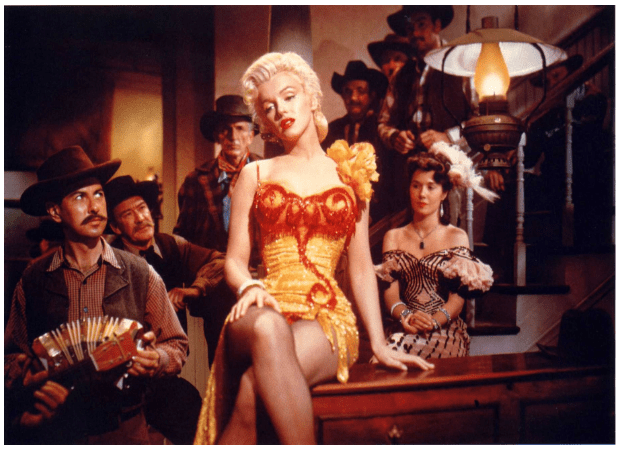
In the numerous attempts to capitalize on the 50th anniversary of Marilyn Monroe’s tragic death, 20th Century Fox has made the most welcome one, releasing impeccably restored editions of seven of her films in the “Forever Marilyn” Blu-Ray box set. Also available individually, these discs are a striking reminder that Monroe was not simply a mass-produced fetish toy, but an idiosyncratic artist who keenly played off of, and frequently subverted, the dumb-blonde characters she was saddled with. It includes Gentlemen Prefer Blondes, How To Marry A Millionaire, River of No Return, There’s No Business Like Show Business, The Seven Year Itch, Some Like It Hot and The Misfits. While Gentlemen Prefer Blondes remains an ebulliently entertaining treatise on female friendship, the revelation for me was Otto Preminger’s River of No Return (1954), a rather melancholy Western (with the saddest theme song in history), in which she plays her woman of questionable virtue with a daring opacity, causing Darryl Zanuck to demand re-shoots to clarify her character’s motivations.

River of No Return was originally conceived by screenwriter Louis Lantz as a Western remake of Vittorio De Sica’s Bicycle Thieves. It concerns a man, Matt Calder (Robert Mitchum) whose horse and gun are stolen by gambler Harry Weston (Rory Calhoun). Unable to work on or defend his farm, Calder and his son Mark (Tommy Rettig) search the dangerous countryside for the thief. As Chris Fujiwara reports in his meticulously researched critical biography of Preminger, The World And Its Double, Lettig’s treatment was heavily revised by Frank Fenton, brought in by young Fox producer Stanley Rubin. They fleshed out Calder’s backstory, making him an ex-con recently released from prison on a murder charge. Weston was also given a saloon singer fiancee, Kay, to be played by Monroe. After the theft, Kay is embarrassed by Weston’s actions and stays behind with Matt and Mark,  but her ultimate loyalties are left ambiguously undefined.

Fox executive Darryl Zanuck intended the film to be a garish spectacle that would show off Monroe and the new CinemaScope process, writing in a memo that he wanted it to “stand an audience on its ear.” Otto Preminger did not entirely deliver the thrills Zanuck sought, so Jean Negulesco was brought on to film reshoots, including the sexually suggestive scenes in which Mitchum massages, and later violently wrestles with, Monroe.

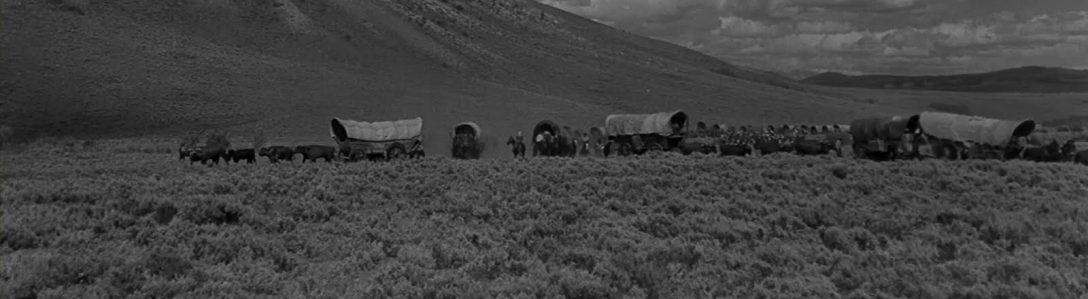
Preminger was brought late into the production, after the screenplay and much of the cast were finalized. Used to being producer/director on his films, and having just finished The Moon Is Blue, doing work for hire was a new and fraught experience for him. It was also the first film that he shot in CinemaScope, which he adapted to with a remarkable ease. Working with cinematographer Joseph La Shelle, Preminger composed images for the widescreen frame, which was perfect for capturing the horizontal lines of the pseudonymous river (shot in Alberta, Canada). He also instinctively understood that the wider frame was inimical to quick pans and editing, so he often uses depth to stage multiple actions in one shot. At the time Andre Bazin wrote that River of No Return was an exemplar of CinemaScope filmmaking, that it was one of the first films in which “the format really added something important to the mise en scene.”

This can be seen to an offhandedly brilliant effect in an early shot where Mitchum is strolling through a gold rush town, interrogating a priest about the whereabouts of his son, whom he is picking up. The priest laments that he came West as a missionary to convert Native Americans, but that he thinks white folk need him more now. Gold fever has corrupted his town. In the background Preminger presents nature as another force luring people into the muck. There is a carriage fording the river behind Mitchum, loaded up with women. It gets stuck in the mud,  and one of the ladies tumbles into the water before it reaches shore. This is a comic variation on the dangers the river will later present to Calder and to Kay. Background is comedy, foreground is tragedy.

As easily as Preminger adapted to CinemaScope, the same can’t be said regarding his relationship with Marilyn Monroe, who brought along her very vocal acting coach Natasha Lytess. Fujiwara details Preminger’s growing irritation with Lytess’ constant interruptions, until he finally banned her from the set. She would later return due to Zanuck’s intervention. But regardless of the tension off the set, Monroe is teasingly enigmatic in the film, emphasizing Kay as a performer. She appears warm toward Mark, but there is a coldness in her tone that implies it could be an act, as she is still sworn to marry Weston. She is the perfect foil for Mitchum’s brooding introvert – who repeatedly tells Kay and his son that they are likely to die on their journey. They are like two stubborn mules who kick each other enough until they realize they both like it.

Zanuck did not approve of the ambiguous nature of Kay and Calder’s motivations, writing in a memo that “our picture is inarticulate. We have got to stop guessing about these relationships. Once and for all, we want to lay it on the line so there can be no doubt or confusion as to what our people mean and how they feel.” Three new scenes were shot, including the two sexually suggestive ones previously mentioned, and another with Monroe and Rory Calhoun that would clarify their intent to marry.

Regardless of these additions, Preminger’s film remains intriguingly opaque, the characters’ moral reversals seemingly coming with the wind more than from some inner will. In the glorious CinemaScope landscapes, it is the world that seems to determine the action, and not the other way around, as Calder and Kay are tossed to and fro along the riverbank. It is even the river that provides the most famous symbolic moment in the film – when Kay’s suitcase escapes in the water as Weston carries her to the shore, and onto Calder’s farm. Her final ties to civilization are carried away by the current, and Mitchum’s (gun and horse) are forcibly removed by Weston. They are forced to find a new life, re-shaped and re-directed by the river’s ceaseless flow.

THE TOSHIRO MIFUNE BLOGATHON: THE CHALLENGE (1982)

August 7, 2012

Screen Shot 2020-02-05 at 1.13.22 PM

The collaboration between Toshiro Mifune and director Akira Kurosawa ended in 1965, following the release of Red Beard, their sixteenth and final film together. Having built up an international reputation thanks to his work with Kurosawa, Mifune looked West, receiving his first Hollywood paycheck playing against type as a Japanese industrialist in John Frankenheimer’s Grand Prix (1966). He would jump back and forth between Japan and the U.S. through the early 80s, working mainly in stolid war dramas (MidwayInchon), but also getting to stretch out a bit with John Boorman (Hell in the Pacific) and Steven Spielberg (1941). In terms of viewership, his greatest success was playing opposite Richard Chamberlain in the TV mini-series of James Clavell’s Shogun (1980).Perhaps realizing that Hollywood would continue to shunt him into stereotyped Japanese roles in stuffy historical dramas, he spent the majority of his remaining career at home. For his final U.S. film in this period, he re-united with John Frankenheimer to shoot the entertainingly silly East-meets-West martial arts film, The Challenge (1982). Frankenheimer had similarly entered a low ebb in his career, resulting in these two dynamic talents making a mid-budget action film for CBS Films, to be distributed by the small Embassy Pictures studio.

The Challenge stars Scott Glenn as a prototypical ugly American who gets caught in the middle of a feud between two Japanese brothers over their family’s legendary samurai swords. Glenn was fresh off of his supporting role in Urban Cowboy, and this was CBS and Embassy’s attempt to capitalize on that and make him a star. That it didn’t work doesn’t take away from Glenn’s admirably schlubby performance, in which he slouches and slurs his way through Kyoto. Buried up to his head in dirt, he even manages to croak out “Deep In the Heart of Texas.”  Shot on location, the film has a largely Japanese crew, including DP Kozo Okazaki, but there were some up and coming American collaborators as well. John Sayles did a major re-write of the screenplay, and had fond memories working on the film, as he told Philip Wuntch:

The funniest experience I had was rewriting The Challenge for John Frankenheimer before it started filming. When Frankenheimer found out he could get Toshiro Mifune, he changed the background from Chinese martial arts to Japanese martial arts. They’re completely opposite forms, but he said no one would know the difference. We changed all the martial arts scenes and all the background story because he was able to get Mifune.

Steven Seagal was living and teaching Aikido in Japan, and was brought on as “martial arts coordinator”, presumably helping to help choreograph and fact check the accuracy of the fight sequences. He would later open a martial arts school in North Hollywood, teaching the movie execs who would later make him a short-lived star. But as Sayles writes, it was Frankenheimer’s eagerness to work with Mifune that necessitated large scale revisions, as well as scouting locations in an entirely different country from which they expected. As an actor, Mifune still garnered that kind of respect, although Embassy had to be hoping it was Glenn that would drive the box office, as it was his face that is emblazoned on the posters.

The movie provides a stark vision of culture clashes, creating a triangle between old-school samurai Toru (Mifune), his super-rich Westernized brother Hideo (Atsuo Nakamura), and the brusque uncultured America of Rick (Scott Glenn). Rick is a down and out boxer, who Toru recruits to help escort one of his lost swords back to Kyoto. Unaware of the dangers of his employment, he agrees, but he is soon waylaid by Hideo’s goon Ando (a wonderfully sarcastic Calvin Jung), and endures a barrage of beatings before he has any idea what is going on. It’s a broad mishmash of the kineticism of Chinese kung-fu movies, the honor code of Japanese samurai films, and the body count of Hollywood action movies.

Mifune plays his Toru as a gruff, soft-spoken patriarch with a shock of white hair, injecting gravitas into a movie of profound absurdity. The final action sequence has the samurai-robed Mifune taking down an entire skyscraper of guards and goons with his bow and arrow (and an assist from a machine-gunning Glenn). It’s an outrageous sequence that presages the bloodbath at the end of Commando (1985), and the only thing keeping the film moored to its dramatic arc is Mifune playing it absolutely straight. The sequence is a pungent metaphor for the fears Americans had toward the growing economic power of Japan, as the film pines for the civilized, if technologically backward dojo of Toru, while painting Hideo as an unprincipled free-market capitalist ready to destroy tradition for his material gain. The American Glenn comes to the aid of Toru, battling back the threatened economic competitor.

It is what they call “a rich text”, although it’s unclear how much Frankenheimer contributed. It was during this period that he had become a serious alcoholic, and he told Charles Champlin that he was even bringing drinks to the set, for the first time in his career. It was following this eye-opening and sense-dulling shoot that Frankenheimer checked himself into rehab and dried out. It is not one of his more visually interesting films, lacking his usual smooth lines and frames-within-frames. Although I should admit I had to watch it in a cropped 1.33:1 aspect ratio (it was shot in 1.85), as this VHS version is the only one available. He would dry out, and revive his career on television, where he began. Mifune would also make a series of TV movies in Japan, before ending his career in 1995 with the drama Fukai kawa.

SOMETHING TOUGH: BODY AND SOUL and FORCE OF EVIL

July 31, 2012

Screen Shot 2020-02-05 at 12.40.26 PM

“According to materials contained in the PCA [Production Code Administration] files in the AMPAS Library, PCA director Joseph I. Breen objected to ‘the completely anti-social basic theme of this story, which presents wrong as right and right as wrong, in violation of both the letter and spirit of the Production Code.’” –Force of Evil entry, American Film Institute Catalog

In 1946, John Garfield’s contract with Warner Brothers expired. Instead of re-signing, or moving to another studio, Garfield signed on with the independent Enterprise Productions. Bringing together a group of artists who were communists, or communist sympathizers, Enterprise made an inflammatory group of nine films before folding, after which many of its members were blacklisted, including directors Robert Rossen and Abraham Polonsky. Two of their features, Body and Soul (1947) and Force of Evil (1948), respectively, ended up in the Republic Pictures library, and are being released today on Blu-Ray from Olive Films, in strong transfers. Garfield was eager to make a statement with Enterprise, telling PM Magazine in this period that:

I want to make pictures with a point – I know I gotta continue to appear in pictures like Postman [The Postman Always Rings Twice, 1946]. I know I gotta retain my position of value at the box office, but I also want to be available in between for the kind of picture that’s harder to do but may turn out to be more interesting. Maybe in the next few years I’ll make so many mistakes I’ll kill my career. I can afford the chance. There’s fear in Hollywood about tackling dangerous subjects, difficult subjects. I feel I owe it to myself to be available when some enterprising people want to try something tough.

Enterprise productions was formed by David L. Loew, Charles Einfeld, and silent partner A. Pam Blumenthal. Loew was a son of MGM founder Marcus Loew, and left the studio to pursue an independent producing career in 1935, working with directors like Jean Renoir (on The Southerner (1945)) and Albert Lewin (The Moon and Sixpence (1942)). Einfeld was the former advertising and publicity director at Warner Brothers, and therefore familiar with Garfield, while Blumenthal helped them garner a $10 million line of credit from Bank of America to finance their first six films. Garfield and his business partner Bob Roberts set-up their Roberts Productions shingle under the Enterprise banner.

It was an idealistic endeavor, which actor Norman Lloyd described as “Nirvana”, and then-Assistant Director Robert Aldrich judged that, “For about two and a half or three years before it went down the drain, I would guess that it had a better esprit de corps, and more interest and excitement going for it among the employees, from the laborer to the star, than any place in Hollywood.” Garfield and Roberts’ first film at Enterprise was Body and Soul (1948), and the talent on-board is staggering. Along with Aldrich as AD, it attracted Rossen as director, Polonsky as screenwriter, James Wong Howe as cinematographer and Robert Parrish as editor. Dialogue director (and later a director period) Don Weis told Garfield biographer Robert Nott that “I was amazed that everyone in the company with the exception of [cameraman] Jimmy Howe was involved politically. Every day they [Polonsky, Roberts and Garfield] would come down from the office with a petition for us to sign, for good things like housing for the poor, and I signed everything. “

Garfield bought the rights to the life story of Barney Ross, a Jewish boxer and decorated WWII soldier who was born on Rivington St. in the Lower East Side of NYC, just like Garfield. Ross was born Dov-Ber Rosofsky, son of a Talmudic scholar, while Garfield was originally named Jacob Garfinkle, born to a clothes presser and part-time cantor. It was a deeply personal story to Garfield, although the story’s ethnic character was drained by the PCA, who even objected to showing bouts between a black and a white fighter, although the fight between Garfield and Canada Lee remains in the film. The script had to be heavily revised by Polonsky in any case, telling a profoundly sad version of the familiar rise and fall boxing narrative, as Charley Davis (Garfield) spurns his neighborhood sweetheart and family for the lure of big money promised by mobbed up promoter Roberts (Lloyd Gough). Charley’s Jewishness is never stated directly, but is strongly implied by a neighbor who states that, “over in Europe, Nazis are killing people like us, just because of their religion. But here, Charley Davis is champion.”

The previous winter the N.Y. State Boxing Commission investigated bribery charges, to much publicity and little results, which inspired the powerfully damning depiction of corruption in the Roberts character. His money instantly degrades, as seen when punch-drunk Ben (the civil-rights activist Canada Lee) refuses to take the bills Roberts contemptuously throws onto the ground at his feet. Ben refuses, but Charley picks it up and forces him to take it, telling him that cash has no memory.

This off-hand character moment in Body and Soul becomes the central theme of Force Of Evil (1948), in which the phrase is turned around into, “money has no moral opinions”, and capitalism exists as a pit of despair in which all of the film’s characters sink. J. Hoberman writes in An Army of Phantoms that “The threat in this openly anticapitalist gangster film is the system itself.” Both written and directed by Polonsky this time (adapted from Ira Wolfert’s 1943 novel Tucker’s People), it retains many of Body and Soul‘s crew, including Aldrich and Weis, although now George Barnes would handle the cinematography’s canted angles and haunting chiaroscuro. The compositions often look like they are for a horror film, with the monster around every corner. The largest bogeyman in this stretch of Wall Street is Tucker (Roy Roberts) a mobster looking to take over the numbers rackets in town, aided by Joe Morse (Garfield), a convictionless lawyer. Tucker even wants to absorb the Mom and Pop bookie service run by Joe’s brother Leo. This relentless amassing of power, with little regard for the welfare of its workers, is the bluntly drawn and bleakly devastating metaphor for the post-war capitalist system that Polonsky and his collaborators were agitating against.

They lost. Enterprise Productions’ largest production, Arch of Triumph (1948), was a box office disaster. Set among refugees in pre-WWII Paris, they again attracted great talents, including Ingrid Bergman and director Lewis Milestone, but their investment went bust. So just as Force of Evil’s indictment of capitalism was hitting screens, Bank of America was seizing the assets of Roberts Productions, after their failure to make their loan payments. Garfield, Polonsky and Rossen were called before the House Un-American Activities committee in 1951, refused to name names, and were blacklisted. Garfield then died of a heart attack on May 1st, 1952.

PLEASURES OF THE PRE-CODE: FORBIDDEN HOLLYWOOD VOLUMES 4 AND 5

July 24, 2012

Screen Shot 2020-02-05 at 12.36.19 PM

This astounding publicity shot of a screwfaced James Cagney reluctantly probing the shoulder of a coolly admiring Claire Dodd should sell anyone on the value of Hard To Handle (1933), or of the two new volumes of WB’s Forbidden Hollywood DVD series that is releasing it. The way Cagney separates his left ring and pinky fingers – as if he couldn’t bear to put the effort into using all five digits – exemplifies his casual mastery (even in PR shoots!) in fleshing out the con-artist cads he played throughout this period. And this is only one of the pleasures found within volumes 4 and 5 of the series, which includes a trio of treats from director William Dieterle, and snappy banter from the likes of Barbara Stanwyck and Joan Blondell. The last edition appeared in 2009, containing a bevy of depression-scarred William Wellman films, but as DVD sales have continued to crater, so has the prominence of this series, with the new editions being released on WB’s movies-on-demand line, the Warner Archive.

Volume 4 includes Jewel Robbery (1932), Lawyer Man (1932), Man Wanted (1932) and They Call It Sin (1932). The first three were directed by William Dieterle in his first flurry of creativity after arriving from Germany in 1931. I have enthused about Jewel Robbery in this space before, but it is truly a marvel, an effervescent sex (and drugs) comedy that is also one of Hollywood’s rare explorations of female desire. Kay Francis wishes for adventure, and in swoops the slick-haired and slicker-tongued thief William Powell, waiting to sweep her away. Lawyer Man (shot in 21 days) finds Powell back as a smooth talker, this time as an idealistic New York City lawyer brought low by the corruption in the system and in his loins. His sole connection to his former straight life is his ever-loyal and plucky secretary Lola, played with usual verve by Joan Blondell.

Blondell is the star of Miss Pinkerton (1932), part of Volume 5, which also includes Hard To Handle (’33), Ladies They Talk About (’33) and The Mind Reader (’33). As with Kay Francis in Jewel Robbery, Blondell plays a gal eager for adventure, although instead of a society dame, she’s a gum-smacking nurse. While dressing down to her negligee in the employee lounge, she dreams of an escape from routine and the smell of chloroform. Then she is plucked to minister to a sick old crone in an old dark house. It turns out the crone’s nephew may have been murdered there, and the detective in charge (George Brent) has tapped Blondell to glean any info she can from its nervous inhabitants. The story is a third-rate whodunit, but it’s directed by the prolific pro Lloyd Bacon with speed and plenty of comically looming shadows, and Blondell is as charming as ever, blazing through the dusty plot mechanics with a brassy bravado.

Then there’s Hard To Handle, a breezy comedy about an endearing shyster. Cagney is loose and playful as Lefty Merrill, a two-bit scam artist who goes from promoting a phony “treasure hunt” (which causes a riot) to becoming the CEO of his own giant PR firm. The art of the con is essential knowledge for the advertising biz, as Cagney lies his way up the ladder. His rise is paralleled with his gal pal Ruth (Mary Brian), an aspiring model whose scheming mother Lil (Ruth Donnelly) plans to marry her to the richest husband possible. As Lefty’s fortune’s rise and fall and rise again, so does Lil’s interest. Everyone has an angle, but this is no cynical satire, but rather a bubbly romantic comedy. Director Mervyn LeRoy simply lets Cagney spin like a top, his machine-gunning speech patterns timed to nimble half-pirouettes, a man in constant motion, forever searching for a score. Scrounging for money was simply a fact of life, with no moral qualms attached.

Ladies They Talk About is saddled with moralizing speeches, by radio pedagogue David Slade (Preston Foster). A non-denominational preacher, he gains fame (and one assumes) fortune from railing against the vices pre-code Warner Brothers capitalized so heartily on. But while Slade wins in the end, there is plenty of titillation in between his hollow victory. The focus of his efforts is Nan Taylor (a particularly slinky Barbara Stanwyck), who got arrested for acting as a decoy for a gang of bank robbers. Initially posing as innocent, Slade sets up a PR assault to set her free, until she offhandedly admits her guilt, and Slade lets her go to jail. One of the earliest women-in-prison movies, Ladies They Talk About excels in scenes of female camaraderie, as Stanywck strikes up an instant friendship with another tough broad played by Lillian Roth. She takes her on a tour of the cell block, a hard-bitten crew of murderers and thieves given a roll-call in close-up, no innocents here. Directors Howard Bretherton and William Keighley give a sense of their daily routine in an impressive tracking shot across multiple cells. A particularly grim vision of femininity as imprisonment, Nan’s union with Slade retrospectively looks like she’s trading one cell for another.

Warren William’s characters, however, thoroughly enjoy the patriarchy and wring every advantage possible out of it. In The Mind Reader (shot in 22 days), William plays another con-artist of the carny kind, pulling teeth “painlessly” at a county fair, selling hair tonic on the road, and finally hitting the jackpot in the fortune telling business. He slaps a towel on his head, calls himself “Chandra”, and William has women pledging their bank accounts to him. Busy milking the rubes, he also finds time to fall in love with boring good-girl Sylvia (Constance Cummings), who only marries him if he promises to quit the con game. He agrees, and pathetically goes door-to-door selling wire brushes.  William tells a friend, “I’m on the straight and narrow…you know…the wife.” Bored and broken, William realizes he’s a cheat at heart, and returns to soothsaying even though he knows it could destroy his life. In the shattering penultimate sequence, William is shown drunk in Tijuana, the perfectly oiled William coiffure mussed into a mess. Overcome by self-loathing, he re-directs it toward the crowd, berating them for believing his lies of their future, believing that his own had all but run out.

A cornucopia of deviant money-grubbing borne out of the Great Depression, volumes 4 and 5 of Forbidden Hollywood are ideal viewing for our never-ending Great Recession, with the added value of sublime performances from Kay Francis, James Cagney, Joan Blondell and Barbara Stanwyck. There is no finer way to spend an economic apocalypse than in their company.