HIGH & LOW: HARUN FAROCKI AND JOHN LANDIS

September 13, 2011

Screen Shot 2020-01-31 at 5.48.13 PM

Two sixty-something masters of their domain have new work showing in the U.S. John Landis, a dean of the low farting arts, has his morbid comedy Burke and Hare playing cable-on-demand services and a limited theatrical run. Harun Farocki, of the high brow-furrowing arts, has a new exhibition at the Museum of Modern Art entitled Images of War: At a Distance. Landis has been tagged with artistic decline, something Hollywood directors have to deal with as soon as they sprout their first grey hair (Burke is his first narrative feature since 1998, was financed and made in the U.K., and released there in Oct. 2010). This kind of ageism doesn’t appear in the gallery world, where Farocki is now being embraced after decades as an experimental video artist. The MoMA exhibition is running his most recent work on a loop, Serious Games I-IV (2009-2010), but also providing nearby monitors that are showing nearly all of his previous videos (which they acquired for their library). As artists, they are similar mainly in their dissimilarity, but both have a deep and playful sense of film history.

Burke and Hare tells the frequently adapted tale of the two eponymous Williams, who murdered 17 people in Edinburgh during 1827-1828, and sold the corpses to an anatomy lecturer.  It is a production of Ealing Studios, that venerable institution of British comedy (famous for Alec Guinness’ multiple personality marvels like Kind Hearts and Coronets (1949)). Landis takes full advantage of the studio’s connections by hiring some of the great British stage and screen actors to fill out his cast. The leads are semi-familiar faces Simon Pegg (Burke), Andy Serkis (in the flesh this time as Hare) and Isla Fisher (Ginny Hawkins), but small roles are enlivened by Ronnie Corbett (from BBC’s long-running sketch show “The Two Ronnies“), stand-up comic Bill Bailey, Stephen Merchant, Tim Curry and Christopher Lee.

These casting decisions are not marketing filler, for each of these faces fills a particularly exaggerated space in Landis’ palette of caricatures. Serkis purses his lips to bring out the frogginess of his features, with the battered top hat adding to the impression of a dissolute Mr. Toad from Wind in the Willows. His Hare is the insatiable id of the duo, pushing them onward to more profitable indignities while remaining dutifully horny towards his equally greedy wife (Jessica Hynes). Burke is the apparently sympathetic one, Pegg’s kindly weasel features reluctantly acceding to Hare’s plans, as it’ll give him the cash he needs to wrangle Ginny, who wants to put on an all-female version of Macbeth. Isla Fisher is the most conventionally attractive, but her disconcertingly manic energy, and bizarre artistic ambition, place her with the freaks.

The supporting actors all provide comic accents to this unfortunate quartet. Corbett plays Captain McLintoch, of the Edinburgh militia, who is in charge of wrangling the local body snatchers. At 5′ 1″ and 80 years old, he waddles in front of his young recruits like an asthmatic Napoleon. His face squeezes into helmet and uniform reluctantly, jolly rolls of wrinkles unwillingly curling down his neck. Corbett is delightfully game, berating his charges with drill sergeant anger, and eager to flash his superiors a disarmingly adorable grin. He plays it straight and walks away with the movie. Then there is Tim Curry’s tortoise-headed scientist, Stephen Merchant’s stork-like dope, and the blustering Christopher Lee, who is no animal but simply himself, which is enough.

Landis lovingly arranges his menagerie into cleanly executed frames of clean executions (Bill Baily plays the sarcastic hangman and narrator). The jokes move swiftly, and the actors maintain a jittery pace that injects life into the material even when it sags. It’s the best comedy I’ve seen this year.

Harun Farocki’s videos aren’t funny, per se, but they are certainly playful. The centerpiece of the MoMA exhibition is Serious Games I-IV (2009-2010), which focuses on the military’s use of video games, but I immediately latched onto a few other video works. The first is On the Construction of Griffith’s Films (2006). This simple but brilliant short (2min. 30 sec.) splits D.W. Griffith’s use of shot-countershots into two screens, so you can see the eyeline matches line up next to each other. It begins with an example of a one-shot scene from The Lonedale Operator (1911), where “a door connects two shots, or separates them.” Then five years later Farocki broke down the varying camera angles and setups that Griffith innovated in Intolerance (1916), where there was “an exchange of glances, instead of words.” With close-ups and shot-countershots, actors could convey emotion without the use of inter-titles. Doorways still connect shots now, but the space has become elastic. Farocki shows a scene between Mae Marsh and Robert Harron, and a repeated sequence of shot-countershot. Farocki writes how cinema creates “structures of its own making, parallel worlds.” As you watch Marsh and Harron glance at each other in their little boxes, it’s possible to see Farocki’s fascination with two-channel video pieces, giving him the ability to have his parallel worlds communicate simultaneously, instead of the cuts made necessary in single-screen narrative cinema.

He brought this two-screen conversation to the fore in Counter-Music (2004), his version of a city symphony, set in Lille, France. This densely allusive piece uses Dziga Vertov’s Man With a Movie Camera and Walter Ruttman’s Berlin, Symphony of a City as comparison points against a modern metropolis. Instead of footage shot on the street, he re-purposes footage from a sleep study lab, security cameras, heat maps and CG modelings of car and train traffic. These are images made without a cameraman, capturing the daily life of the city without the intervention of an artist. It is, Farocki contends, something Ruttman and Vertov dreamed about.

One of the early connections Farocki makes is inspired by test footage pushing forward inside a sewer pipe, checking for the integrity of welds. In a deadpan voice-over, he he has “recollections of a film with Raquel Welch”, of the ship flying through a human body in Fantastic Voyage. To him, this shot of the sewage pipe shows, “man as a world, the city as a body”. These systems and constructions are extensions of human thought, and therefore our body. But what kind of body have we created?

This multiplicity of images would have stunned Vertov and Ruttman, but not the sterility of their content. In one evocative passage Farocki runs a clip of some of Vertov’s textile workers on the left channel, working balletically around a giant machine, while on the right channel a single modern office worker sits silently in front of a glimmering screen. The man and his world have been overtaken by his body. Another comparison: between circling traffic and loitering teens. As industry jobs decline, Farocki opines, we circulate to instead of sitting about, and whoever doesn’t move makes themselves suspicious. Sitting still is a kind of revolutionary act. Near the end, a boy in a sleep study, covered in sensors and wires, struggles awake and waves to the camera, happy to be conscious.

These are wildly divergent artists, but both draw from their obsessive cinephilia to fuel their art. Landis mines the history of British comedy to sculpt the physical comedy of his cast of grotesques, while Farocki uses Intolerance (and Fantastic Voyage) to define his approach to cinema and to the cities that we inhabit. Go see both, and ignore their brows.

THE PROLIFERATING FICTIONS OF RAÚL RUIZ

August 30, 2011

Screen Shot 2020-01-31 at 3.44.57 PM

“In true travel, what matters are the magical accidents, the discoveries, the inexplicable wonders and the wasted time.” -Raúl Ruiz, paraphrasing Serge Daney in Poetics of Cinema

No director wasted time more spectacularly than Raúl Ruiz, who passed away last week at the age of 70. The restively prolific Chilean, who fled to Paris after Augusto Pinochet’s rise to power, made over 100 films, and was working on two at the time of his death (the Australian film journal Rouge compiled an invaluable annotated filmography through 2005). Obsessed with the multiplicative nature of storytelling, his work branched narratives, opened up parallel worlds and rendered dreams more real than reality. They often feel like a serial drama happening all at once, the plot twists layered one on top of the other in a dissolve or superimposition. Raised on robust American trash like Flash Gordon, Ruiz’s films are overflowing with wild incident (he later wrote scripts for the brash anti-realism of Mexican telenovelas). He embraced their  irruptions of logical narrative order, and also found delight in the “mistakes” of higher-budgeted productions :

For years I watched so-called Greco-Latin films (toga flicks, with early Christians devoured by lions, emperors in love, and so on). My only interest in those films was to catch sight of planes and helicopters in the background, to discover the eternal DC6 crossing the sky during Ben Hur’s final race, Cleopatra’s naval battle, or the Quo Vadis banquets. That was my particular fetish, my only interest. For me all those films, the innumerable tales of Greco-Latinity, all partook of the single story of a DC6 flying discreetly from one film to the next.

Ruiz always followed the plane, that is, he let the image determine the story, rather than vice versa. If a plane entered the frame, that dictated that a new tale had to be written: “It [the image-situation] serves as a bridge, an airport, for the multiple films that will coexist in the film that is finally seen.”

Ruiz did not emerge with this theoretical grounding in place, however. In watching a few of his early works, the influence of Neorealism and the American Independent Film of Cassavetes comes through stronger than Flash Gordon. His first short film, La Maleta (The Suitcase, 1963) is a grim Kafkaesque tale revealing a violently competitive Chilean society. It was presumed lost, but resurfaced at the 2008 Valdivia Film Festival, re-edited by Ruiz. It follows a gaunt silent man as he cleans up his spartan apartment. Ruiz follows him in tight handheld 16mm shots, registering the actor’s perpetually sour visage. He cheerlessly labors with unintelligible grunts (there is almost no dialogue), hauling a trunk on his back to another grim-looking room. Ruiz reveals another sallow businessman trapped inside the case, who then exacts an ironic revenge for his unusual imprisonment. There is one Ruizian moment within this social commentary, though, involving human experimentation with plastic tubing and water bubbles. This eruption of an inexplicable dream-image presages his bolder leaps from narrative.

His first feature, Los Tres Tristes Tigres (Three Sad Tigers, 1968), named after a Spanish tongue-twister, continues the handheld, back to the street aesthetic. It follows Tito (Nelson Villagra), a lower middle-class hustler who pimps out his sister Amanda (Shenda Roman) while doing errands for a struggling real estate developer. This is a hang-out movie, with Ruiz clearly influenced by Cassavetes’ Shadows (1959). Tito and Amanda stumble around Santiago, setting up men to fall for Amanda’s charms while failing at landing any bigger scores. The loose structure allows Ruiz to string together a series of short stories, a more straightforward version of his later re-combinatory approach to storytelling. There is also a striking scene at a strip club, in which empty bottles cover the floor, and Tito’s drunken friend instructs the lighting guy to direct his lamp towards this field of debauchery. The bottles are too intricately arranged to be natural, a shot of pure artifice in this otherwise “realist” drama. It won the Golden Leopard at the 1969 Locarno Film Festival, and the unvarnished performances of the two leads still effectively bear witness to the wounds of everyday disappointments.

After the CIA-aided overthrow of Salvador Allende in 1973, Ruiz moved to Paris, where he would continue to elaborate his theories of storytelling. I have only managed a glancing familiarity with his work (having seen 9 of his wide-ranging corpus), but the trio of Hypothesis of a Stolen Painting (1978), Three Crowns of the Sailor (1982) and City of Pirates (1983) seem to give full flowering to his experiments in narrative fracturing. Hypothesis was made for French television, and is on the surface a parody of stuffy masterpiece gazing (the on-air host, Jean Rougeul, falls asleep at one point), but becomes an elaborately proliferating mystery. That is, Ruiz, along with writer/artist Pierre Klossowski, invented a painter (Tonnerre) and his cycle of historical canvases, which contain a puzzle that Rougeul and an anonymous announcer try to solve. Re-enacting the paintings with live models, secret patterns emerge. Rougeul urges that the only way to see them is to ignore the story and simply examine the image, which reveals hidden symbols and matching gestures in the un-looked at segments of the frame. The visible narratives of the painting mutate under each inspection, revealing troubling absences and cloudy motivations in each composition. One of Tonnerre’s works has been stolen however, thus much of the mystery is speculative, and thereby unreliable.

The narrator of Three Crowns of the Sailor is equally unreliable. Ruiz took the stories of his merchant seaman father, Coleridge’s “The Rime of the Ancient Mariner” and Erich Maria Remarque’s “A Night in Lisbon” and placed his Sailor (Jean-Bernard Guillard) as the protagonist of all of them. The Sailor cannot re-board his beloved phantom ship, the Funchalense, until he receives three Danish crowns. He intends to earn them from Tadeusz, a theological student who has just murdered his teacher and is eager to leave the country. The Sailor will grant him passage if Tadeusz will listen to the story of his life, leading up to his requesting of the crowns. What ensues is a convulsion of myth and bullshit and braggadocio, as the logorrheic Sailor recounts his adventures with whores, reverse-aging doctors and men who sweat worms. The various stories overlap, details leaching from one to the next. The Sailor even tells a variation in which he dies in a car crash. The stories are shot in rich candy colors, while the present day scenes are shot in Bela Tarr black and white. Ruiz develops a fun house visual style that uses extreme foreground close-ups in between his already-patented circling tracking shots. Faces loom absurdly large, the lines in their faces as prominent as the waves in the sea, human folly and imagination shaping the world to their own ends.

While Three Crowns is still moored in reality because of its flashback structure, City of Pirates proceeds entirely on dream logic, with the images dictating the story. It is the purest example of Ruiz’s approach to cinema that I’ve seen. The centering force is Isidore (Anne Alvaro), a wide-eyed, perpetually perplexed woman who drifts through landscapes like Maya Deren in Meshes in the Afternoon. She is first seen as part of a family unit, in a resort house by the sea. Images of the uncanny abound, including a ball that can hear, a séance that summons the police, and a POV shot from inside her dad’s mouth. This pileup of unnatural visuals unsettles Isidore, and she desires escape. After she does an I Walked With a Zombie stutter down the seaside, she elopes with a serial-killing Peter Pan who becomes her fiance. His face is angelic, so his story is irrelevant. She floats with him through white laundry and into the Isle of Pirates, where again her reverie breaks down and she must confront images of imprisonment and decay. Shot in soft, glowing pastels by Acacio de Almeida, and with Ruiz slowing down the pace to a REM sleep crawl, it’s a film that will live in your dreams.

One of his more approachable puzzle boxes (albeit at 4 hours and 20 minutes) is Mysteries of Lisbonin theaters now,  a grand melodrama about an orphan’s convoluted parentage.  Adapting the 1852 Portuguese novel by Camilo Castelo Branco (also a favorite of Manoel de Oliveira, who put Branco’s Doomed Love on screen), Ruiz stays within a stable narrative world, but it is a world of constantly shifting identities and slippery truths, changing with each character’s perspective. Joao is the child in search of his parents, the result of a forbidden union in the aristocracy. This act instigates a cascade of conspiracies, kidnappings and murder that has reverberations over thirty years. Mini-dramas open up inside the grand narrative, digressions within digressions, where Ruiz can have his play with story and reveal his characters as constructions, their personalities cogs in the story-machine. Father Denis (Adriano Luz) acquires no less than three of his own – to prolong the story and his own survival. Mysteries of Lisbon is an expansion of similar ideas he explored in his Proust adaptation, Time Regained (1999), which also pushes his restlessly arcing camera around characters of brittle and fungible identities.

The loss of Raúl Ruiz is an immeasurable one, and the sole consolation is the presence of more new Ruiz movies. Before his untimely death, he had completed La noche de enfrente (The Night Ahead), which, according to Screen Daily, is “a Chile-set film inspired by his childhood.” Whether or not this is his last film to be discovered, his work is inexhaustible, revealing as it does the secret life of stories, the forking paths tales could proceed down, each leading to a parallel world. Instead of taking the road less traveled, he took them all.

BLONDE AMBITION: JOAN BLONDELL IN THE CROWD ROARS (1932)

August 23, 2011

Screen Shot 2020-01-31 at 3.41.30 PM

Joan Blondell made herself at home in the cinema. Regardless of the plot or set decoration, Blondell would adjust her sheer stockings and plop into a seat as if she was at a cuckolded boyfriend’s pad. This Warner Brothers working class goddess buckled knees with this studied insouciance,  a glamour of gum-smacking nonchalance. Our blog-a-thon has been counting down the days until the Blondell-bonanza on August 24th, her day on TCM’s Summer Under the Stars. Earlier this week Jeff discussed the James Cagney-Blondell pairing Blonde Crazy (1931), and today I’ll take a look at their subsequent film together, Howard Hawks’ The Crowd Roars (1932).

Hawks had just completed work on Scarface (1931), his large-scale gangster film for producer Howard Hughes, and as the film was encountering censorship battles across the country, the director was busy with his next project. He took the conflict of the 1917 play, “The Barker: A Play of Carnival Life”, by Kenyon Nicholson, and adapted it to one of his hobbies, auto-racing. Nicholson’s story concerns a carnival barker who lives with a young mistress. His brother is coming to visit, and he wants to hide the affair. So he has his girlfriend sic one of her cohorts on his sibling to seduce and distract him. With a few tweaks, Hawks and his horde of screenwriters John Bright, Niven Busch, Kubec Glasmon and Seton I. Miller transplanted the tale to the race track. Production lasted from December 1931 – February 1932, and was released on April 16th 1932.

The Crowd Roars stars James Cagney as championship driver Joe Greer, a four-time winner of the Indianapolis 500 and sometime lover of Lee Merrick (Ann Dvorak, also fresh off of Scarface), who grows impatient with his immaturity. When Joe starts mentoring his racing-hopeful brother Eddie (Eric Linden), Joe cuts Lee out of his life, not wanting to be distracted from the training. In a fit of pique, Lee encourages her friend Anne (Joan Blondell) to flash her wares to Eddie, so Joe can experience how it feels to be separated from a loved one.

When shooting was slated to begin Ann Dvorak was cast as the vampy Anne and Blondell was to portray the long-suffering Lee. However, as Todd McCarthy wrote in his fabulous biography, Howard Hawks: The Grey Fox of Hollywood:

Once they got down to work, however, Blondell announced, “I can’t play a neurotic,” and Dvorak decided, “I can’t play an ingenue,” so, with Hawks’s agreement, they swapped roles without even telling the studios.

In retrospect this seems like an obvious switch to make, although it meant Blondell was willingly taking on a lesser role, as Anne has roughly half the screen-time as Lee. This indicates a striking self-awareness on Blondell’s behalf, knowing that she can make a bigger impact in the smaller part better suited to her talents. She was managing a persona that was already well established, having cranked out 10 films in 1931, her wide-eyed and acid tongued striver a familiar and welcome sight for Depression-scarred audiences. Blondell was given second-billing behind Cagney despite her diminished presence in the film (in the trailer below, she’s “The Peppiest Blonde Who Ever Broke a Heart”), since Dvorak was still breaking in as a lead (Scarface was her first) and Blondell had already garnered box office success with Cagney on Blonde Crazy.

The Crowd Roars is a classic Hawksian scenario of male camaraderie and competition, with self-worth won on the job. The setting here is the race track, instead of the airport of Ceiling Zero (1936) or fishing boats of Tiger Shark (1932). While the film has stunning racing photography by Sid Hickox (shot at real Indianapolis, Ventura and Ascot tracks), Eric Linden’s limp turn as Eddie leeches the central conflict of tension, and the female characters are not as fully developed as Dvorak was in Scarface, or Carole Lombard in Twentieth Century (1934) a few years later. Lee is present to be hysterically in love with Joe, and Anne ultimately ends up married and neutered to Eddie. There are hints of the past and present Hawksian women to come though, in Anne and Lee’s banter about Joe, privileging a female perspective on the male lead in a few scenes. Feminist film theorist Laura Mulvey, in her essay on Gentlemen Prefer Blondes, does note it for giving Dvorak and Blondell “enough screen time and dialogue together to establish a real friendship which only later, as the story spirals out of control, becomes overtaken be plot points.”

Watching Crowd Roars now, it’s hard to conceive Blondell as the rather shrill wilting lily Lee. Anne, as thinly sketched as she is, dominates every scene she’s in, a sexual dynamo until the third act unconvincingly turns her into a housewife. Although they share only a few scenes together, Cagney and Blondell maintain the sparks they lit on Blonde Crazy. Cagney is a marvel, as usual, swatting Joe Greer’s problems away with jittery flits of his hand, while Blondell is constantly fidgeting with her stockings and urging Dvorak to dump him. Hawks told Joseph McBride about working with Cagney:

“Cagney was so much fun to work with because you never know what Cagney was going to do. When I work with Cary Grant, I can go home and write a scene for Cary and know how he’s gonna to handle it the next day, but Cagney had these funny little attitudes, you know, the way he held his hands, and things like that.”

You first see Cagney playing with Dvorak’s hands, mocking her for wanting a wedding ring, and then throughout the film he uses a flat-palmed Queen’s wave as kiss-off, a curious, electrifying gesture of contempt. Hawks doesn’t discuss Blondell, but she’s equally resourceful in her few scenes.

She is introduced after a close-up of a telegram from Joe, informing Lee that he’ll be delaying his return in order to train Eddie. Lee crumples the note and throws it in the trash. Blondell is splayed out on a divan in the background, and sashays slowly to the foreground, implanting a hand on her hip. She grabs the note dismissively and strides right, bobbing her head to snap off her complaints like, “playing nursemaid to a kid, huh?”. She sits down on the bed, and crosses her legs, her feet resting on an ottoman, to continue her harangue. Angrily throwing back the note, she walks to the middle of the frame, bends over, and adjusts her stockings before snapping, “You can take those hard-drinking, hard-riding men and put them in a truck and shove them over a cliff, as far as I’m concerned.” It’s a play of anger and self-regard that rivals Cagney’s regal kiss-off to Lee. Blondell continues these moves later in the film, propping her gams up on a table, and pulling up her hose, in order to entrance Eddie. This time her primping is an act, although one Blondell has established that Anne is happy to perform.

Blondell’s performance is one of constant small surprises, matching Cagney’s bantam rooster routine gyration for gyration. While The Crowd Roars is a second-tier Hawks film, the director’s openness to improvisation makes it a particularly riveting one, and reveals Blondell to be a wonderfully inventive actress as well as an indelible personality.

VINTAGE VIOLENCE: SANDS OF THE KALAHARI (1965) AND LIVE LIKE A COP, DIE LIKE A MAN (1976)

August 2, 2011

Screen Shot 2020-01-31 at 2.59.28 PM

A baboon and Santa Claus are witnesses to man’s descent into savagery. In Sands of the Kalahari (1965, out on DVD today from Olive Films), a charter plane crashes in the African desert, and its passengers battle each other (and some observant simians) for survival. Live Like a Cop, Die Like a Man (1976, a recent Raro Video DVD release)  finds a couple of pretty boy Dirty Harries gunning down suspects before they have time to commit crimes. Poor Old St. Nick can only grin and bear these assaults on individual freedom. Both films display the brutalizing depths wisecracking civilized types can descend to when they feel above or outside the law.

After the international success of Zulu (1964), director Cy Endfield and actor/producer Stanley Baker reunited in South Africa for Sands of the Kalahari. Endfield, born in Scranton, PA,  had been working in the UK for over a decade after being declared a former Communist by the House Un-American Activities Committee. I discussed his second-to-last Hollywood film, the inflammatory noir The Sound of Fury (1950, aka Try and Get Me), back in February. He used a variety of pseudonyms in the years after he was put on the blacklist, since British producers still wanted U.S. distribution.

Endfield (credited as Charles de la Tour) first worked with Baker on Child in the House (1956), a family drama adapted from the novel by Janet McNeill. They hit it off, and returned with Hell Drivers (where Endfield used his real name for the first time), a taut trucking adventure that established the fatalistic tone of their future collaborations. They continued to elaborate their interest in self-destruction in the thrillers Sea Fury (1958)and Jet Storm (1959) before hitting it big on Zulu.

Like Jet Storm (set on a plane in which a grief-stricken passenger (Richard Attenborough) intends to blow himself up) and ZuluSands of the Kalahari contends with a small group grappling with the prospect of  imminent death. The story was adapted by Endfield from William Mulvihill’s novel of the same name. When a commercial flight is canceled at a Johannesburg airport, a few of the international travelers charter their own plane out: there is the fadingly charismatic pilot Sturdevan (Nigel Davenport); the unfailingly logical, and vaguely Eastern European Dr. Bondrachai (Theodore Bikel); ex-German soldier and monkey lover Grimmelman (Harry Andrews); professional British lady Grace Munkton (Susannah York); functioning alcoholic Bain (Stanley Baker); and the immediately shirtless big-game hunter O’Brien (Stuart Whitman).

The plane runs into a swarm of locusts and crashes into the dunes of the Kalahari desert. After the junky jet explodes, the group is stranded in the middle of the most inhospitable place on earth, with sharp-toothed monkeys monitoring their every move. O’Brien sheds his shirt and takes over, and slowly goes mad Heart of Darkness style, growing obsessed with the absolute power he can maintain in this exotic outpost of humanity. Ms. Munkton swoons over his rippling pectorals, but the other passengers aren’t so impressed, and get picked off one by one. What O’Brien ultimately wants is to dominate nature itself, and when humanity fails to pose a challenge, he opts to wage a war against the baboons.

Endfield takes full advantage of the Panavision frame, using the early urban sequences for centered compositions filled with background action, while the desert sections are unbalanced and emptied out. The opening is in medium-shot, while the desert sequences are in long-shot. As the enormity of their situation dawns upon his characters, Endfield pulls further away. It is a nasty little picture, attuned to the brutality of the scenario more than others of its ilk, including the (quite good) Five Came Back (1939, dir. John Farrow), Desperate Search (1950, dir. Joseph H. Lewis), and Flight of the Phoenix (1965, dir. Robert Aldrich). Endfield said, “The only way to do it was to show the essentialism of survival, which was impossible given censorship rules. Otherwise it seems like ‘Swiss Family Robinson’.” (from Brian Neve’s career spanning interview).

I shudder to think what an uncensored Sands of the Kalahari would look like, because this is pretty raw material. In one queasy sequence, the remaining men club a wounded impala to death with stones, as Endfield frames them in rare close-up with maniacal grimaces on their faces. In another, O’Brien guns down baboons from their mountainside dwellings, and their corpses fall to the ground like a mealy potatoes.

The main conflict is between O’Brien’s hyper-macho Darwinism and the other men’s reluctant egalitarianism. There is no true competitor, as the Doctor is a coward, the German resorts to the violence he disdains, and Bain is brave but a bit of a dolt. Endfield clearly agrees with the milquetoasts, but is fascinated by O’Brien’s animality. Shunning escape, he chooses to live alone in the desert, growing a patchy beard and awaiting the showdown with the primates whose homeland he has invaded. This final battle is gruesome and short, and in the end Endfield pulls away in his longest long shot, until O’Brien is just another dot on the landscape. Nature, as ever, is unperturbed.

Live Like a Cop, Die Like a Man does not exhibit that kind of formal control, but its tilt-a-whirl frenzy holds its own insane appeal. Directed by Italian exploitation specialist Ruggero Deodato (Cannibal Holocaust), it’s a near plot-less exercise in gonzo action sequences. Fred (Marc Porel) and Tony (Ray Lovelock – who also sings the Dylan-esque theme song) are model-handsome cops spearheading a special operations force in Rome. These two grinning sociopaths gleefully snap necks of suspects who survive their chases, and resort to torture for small bits of information. They are the exploitation version of Dirty Harry, who at least had motivation for his sundering of the law. These two are simply insane, although they go about it in an amiable cop show manner, as if CSI: Miami’s David Caruso just started choking out schlubs in the interrogation room.

Without characterization or narrative to speak of, the juice here is in the location shooting of the action scenes, which deliver wildly dangerous stunts on the streets of Rome, often shot without permits. The stunner is the opening motorcycle chase, an epic jaunt through the Via del Corso that weaves through traffic, crashes through cafes, thunders on top of cars, and scares an old blind man. Interspersing camera mounted cycle shots with the death-defying stunt-riders, it’s a full kinesthetic assault that matches its other model, The French Connection (1971), for white-knuckle realism. When the action scenes end, it’s just another campy exploitation movie, but when the cameraman hits the ground running once more, it’s wise to start paying attention.

THE 2011 NEW YORK ASIAN FILM FESTIVAL AND JAPAN CUTS

June 28, 2011

mov_68FFCI_20110106174616_4

If you’re suffering from the summer blockbuster blues, there’s no greater pick-me-up than the New York Asian Film Festival, an invigorating potpourri of the finest in creative Eastern bloodletting. It marks its tenth decadent year with 45 features from nine different countries, unspooling at the Film Society of Lincoln Center from July 1st – 14th. 11 of those films are co-presented with Japan Cuts, the NYAFF’s more studious (if no less ambitious) five-year-old sister festival, held at Japan Society from July 7th – 22nd. Including the 21 other titles in Japan Cuts, there are 66 Asian movies hitting screens in July, most of which will never receive distribution in the United States (although many will be obtainable at Asian DVD retailers).

Surveys of national cinemas are usually funded by state organizations (i.e. Rendezvous With French Cinema at Lincoln Center is “supported by” the French embassy’s Cultural Services department), turning them into bland diplomatic exercises. The movies selected veer toward middlbrow arthouse or sophisticated-seeming romantic comedies – presenting how these countries want to be seen. The NYAFF and Japan Cuts buck this trend by culling movies from every genre and budget size, from popular hits (Reign of Assassins) to 4 1/2 hour indie experiments (Heaven’s Story).

NYAFF is funded by a gaggle of cultural services and corporate sponsors (scroll to the bottom of the home page to see which ones) but beholden to none, while Japan Cuts is underwritten by The Japan Foundation, a government-created cultural exchange entity that became an independent administrative institution in 2003. These benefactors continue to give ace programmers Grady Hendrix (NYAFF) and Samuel Jamier (Japan Cuts) space to select titles both lowbrow and high, sketching a more wide-ranging portrait of Asia than you’ll likely read in the newspaper.

It’s impossible to cover everything on display (including a great Tsui Hark mini-retro), but most of the revelations in this year’s slate came in the NYAFF sidebar, “Sea of Revenge: New Korean Thrillers”, so I’ll focus there. Park Chan-wook re-invented the ax murder in his wildly popular vengeance trilogy, but it wasn’t until the runaway success of Na Hong-jin’s The Chaser (2008) that a new cycle of revenge films got kicked off in Korea. The only inkling we’ve received stateside of this wave was the release of Kim Jee-Woon’s fantastical sadism duel,  I Saw the Devil (2010, Magnolia Pictures), earlier this year. The titles in the sidebar are perversely pessimistic thrillers that repeatedly take aim at Korea’s governmental institutions. It is no coincidence that the cycle began in 2008, the year which ushered in our continuing economic crisis (almost all the others landed in 2010).

The Chaser stars the plump and harried Kim Yun-Seok as Jung-Hoa dirty ex-cop who runs a second-rate prostitution ring that is bleeding cash. Two of his girls have fled, and another has quit, so he forces a feverish Mi-Jin (Seo Young-hee) out on a job. Then he notices the address, which is the same location where he sent the two girls who disappeared. His vestigial detective instincts kick in, and he begins a frenzied investigation into the john, Ji Young-Min (Ha Jung-Woo)who is soon revealed to be a mild-mannered serial killer.

The tone begins as grimly comic noir, as Jung-Ho’s short-tempered capitalist pursues the mystery out of base self-interest. He initially believes Ji has merely sold his whores, and becomes a P.I. only to save his business. When the extent of Ji’s crimes become clear, his focus sharpens and his defensive cynicism falls away. He literally runs down clues through the streets of Seoul as Na’s jittery camera struggles to keep up. The pace relentlessly carries the film through its operatically tragic conclusion. The few moments of humor are reserved for the incompetent police force, who are occupied by a protestor who threw shit in the mayor’s face (hapless Keystone Korean Kops are a recurring presence in the series). Hoarding its resources into handling that PR fiasco, sad-sack Jung-Ho is tasked with being a hero, a role he is ill-suited to execute.

Na followed this up with The Yellow Sea, NYAFF’s closing night film and a selection in the 2010 Cannes Film Festival’s Un Certain Regard section. It’s bigger and bloodier but equally swift and despairing as his boffo debut. He takes on the phenomenon of the “joseonjok“, Chinese citizens of Korean ancestry who illegally sneak back into Korea to get work. Na reverses the actor polarities from The Chaser: this time Ha Jung-Woo plays the beaten down anti-hero (Gu-nam) and Kim Yun Seok is the  mercilessly violent Chinese gang boss Myung-Ga. Gu-nam borrowed 60,000 yuan to get his wife a visa to work across the border, and he hasn’t heard from her since. Hassled by loan sharks and fraying at the seams beneath a stoic stone-face, Myung-Ga offers him a mountain of cash if he kills a man in Korea – while also giving Gu-nam the opportunity to track down his wife.

In the opening voice-over, Gu-nam speaks of his childhood. In his village, a dog infected with rabies killed its mother. Later he saw it wobble toward him and die from malnourishment. The village elders ate the corpse, and the disease spread throughout town. It is an original sin of a sort, his people cursed because of the desperation brought on by poverty. Gu-nam spends the film in atonement for this sin, enduring unspeakable physical abasements, although there is no transcendence on the other side.

With terse efficiency, Na depicts the Gu-nam’s journey across the Yellow Sea in a junk ship, hiding in a hull with the other illegals, dumped like netted lobsters on the Korean coastline. The scenes in which Gu-nam cases his mark’s home are object lessons in creating tension through narrative withholding, as we are restricted to his POV as he wordlessly pieces together the routines of the building. The aftermath of the murder opens up the narrative scope, as the POV expands from Gu-nam up to the corporate and criminal leaders who ordered the hit. He becomes merely part of a tapestry of corruption.

The cops, as in The Chaser, are comically inept, this time to a Keatonian level. In Gun-nam’s escape after the killing, he evades hundreds of police offers on foot, carrying a knife. The scene, with police cars flipping past him and baton-wielding ninnies yelling at him to stop, is a direct descendent of the Keystone Kops. It’s a spectacularly sarcastic scene, one with echoes throughout, including a cowardly local cop who accidentally shoots his partner. There is no faith in official institutions – everyone is on the take or just stupid.

I should also note the heavy use of blade violence [the following has been updated after a colleague alerted me to South Korea’s gun laws]. There are no guns in this movie – everyone gets stabbed or bludgeoned by an axe-handle, mostly by Myung-Ga – and there are some epic battles here. With South Korea’s highly restrictive ownership laws, even the underworld has trouble obtaining firearms. Without shoot-outs, each death becomes more personal, because you have to get close and smell the sweat of your opponent before taking their life. It is a ritual bloodletting to rid the world of the infection of humanity. Somehow this is getting released by 20th Century Fox, release date unknown.

The other major director in the sidebar is Ryoo Seung-Wan, a cheerier exponent of vengeance whose films have a pulsating rhythm. Represented by City of Violence (2006), The Unjust (2010) and Troubleshooter (2010, which he produced but did not direct), Ryoo churns out sleekly absorbing actioners with more self-reflexive panache than Na. City of Violence pits childhood friends against one another, pivoting on shady real estate deals (two years before the crash!), climaxing in fight scenes of comic-book abstraction. Clearly influenced by the ironic japery of Kill Bill, its centerpiece blowout is an exuberantly over-the-top homage to The Warriors. With The Unjust  he gets serious(er). A twisty, multi-layered corruption drama, it squares off a power-hungry detective and a power-hungrier prosecutor as the entire Korean justice system is jauntily sketched out as on the make. The detective, Captain Choi (Hwang Jung-Min), is tasked to frame a fall guy for the murder of a young girl, after the main suspect was unjustly killed by the police. The prosecutor (Ryoo Seung-Bum, the director’s brother) finds out, and thus begins an escalating game of blackmail that spreads throughout the city. Ryoo finds expressive uses for the slow zoom, moving from micro crimes to macro institutional corruption in one shot.

Kwok Hyeok-Jae helmed Troubleshooter (2010) which Ryoo produced and co-wrote. A hectic menage of the Bourne films and Hitchock’s The Wrong Man (or less hyperbolically, The Fugitive), it frames P.I. Tae-Sik (Sol Kyung-Gu) for murder, and he has to outrun the cops and prove his innocence before he gets his head blown off. Set to a backbeat of corruption news on his car radio, he dons disguises and endures betrayals with a breezy disregard. The busy visuals, a lot of screens within screens and flash editing, is tiresome after a while, but Sol is an amiable and ably physical performer, and the pace never flags. As for the other entries, The Man From Nowhere is a passably diverting Eastwood gloss, and I didn’t have time to watch Bedevilled.

Japan Cuts is studded with gems of its own, although the spurting bodily fluids they elicit comes from the tear ducts rather than the jugular. The most ambitious is Heavens Story, a four and a half hour labor of love for director Takahisa Zeze, the former “King of Pink” (Pink films are the softcore porn of Japan). An independent project that took him five years to make, it follows a group of characters dealing with the aftermath of a series brutal murders. It reminded me most strongly of Shinji Aoyama’s Eureka (2000) a similarly epic reckoning with grief, although their approaches are much different. Aoyama’s B&W long take naturalism is a far cry from Zeze’s blunt symbolism, but both reach to evoke the stasis induced by unutterable emotional pain, that netherworld between grieving and living. Zeze’s clumsy DV framings often fail to reach the heights he’s groping for, but there are plenty of striking images that blaze through, including an existential death match in an abandoned mining town, and the magical closing Kabuki performance that offers an escape from the cycles of violence. Another, more assured multi-character tale is Kazuyoshi Kumakiri’s Sketches of Kaitan City (2010), which documents the decline of an industrial port town in intersecting vignettes. Its highly detailed soundscape of clanging bells and alarm clocks seem to be counting down to the city’s demise.

One of the biggest surprises is Masahiro Kobayashi’s Haru’s Journey, a gentle drama about aging starring the legendary old lion Tatsuya Nakadai (High and Low, Ran et. al.). Kobayashi had been a maker of challenging festival films, including Bashing (2005) and the remarkable endurance test that is The Rebirth (2007). But here is his ode to Tokyo Story, a mainstream melodrama about Nakadai and his granddaughter, asking each of his siblings if he can live with them, and repeatedly being rejected. It’s a showcase for Nakadai, who is charmingly irascible throughout, his demeanor embodied in his lame leg, giving him a herky-jerky walk that is a warning to fellow pedestrians.  Kobayashi’s visuals are calmly controlled, often using extreme long shots to evoke this family’s emotional distance, proving he can handle melodrama with aplomb. Haru’s Journey is a lovely and bittersweet, anchored by Nakadai’s resolutely unsentimental performance.

Another unexpected departure is A Boy and His Samurai (2010), in which NYAFF and Japan Cuts regular Yoshihiro Nakamura diverts from his comic-paranoiac mode (as in the punk rock apocalypse of Fish Story (2009)) into a sweetly satisfying family film. Yusa is an overworked single mother whose child, Tomoya (Fuku Suzuki), is suddenly visited by an inadvertently time-traveling samurai named Kajima (played by Japanese TV heartthrob Ryo Nishikido). Without a clue how to live in the modern age, Kajima stays inside and becomes a super-dedicated housemaid, and eventually a world-class pastry chef.  With its gentle fish-out-of-water humor and its unassuming investigation of gender politics, it’s a preposterously entertaining  and intelligent movie.  It’s all wonderfully absurd, and put across with conviction by the engaging cast, especially the cherubic Fuku Suzuki, who just might be the cutest kid on screen since Jackie Cooper.

Considering the evidence on display, Asian cinema is as resourceful and inventive as ever, with an especially vibrant genre scene happening in Korea.  With I Saw the Devil pushing the revenge genre toward self-reflexiveness and closer to parody, the last stage in any stylistic cycle, it’s possible the next creative spurt has already started elsewhere. Maybe the exploitation action movies of the Phillippines and Thailand (like this year’s wondrously chaotic BKO: Bangkok Knockout) are hiding even more treasures.  I’ll have to wait until the next NYAFF and Japan Cuts to see what develops.

AN EVENING WITH ELAINE MAY (AND ISHTAR)

May 24, 2011

Screen Shot 2020-01-29 at 4.13.37 PM

It is hard to separate a film from its context. This becomes especially clear with Ishtar (1987), Elaine May’s notorious flop that is known more as a punchline than a movie. Last week, 92nd Street Y in NYC screened the “Director’s Cut” of Ishtar,  followed by a rare discussion with May (a Blu-ray of the film was announced, then delayed, by Sony, but hopefully this cut will see release by year’s end). This is the first time I have seen the film, and cannot say what differences appear in this cut.

In a much needed reversal, May was delivering the punchlines while Ishtar the movie was talked about more than its account books. The coverage before its initial release fixated on its $55 million budget, with the Los Angeles Times repeatedly referring to it as “Warrensgate”, imputing both Watergate criminality and Heaven’s Gate excess to its cost overruns. An epic New York Magazine profile from March 16, 1987, reports on the doomed casting of a camel, and that May shot 50 takes of one scene, “with three cameras rolling at all times”. And this was from a writer seemingly sympathetic to the project. Ishtar was eclipsed by its own production history before it hit screens.

Watching it outside of the media maelstrom, it seems a natural extension of May’s other films, a nimble comedy about the thin line between attraction and revulsion in friendships and love affairs. Intense identification inevitably boomerangs into pity and contempt in May’s universe, with her performers utilizing a fidgety physicality to wriggle uncomfortably under their admirer’s gaze. In A New Leaf, Walter Matthau’s fastidious aristocrat plans to murder his wife (played by May) as she praises him for instilling her with a new found confidence. The purer her intentions, the more vicious Matthau gets, his smooth patter reduced to sputtering rage. In The Heartbreak Kid, Cybil Shepherd treats Charles Grodin’s obsession initially as a flattering lark, and then as a perplexing challenge. Her early, brittle laughter at his clumsy advances changes to a look of beatific confusion as Grodin refuses to give up the chase. Mikey and Nicky might be the purest distillation of this push-pull rendered in gestural uncertainty, as Peter Falk and John Cassavetes weigh friendship against self-preservation.

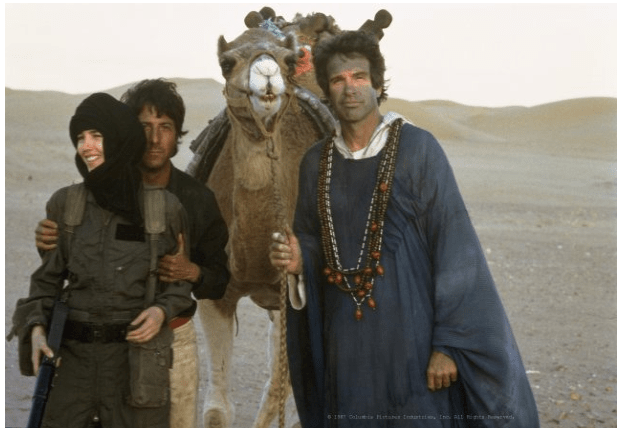
Ishtar places the central friendship on a grander scale, in the middle of a Cold War Hope-Crosby movie crawling with counter-intelligence officers. Dustin Hoffman and producer Warren Beatty star as the impossibly awful songwriting duo of Clarke & Rogers, who are shocked when, “That A Lawnmower Can Do All That” and “Wardrobe of Love” don’t lead to fame and fortune. So they take a gig at a nightclub in Morocco to live out the string of their dream. They are swiftly enmeshed in spy games, however, as Hoffman is drafted by Charles Grodin’s CIA agent, while Beatty is charmed by an attractive revolutionary (Isabell Adjani). Inadvertently acquiring a map that could inflame tensions in the neighboring country of Ishtar, they are chased, cajoled and seduced by secret agents from all over the world. It’s all showbiz to Clarke & Rogers, who work the levers of justice to release their art to the world.

May and cinematographer Vittorio Storaro reportedly clashed on the set, with Peter Biskind writing that, “Storaro was designing shots with an eye to their composition, their beauty, whereas she was composing for comic effect.” Whatever their professional relationship was like, it produced a comedy of rare visual logic. Early on, Warren Beatty is shot recessed into the frame, most notably in a bar where Hoffman tells him he wants to be alone. So Beatty sits at the far back right corner, with Hoffman in the left foreground. Instead of cutting in to Beatty sitting alone for a cheap reaction laugh, May and Storaro keep it in long shot, emphasizing Beatty’s absurd isolation from Hoffman, and setting up their long-distance conversation punchline. This shot encapsulates the Clarke & Rogers team, with Hoffman’s Clarke striving for a kind of hipster depressive cool while Beatty’s Rogers is dopey and supportive, although more honest about his secondary role in life – a background singer comfortable in his own clumsy skin.

Hoffman conveys his contradictory love and disdain for his puppy-dog pal throughout with self-lacerating self-loathing. Clarke clearly hates himself, dolling himself up in Boss bandanas and ska skinny ties, he’s a man without a personality, and attempts suicide early on. He desperately needs and intensely pities and loathes Roger’s affection, a dichotomy that plays out when they are pinned against each other in the Cold war intrigues.

Early on, Beatty seems to be laboring over his Stan Laurel-esque dope, underlining every inanity with a too broad smile not aided by the cartoonish wardrobe of floppy hats and kitschy sweaters. But as the film rolls on he eases into a rhythm, underplaying the punchlines like a pro. His obliviousness as a blind camel knocks down passersby is an uproarious scene aided by his deft obtuseness. In the discussion, May compared the two performances to the rejected contestants on American Idol, noting “how touching they are” in their unbowed belief in their non-existent skill. She also compared them to Ronald Reagan, whom she had met previously. He was a big fan of her act with Mike Nichols, and could recite their “Telephone” sketch from memory. She said he was “an amazingly naive, charming guy, who really cared about show business”, clearly a model she used for both leads.

May was in fine form, as if she had been workshopping her material in clubs the previous week. Received to extended applause, she deadpanned, “Either you like the movie or I’m very sick.” Referring to herself as a “nightclub comedian”, she ran through the Ishtar scrum with a residue of anger, venting at then-Columbia president David Puttnam for releasing the budget figures and publicly attacking Hoffman and Beatty. Essentially, she said, “the entire studio committed suicide”, and Coca-Cola sold Columbia to Sony in 1989, soon after the debacle. But the main focus was on her work, and the instinctually humble May was clearly uncomfortable at all the hosannas floating her way. When asked if Ishtar was ahead of its time, she quipped, “No, that’s impossible. Even with string theory.”

DVD TUESDAY: PARK ROW (1952)

May 17, 2011

Screen Shot 2020-01-29 at 4.10.08 PM

One of Sam Fuller’s most personal films, Park Row (1952), has been released on DVD through MGM’s burn-on-demand service, the “Limited Edition Collection” (available through Amazon and other retailers). Inspired by his time as a copy-boy for Hearst’s New York Journal and as a crime reporter for the New York Graphic, it is an impassioned paean to American journalism, opening with a scroll of the 1,772 active daily papers at the time (in 2009 the numbers were down to 1,387).  I can confirm that the listed Waukesha Daily Freeman is still running, with reasonable subscription rates. Fuller’s artistic temperament was formed in his ink-stained years, as he wanted his films to have the visceral impact and clarity of a 100 point size headline. Park Row is his gift to the business that made him. MGM’s DVD is presented in a solid if unspectacular transfer, with strong contrast. It includes a trailer.

In his raucously entertaining autobiography A Third Face, Fuller writes:

In 1952, I got an opportunity to make a film about the origins of American journalism and the passion for a free press. Park Row was the only film I’d ever produce with my own dough. But I had to make it, if for no other reason than to pay homage to the memories of my youth on that street I loved.

And an homage it is, a sweet love letter to the profession that gave him his start. It stars  Gene Evans and his clipped cadences as Phineas Mitchell, a born newsman floundering as a writer for the New York Star. When an enterprising printer pitches him on editing a new paper, The Globe is born, a muckraking start-up published on butcher paper that electrifies the city. Mitchell quickly riles up the Star’s owner, Charity Hackett (Mary Welch), and a circulation war flares and turns violent.

As Fuller notes, he used his own money to produce the film. He originally wanted to make it after his success with The Steel Helmet (1951), but Darryl Zanuck nixed the idea, since Richard Brooks was already directing a newspaper picture for 20th Century Fox, Deadline-USA (1952). Instead, he made another remarkable Korean War film in Fixed Bayonets. Fuller came back to Zanuck again with Park Row, and this time Zanuck agreed, but only if Fuller would turn it into a CinemaScope musical starring Gregory Peck and Susan Hayward. So he “decided that the only way to make Park Row was to put up my own dough and produce it myself. Two hundred grand, to be exact. To hell with Zanuck and Fox! Fuck the entire studio system!”

With limited funds, the film takes place entirely on one small city street set, that included the two newspaper offices and a bar. Every shot feels insular and cramped, with Fuller grouping his small cast in tight formations in the foreground of the frame. He doesn’t have the space to execute many tracking shots (although there are a few doozies, including a brawl that ends at the feet of Benjamin Franklin), which gives the film an unusual tension. The dialogue crackles but the characters are static, prompting Manny Farber to complain about its, “absence of fluidity – two huge faces usually dominate the screen.” While there are more group shots than Farber remembers, it is definitely a movie of close-ups, Fuller’s attempt inscribe these invented faces into history – they become monuments to his memory of being a newsman. This is established in the opening of the film with shots of three statues resting on the Park Row street set: of Gutenberg, Benjamin Franklin and Horace Greeley.

His personal investment becomes most touching in the character of  Rusty (Dee Pollock), the young kid who Phineas hires to become the “printer’s devil”, who has to re-organize the used typefaces. He is clearly the incarnation of Fuller when he was at the Journal, soaking up the atmosphere and strange argot (guideline, key-line, point, pull, stick, stone) that holds the mystery of an undiscovered country. There is a lot of talk about journalistic ethics, but the first story the Globe publishes is one they help construct. Phineas tells Bowery Street legend Steve Brodie that he’ll print a story about him if he jumps off the Brooklyn Bridge. What starts as a joke becomes front page news as Brodie and Phineas soon see the publicity potential in such a stunt. The story fuels the Globe’s opening week surge, and renders Phineas’ ethical issues at the Star moot. Clearly his biggest complaint was not ethics but entertainment. The Star’s corruption had simply become boring, and Phineas simply wanted to bring ballyhoo back to the printed page.

Fuller adapted some real events into the story to fuel Phineas’ Globe. Steve Brodie was a real Bowery legend, who became famous for jumping off the Brooklyn Bridge, even if it is now likely to be considered a hoax. In Luc Sante’s history of NYC shysters, Low Life, he writes that Brodie “had inconspicuous beginnings as a newsboy and bootblack, staking out the Manhattan end of the Brooklyn Bridge as his territory immediately after the 1883 opening. A few years later he began announcing to friends that, as a sort of dare, he planned to jump off the bridge. One of his friends was a printer named Tom Brennan, who had numerous connections in the newspaper world, and so word spread fast.” The line between “news” and “stories” is immediately blurred in Park Row, with Phineas becoming the hero over Charity only because his stories are more entertaining, if not more true.

It’s interesting to compare Fuller’s depiction of Brodie with Raoul Walsh’s, who filmed a version of the story with The Bowery in 1933. There is a difference in budget and approach. Fuller is working with no money, using the threadbare spaces to invest his film with a sense of monumentality, and a highly conscious nostalgia. Walsh was working with a big studio budget, and his frames are dense with people and action, evoking a sense of history-as-present. Even the basic conversational two-shot has drunkards and con-men gyrating in the background (he used his recollections of the real Bowery to construct his scenes, where he shot for Regeneration in 1915). These stylistic choices were made possible by their respective budgets, but they also fit each directors’ interests. Fuller is an idea man who uses images as rhythmic blunt force objects to get his concept across – working from the outside-in. Walsh prefers to go inside-out, building incidents and bits of business until patterns emerge of their own accord, a crafter of moments. Watch them both.

DVD DOUBLE BILL: THE VANQUISHED AND STARS IN MY CROWN

March 29, 2011

Screen Shot 2020-01-28 at 6.18.36 PM

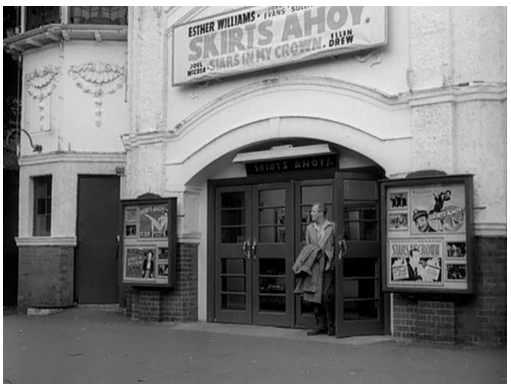
In the third and final short film in Michelangelo Antonioni’s The Vanquished (I Vinti, 1953), a youthful British strangler walks out of a double bill at The Saffron theater. The headliner is the Esther Williams musical comedy Skirts Ahoy (1952), with Jacques Tourneur’s Stars in My Crown (1950) as the “B” picture. Aubrey (played by Peter Reynolds), is the fame-seeking young poet exiting the cinema, ready to commit his so-called perfect crime. But did perky Esther Williams or the avuncular Joel McCrea make him do it? I encourage one and all to stage your own version of this twofer and see if any homicidal rage bubbles up. Please report in the comments. But alas, Antonioni doesn’t answer this pressing question in The Vanquished itself. What is undeniably true is that both The Vanquished and Stars in my Crown both received recent DVD releases, from RaroVideo and the Warner Archive, respectively. It’s a dreamlike bit of capitalist coincidence, and one of those secret joys of cinephilic pursuits.

RaroVideo is a cult Italian DVD label that initiated a North American wing earlier this month, starting out with Fellini’s I Clownsthe Fernando Di Leo Collection and the pretty 1974 horror film The Perfume of the Lady in Black. Today they drop The Vanquished. In the ever-shrinking DVD market, they are an idiosyncratic godsend, plucking high- and low-brow gems from Italian film libraries.

The Vanquished is an omnibus film, containing three short films of teenage rebellion and murder in three different cities: France, Italy and England. Released the same year, 1953, as Marlon Brando’s leather-clad rebellion in The Wild One,  it was partaking of the worldwide paranoia regarding juvenile delinquency that would peak with Rebel Without a Cause two years later. Adapting three real-life crimes, the production was hit with official protests, and severe changes were made to the script before production. It was Antonioni’s second feature, following 1950′s Chronicle of a Love Affair, and without any leverage he had to bow to their demands. Because of imposed re-shoots and other post-production difficulties, The Vanquished was released into theaters months after The Lady Without Camelias, which is often credited as his second film as a director, although it was the third he shot.

The French section was modeled after the “Affaire J3″, in which a young man, Alain Guyader, was killed by his schoolmates during a picnic in the woods near Paris. Google Books has made available an article on the murder in LIFE magazine from June 4th, 1951. Through the years of rationing during and following WWII, “J3″ was the government’s code for cardholders from the ages of 15 to 18. The anonymous writer notes that now, “the term has become the symbol for a tragic story of adolescent intrigue, confusion and murder”, opining on the “fearsome look the trial provided into the curious dream world in which these adolescents lived and played at adult affairs.” That is, they acted like they were in a movie, this time a WWII French Resistance film.

The scandal of it all was that these children were from solidly bourgeois families, so the usual bromides about violence originating in poverty couldn’t be trotted out. This was something new, and newly ascribed to this generation being raised during a world war, inured to bloodshed. They are what the film’s tacked-on introduction describes as the “burnt-out generation”. This group of teens played at being black marketeers and revolutionaries: “When studies seemed unexciting, they created their own excitement, hatching plans to organize a great new Maquis [a rural guerilla bands in the Resistance]  if the Russians would come. They would make a fortune in the black market…and would run arms to the Middle East.” This adolescent cell grew tired of Guyader’s boasts, including his declarations that he was “a man of his times” as well as made up love affairs with other members of the group. Setting up a mock trail, the Maquis declared “he was too vain and would have to die.” They scripted their own drama.

This episode in The Vanquished was the subject of a “defamatory press campaign” and protested by the family members of the “J3″ teens. The French Ministry of Commerce refused to grant an export visa, blocking the transportation of the negative to Italy. Although it eventually got through, France still banned the film until 1963. Antonioni’s handling of the material is anything but exploitative – opting for a talky naturalism, with long-take group shots of the kids joining and breaking-up in endless waves. It skimps on the details of the murder in favor of a disconcerting reverie. The group has already decided to kill, so they spend their time gallivanting through the verdant woods, talking of their lame parents and fickle crushes. It is indebted to neorealism, with its use of real locations and unaffected performance,  but Antonioni’s penchant for intensely psychologized spaces and architecture crops up in the final scene. The murder takes place in the ruins of a castle, reflecting the fractured fairy tales cycling through these embryonic Red Brigadeers’ heads.

The Italian episode was hacked to pieces. The original scenario, as described by Stefania Parigi, was to follow a “hotheaded fascist who sets up his own suicide in such a way that the blame seems to lie with the Communists.” This was based on the story of Achille Billi, a young fascist who was murdered and dumped into the Tiber River. The April 25th, 1949 issue of Life magazine has a photo of the funeral, captioned FASCISM REVIVES. The photo shows an overflowing crowd (credited as over 5,000) giving his coffin the Fascist salute. The producers gutted the scenario, first changing the main character to a violent leftist who bombs an arms depot (this version is presented as an extra on the disc), and then removing politics entirely, requiring re-shoots to change him into a small-time smuggler. The result is a rather ridiculous, neutered scenario – a high schooler ends up  bossing around a grizzled bunch of black marketeers. But it certainly looks stunning, filmed mostly at night in low-light chiaroscuro by Enzo Serafin.

The final section, with our beloved Aubrey, was based on the crime committed by 19 year old Herbert Mills, who strangled an older prostitute in the suburbs of London, “for no apparent reason” (Parigi, liner notes). This section seems to have been left untouched, and in an Antonioni anomaly, is a rather straightforward Hitchcockian mystery. Reminiscent of Robert Walker’s epicene character in Strangers on a Train, Aubrey is after the perverse pleasure of getting away with murder, a decadent Raskolnikov. It becomes clear early on that he is guilty, the question becomes how he did it, and whether he’ll get away with it. Peter Reynolds, playing Aubrey, is a self-deluding delight as the muckracking murderer, who smirks his way to the newspaper as he trumps up publicity for the crime he just “witnessed.” Maybe Aubrey saw Strangers on a bill right before Stars in My Crown, and wanted his own slice of notorious fame and fortune (Antonioni might have had this short in mind during Blowup, with its concluding shot of a tennis match).  J. Hoberman, in his Cold War histories,  would say they were just participating in the violent dream life of nations.

In Stars in My Crown, the dream is of an idealized past. The whole film is a flashback reminiscence of John Kenyon (Dean Stockwell), whose voice-over forthrightly idealizes the small Southern town of Walesburg that he grew up in. Jacques Tourneur famously took a pay cut to direct this modest triumph, and it was the favorite of his films. What is immediately striking is the unreliability of the narration – which is focalized solely through Kenyon’s perspective. In his opening voice-over, he states, “According to the words of the song we are promised a city of gold in the hereafter. I used to think that was a long time to have to wait. But I know now that there is a city of gold right here on Earth for every one of us. The city of our youth.” We can return to our memories of childhood to construct our vision of heaven. The story to follow will be an act of Kenyon’s imagination, his personal Utopia.

Joel McCrea is the Pastor who raises Kenyon, a folksy preacher who can joke and fish as well as read the gospel. He is a man of the world as well as a man of God, and his wife Harriet (Ellen Drew) is equally wise, beautiful in body and soul. McCrea is a jovial oak, laying down roots with every stride of his giant frame, bringing the community around him in the tight medium-shots that Tourneur frames the majority of the film inside. These frames are egalitarian spaces in which any member of the town can take center stage, from the half-wit Chloroform (Arthur Hunnicut) to Uncle Famous (Juano Hernandez), the African-American livestock farmer who has acted as the entire town’s generous godfather.

The relationship between the Pastor and Harriet is one of the most genuinely loving depictions of marriage ever put on film. One scene, and a few gestures, stand out. Kenyon contracts Typhoid, and the adoptive mother and father take turns watching over him. Pastor tells Harriet to take a rest. She goes to her bed, and fights back a sob, wondering aloud if the boy understands how she loves him like her own. McCrea, standing above her, silently lets her work through her emotions. Then, he notices her taking out two hairpins, to get ready for bed, as she continues her monologue. Without a word he takes over this ritual, silently plucking out the remaining pins, and then straightening her hair as it tumbles down. The Pastor’s gestures allow Harriet to allow her entire body to grieve – he has seamlessly taken over the practical rituals of her evening in order to let this take place. It is both comfort and freedom, and an indication of the complex density of their bond.

Antonioni and Tourneur present nightmares and dreams of youth in this impromptu double bill. If you’re feeling frisky, you can also add Tourneur’s Days of Glory (1944), just released by the Warner Archive. Released in the short window of Hollywood pro-Soviet propaganda towards the end of WWII, it presents a bustling anti-Nazi resistance cell in Russia, led by Gregory Peck in his first starring role. Saddled by a ponderous script and the Manichean dictates of the propaganda machine, it’s a minor, frustrating work, but Tourneur still manages some striking scenes of communal living. Managing deep focus in this makeshift hovel, he establishes multiple planes of action as the group oils their guns, boils their soup, and plots for Soviet victory. It’s a canned, albeit elegant, dream of romantic revolutionaries, the flip side of the canned nihilistic violence in THE VANQUISHED. STARS IN MY CROWN is the only fantasy here that is worth believing in.

FILM COMMENT SELECTS 2011 (PLUS A NOTE ON UNKNOWN)

February 22, 2011

Screen Shot 2020-01-28 at 4.59.07 PM

In its 11th year, the Film Comment Selects series at Lincoln Center, which runs February 18th – March 4th, is as staunchly idiosyncratic as ever. The slate is chosen by the venerable magazine’s contributors and editors, with an assist from the Asian genre aficionados at Subway Cinema, who are co-presenting three features. Pulling from brows both high and low, they open with the historical excavations of Jia Zhangke’s I Wish I Knew and close with the horror kicks of James Wan’s Insidious and the  morbid comedy of John Landis’ Burke and Hare. In between lies an entire range of obscure festival titles (El Sicario), forgotten repertory gems (Fassbinder’s I Only Want You to Love Me, Peter Yates’ Robbery) and the latest philosophical doc from Werner Herzog, the 3D Cave of Forgotten Dreams. Herzog’s film is one of the few with U.S. theatrical distribution (from IFC Films), so for many of these titles this series is the only opportunity to see them on the big screen.

I’ve seen five films in the program so far, and Jia Zhangke’s I Wish I Knew stands out. As Tony Rayns reported in CinemaScope, Jia was commissioned to make a film about Shanghai for that city’s World Expo in April 2010. As with his last documentary feature,  24 City (2008), Jia uses personal histories to explicate the wider story of his country, from the communist revolution through the introduction and explosion of capitalism. 24 City focused on the industrial city of Chengdu, in which the lifeblood of the town, Factory 420, was being torn down to build a gigantic condominium complex. In the midst of the documentary interviews he introduces a fictional story about the factory, starring Joan Chen.

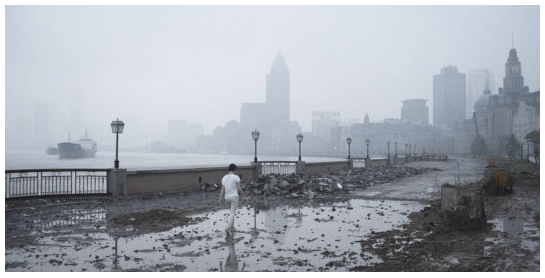
I Wish I Knew deals with a wider canvas, examining the Shanghainese diaspora created by the Communist victory in the Chinese Civil War. Jia talks to survivors in Shanghai, Hong Kong and Taiwan, whose entire lives were uprooted or destroyed, nationalists and communists both. Woven in between these interviews are wordless shots of actress Zhao Tao, Jia’s frequent collaborator, strolling through the ruins of old Shanghai, as skyscrapers get erected all around her. This is an extension of the Joan Chen sequence in 24 City, but also of Jia’s entire corpus, extraordinary documents of living history in which China’s economic miracle inevitably buries and denies the history of the country. From Platform on, Jia has been trying to capture the last breaths of bulldozed and drowned neighborhoods and memories  before they disappear under steel and glass.

The people Jia interviews are natural storytellers. There is Yang Xiaofo, whose father, leader of the Chinese Civil Rights Alliance, was assassinated upon the order of Chiang Kai-Shek. Yang remembers the days when he and his dad would stroll down Nanjing Road and look for coffee shops. Jia then takes his camera and strolls down the modern-day strip, slowly weaving his way through a cafe, until  he settles upon Zhang Yuansun. Zhang informs us his father was a hugely popular Peking Opera performer, and owned a yacht.  But during the Cultural Revolution, the Red Guards declared him a reactionary, ending his career and forcing him to live in poverty. Then Zhang attends a senior dance, twirling to Dick Haymes’ “I Wish I Knew”.

There is an endless list of lost fathers. The most devastating is the story of Wang Peimin, whose dad was executed by firing squad by the KMT weeks before her birth. She has photos of him shortly before his death, handled by impossibly young-looking guards, and with a beatific look on his face, defiantly proud. And despite all of the impossible trials of their youth, all of the subjects share this  stubborn refusal to give up on life, and Jia honors their incredible perseverance. Zhao Tao wanders through the rubble-strewn streets of their past, now abandoned by the city, as the film itself tries to inscribe these spaces back into history. The film is currently without U.S. distribution, but there is a Region 3, English subtitled DVD available at outlets including YesAsia.

***

Cave of Forgotten Dreams was the hottest ticket, as seeing Werner Herzog’s mischievous mug in three dimensions is apparently too provocative to miss. I even spied David Bordwell and Kristin Thompson in attendance, which hopefully means an extended blog post from them both looms in the future. But of course the main pull was seeing the 32,000 year old paintings that cover the interior of France’s Chauvet cave, which the government rarely opens to non-specialists. The spectacle of these ancient masterpieces can be overwhelming, especially the ingenious way in which they were adapted to the undulating surfaces of the walls. Many compositions were arranged in circular groups that lead the eye around the crevasses, imparting a sense of motion. This kinetic aspect appears in the figures themselves, as Herzog notes a bison drawn with eight legs, conveying an idea of speed, which he describes as “proto-cinema”, but which is more proto-Futurism, which is still pretty mind-blowing. The 3D image gives a wondrous sense of depth and curvaceousness inside the cave, but the large segments of interviews with scientists and researchers are a drag in the format. Herzog’s patented mystical madman commentary is pushing into self-parody, but in this case the footage alone is worth the price of admission.

***

QUICK TAKES

The Silence (2010) is a heavy-handed but refreshingly downbeat police procedural from Germany, directed with precision by Baran Bo Odar. A little girl is murdered in the same spot as another child was 23 years earlier, and a jowly retired detective with his burnt-out former partner try to link the two cases. The characters are thinly drawn, but the actors are superbly worn-down, committing completely to the ornately doom-laden scenario.

Sodankyla Forever (2010): this is only part one of four segments from Peter von Bagh’s history of  the Midnight Sun Festival in Finland, but it makes me want to watch the whole thing. Each section culls from the voluminous director interviews von Bagh has conducted over the years.This section focuses on a variety of directors’ experiences of war, with a lot of emphasis on Eastern Europe, with many pointed comments from Milos Forman, Jerzy Skolimowski and Ivan Passer, who all attended the same boarding school with Vaclav Havel. There was also a striking exchange between Krystof Zanussi and Dusan Makavajev as they discuss their refusal to attend a screening of Battleship Potemkin (those who celebrate it haven’t lived through its philosophy). Also, plenty of prime Sam Fuller.

I Only Want You to Love Me (1976): this little-seen Rainer Werner Fassbinder TV movie is an occasionally entrancing exercise in style. The narrative is a failed allegory about a kid who can never please his parents, and so in his marriage he constantly buys his wife presents, running up their credit and driving them into poverty. It’s poised between absurdism and realism but never settles into a coherent tone. He builds a house for his parents, and they forget about it two weeks later, a blackly comic sequence. But then the rest of the film is a starkly realist portrait of a working class family sliding into the poorhouse. It’s held together by Fassbinder’s dynamic compositions, lots of angled mirrors, smoked glass and foreground/background interaction, but in the end it feels like a test case for his future triumphs.

***

Unknown (2011): This is not a part of Film Comment Selects, but Jaume Collet-Serra’s sleekly beguiling thriller certainly belongs with that ragtag group. Following up the cold precision of his ace horror flick Orphan, Serra again churns out a film of with strong compositional lines and an entertainingly ridiculous scenario. What stands out this time is his tactile sense of place, a multi-cultural Berlin of five-star hotels and seedy flop-houses. It’s a huge improvement on its model, Taken, the previous Liam Neeson Euro-sploitation outing, which was directed by Pierre Morel. While that film took place in a world of Eastern-European stereotypes and chopped its action sequences to bits, here the city still seethes with racial tension (a taxi dispatcher blames the city’s perceived decline on immigrants), but Neeson is assisted in his quest by a Bosnian cab driver (played convincingly by Diane Kruger) and her African immigrant pal named Biko (a nod to South African activist Steve Biko, played by Clint Dyer). As with Orphan, its actions sequences are concise bits of legible brutality . Bruno Ganz steals the movie as a proud former Stasi member who aids Neeson in his quest for identity. In what is surely to be one of the finest scenes of the year, Frank Langella swings by to cradle Ganz in his arms, as they discuss how to die with dignity.

DVD ROUNDUP: 11 HARROWHOUSE (1974) AND LUCKY LADY (1975)

January 25, 2011

ll

Two reviled flops from 20th Century Fox have finally made their way to DVD on the brave shoulders of the Shout! Factory label. Charles Grodin adapted and starred in the heist film 11 Harrowhouse after the  success of his turn in The Heartbreak Kid (1972), only to be met with critical and audience indifference. Lucky Lady is the more infamous failure, the product of agent-turned-producer Michael Gruskoff’s ability to game the Hollywood system (both DVDs come out next Tuesday, February 1st.). Formerly the representative for screenwriters Gloria Katz and Willard Huyck, he bought the rights to their script for $75,000, and then sold it to Fox for $450,000. An impressive profit over the 10% he previously made from their services. By investing that kind of scratch, Fox had to inflate the story into a blockbuster, signing up Liza Minnelli, Gene Hackman and Burt Reynolds to star, and Stanley Donen to direct. It received vitriolic reviews, many noting Gruskoff’s ploy, and failed to make a profit (although Jonathan Rosenbaum indignantly reported in Movie Wars that it came close, with $12,107,000 in rentals, a half-million less than its budget, due to Fox’s forcing theaters to keep it for extended runs if they wanted it at all.)

Despite all of these shady backdoor dealings, I rather enjoyed both of them, the “bumbling and stupid romp” (Pauline Kael, New Yorker) 11 Harrowhouse and the “mirthless trumpery” (John Simon, NY Mag) of Lucky Lady. Seeing them outside the torrent of negative publicity both received upon their initial release, it’s easier to judge them on their own limited but amiable merits.

11 Harrowhouse was based on a novel of the same name by Gerald A. Browne, for which Grodin received the ambiguous “adapted by” credit, while Jeffrey Bloom is named as the screenwriter. It’s unclear how much input he had into Bloom’s script, but it at least indicates his investment in the material. Directing duties were handed to Aram Avakian, who had filmed another comic heist, Cops and Robbers, in 1973. Harrowhouse is deeply marked by Grodin’s laconic personality, delivered through his sarcastic voice-over that coolly belittles the events on-screen. It’s an odd distancing device that was apparently removed from some home video releases, turning it into a more conventional thriller. The new Shout! Factory DVD contains the original voice-over, thankfully, and the video transfer is strong. The original film element shows some wear, and the colors are slightly faded, but it shows nice texture and sharpness, probably the best it could look with the material they had. The only extra is the theatrical trailer.

Grodin plays Howard Chesser, a small-time gem trader hired by business tycoon Clyde Massey (Trevor Howard) to steal an enormous cache of uncut diamonds in London. With the help of his scrappy heiress girlfriend Maren (Candice Bergen) and Watts, their man on the inside (James Mason), they engineer a robbery of Rube Goldberg-esque intricacy. The owner of the fleeced diamond exchange, the fastidious Meecham (John Gielgud), is understandably peeved, and Chesser and Maren try to escape with the jewels and their lives.

The material is not a good fit for Grodin’s deadpan sad sack routine, which is presumably why the caustic voice-over was added. But the narration is so cutting it undermines the usual genre pleasures of the heist film. When Chesser’s voice drops out and the narrative picks up, the jaunty tone disappears and we’re back inside the thriller mechanics, which Avakian runs through at a dulled pace. This tension between tones drains the film of any suspense, as we are now viewing the actions through Chesser’s retrospective disdain. It’s an odd, discomfiting viewing experience, an experiment in POV that implodes its own narrative.

But there is plenty to savor amid the debris (see the grizzled faces above). While Grodin and Bergen both seem cold and affected for their supposedly suave characters, the supporting cast is superb. The three Brits inject reptilian evil (Gielgud), blowhard narcissism (Howard) and a weary nihilism (Mason) into their preciously scant screen time. These are actors who can evoke entire backstories with an inching up of an eyebrow. Mason’s aging diamond appraiser quietly shuffles off with the film, secreting tragedy in the midst of the procedural. Watts has been under the employ of Gielgud’s Meecham and suffered his silent censures, whether dismissive hand waves or a skeptical lip curl, for a lifetime. Mason is a mound of regret, with a slightly haunched back and a slow-motion manner. The way in which he delicately eats a sandwich in a secret meeting with Grodin expresses everything about him – his professionalism and exactitude as well as his fatalism, as  might be the last lunch he ever has. (Reviewers of the time also singled out Mason’s performance, including Kael, Stanley Kaufmann, and the NY Times’ Nora Sayre).

No saving graces were allowed for Stanley Donen’s Lucky Lady:

Pauline Kael: “an agent’s picture – everybody’s rip-off” (compiled in When the Lights Go Down)

Jonathan Rosenbaum: “conspicuously overproduced and under-nourished.” (quoted in Movie Wars)

Vincent Canby: “it’s ridiculous without the compensation of being funny or fun.” (NY Times)

The ever-misogynistic John Simon:  “As for Miss Minnelli, she is herself a perfect menage a trois in which lack of talent, lack of looks, and lack of a speaking voice co-habit blissfully. Donen sensibly concentrates on her best feature, her legs, but he unfortunately can’t wrap them around her face.” (New York Magazine, Dec. 29th, 1975)

And yet, I found it companionable and amusing, despite the vaseline-gauzed cinematography and the cramped framings necessitated by shooting everything on real boats at sea (it is, in terms of press, the Waterworld of its time). According to one of the two promotional shorts included on the DVD, the production took “a full year to make”, because of the stars’ schedules and the endless problems of shooting on rocking vintage boats. Fox also required re-shoots to include a happy ending (as Joe Baltake outlines here). But as important as production history is to criticism, it is no substitute, and I found Donen’s disaster to be a rather fleet and funny (albeit over-designed) vehicle that teased out the idiosyncracies of his actors.

Liza Minnelli (as Claire, a flapper), Burt Reynolds (as Walker, the dandy) and Gene Hackman (as Kibby, the hobo wiseacre) start up a rum-running business during Prohibition, running their boats up from Mexico. This cuts into the mob’s market, and soon they’re in a shooting war over territory.

The script is slangy and self-conscious without being arch, a pastiche of Jazz Age argot that the actors are able to thrum to life. The set-design is overstuffed art-deco, suffocating the already cramped spaces Donen has to work in, and the decision to use heavy soft-focus filters throughout the film is a failed attempt to go nostalgic, ladling every image over with a soupy haze (the DP was Geoffrey Unsworth, who also shot Liza in Cabaret).

In and around these production snafus the actors excel. Minnelli, the critics punching bag, is quite touching here as the dizzy dame love interest of both leads. Minnelli plays Claire, the intended bombshell, more like an antic Jean Arthur than the Harlow clearly intended. She’s the feather boa-clad ball of energy bouncing off the deft comic work of Burt Reynolds, who exhibits his flair for self-deprecating slapstick (Another bizarre John Simon sidebar, on Reynolds:  “[his] face looks like an armored car made, inexplicably, out of meat.” If someone can parse this, please let me know). Hackman has the knockabout trickster role, the gruff kind of asshole he could play in his rum-induced sleep. Together they form an improbably fun trio, and form one of the few successful polyamorous relationships on film.

The DVD of Lucky Lady is a fine anamorphic presentation, the soft image resulting from the original material (it’s remarked upon in the original reviews). The two vintage featurettes feature interviews with the cast and crew, and there are three theatrical and TV trailers.