ESSENTIAL PRE-CODE: JEWEL ROBBERY (1932)

Originally published at Movie Morlocks, the official blog of Turner Classic Movies

July 12, 2011
Screen Shot 2020-01-31 at 2.29.09 PM

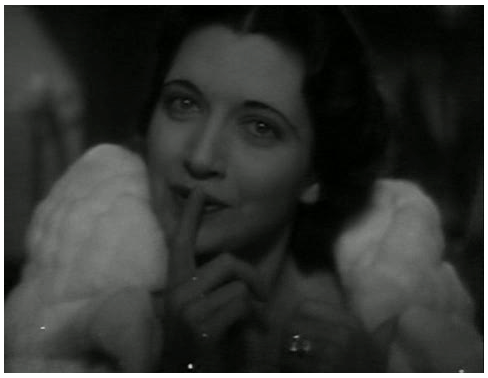
Kay Francis dreamily asks for your complicit silence. She is about to commit an illicit act, and it would be gentlemanly not to speak of it.   So I shan’t, although I will spill fawning words about the film that encloses her, William Dieterle’s Jewel Robbery (1932). It is screening as part of Film Forum’s Essential Pre-Code series (and airs on TCM on occasion), a near annual festivity of tough-talking immorality that begins this Friday, July 15th. Released the same year as Ernst Lubitsch’s similarly themed Trouble in Paradise (and double-billed with it on August 7/8),  Dieterle’s debonair crime fantasy was necessarily overshadowed, but should be reckoned with as a major work in its own right.

A play by the Hungarian Ladislaus Fodor (“Ekzerrabalas a Vaci-uccaban”, 1931), was purchased by Warner Brothers on February 8th, 1932, with production beginning less than a month later, on March 2nd (credit to Roger Bryant’s biography, William Powell). To lens this sophisticated charmer set in Vienna, the studio tapped their European emigre, the German-born William Dieterle. Dieterle, a prolific actor and director in the Weimar cinema, came to Hollywood to shoot German language versions of WB productions. His first original film for the studio, the Lost Generation drama The Last Flight (1931, which I wrote about here), was a success, and he went on an incredibly creative run throughout the 1930s (I would also recommend 6 Hours To Live (1932) and The Devil in Love (1933)).

For the leads, he was gifted William Powell and Kay Francis. $100,000 of the $291,039 budget went to Powell, more than a third of the entire cost. Francis received a comparatively paltry $27,000 (reported by Bryant). Powell plays the unnamed “Robber”, a fastidiously well mannered thief. Francis would get a supporting role in Trouble in Paradise later in the year, but here she is the slinky, shallow and slightly bored housewife Baroness Terri. Stuck with the wealthy but gout-ridden Baron Franz (Henry Kolker), she dreams of escape. Her fantasies incarnate when Powell swoops in to the jewelry store to relieve her of the “Excelsior Diamond” which she was about to squeeze out of the Baron. Entranced by his swaggering, well-coiffed masculinity, the robbery turns into a battling flirtation. Powell, equally intrigued, starts a game of break-ins into the Baroness’ quarters, forcing her to make a choice between comfort and passion.

Dieterle instills a martial rhythm, matching the military precision in which Powell’s Robber executes his heists. He cuts when a screen is filled or an action performed – no lingering on atmosphere. During production, reports Bryant, Warner executive Darryl Zanuck showed concerned about this speedy style. On March 26th he wrote producer Lucien Hubbard to, “keep your eye very close on the rushes of Dieterle…as he has a habit of shooting his most important scenes with the camera moving or sweeping around or going back and forth and you miss the most important point of all.” Ever the diplomat, he sang a different tune to Dieterle, on April 5th: “The rushes continue to be very excellent, and I like the manner in which you are continuing to put movement and action in all the scenes … Keep this up. This is very fine.”

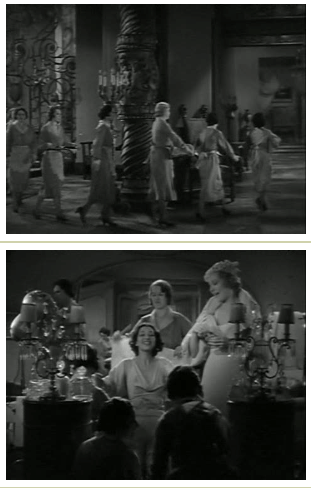
In a rapid opening montage, Dieterle shows a series of safe doors shutting and locking. With equal precision, a group of jewelry shop employees scuttle to line up diagonally across the frame. Dieterle repeats this line-up image in the next two sequences.  As soon as the last man enters the frame, he cuts to the pretentious owner bragging about the new security system. Of course, a few seconds later, he is robbed.

Screen Shot 2020-01-31 at 2.32.02 PM

The next lineup occurs in the Baroness’ home, as a who army of maids tromps down a grand staircase to minister to her needs. In the first scene, the line of men was protecting a diamond, in the second, the line is pampering Kay Francis. This jewel/Baroness metaphor continues when one of her helpers carries her into a massage chair to be buffed into beauty – a delicate object cleaned up to be presented to the world.
Screen Shot 2020-01-31 at 2.32.09 PM

Powell’s men form the third line-up, a dapper parade of black-suited shysters. And they are here not to protect, but to steal. As the Baron, Baroness and friends try to escape the store, a group of top-hatted criminals enter from the back, doff their caps in unison, and aim guns at chests. It is this shift in the line-up pattern that that then shifts the narrative. No longer coddled, Baroness Teri is shocked out of her comfort zone, and into one of romantic fantasy.

Screen Shot 2020-01-31 at 2.32.19 PM

Powell’s perfection has an air of unreality about it, a charming, un-threatening adventurer conjured out of Teri’s imagination. After he frisks a revolver out of a lovely pearl-inlaid box, he tells the stunned patrons, “Would you kindly put up your hands”. And then, to calm their troubled nerves, he gives them all some pot to smoke (a joint is later passed to the police department, who fully investigate its possibilities). The idea that this is just a beautiful dream of Teri’s continues when she is whisked away, or willingly kidnapped, to his ornate apartment getaway, which is filled with his ill-gotten gains. As they sit down for dinner, she asks him for his name, and he gently refuses. To admit to a name would pin down his identity, and snuff out the mystery which fuels her desire. He is anything she wants him to be. I don’t think I’ve seen a film that portrays female fantasy with such sensitivity.

***

The other must-sees, or at least, the titles I’ve been most obsessed with recently, are three early stunners from Raoul Walsh:  Me and My Gal (1932), The Bowery (1933) and Sailor’s Luck (1933). 1932 was a good year. I wrote my first post here at Movie Morlocks on Me and My Gal, and lets see if it embarrasses:

Walsh shot the film in a scant nineteen days, and he doesn’t even mention it in his rakish autobiography, Each Man In His Time.

Perhaps it’s the speed of the schedule that led to its inventive, magpie spirit. Plenty of material needed to be created on the spot (there was obviously little pre-production time), and the film is flooded with ideas (some borrowed, some new) – ideas for pratfalls, camera movements, parodies. The movie contains direct addresses to the camera (by a tight J. Farrell MacDonald), self-reflexive voice-overs, and endless bits of comic business, from Will Stanton’s drunk act to the stinging bon mots flung from Bennett to Tracy.

A little sloppy, but not bad. The movie, as always, astounds. The Bowery is a more personal project for Walsh, revisiting the street that he used to rubberneck at as a curious upper-middle class kid in New York. In his autobiography he writes about how he cast real winos and bums to fill the backgrounds of his shots, in which he experiments with deep focus, a technique he would investigate the rest of his career. Then there’s Sailor’s Luck, which sets a giddy land-speed record for sexual innuendo and bumptious ethnic humor.

DVD ROUNDUP: SHOUT! FACTORY AND WARNER ARCHIVE

July 5, 2011

Screen Shot 2020-01-31 at 2.24.06 PM

Edmond O’Brien enjoys a post-Independence Day fireworks display in Rio Conchos, the 1964 Western just released by Shout! Factory on DVD. With all my squawking about studios cutting back on library titles for home video, there are still plenty of rare and strange items sneaking onto those glimmering circular discs. Over the past few weeks, Shout! Factory and Warner Archive have shown they’re still fighting the good fight, and I’ll run down a few of their most intriguing recent renovation jobs.

I’ll start with Mr. O’Brien. Rio Conchos (1964) is paired with another 20th Century Fox film, the Blaxploitation-Spaghetti Western Take a Hard Ride (1975), encoded onto one dual-layered DVD. Directed by Gordon Douglas in sun-scorched CinemaScope, Conchos is a nasty job in which its ostensible hero, ex-Confederate soldier Jim Lassiter (Richard Boone), cold-bloodedly slaughters a group of Native Americans in the opening. It’s his bad luck that the repeating rifle he used was part of a cache stolen from the U.S. Army. He soon has Army Captain Haven (Stuart Whitman) and sullen Buffalo Soldier Franklyn (Jim Brown, in his first movie role) on his tail. Haven needs Lassiter to lead him to the rifle seller, so this unlikely trio heads south to Mexico, with the fast talking ex-con Juan (Tony Franciosa) as their guide.

Douglas, whose haunting Only the Valiant I wrote up earlier this year, again utilizes gothic imagery, this time setting Lassiter against imagery of decay and death. In the opener, in which Lassiter’s face is never seen, Native Americans are recovering their dead from a field of gnarled and petrified trees. These civilians are gunned down by a dot in the far background, and fall dead with their brothers. All we see of Lassiter is a reverse angle of his hat and gun, and then a pan down to the shells hitting the ground, a visual rhyme to the men he killed. The next time we see Lassiter, he is sitting, fat and happy, in a burnt out husk of a home, with the sun hollowing out the wrinkles in his jowly face – a satanically jolly figure.

He becomes a hero by default, with the passivity of Haven and the apathy of Franklyn unable to take the lead. Or perhaps because he is so familiar with evil he is the only one comfortable enough to confront it. In the infernal climax, Lassiter is right at home. In Chihuahua he meets his old Colonel Pardee (O’Brien), who has gone mad with dreams of establishing a new South in Mexico, and his half-built plantation house is the misshapen manifestation of that insanity. This time Lassiter enters another man’s decay, and fulfills the promise of those opening scenes, but destroys Pardee along with himself in a scene of grandiose self-immolation.

Speaking of grandiosity, there is Warner Archive’s handsome-looking remastered release of Dark of the Sun (1968), Jack Cardiff’s rollicking men-on-a-mission gloss that nails all of that genre’s pleasures with irresistible efficiency. You’ve got a shirtless Rod Taylor and Jim Brown, an evil German guy (Peter Carstein), and Yvette Mimieux wearing tight pants. Taylor and Brown are mercenaries hired by the Congolese government to recapture uncut diamonds in rebel-held territory, and things do not go as planned. Add chainsaws, gruff cynicism, an anthemic score and $25 million in diamonds, and you’ve got a movie out of Quentin Tarantino’s wet dreams (and he did sample the score for  Inglorious Basterds).  What makes this more than camp fodder is Cardiff’s slashing compositions, whose brash diagonals point to further adventures off-screen. Another unusual aspect to this Dirty Dozen clone is its frank depiction of violence. While it has its share of cartoon shootouts (see above), there are also awkward, grotesque deaths impossible to cheer – here civilians do die and consciences remain decidedly unclean. Rod Taylor is superb as the no-nonsense mercenary, a granite he-man who still sweats like an ox.

Another kind of masculinity is on display in Warner Archive’s The Breaking Point (1950), Michael Curtiz’s faithful adaptation of Hemingway’s novel To Have and Have Not. A spare and relentless noir about how unemployment can reduce a man to neurosis and petty crime, it bears no relation to Howard Hawks’ heavily reworked version of the story. In the Curtiz film, Harry Morgan is played by a hunched and fidgety John Garfield, in one of his finest performances. Morgan is a fishing boat captain with a wife and kids, but his business is floundering. His wife Lucy (Phyllis Thaxter) wants him to quit and work on her family’s lettuce farm (Garfield: “What’s so great about lettuce?”). Stubborn to a fault, and loyal to his partner Wesley (Juano Hernandez, whose quiet dignity was also present in Stars in My Crown the same year), he makes some extra cash by ferrying revelers over the border to Tijuana. One of those passengers is Leona Charles, a man-eater played by Patricia Neal with a knee-buckling purr. After her date abandons both of them in Mexico, Morgan doesn’t have the money to pass through inspections to get back home. So he takes on a job smuggling illegal Chinese immigrants back into the states. It is the beginning of his troubles.

Curtiz makes it a film about foreground and background interaction, with his expert blocking allowing for constant motion in every segment of the frame. It’s when the background moves forward, and into Morgan’s space, that his world starts to disintegrate. Harry and Wesley have calm spatial relations, as seen in the first photo, each carving out their own domain. It is the same way in Harry’s home, in which Lucy and his kids occupy background spaces, and approach with his tacit permission. But the entrance of Leona into his life is the breach that brings him down. Expecting just a single man, he spies a couple in extreme long shot, walking down the pier. Once they arrive, the separation between background and foreground breaks down, with Leona inviting them to puncture the space.

Within these setups, Garfield’s unraveling takes place behind his tense jaw clenches and repressed desires. He repeatedly forces himself close to Leona, only to deny himself her body again and again. It is a masochistic maneuver, testing the boundaries of his guilt. He represses his sexual urges and releases his neuroses in violence instead — taking a getaway boat driver job on a horse racing heist. By that point his doom is pre-ordained. But in the culmination of Curtiz’s work with foregrounds and backgrounds, the final shot is reserved for a wandering supporting character, pushed to the fore. Wesley’s son is seen searching the pier for his father, unseen and unknown.

***

I ran out of time this week, but Shout! Factory has also released an inspiring two-disc set of three Roger Corman Women-In-Prison movies (with a Blu-Ray slated for 8/23): The Big Doll House (1971), Women in Cages (1971) and The Big Bird Cage (1972). Fun for the whole family.

THE 2011 NEW YORK ASIAN FILM FESTIVAL AND JAPAN CUTS

June 28, 2011

mov_68FFCI_20110106174616_4

If you’re suffering from the summer blockbuster blues, there’s no greater pick-me-up than the New York Asian Film Festival, an invigorating potpourri of the finest in creative Eastern bloodletting. It marks its tenth decadent year with 45 features from nine different countries, unspooling at the Film Society of Lincoln Center from July 1st – 14th. 11 of those films are co-presented with Japan Cuts, the NYAFF’s more studious (if no less ambitious) five-year-old sister festival, held at Japan Society from July 7th – 22nd. Including the 21 other titles in Japan Cuts, there are 66 Asian movies hitting screens in July, most of which will never receive distribution in the United States (although many will be obtainable at Asian DVD retailers).

Surveys of national cinemas are usually funded by state organizations (i.e. Rendezvous With French Cinema at Lincoln Center is “supported by” the French embassy’s Cultural Services department), turning them into bland diplomatic exercises. The movies selected veer toward middlbrow arthouse or sophisticated-seeming romantic comedies – presenting how these countries want to be seen. The NYAFF and Japan Cuts buck this trend by culling movies from every genre and budget size, from popular hits (Reign of Assassins) to 4 1/2 hour indie experiments (Heaven’s Story).

NYAFF is funded by a gaggle of cultural services and corporate sponsors (scroll to the bottom of the home page to see which ones) but beholden to none, while Japan Cuts is underwritten by The Japan Foundation, a government-created cultural exchange entity that became an independent administrative institution in 2003. These benefactors continue to give ace programmers Grady Hendrix (NYAFF) and Samuel Jamier (Japan Cuts) space to select titles both lowbrow and high, sketching a more wide-ranging portrait of Asia than you’ll likely read in the newspaper.

It’s impossible to cover everything on display (including a great Tsui Hark mini-retro), but most of the revelations in this year’s slate came in the NYAFF sidebar, “Sea of Revenge: New Korean Thrillers”, so I’ll focus there. Park Chan-wook re-invented the ax murder in his wildly popular vengeance trilogy, but it wasn’t until the runaway success of Na Hong-jin’s The Chaser (2008) that a new cycle of revenge films got kicked off in Korea. The only inkling we’ve received stateside of this wave was the release of Kim Jee-Woon’s fantastical sadism duel,  I Saw the Devil (2010, Magnolia Pictures), earlier this year. The titles in the sidebar are perversely pessimistic thrillers that repeatedly take aim at Korea’s governmental institutions. It is no coincidence that the cycle began in 2008, the year which ushered in our continuing economic crisis (almost all the others landed in 2010).

The Chaser stars the plump and harried Kim Yun-Seok as Jung-Hoa dirty ex-cop who runs a second-rate prostitution ring that is bleeding cash. Two of his girls have fled, and another has quit, so he forces a feverish Mi-Jin (Seo Young-hee) out on a job. Then he notices the address, which is the same location where he sent the two girls who disappeared. His vestigial detective instincts kick in, and he begins a frenzied investigation into the john, Ji Young-Min (Ha Jung-Woo)who is soon revealed to be a mild-mannered serial killer.

The tone begins as grimly comic noir, as Jung-Ho’s short-tempered capitalist pursues the mystery out of base self-interest. He initially believes Ji has merely sold his whores, and becomes a P.I. only to save his business. When the extent of Ji’s crimes become clear, his focus sharpens and his defensive cynicism falls away. He literally runs down clues through the streets of Seoul as Na’s jittery camera struggles to keep up. The pace relentlessly carries the film through its operatically tragic conclusion. The few moments of humor are reserved for the incompetent police force, who are occupied by a protestor who threw shit in the mayor’s face (hapless Keystone Korean Kops are a recurring presence in the series). Hoarding its resources into handling that PR fiasco, sad-sack Jung-Ho is tasked with being a hero, a role he is ill-suited to execute.

Na followed this up with The Yellow Sea, NYAFF’s closing night film and a selection in the 2010 Cannes Film Festival’s Un Certain Regard section. It’s bigger and bloodier but equally swift and despairing as his boffo debut. He takes on the phenomenon of the “joseonjok“, Chinese citizens of Korean ancestry who illegally sneak back into Korea to get work. Na reverses the actor polarities from The Chaser: this time Ha Jung-Woo plays the beaten down anti-hero (Gu-nam) and Kim Yun Seok is the  mercilessly violent Chinese gang boss Myung-Ga. Gu-nam borrowed 60,000 yuan to get his wife a visa to work across the border, and he hasn’t heard from her since. Hassled by loan sharks and fraying at the seams beneath a stoic stone-face, Myung-Ga offers him a mountain of cash if he kills a man in Korea – while also giving Gu-nam the opportunity to track down his wife.

In the opening voice-over, Gu-nam speaks of his childhood. In his village, a dog infected with rabies killed its mother. Later he saw it wobble toward him and die from malnourishment. The village elders ate the corpse, and the disease spread throughout town. It is an original sin of a sort, his people cursed because of the desperation brought on by poverty. Gu-nam spends the film in atonement for this sin, enduring unspeakable physical abasements, although there is no transcendence on the other side.

With terse efficiency, Na depicts the Gu-nam’s journey across the Yellow Sea in a junk ship, hiding in a hull with the other illegals, dumped like netted lobsters on the Korean coastline. The scenes in which Gu-nam cases his mark’s home are object lessons in creating tension through narrative withholding, as we are restricted to his POV as he wordlessly pieces together the routines of the building. The aftermath of the murder opens up the narrative scope, as the POV expands from Gu-nam up to the corporate and criminal leaders who ordered the hit. He becomes merely part of a tapestry of corruption.

The cops, as in The Chaser, are comically inept, this time to a Keatonian level. In Gun-nam’s escape after the killing, he evades hundreds of police offers on foot, carrying a knife. The scene, with police cars flipping past him and baton-wielding ninnies yelling at him to stop, is a direct descendent of the Keystone Kops. It’s a spectacularly sarcastic scene, one with echoes throughout, including a cowardly local cop who accidentally shoots his partner. There is no faith in official institutions – everyone is on the take or just stupid.

I should also note the heavy use of blade violence [the following has been updated after a colleague alerted me to South Korea’s gun laws]. There are no guns in this movie – everyone gets stabbed or bludgeoned by an axe-handle, mostly by Myung-Ga – and there are some epic battles here. With South Korea’s highly restrictive ownership laws, even the underworld has trouble obtaining firearms. Without shoot-outs, each death becomes more personal, because you have to get close and smell the sweat of your opponent before taking their life. It is a ritual bloodletting to rid the world of the infection of humanity. Somehow this is getting released by 20th Century Fox, release date unknown.

The other major director in the sidebar is Ryoo Seung-Wan, a cheerier exponent of vengeance whose films have a pulsating rhythm. Represented by City of Violence (2006), The Unjust (2010) and Troubleshooter (2010, which he produced but did not direct), Ryoo churns out sleekly absorbing actioners with more self-reflexive panache than Na. City of Violence pits childhood friends against one another, pivoting on shady real estate deals (two years before the crash!), climaxing in fight scenes of comic-book abstraction. Clearly influenced by the ironic japery of Kill Bill, its centerpiece blowout is an exuberantly over-the-top homage to The Warriors. With The Unjust  he gets serious(er). A twisty, multi-layered corruption drama, it squares off a power-hungry detective and a power-hungrier prosecutor as the entire Korean justice system is jauntily sketched out as on the make. The detective, Captain Choi (Hwang Jung-Min), is tasked to frame a fall guy for the murder of a young girl, after the main suspect was unjustly killed by the police. The prosecutor (Ryoo Seung-Bum, the director’s brother) finds out, and thus begins an escalating game of blackmail that spreads throughout the city. Ryoo finds expressive uses for the slow zoom, moving from micro crimes to macro institutional corruption in one shot.

Kwok Hyeok-Jae helmed Troubleshooter (2010) which Ryoo produced and co-wrote. A hectic menage of the Bourne films and Hitchock’s The Wrong Man (or less hyperbolically, The Fugitive), it frames P.I. Tae-Sik (Sol Kyung-Gu) for murder, and he has to outrun the cops and prove his innocence before he gets his head blown off. Set to a backbeat of corruption news on his car radio, he dons disguises and endures betrayals with a breezy disregard. The busy visuals, a lot of screens within screens and flash editing, is tiresome after a while, but Sol is an amiable and ably physical performer, and the pace never flags. As for the other entries, The Man From Nowhere is a passably diverting Eastwood gloss, and I didn’t have time to watch Bedevilled.

Japan Cuts is studded with gems of its own, although the spurting bodily fluids they elicit comes from the tear ducts rather than the jugular. The most ambitious is Heavens Story, a four and a half hour labor of love for director Takahisa Zeze, the former “King of Pink” (Pink films are the softcore porn of Japan). An independent project that took him five years to make, it follows a group of characters dealing with the aftermath of a series brutal murders. It reminded me most strongly of Shinji Aoyama’s Eureka (2000) a similarly epic reckoning with grief, although their approaches are much different. Aoyama’s B&W long take naturalism is a far cry from Zeze’s blunt symbolism, but both reach to evoke the stasis induced by unutterable emotional pain, that netherworld between grieving and living. Zeze’s clumsy DV framings often fail to reach the heights he’s groping for, but there are plenty of striking images that blaze through, including an existential death match in an abandoned mining town, and the magical closing Kabuki performance that offers an escape from the cycles of violence. Another, more assured multi-character tale is Kazuyoshi Kumakiri’s Sketches of Kaitan City (2010), which documents the decline of an industrial port town in intersecting vignettes. Its highly detailed soundscape of clanging bells and alarm clocks seem to be counting down to the city’s demise.

One of the biggest surprises is Masahiro Kobayashi’s Haru’s Journey, a gentle drama about aging starring the legendary old lion Tatsuya Nakadai (High and Low, Ran et. al.). Kobayashi had been a maker of challenging festival films, including Bashing (2005) and the remarkable endurance test that is The Rebirth (2007). But here is his ode to Tokyo Story, a mainstream melodrama about Nakadai and his granddaughter, asking each of his siblings if he can live with them, and repeatedly being rejected. It’s a showcase for Nakadai, who is charmingly irascible throughout, his demeanor embodied in his lame leg, giving him a herky-jerky walk that is a warning to fellow pedestrians.  Kobayashi’s visuals are calmly controlled, often using extreme long shots to evoke this family’s emotional distance, proving he can handle melodrama with aplomb. Haru’s Journey is a lovely and bittersweet, anchored by Nakadai’s resolutely unsentimental performance.

Another unexpected departure is A Boy and His Samurai (2010), in which NYAFF and Japan Cuts regular Yoshihiro Nakamura diverts from his comic-paranoiac mode (as in the punk rock apocalypse of Fish Story (2009)) into a sweetly satisfying family film. Yusa is an overworked single mother whose child, Tomoya (Fuku Suzuki), is suddenly visited by an inadvertently time-traveling samurai named Kajima (played by Japanese TV heartthrob Ryo Nishikido). Without a clue how to live in the modern age, Kajima stays inside and becomes a super-dedicated housemaid, and eventually a world-class pastry chef.  With its gentle fish-out-of-water humor and its unassuming investigation of gender politics, it’s a preposterously entertaining  and intelligent movie.  It’s all wonderfully absurd, and put across with conviction by the engaging cast, especially the cherubic Fuku Suzuki, who just might be the cutest kid on screen since Jackie Cooper.

Considering the evidence on display, Asian cinema is as resourceful and inventive as ever, with an especially vibrant genre scene happening in Korea.  With I Saw the Devil pushing the revenge genre toward self-reflexiveness and closer to parody, the last stage in any stylistic cycle, it’s possible the next creative spurt has already started elsewhere. Maybe the exploitation action movies of the Phillippines and Thailand (like this year’s wondrously chaotic BKO: Bangkok Knockout) are hiding even more treasures.  I’ll have to wait until the next NYAFF and Japan Cuts to see what develops.

SKYSCRAPER SOULS: DON’T GO BREAKING MY HEART (2011)

June 21, 2011

Screen Shot 2020-01-31 at 12.01.41 PM

The evil geniuses over at Hong Kong’s Milkyway Image productions (above, looking evil) have begun their takeover of the Mainland.   Johnnie To (seated) and his long time co-director and screenwriter Wai Ka-fai (flashing the horns) have had their last decade of gangster sagas (Election, Triad Election, Exiled, et. al.) banned or censored in China. So in an effort to expand their audience, they are making two Chinese co-productions, both romantic dramas, back-to-back. Don’t Go Breaking My Heart was released in March of this year (and is now available on DVD and Blu-Ray), and Romancing in Thin Air recently wrapped production in Yunan province, and should open early in 2012.

Regarding Don’t Go Breaking My Heart, Johnnie To told the South China Morning Post that, “we believe in our ability to bring our own style of filmmaking to audiences up there.” But then went on to hedge that, “It’s not exactly the kind of film that could best bring our skills to play – but if we were to do something else, like a police thriller, we would have to attend to a lot of potential problems with the censors.” A director, like any artist, is also a full-time hustler, and has to follow the money in order to get their work made. With Hong Kong’s film industry in an across the board decline and the Mainland still flush with cash, Milkway Image is making artistic concessions to keep afloat. The strange thing about To’s comment is that they’ve made superb romantic comedies before, including the smash hit Needing You in 2001 and the wonderful cult item My Left Eye Sees Ghosts (’02). Their skills certainly play well in that genre, although it’s clearly not where his creative interests lie right now. In the downtime between the Chinese super-productions, he shot a low-budget HK thriller starring Lau Ching-wan, Life Without Principle, whose release date is unknown.

Even with all the concessions to Chinese censors, Don’t Go Breaking My Heart is an impeccably constructed and eccentric comedy. The plot concerns a love triangle set during the 2008 financial meltdown, in which a spunky stock market analyst (Gao Yuanyuan) is torn between the wooing styles of a suave investment banker (Louis Koo) and an earnestly charming alcoholic architect (Daniel Wu). To sets up their dynamic in an exchange of point-of-view shots in the opening scene in Hong Kong. Gao wedges herself onto a bus during a morning commute, while Koo cruises by in his luxury convertible. Gao has moved from Suzhou in the north, and tries to teach herself Cantonese during the ride (the majority of the film is in Mandarin, another concession to Chinese audiences). Koo pulls up next to the bus at a stoplight, and eyes her through the window, with Gao briefly accepting his gaze.  This establishes the central visual motif, of looking, and physically communicating, through panes of glass.

Gao gives up her seat to a pregnant woman, who then turns out to be the wife of her ex-boyfriend. The wife then panics at Gao’s presence, and her ex urges her to leave the bus before his wife gets hysterical. She leaves, jittery and angry, and trips and falls in the middle of the street. This is where a bearded and homeless looking Wu steps in, directing traffic around her while helping to pick up her papers. Koo, who had followed her off the bus, loses her in the scrum, and Wu starts a flirtation that secures a date the following week. This sequence cements Koo as distant and voyeuristic, and Wu as selfless to the point of masochism.

To extends the motif of looking/looked-at the following business day, when Koo notices that Gao works in the skyscraper across the street a few floors above him. To get her attention, he makes a smiley face collage out of post-it notes on his window, and once he attracts her glance, he does a mini-magic act and pantomimes where to meet her for some coffee. Enraptured by his bravado, and by how he breaks the spell of their mutual voyeurism, she agrees to their date. However, another woman on a lower floor also saw Koo’s performance, and she intercepts him before his rendezvous with Gao. This interloper is revealed in one of the final counter-shots in the sequence, the perfect punchline to reveal how much POV shots can hide. Gao and Wu learn the effects of this perspectival narcissim, when both are stood up for dates (Gao by Koo, and Wu by Gao).

The triangle goes through some convoluted twists and turns over its 115 minute running time (including a mandated trip to China), and the narrative convulsions can be tiresome. But when the material strains credulity, To and Ka Fai’s staging and composition never fails them. After Gao’s company goes bankrupt, Wu’s architecture firm takes over his space, and in order to finally win Gao’s hand, he puts on a skyscraper magic show of his own, with more elaborate effects (he’s in the middle distance in the image below). It is the only way Wu can wrest  screen space away from the image-savvy Koo.


To and Ka-fai are wise enough to leave both Wu and Koo as ambiguous figures. Neither is a simple good guy or douche, as is the norm in romantic comedies. Wu is gentle and understanding, but also exhibits neediness and passivity. Koo is charismatic and handsome, but also an arrogant philanderer. Both men obsess over one-upping the other, until their love is transformed into escalating bouts of childish violence. It seems Gao might be better off alone. In the end, she makes her choice between the two sods while once again looking out a skyscraper window, but this time the only thing she can see is her reflection.

JOHN CARPENTER’S THE WARD (2011)

June 14, 2011

249011_175121749210079_173855242670063_396378_4155729_n

After a ten-year absence from the screen, John Carpenter’s welcome return is with a haunted insane asylum quickie entitled The Ward (released on cable VOD June 8th, it will receive a limited theatrical run starting July 8th). Following the box-office failure of his underrated Western-in-space yarn Ghosts of Mars (2001), Carpenter felt “burned out” and took a step back from Hollywood. He was unofficially retired, aside from happily cashing the checks from studio remakes of his work (Assault on Precinct 13, the forthcoming They Live). But after directing two episodes in Showtime’s Masters of Horror series, with tight budgets, compressed schedules and little oversight, “it was actually fun again” (interview with Fangoria). He looked for a similar setup for a possible feature, and found it when actress Amber Heard invited him to direct her in The Ward, an indie horror film funded by Echo Lake for a modest$10 million (the estimate at IMDB). He did not write the script or the score, and The Ward misses his sense of group dynamics that he studiously gleaned from Howard Hawks. Instead it’s a solid job of craftsmanship, punching up Michael and Shawn Rasmussen’s hacky story mechanics with an effortlessly controlled visual scheme that creates a circular, suffocating sense of claustrophobia.

It’s 1966 in North Bend, Oregon, and Kristen (Amber Heard) is found kneeling in front of a handsome farmhouse as it burns to the ground. As the guilty, raving firebug, she is committed to a mental institution presided over by Dr. Stringer (Mad Men’s Jared Harris).  She is isolated in a locked down section of the institute, along with four other female crazies: Emily (Mamie Gummer), Sarah (Danielle Panabaker), Zoey (Laura-Leigh) and Iris (Lyndsy Fonseca). She warily enters their combative circle, and it is not long before she is greeted by a mummified ghost with a thirst for inmate bloodshed. The more she discovers about this poorly groomed spirit the more questions are raised about Kristen herself.

John Carpenter to I Am Rogue: “I wanted to have a good time. I could make a shadowy corridor, which is something I want to do.” Having only a few sets to work with, Carpenter makes the most of them with unsettling repetitions, evoking the ritualized circular movements of these girls’ daily lives. Even their escape attempts walk down well-trodden pathways, and always end up back where they started. Carpenter’s opening shot trawls down the hallway that leads to their cells, followed by eerily emptied out hospital rooms. This establishes the set as one of the protagonists of the film, and it ensnares its inhabitants in short order. Throughout, the institute is strangely depopulated, a result of the low budget, but it fits the interorized space he’s creating.

Carpenter fetishistically returns to the low-to-the-ground hallway tracking shot throughout the film, as it pushes in both directions, a forever thwarted promise of escape and ever-present threat of return. Kristen repeatedly tries to exit the double doors at the end of the hall, each time blocked by the brusque orderly. She succeeds one final time, with Zoey as a hostage, but this exit signals her psychological breakdown.The other major repeating setup is a high-angle view in the cells, looking down at Kristen and the previous tenant, Tammy. This establishes a vertical axis of escape as opposed to the tracking shots’ horizontals pushing through the frame. This pays off when Kristen and Emily scamper their way through an air vent above their section, but this axis ultimately pushes them down, and they end up in the basement morgue, even further from freedom. The girls are caught in these two axes of up and down, forward and backward, an endless circling with no exit. It’s a simple template well elaborated by Carpenter and his DP Yaron Orbach.

The cast, a marketer’s dream team of starlets (it’s Shutter Island Gossip Girl, or something), is surprisingly effective. Amber Heard does a fine no-frills job as Kristen, playing against her delicate beauty by exuding a bulldog intensity, pushing forward regardless of the consequences. Panabaker does a fine if cliched narcissistic bitch routine, while Laura-Leigh has little more to do than mew at her stuffed bunny. The real standout is Mamie Gummer’s Emily,  a jumpy, skittish yelper, and the only lady that truly seems unhinged. Her moon-face and wild eyes fixate on Heard early on, threatening violence or a suffocating kind of love.

The dialogue they churn through is of the boiler-plate variety, chewy exposition to move the ladies into the next fright. The ghost, though, is refreshingly physical, with the CGI reserved for long shots or disapperaing acts. For the most part it’s a make-up aided product, and you can feel the weight of its leprous fingers as they twitch the electroshock machine past its breaking point. The explanation for the wraith’s behavior, as is usual these days, is explained by a final twist that invalidates all of the action that came before it. It cannot, however, undo the understated brilliance of Carpenter’s relentlessly logical visuals, whose intimations of spiritual and physical entrapment lingers long after the script’s manufactured shock fades away.

DVD TUESDAY: FASSBINDER’S DESPAIR (1978)

June 7, 2011

Screen Shot 2020-01-30 at 4.01.02 PM

Today Olive Films releases two lesser known Rainer Werner Fassbinder films to DVD in strong transfers: I Only Want You to Love Me (1976) and Despair (1978). The first is a bare-bones TV movie, the second a big budget international co-production starring Dirk Bogarde. According to Thomas Elsaesser,  Despair cost 6 million deutsche marks, when his previous works averaged 4-500,000. Despair was his bid to become a major European auteur, and to work on a larger palette. For this he received pushback from his growing cult (see Philip Lopate’s essay “A Date With Fassbinder and Despair” for a personal take on it), and it has generally drifted into disrepute, hence its unavailability on home video.

Seen on its own, the film is a mordantly funny black comedy that imperceptibly tips into tragedy. As Despair marks a major change in Fassbinder’s directorial identity, it’s appropriate he chose to adapt Vladimir Nabokov’s novel of the same name. It concerns Hermann (Bogarde), a Russian emigre chocolate factory owner in 1929-1930 Berlin, who suffers from dissociative episodes and then fatefully encounters Felix (Klaus Lowitsch), whom he considers to be his doppelganger. Eager for a new life, he plans to kill Felix and take on the role of a poorer, but freer man. It’s a delicate tonal shift handled with care by Fassbinder and DP Michael Ballhaus’ lush house-of-mirrors cinematography, which starts with broad caricature (kitschy frosted glass of endlessly doubling images) and ends with visual rhymes that recontextualize the earlier laughs (a drip into broken porcelain calls back to the opening shot of a tacky cocktail mixing). Their ever-intricate tracking shots are supplemented here by zooms, both puncturing and retreating from these dynamic spaces, shifting from clarity to opacity. Reportedly one of Fassbinder’s favorites, it is overdue for re-evaluation.

Adapted into a screenplay by Tom Stoppard, the theme of unstable identity is elaborated by giving Hermann a history of shifting allegiances: “I was a black shirt fighting the Reds in the White Army. After the revolution I got out as a Caucasian fighting the Brown Shirts in the Red Army. Now I am just a yellow belly in a brown hat”. He says this while armies of little chocolate men roll by on a conveyor belt in the foreground. With Nazism slowly on the rise, Hermann has the creeping fear he’ll just go along to get along again, a monstrous accommodation that introduces one of the many seams in his psyche. No longer certain that there is a core to his being, Hermann depends on class-based masks to get through the day. Bogarde is done up in the height of haute-bourgeoisie. He is a businessman with a blonde wife, swank apartment, and impeccably arranged coiffure. His suits are pressed and his eyebrows dutifully cocked in response to an appropriate innuendo. Mostly he slags his wife Lydia (Andrea Ferreol) for lacking his worldly smarts. This despite his refusal to acknowledge her affair with cousin Ardalion (Volker Spengler), a sloppy painter and slobby human.  He tells Lydia that “Wall Street collapsed”, and she responds, “were people killed?”. Later, he speaks of a “merger” and she mis-hears, “murder?”. Money is equated with violence, and once Hermann’s business collapses, his psyche goes down with it.

His breakdown is first visualized during a sex scene, when Hermann has his first dissociative episode. Still fully clothed in tasteful smoking robe, he tries to mount Lydia’s Rubenesque figure, but fails to feel physically present. Instead, he sees his split-self sitting across the room, watching his impotent pawing with calm resolve. He had told Lydia that “intelligence would take the bloom off your carnality”, but it’s clear his bravado is an impotent show for his little middle class apartment theater. His space is a brightly-lit, garish labyrinth, illustrated with art-deco ladies cavorting in frosted glass . This rhymes with the dour fishbowl darkness of his other glassed-in space, at the office of his chocolate factory. Situated in the far right-hand corner of the office’s frame, he can see all his exhausted minions as they type away to do his bidding. At home he’s an actor, at work a director.

Needing desperately to escape these spaces and his unmoored mind, he finds a solution in another glassy plain, in a fairground mirror maze (the headlining image). There he sees a confused Felix searching for a way out, and Hermann gives him one, believing him to be his doppelganger. Hermann’s idea was hatched in the cinema, where he had watched a gangster melodrama in which a cop switched places with his criminal brother, ending in both of their deaths. Ignoring the ending, he latches on to an identity switch as his only path to salvation. Their relationship is practical, and Hermann offers Felix cash to switch identities, but their time together is also intensely homoerotic – Hermann trying on one more identity before moving on. In their scenes together Fassbinder and Ballhaus shoot them in very low light, and in the scene of the “switch”, Hermann tenderly gives Felix a manicure and pedicure before sending him on his way, and giving him a bullet in the back. In creating Felix as a new man, he re-asserts his dissipated sensual powers, lost with Lydia, and celebrates it by shooting Felix dead.

Ecstatic at his new found freedom, he fails to realize his dead doppelganger is half a hallucination. Felix existed, but had no visual resemblance to Hermann, who simply created a twin in his mind’s movie theater. Morose and broken in a hotel room, a loose faucet drips rhythmically into a shard of broken porcelain, recalling his middle-class cocktail heroics in the opening shot, when a drop fell into a halved egg. He doesn’t put up a fight when arrested, this gaunt fabulist now believing himself a movie star.

***

This was my write-up of I Only Want You to Love Me (1976) when the Film Comment Selects series screened it earlier this year:

This little-seen Rainer Werner Fassbinder TV movie is an occasionally entrancing exercise in style. The narrative is a failed allegory about a kid who can never please his parents, and so he displaces this insecurity in his marriage by constantly buying his wife presents, running up their credit and driving them into poverty. It’s poised between absurdism and realism but never settles into a coherent tone. He builds a house for his parents, and they forget about it two weeks later, a blackly comic sequence. But then the rest of the film is a starkly realist portrait of a working class family sliding into the poorhouse. It’s held together by Fassbinder’s dynamic compositions, lots of angled mirrors, smoked glass and foreground/background interaction, but in the end it feels like a test case for his future triumphs  [Update: Like Despair two years later!].

THE 2011 MIGRATING FORMS FESTIVAL

May 31, 2011

Screen Shot 2020-01-29 at 4.32.46 PM

For the Migrating Forms festival, now in its third year at Anthology Film Archives, a moving image is a moving image. Whether it’s a supercut on YouTube or a gallery installation, programmers Nellie Killian and Kevin McGarry have their antenna up for playful, provocative work regardless of origin. This edition, concluded on Sunday night, presented films and videos from 49 artists from 15 countries, along with 12 retrospective screenings and one-off events. It’s impossible to reduce this multiplicity of material (culled from museums and film festivals and viral videos), into a unified theme, but it’s this very impossibility that gives Migrating Forms its vibrancy and its mission.

First, the astonishing OXHIDE (2005) and OXHIDE II (2009). Young Chinese tyro Liu Jiayin was only 23 years old when she wrote and directed the first of these fictions starring her family in Beijing (both will be available on DVD in the educational market through dGenerate Films). Shooting in DV entirely in their apartment, it is composed of 23 static long takes that slowly fill in the back-story. Her father Zaiping is a struggling retailer of leather purses, which he makes and designs at home with his wife Huifen. Jiayin plays herself, nicknamed “Beibei”, who is mainly concerned about her short height.

Information is doled out through the intricately arranged compositions, in which there is a constant play with the frame lines and the surface of the image itself. The emphasis is on “play”. For such an intense formal experiment, it’s great fun, with often hilarious inter-family bickering emerging organically from the impeccable compositions.  In the second shot, you get a sense of her mastery of off-screen space. In this high-angle shot, the camera looks down at a close-up of a desk, with the edges of a picture frame, pen holder, and a printer poking into the frame, with the center of the image a bare brown wood top. On the audio track, Zaiping is instructing Beibei to type something, although it’s impossible to tell what from the context. Zaiping is mulishly stubborn, and Jiayin endearingly indulgent, until finally he is satisfied. Then, where the printer mouth peeks over the edge of the frame, an ad for a purse sale slowly emerges downward, unsettling the balanced composition and revealing the content of their conversation.

The other major motif is surfaces. Most of the setups are in shallow focus, with characters and objects shoved right up to the lens, with no depth to the image. This is pushed to an extreme with a bird’s eye view of some leather that Zaiping is working on. The brown material fills the entire frame, with the father and mother’s hands ranging over it, rubbing in oils to smooth out imperfections. The surface of the leather is the surface of the frame, the parents trying to smooth out the image for us with their expert hands. But they fail, as some indentations are too deep to fix, an admission by Jiayin that she cannot control every aspect of her constructed frames. Reality seeps in, and Zaiping’s money anxieties have him stare wide-eyed into the night as the credits roll.

Oxhide II extends these puzzle box shots into chunks of pure duration. In this 132-minute film there are 9 static shots, each one rotating over 45 degrees (as David Bordwell notes) around a work table as the family makes dumplings. Now working in HD, the images bustle with even more detail in the increased duration, and Jiayin’s  sound editing becomes more complex. It’s a rigorously orchestrated piece, which again shows off her parent’s remarkable digital dexterity. It begins with Zaiping stretching out a large piece leather. This is in a long shot in which his whole body is visible, the work table stretching from left to right, mirroring the length of the frame. He strains against the material. He pauses to straighten a picture, and Huifen enters, with the vegetables for the dumpling recipe. Ending his workday, and transitioning the table into a food prep site, he turns the table towards the camera, with the end perfectly lining up with the bottom frame line. This is one of the first wow moments, which continues in the dinner prep, when the sound of Huifen and Zaiping’s chopping recalls Steve Reich’s “Clapping Music”. Zaiping later dazzles with a lesson in dough kneading, his meaty paws magically shucking off dumpling-sized spheres while his fidgety daughter struggles to learn his method. Above all, these are films about familial love, observed through work and the manner in which lessons are imparted and absorbed, no matter how slowly by the deliberate Beibei. If one approaches Jiayin’s films with a similar patience, the rewards, while not as satisfying as a homemade dumpling, are immense.

Not as much patience is needed for Laida Lertxundi’s Cry When It Happens, a 14 minute impressionistic short that I first saw at last year’s NYFF, but only came into focus with last week’s screening. In the abstract, it’s about enclosures and open spaces, and more specifically, about being lonely in California. Shot in luminous 16mm, it opens with a shot of two women spooning each other in boredom, followed by a bright blue sky impinged upon by a bar of sunlight. The basic inside/outside binary is established here. Then the shot of the sky is repeated, but it’s on a tube tv in a dingy hotel room, with a black bar scrolling down the frame. Imagery of boxes and enclosures proliferate. In the room, a wordless woman slowly presses her box-shaped accordion and eases out a few tones. An exterior shot of the hotel finds L.A.’s city hall reflected in its windows, trapped. When Laida returns to the shot of the real sky, the chorus of The Blue Rondos’ “Little Baby” plays on the soundtrack: “Little Baby/I want you for my own/I need to see you/See you alone.”  There is a yearning for escape from these box shapes, and a need for human connection, expressed in the bouncy 60s Brit-pop tune. Then, a shift – the hotel TV is plopped outside a mountain range, the sky and the Rondos both enclosed in the plastic enclosure. It is freeing, but ominous. It’s like the movie turned itself inside-out, the interplay between freedom and enclosure never resolving. They need each other, after all.

Moving to the retrospective screenings, Migrating Forms booked an evening of Georges Perec-penned films, with the opener being Serie Noir (1979), a particularly nasty adaptation of Jim Thompson’s Hell of a Woman. Directed by Alain Corneau in gun-metal blues, it is a showcase for lead actor Patrick Dewaere, who gives a charismatically schizo performance as small-town nobody Franck Poupart. Lured into a robbery by a young, near-mute prostitute, Poupart is a fast-talking braggart who can’t manage to say no to anyone, with predictably disastrous consequences. Dewaere has a mop of stringy hair ringing a domed bald spot, a skeletal face hiding recessed weasel-beady eyes, and a chin cleft, like a tree ring, marking the time of his former handsomeness. He walks with a gangly stop-start, as if he only has control of one appendage at a time, and his speech abides by the same skittery pattern. At one point he flashes a smile as fast as a blink, as if a doctor had poked the right neuron. When he has his manic episodes, usually alone in his car in an abandoned lot, the words carom and pick up speed until he reaches a conclusion with a spectacular curse. Then he acts, usually irresponsibly. The movie is boilerplate noir nihilism, and the doting wife and manipulative whore characters are tiring in their offhand misogyny, but Dewaere’s live-wire act is constantly surprising. At a few points he reminded me of a violent Will Ferrell, with the way he never gets his body to work- especially his hands. Compare Dewaere’s use of his hands in hugging the prostitue Mona with Ferrell in Talladega Nights giving an interview. They both hang off at odd, rigid angles, unclear of how to use them in human company.

***

As I’m sure no one has read this far anyway, just a few brief notes on other titles:

Brune Renault (2009, Neil Beloufa): A clever experiment. A car sits still on a set, but Beloufa creates the illusion of speed by moving background props and having lights wash over the driver, like in Pierrot le Fou. Diminishing returns, but I didn’t mind.

The Observers (2011, Jacqueline Goss):  Goss takes her 16mm camera to the Mount Washington Weather Observatory in New Hampshire. Loosely based on the Hawthorne story, “The Great Carbuncle”, Goss recreates the solitary work weather observers do every year. With static shots she captures the lonely grandeur of the job and the location, establishing the hypnotic rhythm of daily routine in a space outside of society, and it seems, outside of time. When tourists arrive in the summer it feels like aliens have landed.

AN EVENING WITH ELAINE MAY (AND ISHTAR)

May 24, 2011

Screen Shot 2020-01-29 at 4.13.37 PM

It is hard to separate a film from its context. This becomes especially clear with Ishtar (1987), Elaine May’s notorious flop that is known more as a punchline than a movie. Last week, 92nd Street Y in NYC screened the “Director’s Cut” of Ishtar,  followed by a rare discussion with May (a Blu-ray of the film was announced, then delayed, by Sony, but hopefully this cut will see release by year’s end). This is the first time I have seen the film, and cannot say what differences appear in this cut.

In a much needed reversal, May was delivering the punchlines while Ishtar the movie was talked about more than its account books. The coverage before its initial release fixated on its $55 million budget, with the Los Angeles Times repeatedly referring to it as “Warrensgate”, imputing both Watergate criminality and Heaven’s Gate excess to its cost overruns. An epic New York Magazine profile from March 16, 1987, reports on the doomed casting of a camel, and that May shot 50 takes of one scene, “with three cameras rolling at all times”. And this was from a writer seemingly sympathetic to the project. Ishtar was eclipsed by its own production history before it hit screens.

Watching it outside of the media maelstrom, it seems a natural extension of May’s other films, a nimble comedy about the thin line between attraction and revulsion in friendships and love affairs. Intense identification inevitably boomerangs into pity and contempt in May’s universe, with her performers utilizing a fidgety physicality to wriggle uncomfortably under their admirer’s gaze. In A New Leaf, Walter Matthau’s fastidious aristocrat plans to murder his wife (played by May) as she praises him for instilling her with a new found confidence. The purer her intentions, the more vicious Matthau gets, his smooth patter reduced to sputtering rage. In The Heartbreak Kid, Cybil Shepherd treats Charles Grodin’s obsession initially as a flattering lark, and then as a perplexing challenge. Her early, brittle laughter at his clumsy advances changes to a look of beatific confusion as Grodin refuses to give up the chase. Mikey and Nicky might be the purest distillation of this push-pull rendered in gestural uncertainty, as Peter Falk and John Cassavetes weigh friendship against self-preservation.

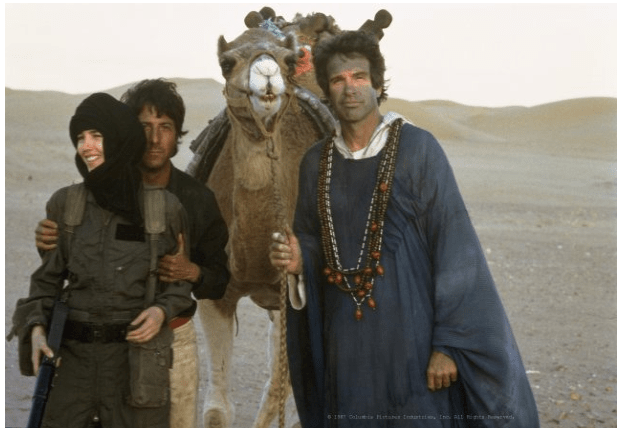
Ishtar places the central friendship on a grander scale, in the middle of a Cold War Hope-Crosby movie crawling with counter-intelligence officers. Dustin Hoffman and producer Warren Beatty star as the impossibly awful songwriting duo of Clarke & Rogers, who are shocked when, “That A Lawnmower Can Do All That” and “Wardrobe of Love” don’t lead to fame and fortune. So they take a gig at a nightclub in Morocco to live out the string of their dream. They are swiftly enmeshed in spy games, however, as Hoffman is drafted by Charles Grodin’s CIA agent, while Beatty is charmed by an attractive revolutionary (Isabell Adjani). Inadvertently acquiring a map that could inflame tensions in the neighboring country of Ishtar, they are chased, cajoled and seduced by secret agents from all over the world. It’s all showbiz to Clarke & Rogers, who work the levers of justice to release their art to the world.

May and cinematographer Vittorio Storaro reportedly clashed on the set, with Peter Biskind writing that, “Storaro was designing shots with an eye to their composition, their beauty, whereas she was composing for comic effect.” Whatever their professional relationship was like, it produced a comedy of rare visual logic. Early on, Warren Beatty is shot recessed into the frame, most notably in a bar where Hoffman tells him he wants to be alone. So Beatty sits at the far back right corner, with Hoffman in the left foreground. Instead of cutting in to Beatty sitting alone for a cheap reaction laugh, May and Storaro keep it in long shot, emphasizing Beatty’s absurd isolation from Hoffman, and setting up their long-distance conversation punchline. This shot encapsulates the Clarke & Rogers team, with Hoffman’s Clarke striving for a kind of hipster depressive cool while Beatty’s Rogers is dopey and supportive, although more honest about his secondary role in life – a background singer comfortable in his own clumsy skin.

Hoffman conveys his contradictory love and disdain for his puppy-dog pal throughout with self-lacerating self-loathing. Clarke clearly hates himself, dolling himself up in Boss bandanas and ska skinny ties, he’s a man without a personality, and attempts suicide early on. He desperately needs and intensely pities and loathes Roger’s affection, a dichotomy that plays out when they are pinned against each other in the Cold war intrigues.

Early on, Beatty seems to be laboring over his Stan Laurel-esque dope, underlining every inanity with a too broad smile not aided by the cartoonish wardrobe of floppy hats and kitschy sweaters. But as the film rolls on he eases into a rhythm, underplaying the punchlines like a pro. His obliviousness as a blind camel knocks down passersby is an uproarious scene aided by his deft obtuseness. In the discussion, May compared the two performances to the rejected contestants on American Idol, noting “how touching they are” in their unbowed belief in their non-existent skill. She also compared them to Ronald Reagan, whom she had met previously. He was a big fan of her act with Mike Nichols, and could recite their “Telephone” sketch from memory. She said he was “an amazingly naive, charming guy, who really cared about show business”, clearly a model she used for both leads.

May was in fine form, as if she had been workshopping her material in clubs the previous week. Received to extended applause, she deadpanned, “Either you like the movie or I’m very sick.” Referring to herself as a “nightclub comedian”, she ran through the Ishtar scrum with a residue of anger, venting at then-Columbia president David Puttnam for releasing the budget figures and publicly attacking Hoffman and Beatty. Essentially, she said, “the entire studio committed suicide”, and Coca-Cola sold Columbia to Sony in 1989, soon after the debacle. But the main focus was on her work, and the instinctually humble May was clearly uncomfortable at all the hosannas floating her way. When asked if Ishtar was ahead of its time, she quipped, “No, that’s impossible. Even with string theory.”

DVD TUESDAY: PARK ROW (1952)

May 17, 2011

Screen Shot 2020-01-29 at 4.10.08 PM

One of Sam Fuller’s most personal films, Park Row (1952), has been released on DVD through MGM’s burn-on-demand service, the “Limited Edition Collection” (available through Amazon and other retailers). Inspired by his time as a copy-boy for Hearst’s New York Journal and as a crime reporter for the New York Graphic, it is an impassioned paean to American journalism, opening with a scroll of the 1,772 active daily papers at the time (in 2009 the numbers were down to 1,387).  I can confirm that the listed Waukesha Daily Freeman is still running, with reasonable subscription rates. Fuller’s artistic temperament was formed in his ink-stained years, as he wanted his films to have the visceral impact and clarity of a 100 point size headline. Park Row is his gift to the business that made him. MGM’s DVD is presented in a solid if unspectacular transfer, with strong contrast. It includes a trailer.

In his raucously entertaining autobiography A Third Face, Fuller writes:

In 1952, I got an opportunity to make a film about the origins of American journalism and the passion for a free press. Park Row was the only film I’d ever produce with my own dough. But I had to make it, if for no other reason than to pay homage to the memories of my youth on that street I loved.

And an homage it is, a sweet love letter to the profession that gave him his start. It stars  Gene Evans and his clipped cadences as Phineas Mitchell, a born newsman floundering as a writer for the New York Star. When an enterprising printer pitches him on editing a new paper, The Globe is born, a muckraking start-up published on butcher paper that electrifies the city. Mitchell quickly riles up the Star’s owner, Charity Hackett (Mary Welch), and a circulation war flares and turns violent.

As Fuller notes, he used his own money to produce the film. He originally wanted to make it after his success with The Steel Helmet (1951), but Darryl Zanuck nixed the idea, since Richard Brooks was already directing a newspaper picture for 20th Century Fox, Deadline-USA (1952). Instead, he made another remarkable Korean War film in Fixed Bayonets. Fuller came back to Zanuck again with Park Row, and this time Zanuck agreed, but only if Fuller would turn it into a CinemaScope musical starring Gregory Peck and Susan Hayward. So he “decided that the only way to make Park Row was to put up my own dough and produce it myself. Two hundred grand, to be exact. To hell with Zanuck and Fox! Fuck the entire studio system!”

With limited funds, the film takes place entirely on one small city street set, that included the two newspaper offices and a bar. Every shot feels insular and cramped, with Fuller grouping his small cast in tight formations in the foreground of the frame. He doesn’t have the space to execute many tracking shots (although there are a few doozies, including a brawl that ends at the feet of Benjamin Franklin), which gives the film an unusual tension. The dialogue crackles but the characters are static, prompting Manny Farber to complain about its, “absence of fluidity – two huge faces usually dominate the screen.” While there are more group shots than Farber remembers, it is definitely a movie of close-ups, Fuller’s attempt inscribe these invented faces into history – they become monuments to his memory of being a newsman. This is established in the opening of the film with shots of three statues resting on the Park Row street set: of Gutenberg, Benjamin Franklin and Horace Greeley.

His personal investment becomes most touching in the character of  Rusty (Dee Pollock), the young kid who Phineas hires to become the “printer’s devil”, who has to re-organize the used typefaces. He is clearly the incarnation of Fuller when he was at the Journal, soaking up the atmosphere and strange argot (guideline, key-line, point, pull, stick, stone) that holds the mystery of an undiscovered country. There is a lot of talk about journalistic ethics, but the first story the Globe publishes is one they help construct. Phineas tells Bowery Street legend Steve Brodie that he’ll print a story about him if he jumps off the Brooklyn Bridge. What starts as a joke becomes front page news as Brodie and Phineas soon see the publicity potential in such a stunt. The story fuels the Globe’s opening week surge, and renders Phineas’ ethical issues at the Star moot. Clearly his biggest complaint was not ethics but entertainment. The Star’s corruption had simply become boring, and Phineas simply wanted to bring ballyhoo back to the printed page.

Fuller adapted some real events into the story to fuel Phineas’ Globe. Steve Brodie was a real Bowery legend, who became famous for jumping off the Brooklyn Bridge, even if it is now likely to be considered a hoax. In Luc Sante’s history of NYC shysters, Low Life, he writes that Brodie “had inconspicuous beginnings as a newsboy and bootblack, staking out the Manhattan end of the Brooklyn Bridge as his territory immediately after the 1883 opening. A few years later he began announcing to friends that, as a sort of dare, he planned to jump off the bridge. One of his friends was a printer named Tom Brennan, who had numerous connections in the newspaper world, and so word spread fast.” The line between “news” and “stories” is immediately blurred in Park Row, with Phineas becoming the hero over Charity only because his stories are more entertaining, if not more true.

It’s interesting to compare Fuller’s depiction of Brodie with Raoul Walsh’s, who filmed a version of the story with The Bowery in 1933. There is a difference in budget and approach. Fuller is working with no money, using the threadbare spaces to invest his film with a sense of monumentality, and a highly conscious nostalgia. Walsh was working with a big studio budget, and his frames are dense with people and action, evoking a sense of history-as-present. Even the basic conversational two-shot has drunkards and con-men gyrating in the background (he used his recollections of the real Bowery to construct his scenes, where he shot for Regeneration in 1915). These stylistic choices were made possible by their respective budgets, but they also fit each directors’ interests. Fuller is an idea man who uses images as rhythmic blunt force objects to get his concept across – working from the outside-in. Walsh prefers to go inside-out, building incidents and bits of business until patterns emerge of their own accord, a crafter of moments. Watch them both.

SUMMER BLOCKBUSTER: DAREDEVILS OF THE RED CIRCLE (1939)

May 10, 2011

Screen Shot 2020-01-29 at 4.06.17 PM

This year’s summer movie season was inaugurated by the gentle guttural drawl of Vin Diesel in Fast Five, the latest iteration of the jokey car fetishist franchise. Listening to Diesel’s lazy growl battle The Rock’s aggressive, crystalline enunciation offers more diversionary pleasures than most Hollywood money-grabbers. But the most fun I’ve had this year is watching a minor hit from the summer of 1939, the movie serial Daredevils of the Red Circle, which I picked up a $.99 VHS copy of on Amazon. The history of the summer blockbuster is usually traced to Jaws and Star Wars – in which Steven Spielberg and George Lucas filmed B-movie scenarios with A-level budgets and cemented the studios’ preference for the holy teen demographic. Lucas has previously stated that the Flash Gordon serial was one of the influences on Star Wars, and both men further indulged their serial fantasies with the Indiana Jones franchise. While  Spielberg and Lucas continue their attempts to recapture their sense of childhood wonder, always undercut by a winking self-consciousness, the originals are still around, providing unpretentious pleasures their wildly successful descendents have never quite been able to match.

Daredevils of the Red Circle began shooting on March 28th, 1939, and finished a month later, with enough footage to fill 12 episodes released that June. The first is a three-reeler, close to a half-hour, but the rest are two reels clocking in around 17 minutes each. It was budgeted by Republic Pictures at $126,855, but directors William Witney and John English completed it for $126,118. English and Witney had just completed The Lone Ranger Rides Again (1939), the sequel to their smash hit serial The Lone Ranger (1938)  (the current spate of sequels and remakes is nothing new). In his autobiography, In a Door, Into a Fight, Out a Door, Into a Chase,  Witney writes that after a two week vacation, Republic producer Bob Beche called him into his office for the next project, which would be Daredevils. When he heard the pitch from the screenwriting team led by Barry Shipman, he said, “I think you guys should stop drinking and give yourselves a chance to get over the DTs.”

The story follows the adventures of three circus daredevils: the leader (and high diver) Gene Townley (Charles Quigley), the nimble escape artist Tiny Dawson (Bruce Bennett) and the strongman Burt Knowles (David Sharpe). After their trapeze act is firebombed by the notorious Harry Crowel (a skeletal, menacing Charles Middleton), and Gene’s kid brother dies in the blaze, the trio starts investigating Crowel – who has been calling himself by his prisoner number, 39013. 39013 has been attacking the holdings of Horace Granville (Miles Mander), the rich industrialist who had fingered him for arrest. The Daredevils offer Granville assistance, and with the help of his daughter Blanche (Carole Landis) and their dog Tuffy, they attempt to bring 39013 to justice.

The story is an efficient delivery system for action acrobatics, if not narrative logic, and Witney and English take advantage of their athletic leading men. Bennett was an Olympian shot-putter, while David Sharpe was the stunt coordinator and main stuntman for Republic. Of Sharpe, Witney wrote, “It was a director’s dream to have a leading man capable of doing his own fight sequences. It meant you could keep the camera close to him and it gave us a chance to show him off.” The directors take full advantage of this in fight sequences of unusual physicality and intensity. Witney mentions getting the camera close, but he and English often use wide shots with few inserts and fewer cuts, letting the actors and stuntmen careen through industrial landscapes and drab offices with reckless abandon. The closer shots he mentions must be the numerous times he gets Sharpe to bust through a locked door as deadly gases are seeping in.

There is a joy in just letting these expert tumblers loose, epitomized in a late bit in episode 11 where Sharpe, having failed to break into a room where a hired goon cowers, slips around a corner and knocks the thug out through the side window. Sharpe begins to crack a smile at all the fun he’s having, before Witney-English cut to the next bit of wild action. This is the smile that Harrison Ford puts in quotes in Indiana Jones, but here it’s an accidental bit of non-fiction entering the screen. Sharpe’s character is a no-nonsense bruiser, who doesn’t crack a smile in any other bit of action. Unable to repress his happiness in his work, and with Witney-English eager to move on the next shot, this arrested upturn in Sharpe’s mouth remained in the film, and I can’t think of a better example of Godard’s dictum, “film is truth 24 frames per second”, even if it desperately wants to be lying. Along with Sharpe’s exertions, there are dives into oil fires, leaps from speeding cars and innumerable crashes into inanimate objects. This is dangerous and thrilling stuff, held together with flimsy but fleet story material that knew to keep moving forward.

Witney and English recombine basic scenario elements in each two-reeler, with minute variations to keep things rolling. The trio will inevitably get locked inside a room with death stalking them, fight off thugs at an industrial site, demean Granville’s black servant (this racist role is endured by Fred “Snowflake” Toones), and do it all with nary a crease in their natty suits. The use of repetition and variation brought the structure of these works to the forefront, and it is one of the central pleasures of the serial form. In their haste to crank out the serials, Republic created the forerunners of 70s structuralism, who, Hollis Frampton foremost among them, made films in which the structure and shape of the films was the content. The work of Witney and English made their structures just as visible, unintentionally laying bare the devices of their making, a kind of unconscious self-consciousness.

Another remarkable facet of Daredevils in particular is its emphasis on the hopes and fears tied into technology. Almost all of the major fight setpieces take place in a factory or major industrial site. The first episode ends in spectacular fashion, when a tunnel connecting Catalina Island to Los Angeles springs a leak, and Blanche Granville is stuck inside. Using the wonderful miniature work of Babe Lydecker, their tunnel is flooded. Then there are the brawls at an electrical station, an oil derrick and a gas plant, the sabotage of an experimental laser, and 39013′s expert makeup job to pass himself off as Granville. There is a thin line between technological advancement and abject terror, and the unease with the rapid changes of the era is palpable in every frame. The Daredevils offer split-second escapes from the apocalypses of the imagination, and do it with an unguarded smile.