DOUGLAS SIRK: FILMMAKER COLLECTION

October 12, 2010

sirk

The Tarnished Angels (1957) is one of Douglas Sirk’s greatest accomplishments, and it was not available on DVD in the United States until last month (one had to nab Region 2 DVD editions in France and England previously).  TCM released it on September 31st (in partnership with Universal) as part of the Douglas Sirk: Filmmaker Collection box set, along with Thunder on the Hill (1951), Taza, Son of Cochise (1954) and Captain Lightfoot (1955). It’s the latest production from TCM’s Vault Collection, which makes limited runs of hard-to-find studio titles, only available for purchase on-line.

Now is the time for the full disclosure bit. Since I’m writing for TCM, there’s a clear conflict of interest here. Proceed at your own peril, although all of the following thoughts are my own and are not influenced by my beloved corporate overlords (I promise).


Sirk made his reputation on the melodramas he directed for producer Ross Hunter,  but this set shows off his versatility. It contains a murder mystery (Thunder), a western (Taza) and a swashbuckling adventure (Lightfoot) in addition to the more familiar Sirkian drama of The Tarnished Angels. Thunder on the Hill is a stagy whodunit set in a convent, based on the play “Bonaventure” by Charlotte Hastings. It finds Claudette Colbert’s meddling Sister Mary trying to clear the name of convicted murderess Valerie Carns (Ann Blythe). Valerie is being escorted to a prison to be executed, when a dramatically convenient storm maroons her in Sister Mary’s domain. The scenario is creaky but the actors are game, with Colbert’s earnest moon-shaped face beaming out of her nun’s habit. Sirk wasn’t happy with the project, complaining to Michael Stern that, “only on Thunder did I have a producer who was interfering with my work. He was the only one at Universal. After that film I believe they fired him.” A quick look at producer Michael Kraike’s IMDB page confirms it was the last film he worked on for the studio.

Despite the fraught working conditions, Sirk still displays his impeccable sense of composition,  with DP William Daniels setting up B&W shots in depth, analyzing the power relations between characters. The triangle above finds Colbert flanked by a jealous nurse and the passive doctor, who will both be serious impediments to her investigation. Later, there’s a striking sequence where Colbert commiserates with Sister Josephine (Connie Gilchrist, a delightful busybody) about the case while the loyal town idiot Willie (Michael Pate) eats in the corner. The diagonal lineup of characters rhymes with the staircase in the background, a more harmonious arrangement for her informal deputies.

Taza, Son of Cochise is less satisfying, but does contain stunning color CinemaScope photography from Russell Metty. It’s an informal sequel to Broken Arrow (1950) and The Battle at Apache Pass (1952), where Jeff Chandler portrayed Cochise against James Stewart and John Lund, respectively. Here Chandler appears in an uncredited cameo as the Apache Chief, turning over his responsibilities to his son, Taza (Rock Hudson), who battles his brother Naiche (Rex Reason, a name for the ages) for control of the Apache tribe.  The script is a tired reiteration of the Cochise story, and the film, which was originally shot in 3D, fails to display Sirk’s usual visual dynamism in 2D. The colors certianly pop, though.

Captain Lightfoot is an enormously entertaining comic adventure filled with revolutionary skirmishes in 1815 Ireland. It was the first Hollywood feature film to be entirely shot in the Emerald Isle (The Quiet Man just shot exteriors there), and Sirk and DP Irving Glassberg glory in the rolling hills and elaborate period finery for the color ‘Scope frame. Rock Hudson excels as young rebel Michael Martin, a small-time hood taken under the wing of Captain Thunderbolt (Jeff Morrow), a legendary Robin Hood resistance fighter and bon vivant (the scenario was lifted for Michael Cimino’s Thunderbolt and Lightfoot. Captain Lightfoot’s screenwriter W.R. Burnett was not kind to the remake: “He stole it. Son-of-a-bitch. I’m glad Heaven’s Gate flopped.”).


Burnett, an irascible sort, was also not pleased with his director (from Backstory 1): “Sirk was a very bad job of miscasting. He had no sense of humor.” I beg to differ. While Sirk does not opt for out-and-out slapstick, there is a tender, amused tone throughout, from Hudson’s dance lesson to his strategic cigar smoking in a duel. The compositions here are packed, often overstuffed with action and reactions. Thunderbolt’s elaborate ball is masterfully staged and executed, with Hudson continually framed near the center in his eye-grabbing matte-gray suit. When he’s interrogated by the inspector, all stares remain on him, as ladies gather expectantly behind a window. This cements his transition from the one who looks up to Thunderbolt to the one being looked at.

The centerpiece of the box set is The Tarnished Angels (1957) a downbeat study of a family of stunt-flyers in Depression-era New Orleans. Adapted from William Faulkner’s novel Pylon, it was a treasured project of Sirk’s. Screenwriter George Zuckerman recalled to Gary Morris of Bright Lights film journalthat, “But after the success of Written on the Wind, in conversation with Sirk, I suggested Pylon. His face turned white. He said it was exactly the property he had in mind.” He re-teamed Robert Stack and Dorothy Malone from Written on the Wind, now as the doomed couple Roger and LaVerne Shumann. Roger was a decorated WWI pilot, now reduced to winning dangerous prop plane races at county fairs. LaVerne does the parachute drops, her buffeted skirt giving the guys on the ground a thrill (Sirk: “[Producer Albert Zugsmith] didn’t want her to wear anything underneath!”). Roger’s constant circling around the pylons is a metaphor for their lives: always moving, never going anywhere. With their son Jack (Chris Olsen) and mechanic Jiggs (Jack Carson), they travel the world seeking nothing other than their own anihilation.

Rock Hudson plays a reporter, Burke Devlin, who trolls for a human interest story amidst their wreckage and ends up in love with LaVerne and aghast at the society that produced their infernal little group. Sirk ironically layers images of Mardi Gras and the county fair over their travails, note the ferris wheel behind Dorothy Malone’s head in the group shot above, or the empty chasm of bleachers that opens up next to Hudson in the top-lining still. Then there is the motif of skull masks, which follow LaVerne throughout the film. During her first kiss with Burke, Sirk inter-cuts their clumsy romance with a raucous party next door, where a leotard-clad woman kisses and bites a man in a skull mask. They are instantly associated with death. And when a plane crashes later in the film, another masked man leads her away. The film swoons with metaphorical decay, and in Sirk on Sirk, the director recounts how he read T.S. Eliot’s The Wasteland to Robert Stack and Eliot’s Prufrock to Hudson, to drill in their respective destructiveness and isolation.

The camera is constantly moving on short tracking shots, similar to Roger’s peripatetic nowhere man. I’ll close with Luc Moullet’s provocative disquisition on these dollies, which rise above the level of narrative and celebrates the pure artifice of Sirk’s art (quoted in Jonathan Rosenbaum’s Goodbye Cinema, Hello Cinephilia):

The whole film is made of short tracks, usually lateral, almost invisible, the camera perpetually strolling five or six meters above the ground. Why? No reason. Just Sirk’s pleasure in making the camera move…In art, there is only artifice. Let us therefore praise an artifice that is cultivated without remorse, which consequently acquires a greater sincerity rather than artifice masked by itself as by others under hypocritical pretexts. The true is as false as the false; only the archi-false becomes true. (Cahiers du Cinema no. 87, September 1958).

***

For a look at the technical quality of the set, DVD Beaver has reviewed it here.

***

I have no more words to spare on the New York Film Festival, but please check out David Bordwell here and Michael J. Anderson here on my co-favorite film of the festival (tied with Uncle Boonmee)Raul Ruiz’s magisterial The Mysteries of Lisbon.
THE AGE OF SENSELESS VIOLENCE: THE DAMNED (1963)

October 5, 2010

damned

Every Friday night this month, TCM is showing a slate of Hammer Horror films, so we at Movie Morlocks have been saluting the venerable production company’s work. Hammer Films, launched in 1934, has an imposingly large filmography, and has just re-started after a 30 year hibernation.  Let Me In (the remake of Let the Right One In (2008)) is its first production to hit U.S. theaters since their 1979 version of The Lady Vanishesstarring Cybill Shepherd and Elliott Gould. They claim to have 25 projects in preparation, and they just inked a deal to publish horror novels with Arrow (an imprint of Random House). I’m going to dip into their past, though, and focus on the 1963 Joseph Losey film The Damned (re-titled These Are the Damned in the U.S. It airs October 22nd at 11:15PM. It is also available on DVD).

It’s a strange beast, a youth-in-revolt drama that morphs into a sci-fi dystopia fueled by nuclear panic. Based on a story by H.L. Lawrence (The Children of Light), and adapted for the screen by Evan Jones, it stars Macdonald Carey as Simon Welles, a rather dissolute American traveling to the graying resort town of Weymouth, in England (a stand-in for the blacklisted American exile, Joseph Losey). There he meets Joan (Shirley Ann Field), who lures him into a mugging by her brother King’s leather-clad Teddy Boy gang. King (played with neurotic smarminess by Oliver Reed) is a sexually-repressed type, tyrannically controlling his sister’s love-life and channeling his own lust into bits of random violence. Joan runs off with Simon, and they hide out in the cliffs, where they discover a secret government experiment to forge children who could survive a nuclear holocaust. King chases them into the same nightmare.

The experiment is lorded over by Bernard (Alexander Knox), an avuncular and nihilistic scientist convinced that nuclear destruction is unavoidable, and one suspects he thinks necessary as well. He tells Simon after his mugging that the “age of senseless violence has caught up with us too.” This statement, ostensibly about the Teddy Boy gang who jacked up Simon, is also writ large on the geo-political stage. Bernard wants to start the world from scratch with his miracle children, who have survived irradiation, are cold to the touch, and whom he treats as his students, although he locks them inside a cliff.

Joseph Losey was not thrilled to take on the project. He tells Tom Milne in “Losey on Losey” that:

I undertook The Damned, from a novel I thought confused and good, because several other projects had fallen through at that moment and it was a difficult period in my life. This has never been sufficient for me to take on anything; but I did, because I thought the novel spoke passionately and felt passionately about the irresponsible use of the new atomic powers put into the hands of the human race… I knew I was making it for a company distinguished for making pretty horrid horror films. I…was interested in parallel levels of violence. …These were the things I wanted to play on; the science-fiction aspects of the story didn’t interest me at all.

Despite his low opinion of Hammer Films, the company still did all it could to satisfy him. The original script was written by a former collaborator of Losey’s, Ben Barzman, which Columbia had approved, but he rejected it on the set, and moved forward with a new script from Evan Jones, which Denis Meikle says was “written on the hoof” in his A History of Horrors. Producer Tony Hinds left the production because of this radical change, to be replaced by Michael Carreras. But whoever was in charge, only Losey and Jones knew what the story was any longer.


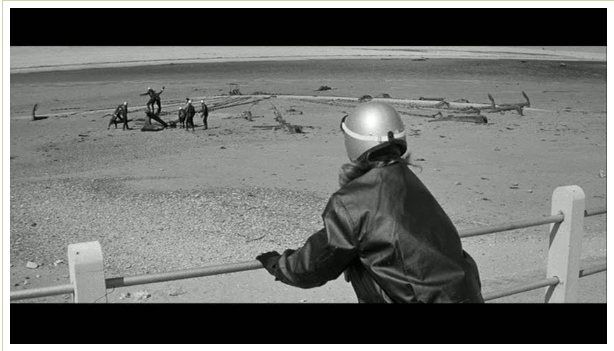
Regardless of the chaotic production, and Losey’s demurrals, it’s a striking and unsettling piece of work. It’s the first film he shot in the 2.35:1 ratio (here called HammerScope), but he and DP Arthur Grant had a firm sense of its possibilities. There is the deep focus of the shot that headlines this piece: of the gang randomly destroying an object in the deep background (a mutating mass of violence) while Joan contemplates fleeing in the foreground (an alienated, isolated presence). This composition repeats insistently in the first part of the film, in which Joan latches on to Simon as an escape hatch.  The leathered gang is always shot as a group, usually in long shot, and like automatons whistle and sing their killer theme song, “Black leather”.

Losey’s work in the first half is highly mobile and engaged. The gang straddles a unicorn statue, sneering to the passersby. In the same take the camera glides up the monument to George III, another icon emptied of meaning to these bored youth. Then Losey cuts straight from George to Joan enticing Simon to follow her to his doom.   As in his U.S. masterpiece The Prowler, institutions are losing power to induce obedience to the law, as endemic corruption has undercut any sense of legitimacy.

With the introduction of Bernard’s destructive paranoia, the gang’s distrust of authority seems apt, if not directed very constructively. Their violence is a microcosm of the battles that are threatening to devour the world, and which triggers Bernard to enact his megalomaniacal experiments. He drills his irradiated orphans with military precision – in art, history and literature, an a futile act of cultural preservation. But the kids are ignorant of their fate, and completely cut off from the world outside. They construct “parents” from magazine photos and their own crude drawings. Even if Bernard’s predictions come to pass, it’s unlikely these desperate children could forge the kind of society he envisions.

Losey’s attention seems to flag with the sci-fi sections, stuck with flat cave interiors, rote plot machinations and an overdetermined political allegory dragging things down. The film was a reaction to the Campaign for Nuclear Disarmament (CND), a vocal activist group in England, formed in 1957, that agitated for unilateral disarmament by the UK (their logo was adopted later as the worldwide emblem of peace). Bernard’s post-hawkish acceptance of a nuclear war is the ideal straw man for CND to knock down.

The rich imagery of social decay pops up only occasionally in the second half, almost entirely in the sculptures of Bernard’s sometime lover and full-time bohemian, Freya, played with cynical resignation by Viveca Lindfors. She constructs desiccated, unpolished works of  human and animal forms, splayed menacingly against Weymouth’s dreary landscape. A shadow of her bird lands behind Bernard in one of the images above. They are portents of death that everyone ignores, even herself.

While the ending is too pat – an everyone loses wake-up call that now looks forced, the film contains an irreducible creepiness, as well as Losey’s inspired sections of societal rot and cycles of violence that he is able to convey almost entirely through the image. Afterward he would move on to a string of art-house hits with his Harold Pinter adaptations starring Dirk Bogarde, but I don’t think any other of his British productions contain the same uncanny power as The Damned.

THE 48TH NEW YORK FILM FESTIVAL, PART 2

September 28, 2010

nyff2

The Social Network, the opening night selection at the 2010 New York Film Festival (and opening nationwide October 1st), consists of men (and one girl) talking in rooms and around tables. Facebook founder Mark Zuckerberg (Jesse Eisenberg)  is the reluctant participant in these discussions, hunched over and bristling, much preferring the inscrutable company of his own mind. The essential opacity of these thoughts to his friends and foes, Zuckerberg’s intractable isolation, is the nexus around which director David Fincher and screenwriter Aaron Sorkin spin their tale of mis-communication and betrayal.

Sorkin frames the story of Facebook’s founding through legal depositions of two concurrent lawsuits facing Zuckerberg. One from his supposed best friend and former CFO Eduardo Saverin (Andrew Garfield), the other from three schoolmates who proposed a similar social networking site called The Harvard Connection.  Their competing testimony shifts the point of view between all three of these perspectives, offering differing visions of Zuckerberg’s character, Citizen Kane style (Sorkin referenced Rashomon at the press conference, but the focus on the unstable image of one man, as opposed to an event, is far more indebted to Kane – for a further elaboration of the comparison, see Michael J. Anderson’s essay here).

The dialogue is read in staccato bursts of defensive manuevers, everyone protecting their intellectual territory. Eisenberg zooms through the script with brittle intensity, a man of supreme arrogance, intelligence and insecurity insulating himself with words. It’s a bravura performance, in which Zuckerberg’s mask of intellectual impassivity is cracked for a few brief moments, introducing doubts about how much of an asshole he really is. The puzzled, crestfallen expression on his face after his final split with Saverin is tantalizing in its ambiguity. Joined by a truly Mephistophelean turn from Justin Timberlake as Napster founder Sean Parker (look at his manipulations in the photo above), the wide-eyed innocence of Andrew Garfield, the blue-blood hauteur of Armie Hammer as both Winklevoss Twins (using the facial motion-capture technique Fincher pioneered in the underrated Curious Case of Benjamin Button), and a scene-stealing demolition job by Douglas Urbanski as former Harvard president Larry Summers, The Social Network is brimming with revealing put downs, glances and asides.

That it’s taken me this long to get to Fincher says a lot about his role here, a true collaborator with Sorkin and his cast (along with DP Jeff Cronenweth and the fine pulsating score from Trent Reznor and Atticus Ross). But the film, like all of Fincher’s work, is beautiful in strange ways. There is the infernal darkening red hues in which he shoots the Harvard sequences, a simmering hormonal pool of class resentments and hard-ons. One sequence, in which he inter-cuts a Dionysian “final club” party with Zuckerberg coding his early “FaceMash” site is revealing of the unreliability of Zuckerberg’s POV. As he builds his site, an ode to a male’s wounded ego, which allows campus libidos to vote on female students’ hotness, we get visions of stripped down co-eds cavorting in the aristocratic party that Mark would never be invited to. The party seems like his resentful projection, but it’s presented as a simple cross-cutting sequence, or his version of the truth. All three POVs should be treated as unreliable, or at least as clouded by self-interest. By the end, when Zuckerberg’s every move seems both justifiable and monstrous, I could only think of Marlene Dietrich’s closing summation in Touch of Evil: “He was some kind of a man. What does it matter what you say about people?”

***

The other triumph in the main slate was Apichatpong Weerasethakul’s Uncle Boonmee Who Can Recall His Past Lives (coming to theaters in the U.S. in  March 2011 from Strand Releasing)Set in a small farming village in the Northeastern part of Thailand, it tracks the last days of Uncle Boonmee (Thanapat Saisaymar) during which he is visited by the curious ghosts of his relatives. It is a film of permeable borders, between Laos, Cambodia and Thailand, between life and death, man and animal, and ultimately, between possible worlds. Boonmee’s caretaker, Auntie Jen (Jenjira Pongpas, from Weerasethakul’s previous Syndromes and a Century), complains about the Laotian caretaker of his farm, worried that he doesn’t bathe. Later, Boonmee is afraid that he created bad karma because “I’ve killed too many communists.” This speaks to the crackdown on Communism in the region following the war in Vietnam, in which peasants informed upon and fought against Communist cells or were accused themselves. The monkey ghosts which haunt the film can be read as the spirits of the Communists who fled into the forest, although that is only one, much too reductive interpretation.

And yes, the monkey ghosts arrive as naturally as the disfigured princess, who arrives in a deliriously beautiful set-piece that Joe staged as an homage to the royal costume dramas of his youth, although I doubt they contained the amorous catfish in his version. But they should have. Boonmee’s procession into death is also a procession into Weerasethakul’s personal memory and history, as well as the history of his films. Along with Pongpas, Sakda Kaewbuadee returns from Syndromes, as Boonmee’s nephew, and later as the monk from the previous film, as the personal blends with the artistic and historical. There are endless strands to analyze and untangle, but there are also the manifest pleasures of lolling in his gentle, comic rhythms and sparklingly beautiful compositions (it was shot on Super-16 and blown up to 35, often using day-for-night). By the time it descends into Plato’s cave and encompasses the whole history of moving images, I knew I had seen a masterpiece. And I want to watch it again right now.

***

As space is running short, some quick notes on other defining moments from the festival:

Film Socialisme, directed by Jean-Luc Godard (no distribution, screens Sep. 29th at 6PM and Oct. 8th at 3PM)

A lament for Europe, in layers of video and text. HD images of a decadent cruise through the Mediterranean are interrupted by degraded and pixelated footage of mobbed dance floors and YouTube videos of mewling cats. He gets incredible effects from reducing the video resolution, getting cubist collages of capitalist excess and moments of incredible, uncanny beauty. One image, a hand placed on a window, then pulled back, obscured by the degraded image and made ghostly and strange, spoke more to me about the cultural losses he refers to so incessantly. The cruise ship docks, replaced by a family owned gas station, whose parents (and then children) are running for election, chased down by a relentless news team. A young boy, adept at slapstick, scares them away with a stick and then conducts an invisible symphony with it. So referentially dense, it would ideally be watched with hyperlinks attached to all the quotes and film clips, as well as the concrete poetry of the partially-translated subtitles, which he puckishly described as “Navajo English”.

The RobberDirected by Benjamin Heisenberg (no distribution, screens Sep. 29th at 9:15PM)

In this propulsive genre workout, a prisoner trains in his cell to be a long-distance runner. Upon release he wins a marathon, but, alas, keeps robbing banks. Incredibly, it’s the true story of Johann Kastenberger (changed to Rettenberger in the film, and played with wiry athleticism by Andreas Lust), or “Pump Gun Ronnie”, who wore a Reagan mask during his reign of terror. The superbly controlled action sequences are shot in sinuous steadicam long takes, and one heist in particular stands out. Lust, after holding up one bank, sprints to another one, as the cop cars are busy investigating the first. Setting his camera up across the street, Heisenberg resolutely keeps his distance from any kind of psychologizing, he’s just here to emphasize the physical feats. Then Lust bursts out of the second, and a chase erupts when a cop car foolishly tries to run him down. Racing up a parking garage, and then down and outside through a cellar, it’s a white-knuckle affair shot with daredevil fearlessness. The steadicam operator was sprinting down hallways as fast as Lust, with little cutting and total spatial coherence.

THE 48TH NEW YORK FILM FESTIVAL, PART 1

September 21, 2010

nyff1

The 48th New York Film Festival begins this Friday night, with David Fincher’s The Social Network, and I’ll be hemorrhaging words about it for the next few weeks. J. Hoberman finished his term as a programmer last year, and the more populist-oriented Todd McCarthy (formerly of Variety, now at Indiewire) took his spot on the team, chaired by Richard Peña, and rounded out by Dennis Lim, Melissa Anderson and Scott Foundas. Since Hoberman is one of my favorite humans, I was prepared for an ever-so-slightly less challenging slate this time around. But no! This year’s titles look awfully impressive sight unseen, a mix of savvy veterans  (Godard! Oliveira! Kiarostami!), peaking  auteurs  (Apichatpong, Reichardt, Puiu) and the promise of relative unknowns (Frammartino,  Grau, Heisenberg, Loznitsa).   Even the sidebars look bountiful, with the NY premiere of Joe Dante’s The Hole and Frederick Wiseman’s Boxing Gym.  With the addition of the oft-overlooked but stacked Views From the Avant-Garde section, the NYFF will gently dominate my life for the next month.

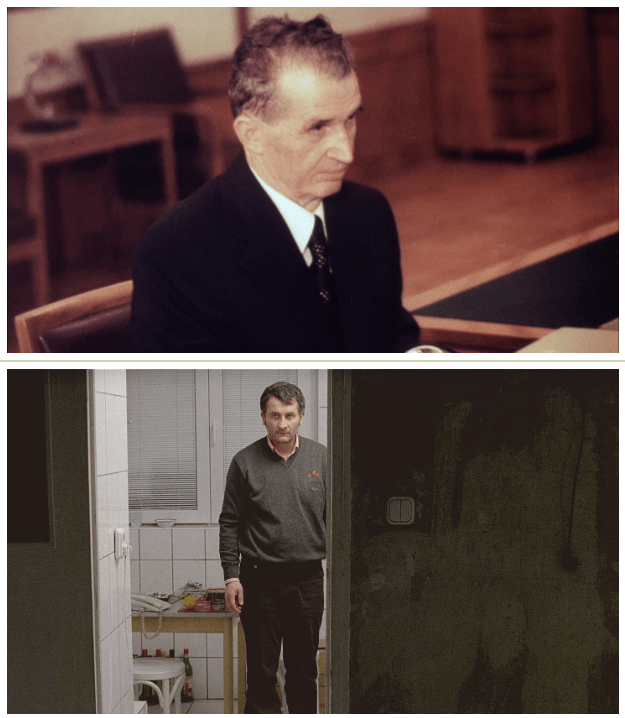
The first festival titles I viewed this year are two Romanian tours-de-force about ordinary men and what may lie behind their vacant stares (yes, Romanian cinema continues to astound). The Autobiography of Nicolae Ceausescu, part of the Special Events sidebar, is a triumph of archival research and editing. Director Andrei Ujica and editor Dana Bunescu compiled footage of the deposed Romanian president from the National Television and National Film Archives in Bucharest. They found home movies of his vacations along with propaganda footage shot at home and abroad. Ujica and Bunescu edited this footage together to create an unintentional “autobiography”, and built up a complex soundtrack for the almost entirely silent footage.

Ujica told Dennis Lim that “The film does have a commentary but it’s a nonverbal commentary. It’s in the construction of the sound and in the intervention of the music.” These manufactured scenes are bookended by grainy video footage of Ceausescu and his wife being interrogated after the 1989 revolution, before they are executed. The grim pallor of his face in this opening shot echoes throughout the multiple representations of his hale and hearty visage that follow.

His unseen interrogator says, “it was your masquerade”, and then the film proper begins, with  footage of Gheorghe Gheorghiu-Dej’s funeral, the former General Secretary of the Romanian Communist Party. Then Ceausescu is inaugurated, and the most striking thing about him is his hair. Swirling but immovable, it sits awkwardly and flamboyantly on his impassive boyish face. Tracking this follicular edifice’s slow decay is one of the film’s multifarious pleasures. It appears at various PR affairs, from the beautiful chaos of the Harvest Festival, where he plays fairground games half-heartedly, to his absurd historical recreation of Romania’s 15th Century King Mircea, which he stages for visiting dignitaries. He is attracted to showmanship, although he himself appears to be an inscrutable bore, his most common expression a half-smirk. He even stoops to cheating at volleyball during a game with friends (he pulls down the net to allow his weak kills to get over).

We see what he wants us to see, so politics are reduced to communist talking points, he won’t budge beyond name-checking Marx and Lenin, or his insistence on removing NATO troops from Europe. Very little is heard or mentioned about domestic initiatives – he seems entirely reactive, only inspired when the world seems to be against him. His most impassioned speech is delivered against the Warsaw Pact invasion of Czechoslovakia in 1968, where he forcibly condemns the “socialist incursion”, and insisted on putting an “end to interference.” While clearly a move based on the fear of invasion for his own fragile nation, it’s a forceful and effective speech, and on the right side of history. But that’s it for an intellectual spark. The rest of the film shows a man becoming more insular and paranoid, retreating into a cult of personality. All we see is scene after scene of Ceausescu smiling uncomfortably next to world leaders, a near daily affirmation of his own importance. He receives visits from Nixon, jets to England to meet the Queen, and is celebrated by Kim Il-Sung in North Korea a number of times, to ridiculously overblown fanfare. His trip to Universal Studios just seems like more of the same puffed up artificiality.

By the end, his face is a mask of boredom, a zombie on the national stage who keeps his country in a similar narcoleptic state. Ujica carefully deploys pop songs, including a memorable appearance from “I Fought the Law” to suggest the alien Western forces that are bleeding in to the edges of Ceausescu’s hermetic frame. By the end, when Ceausescu  looks emaciated inside his ill-fitting suits, his face ravaged with wrinkles and his hair imploding like a collapsed souffle, even his fellow lonely presidents have had enough (in one meeting Gorbachev angrily checks his watch). In the final shot of the post-revolution footage, with Nicolae and his wife Elena looking hollowed out and irascible, he is no longer the totalitarian nightmare of the Romanian imaginary, but just an old man scared to die.

Ceausescu makes quite a pair with Cristi Puiu’s Aurora, another study of a Romanian zombie. It is Puiu’s follow-up to the extraordinary Death of Mr. Lazarescu, and where that film is a portrait of a breakdown in Romania’s public services, this is an experiment that tries to document the breakdown of his country’s psyche. It is the second part of what he calls his “Six Stories from the Outskirts of Bucharest”, dedicated to Eric Rohmer and his Six Moral Tales, of which Lazarescu is the first. Puiu describes this series as about “moral crisis and how inefficiently and artificially the Western model has been applied to a country that had just emerged from the darkness of communism.”

Puiu himself plays the lead character, Viorel, a furtive, ill-tempered man who wanders around Bucharest fulfilling obscure tasks known only to himself. He collects a debt and picks up a firing pin for a shotgun. His face is stony, his wardrobe a consistently tasteful sweater-over-dress shirt combination. He is middle-class, in the midst of renovating his apartment. But instead of fixing up the place he keeps emptying it out, pawning his stuff on family and friends. It seems his is preparing to empty himself out instead. But Puiu reveals nothing of  his motives – Viorel is to remain entirely unknowable and irreducibly human, regardless of the violent acts he commits.

Puiu shoots him constantly from a distance, framed inside of doorways and other transitional spaces, the unbalanced images focused on the sliver of well-lighted spaces he broods in. The visuals are as opaque as the character, bisected and hard to navigate, plus Puiu frequently pans away from major actions, the camera acting like an abused but loving dog, keeping a distance but always wanting to creep closer. Puiu told his cameramen to “follow the character, and to look at him with a feeling that resembles a father watching his child learn to walk.” This is a more compassionate version of my comparison, but still apt. There is a constant tension of what will be revealed inside the frame or about the characters, a puzzle that kept me intensely engaged, especially with its rude bursts of absurdist humor, including a flash of an overweight woman getting a wax, and the brusque apathy of police officers refusing to care about the facts that audiences have been trained to fixate on. It’s a welcome provocation, shifting the weight of analysis from the characters to the viewer, a film to obsess over.

Next week I’ll have a lot more to pontificate on, including Oki’s Movie, Uncle Boonmee, Certified Copy, Film Socialisme, and unless I get shut out, The Social Network.

MAGNIFICENT RUIN: SECRET BEYOND THE DOOR(1948)

September 14, 2010

secret

Before I start this week’s blather, I wanted to acknowledge the passing of the great Claude Chabrol at the age of 80. Dave Kehr’s NY Times obituary is here, the AP’s is here, and David Hudson has an exhaustive collection of links at MUBI. His filmography is massive (near 70 titles), and I’ve barely made a dent, but from what I’ve seen his impish deconstruction of bourgeois morality is a joy to watch. I saw La Ceremonie for the first time this year (Jonathan Rosenbaum re-posted his review of the film today), and its perfectly controlled, distanced cinematography masks a wholly degraded moral universe. He unveils hypocrisy with every cut, making films you peer underneath with trepidation. And through it all he’s a supremely funny guy – just check out his bumptiously perverse turn in Sam Fuller’s Thieves After Dark. Now it’s time to watch more…

Next Monday, September 20th, TCM is airing a 24-hour marathon of restorations performed by the UCLA Film & Television Archive. I’d recommend the entire block, from The Exiles through Killer of Sheep, but today I’m focusing on Fritz Lang’s 1948 curiosity Secret Beyond the Door. An unmitigated disaster at the box office, it led to the dissolution of his production company (Diana Productions), which he had established with Joan Bennett and Walter Wanger. Their short-lived success on Scarlet Street ended in back-biting and recriminations after Secret tanked. And yet it is one of Lang’s most beautiful films, shot by Stanley Cortez in sharply angled shadows.

Lang was against hiring Cortez, as Patrick McGilligan writes in Fritz Lang: The Nature of the Beast. He wanted to work with Milton Krasner again, who shot Scarlet Street, but the scriptwriting process dragged on, and Krasner took another job. Cortez was under contract to Wanger, and having already shot the atmospheric interiors of The Magnificent Ambersons, seemed to be an inspired choice for this very architectural film. But Lang clashed with him immediately, as Welles did on Ambersons, complaining about his slowness in setting up shots.  Regardless of their personal relationship, the results on-screen are mesmerizing. It is a film of shadows in corridors, with Joan Bennett etched into narrow enclosures, endlessly searching for masked entrances and exits. The film is made up of these portals, which open into Bennett’s psyche (displayed in repeated shots of mirrors) and her neurotic husband Mark’s (symbolized by a locked door).

As Tom Gunning details in his essential study, The Films of Fritz LangSecret arrived in the middle of a series of Gothic women’s dramas kicked off by Hitchock’s Rebecca (1940). The introduction of Freudian elements was also common. Gunning: “Using Freudian themes as new plot enigmas and as an excuse for dream sequences with Expressionistic or surrealistic visual elements were aspects the popular women’s film and the new art house fare shared in such films as John Brahms’ The Locket of 1946, the British The Seventh Veil of 1947; or most influential of all, Hitchcock’s 1943 SpellboundSecret is firmly in this tradition.”

The script by Sylvia Richards (adapted from a serial in Redbook by Rufus T. King) tells the dream-like tale of Celia(Joan Bennett), who falls in love with the quixotic architect Mark Lamphere. They quickly marry after an intense flirtation in Mexico, and Celia soon discovers that Mark was previously hitched, and has an erudite, distant son named David. David accuses Mark of killing his mother, and Celia soon suspects that she could be next.

It is heavily influenced by Rebecca and Spellbound, and fails to match those films on a narrative level. The motivations of the supporting characters in Mark’s imposing household are never clearly mapped out, and the psychoanalytical interrogation of Mark is reduced to, as Gunning says, “simply a matter of clearing up false impressions.” Reveal the repressed memory, and Mark will be healed. This is pop-psychoanalysis, but if one is able to separate the images from the overwrought plot mechanics, it is hypnotic, troubling work. The visuals tell the story of Bennett gaining control over her own consciousness, as Gunning convincingly argues. This is traced to the use of voice-over, one of the major bones of contention in post-production work on the film.

Lang originally recorded Bennett’s voice-over with a different actress, intending to convey the idea that one’s unconscious is a completely different person. As relationships broke down after shooting ended, Wanger and Bennett (who were married at the time), decided to re-record the track with Bennett’s voice, making Lang’s film more conventional (this idea of representing a woman with two different actresses was later pulled off brilliantly in Luis Bunuel’s That Obscure Object of Desire (1977).

In any case, the voice-over is used repeatedly in the first 3/4 of the film, with Bennett intensely questioning Mark’s true feelings, as well as her own. It is a tentative, insecure and deeply neurotic voice. The disconnect she feels is visualized by Cortez and Lang through a series of shots in which Mark’s back is turned during conversations. It is his gestural defense against the intrusion that Celia’s love continually presents, a bulwark against female intrusion.

Her self-doubting voice-over stops, however,  when she finally breaks into Room No. 7, the locked door Mark would not allow anyone to enter (entering the Bluebeard fable as another major influence). Mark is a collector of “felicitous rooms”, in which he reconstructs the boudoirs of murders, using as many original elements as possible. He believes that there is something about the structure of these rooms, and their things, that pre-determined the murders, in all of which men kill women. For Mark, architecture is a bloody destiny, an attitude Lang is clearly sympathetic to (i.e., his obsessive mapping of imprisoning city blocks in M). Celia is initially attracted to this death-drive of his, as they first meet watching a bloody duel and exchange erotic gazes. That their dual psychological issues could be solved like a whodunit is silly, but the power of the images often transcends the flimsiness of the material. As Gunning wrote, “One might describe Secret Beyond the Door as the ruin of a great film, or the ruin of a great filmmaker. Through its collapse, structures are revealed that are more astonishing than the more structurally sound edifices of lesser filmmakers.”

VCI. DVD. OMG.

September 7, 2010

vci

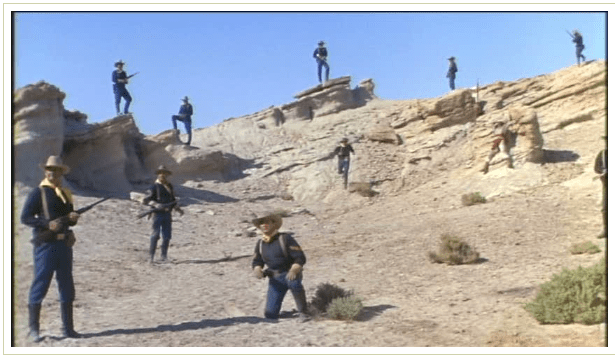
Last week VCI Entertainment released two obscure DVDs into the wild: William Witney’s Apache Rifles (1964, above) and Four in the Morning (1965), which features Judi Dench in her first leading role. Neither are deathless masterpieces, but each are valuable in their own inimitable way. Witney, a prolific director of movie serials for Republic Pictures (he specialized in Roy Rogers and Dick Tracy films, among scores of others), has a small (and growing) auteurist cult, receiving plaudits from Quentin Tarantino in recent years. In 2000, he told the NY Times that, “William Witney is ahead of them all, the one whose movies I can show to anyone and they are just blown away.”

A blunt descendant of The Searchers, it casts Audie Murphy as an Indian-hating U.S. Calvary Captain thrown into a moral quandary when he falls in love with a woman who is half Comanche. Making good use of the desert landscape, Witney starts off with wide shots during Murphy’s vengeful phase, and slowly closes in until the psychologically wrought final sequences take place in intimate two-shots. The first half is shoot outs, the second half fistfights (including a particularly brutal one with L.Q. Jones).

Released the same year as John Ford’s Cheyenne Autumn, Witney’s film is a smaller-budgeted effort to improve the representation of Native Americans on film, although the Apache “Red Hawk” is played by the Italian-American Michael Dante, and the unfortunate ending has him embracing the tribe’s forced relocation to Texas. But the rest of the film is a no-nonsense actioner that pragmatically diagnoses the causes of ethnic violence. That is, the Apache’s land equals money for the town’s miners, and so a higher standard of living for the community. So the “savagery” of the Native Americans is played up by the town leaders in order to provoke a fight. Murphy negotiated a truce with the Apaches mandating that work cease on the local mines, but it swiftly collapses when an Apache is falsely accused of murder. Self-interest always wins out.

Audie Murphy does not have the tools to navigate the minute psychological turns of his character – his bland handsomeness rather dulls the edge of his supposedly violent nature, tempering the drama of his shift in attitude to the Apaches. Witney surrounds him with capable bit players (Jones, Ken Lynch, Bob Brubaker), and matches cuts on action to keep things moving, a whirling film without a center.  To compare Murphy to John Wayne in The Searchers is to see the greatness of John Wayne.

Four in the Morning is a morose bit of British kitchen sink realism, following three tales of working class woe through a single evening. Judi Dench is a harried young mother tending to her wailing and teething infant while her husband gets loaded (she won the “Most Promising Newcomer” award at the BAFTAs). Ann Lynn plays a lonely nightclub gal who strolls the London docks with the eagerly flirtatious Brian Phelan, and they soon alienate each other with a series of power-shifting mind games. In between these two stories, director Anthony Simmons details the fate of a female corpse that washed ashore, documenting the bureaucratic wrangling to send her to the grave.

As a narrative it’s overdetermined and suffocatingly miserabilist, but the stark B&W images of the mud-spattered London ports by DP Larry Pizer subtly expresses the aimless malaise of its characters (Pizer also shot Mannequin 2: On the Move. It’s a job, after all). The scuffed top of the coffin that carries away the Jane Doe says far more, and carries more metaphorical weight, than the overwrought script. If Simmons trimmed the overly theatrical dialogue and let the camera speak, Four in the Morning might be known as more than a footnote in Dench’s career.

The only relationship between these two films is that, luckily, VCI got their industrious hands on them. Of the innumerable companies that release public domain titles, VCI is the only one to put care into their releases. Apache Rifles, as you can see, looks a bit soft, while Four in the Morning has nice sharpness, but exhibits some digital artifacts while in motion. But they are eminently watchable presentations, considering that VCI is dealing with original materials of questionable quality and working on a low budget. Apache Rifles is also festooned with an interview with Michael Dante, and a short, informative documentary about the film.

VCI started in 1961 as a non-theatrical booking company known as United Films, distributing studio titles to college campuses and ships at sea. In 1976 the owner/founder Bill Blair started up a division he named Video Communications, Inc., and they claim to be the first business to sell films directly to home theater owners. They clearly have a strong sense of film history, having also released Douglas Sirk’s Summer Storm and Lewis Milestone’s A Walk in the Sun earlier this year. A rescuer of orphaned films otherwise languishing in flickering boxes on YouTube, VCI is doing cinephilic yeoman’s work, and they should be thus honored.

RAOUL WALSH, ADVENTURER

August 31, 2010

Walsh3

For a man who toiled in the studio system for close to 50 years, cranking out genre quickies and prestige productions with equal aplomb, Raoul Walsh’s work remains astonishingly coherent. My grab-bag syle of viewing has made this resoundingly clear. This week I watched his earliest work, Regeneration (1915) and The Thief of Bagdad (1925) through two films he made in 1953: The Lawless Breed and Gun Fury. The above still is from Along the Great Divide, a spare, Oedipal Western from 1951. All of them, in one guise or another, deals with Walsh’s major concern, the benefits (freedom) and costs (self-absorption, loneliness) of individuality.

In Along the Great Divide (available from the Warner Archive), men are subsumed under vaulting rock formations, isolated and doomed. Kirk Douglas, in his first Western, plays a neurotic U.S. Marshal intent on protecting a cattle rustler accused of murder (Walter Brennan) from his would-be lynchers, and on bringing him to justice. He pushes his deputies as hard as his prisoners, eventually alienating all of them over a harsh drive through the desert. Douglas represses his world-devouring charisma into a bottled-up rage, unleashed only when a bemused, sardonic Brennan starts incessantly humming a tune, “Down In the Valley”, that the Marshal’s Dad used to sing, triggering unwelcome memories.

Filmed in the emptied out High Sierras and the Mojave desert, Walsh shoots his actors in long shots against the alien landscape, reduced to motile dots during shoot-outs. When he comes in close, people are breaking down. The group’s loyalties are in constant flux, and love affairs fall apart on the second half of a shot-countershot. After cooing over a sunset, Virginia Mayo turns a gun on Douglas, eager to save her father (Brennan) from the noose. Everyone acts out of base self-interest, and it is revealed that the Marshal’s obsessive fealty to the law is merely his guilt-ridden reaction to his failure to protect his father. There is a complete interpersonal breakdown, with every man and woman looking after their own interests. As Renoir famously said in the The Rules of the Game, “everyone has their reasons.”

The faces are the landscapes in his debut feature Regeneration (on DVD from Image), a raw urban melodrama of gang life on the lower east side of NYC. Walsh told Peter Bogdanovich:

…I got a thing called Regeneration, a gangster picture, which is right up my alley because I knew all those bloody gangster kids and everybody in in New York. …I went down around the waterfront and around the docks and into the saloons and got all kinds of gangster types, people with terrible faces, hiding in doorways.

In his autobiography he said that, “There were enough bums and winos around to cut down on extras.” Equipped with these authentic visages, Walsh produced a downbeat piece of  social realism that runs underneath the stock drama, a mixture of fiction and documentary that is being mined today by international auteurs like Lisandro Alonso and Pedro Costa (Dennis Lim has a fine overview of this contemporary trend). It tells the story of John McCann (the immortally named Rockliffe Fellowes), a kid whose parents abandon him to fend for himself on the poverty-stricken streets. He turns into a brutal young hood, who softens only under the glare of social worker Mamie Rose (Anna Q. Nilsson), who tries to reform him. As a Walshian hero, though, McCann can never entirely be domesticated, the lure of dissolute freedom is too great. For Walsh, it was a natural decision to use “real” people to fill the cast, a cost-cutting maneuver that also allowed him to film those “terrible faces” which attracted him so much.

Previously employed as an actor by D.W. Griffith, as John Wilkes Booth in A Birth of a Nation and a host of Biograph shorts, there is a strong influence in Regeneration from his mentor. Walsh remembers that he learned “not to allow leads to ‘eat up the scenery’ by overacting’ from him, and describes one of the final sequences of the film:  “I had the camera move in for a close-up in the best Billy Bitzer style.” The close-ups are extraodinary, intimate portraits that impede the story, unnecessary to the action but essential to understand the time and place. More is revealed in a shot of a tattered t-shirt on McCann’s drunken stepfather than any inter-title could convey. Poverty is portrayed matter-of-factly, without condescension or embellishment, and it is this oppressive sense of reality that lends Regeneration its sizable force.

The Thief of Bagdad (streaming on Netflix Instant)was a mega-production, and while it’s more of a triumph for set designer William Cameron Menzies and Douglas Fairbanks’ chest, it continues Walsh’s interest in outsiders, albeit in a brighter, more rakish tone than Regeneration or even Along the Great Divide. Fairbanks’ thief is a charming rogue, but a solitary one, getting tips from a variety of magical grotesques, but his feats of strength and wit are all accomplished alone.

Walsh made two westerns with Rock Hudson in 1953, which deal with opposing visions of masculinity. In The Lawless Breed (on Wesley Hardin escapes the religious strictures of his father, only to fall into the  life of an outlaw. While in Gun Fury (on DVD) Hudson is an upstanding type, a fumbling fiance forced into vengeance when his wife is kidnapped.

The Lawless Breed seems like a dry run for The Tall Men a few years later, as Hardin has a dream of owning a farm and living the quiet life, while his dancehall gal is skeptical. The same dynamic is present between Clark Gable and Jane Russell in the later film, but what they make playful and flirtatious is rendered stolid and melodramatic here. The creaking script makes excuses for all of Hardin’s murders, straining visibly to whitewash his character into a spotless hero. This pushes against Walsh’s instinct to problematize the heroic instinct, and the resulting film is an intriguing failure. The shootouts are crisp and well-staged, but there is no tension or shading in Hardin’s character, with little of the ambivalent violence of Gable, who is a shown as a thief in the opening shot of The Tall Men.

Hudson made Gun Fury with Walsh the same year, which was shot in 3D. It has the most inventive use of 3D technology I’ve seen, mainly in the use of depth effects, which he was already a master at in the lowly 2D format. But here images in the foreground gain a new solidity, with dust kicking up in front of our eyes as a horse cuts through the back third of the frame. There’s a density and volume to the images that is absent from the recent 3D cycle, achieved through the constant interplay between background and foreground that elasticizes the screen space.

Hudson plays Ben Warren, left for dead by a brutal gang who abscond with his wife-to-be Donna Reed. Warren is no fighter, getting gunned down while futzing with a shotgun, and accepts the help of a former member of the gang, and a Native American who had suffered at their hand. The narrative is sleek and focused, pushing Warren forward even when he’d rather not, an accidental hero who’s not very good at his role.

For now, this will be my last post on Walsh, and it’s been nothing less than a revelation for me. His “invisible” style is never less than expressive, from the heights of Manpower to the lengths of the ‘Scope Tall Men, he has an instinctual touch for how to pack his frames for maximum dramatic impact. His heroes are bruised, his women are cynical, but when Walsh alights on a rich vein of dialect (Me and My Gal, Strawberry Blonde), he can be downright hilarious. He’s a shifting target, but I’m in the beginning stages of tracking him down.

RAOUL WALSH’S GROUP THERAPY

August 24, 2010

walsh2

My  hopscotching education in Raoul Walsh skitters on this week, with five gut-punching thrillers. I’m jumping through his career haphazardly, watching whatever I can easily acquire. Last week led me from 1930 to 1955, but today I’m mired in the 1940s, thanks to the Warner Bros.-TCM box set, Errol Flynn Adventures (feel free to ignore this post if you think the TCM branding compromises my objectivity).  Along with Lewis Milestone’s Edge of Darkness, it includes the Walsh-directed Desperate Journey (1942), Northern Pursuit (1943), Uncertain Glory (1944) and Objective, Burma! (1945). I supplemented these with the Warner Archive disc of Manpower (1941).

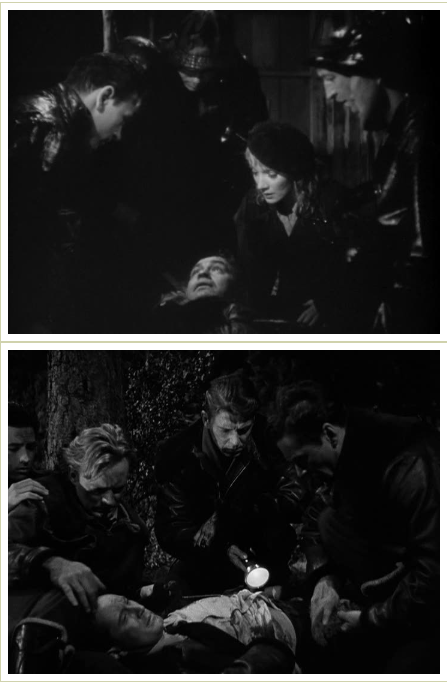
The images at the top present two communities of wisecracking men, and Marlene Dietrich, sending off one of their own. They are from Manpower and Desperate Journey, two mournful studies of male camaraderie. Manpower takes the love triangle (and Edward G. Robinson) from Howard Hawks’ Tiger Shark (1932) and moves it from a fishing village to the road crew for a power company. It’s there that Robinson and buddy George Raft tell tall tales about their amorous accomplishments with fellow boozers Alan Hale, Ward Bond and a group of other grinning mugs. Walsh packs the frame with group shots, of leering, laughing and impulsive men. They gather in semi-circles to trade quips, and end the film in the same group formations saying their final goodbyes.

Marlene Dietrich spends the time in between wisecracks sullenly vamping around Raft and Robinson, in love with the former and married to the latter. She is arresting in the luxurious slowness of her movements, a Josef Von Sternberg-taught dreaminess that seems out of place in the blunt realism and speed of Walsh’s world. The men are in constant overdrive, scampering up transformers to fix high voltage lines in shots of dizzying verticality. Even their diner’s waiter gets amped up, translating their orders into his own intricate lingo. He changes “a bottle of sherry” into “grapes of wrath in a sport jacket”, directly addressing the camera. It is Walsh reveling in working class argot, which he also privileged in Me and My Gal, where J. Farrell MacDonald faced the camera. Instead of this unique (male) mastery, at her wedding Dietrich is framed in between the two fake power grids on the cake, pinned and isolated in her seat.  She is entirely alone. In the top-most photo, Dietrich’s face glows under Ernest Haller’s cinematography, but Robinson’s gaze is irrevocably drawn to Raft’s. It is, as Hawks referred to A Girl in Every Port, a love story between two men.

Raoul Walsh described Desperate Journey in his autobiography as, “a war comedy spiced with enough tragedy to give it reality.” He seems to have it backwards. Shot with low-key lighting by Bert Glennon, it is a relentlessly grim-looking film that its characters face with disconcerting joviality. Errol Flynn is the rakish Flight Lt. Terry Forbes, who crash lands in Germany with a crew that includes Officer Johnny Hammond (Ronald Reagan), Sgt. Kirk Edwards (Alan Hale) and Officer Jed Forest (Arthur Kennedy). They are the former Robin Hood’s merry band of saboteurs, with Hale playing Little John as he did next to Flynn in 1938. He spits seeds at a Nazi prison guard and bellows his way through the epic chase scene that makes up the rest of the film.

The banter that lit up Manpower seems brittle here, forced. It papers over the “1 in 10,000 chance we get out of here”, as Forbes admits. Officer Forest is the realist who refuses to participate in the general raillery. He is, he tells Forbes, just there to do a job and get out, which is later echoed by a female resistance fighter. The male group is no longer a community, but a collection of individuals trying to survive a war, and the film tracks Forbes’ growing realization of this fact.  He begins as a traditional Errol Flynn hero, dashing blithely into danger and improvising a way out. But larger stakes are on the line, and Forrest’s pragmatism begins to infect Forbes, and in turn alters Flynn’s persona in his next few films with Walsh.

In Northern Pursuit, set in the snow white Northwest Territories of Canada, Flynn operates his undercover operation completely alone. He still maintains the dapper moustache while infiltrating a Nazi spy ring, but he’s otherwise cold and calculated. The narrative doesn’t have the normal oomph of a Walsh production, getting bogged down in exposition and failing to take full advantage of the spectacular snow-capped landscapes. Walsh placed Northern and Uncertain Glory along with Background to Danger as “three quickies” he knocked off after completing Gentleman Jim (1941).

Uncertain Glory has more than a passing interest, however. Here Flynn plays his most disreputable character, a thief and murderer in wartime Paris unconcerned with the fate of his countrymen. Arrested by a famed inspector played by Paul Lukas, he’s headed for the guillotine. The Nazis plan on executing 100 Frenchman, however, if a resistance fighter does not turn himself in. Flynn, doomed regardless, proposes to impersonate the saboteur for the preferable death by rifle fire. Filmed in suffocating close-ups and two shots, it’s an earnest, troubled bit of propaganda, in which Flynn offers various shades of guilt and self-absorption. A quickie, but a haunting one.

The Warner Bros. set closes with the monumental Objective, Burma!, an implacably brutal war procedural in which Walsh unleashes all of his plastic gifts. It follows an Army platoon as they are marooned in Burma following a successful demolition job. Hemmed in by Japanese forces, there is no way for them to escape except for a long, grueling hike. With the great lensman James Wong Howe, Walsh is constantly panning the camera, a visual roll call for each soldier. They are given thumbnail characterizations through brief physical tics, whether it’s fastidious nail clipping or a penchant for napping. There are no longer any attempts at the egalitarian community of Manpower – Errol Flynn’s Captain Nelson is more of a haggard motivational speaker, cajoling and halfheartedly inspiring his exhausted men into action.

But character is the least of the film’s concerns, it is interested mainly with process, how a parachute jump is executed, or a supply drop is triangulated. In this emphasis on the mechanics of labor, it finds many points of contact with The Big Trail. The attention to operational detail recalls the intricate way in which the covered wagons were winched down a sheer cliff face or forded across a river in his 1930 Western.

The metronomic regularity of the camera movement emphasizes the men who have been lost from its countdown. The shots grow shorter as the group is picked off one by one, culminating in a night-time shootout where the half-starved, dug-in troops look like gaunt prairie dogs. This final battle takes place in darkness, where an inadvertant rustle can equal death. A dissipating flare offers a few seconds of traditional battle (a similar sequence is found in Johnnie To’s recent Vengeance, where the moonlight hides behind the clouds and shrouds the fight in darkness), but then the enemy returns to being myth and rumor. It is, as Jean-Pierre Coursodon writes, “an awesome achievement”, Walsh at the peak of his technical mastery, and at his most resignedly individualist.

Postscript: In an unnecessary aside, I have to throw in one of my favorite quotes from Walsh’s unreliable but hugely entertaining autobiography, Each Man In His Time. Hanging out with Errol Flynn on the press tour for Objective, Burma!, Walsh relates that, “[Flynn] once told me that when he bought perfume for a present, he always inquired for Chanel number 10. ‘I don’t like my women to be only half sure.’”

LEARNING TO LOVE RAOUL WALSH

August 17, 2010

Screen Shot 2020-01-24 at 5.17.16 PM

Raoul Walsh was nothing if not adaptable. As a teenager, he tagged along with his uncle on a trading mission to Cuba and Mexico. The schooner was damaged in a storm and had a long layover in Vera Cruz. It was there, Walsh claimed, that he learned roping from a man he only knew as Ramirez, whom he paid in Cuban rum. He stayed ashore when the ship returned to NYC, and was soon hired as a cowboy to drive cattle into Texas. His accidentally gained expertise landed him a horse riding gig on Broadway (in a version of THE CLANSMAN, later filmed by D.W. Griffith as THE BIRTH OF A NATION, in which Walsh played John Wilkes Booth), and later got him hired at the Pathe Film Studios, who also needed a horseman. Once he was primed to break out as a leading man in IN OLD ARIZONA, a jackrabbit flew through his windshield, and the glass shards gouged out an eye (he was replaced by Warner Baxter). Hence his eyepatch, and his practically-minded move behind the camera.

Dave Kehr commented on on his blog, relating to his NY Times piece on the Errol Flynn Adventures box set that TCM released with Warner Bros., that “for me Walsh belongs with Ford and Hawks as one of the Big Three American directors, but there has been surprisingly little of substance written about him in English or in French.”  I felt I should be as practical as the director and take this as a sign to dig further into Walsh’s work. There was further discussion of how little he’s esteemed in the under-30 crowd, of which I’m a member for the next few months. And it’s undeniably true. I’ve never had a conversation about Walsh with anyone of my own age group.  So until I hit that magic number in February, I’ll be assessing and re-assessing his work, to find my way through Walsh’s massive filmography and hopefully spark further discussion about this major figure in film history.

Kehr’s erudite readers also took up the challenge, especially Blake Lucas, who wrote an essay-long breakdown of Walsh’s career. Spring 2011 promises a flood of material, with an essay on Walsh in Kehr’s eagerly awaited collection When Movies Mattered, and a forthcoming biography, Raoul Walsh: The True Adventures of Hollywood’s Legendary Director(University Press of Kentucky), by Marilyn Ann Moss. I’m adding my rather undigested thoughts here, and will contribute more in the coming weeks the more I see. I watched The Big Trail  (1930), The Strawberry Blonde (1941), Battle Cry (1955), and The Tall Men (1955) in quick succession with comment below, and my bits on Me and My Gal (1932) and Colorado Territory (1949) are here and here.

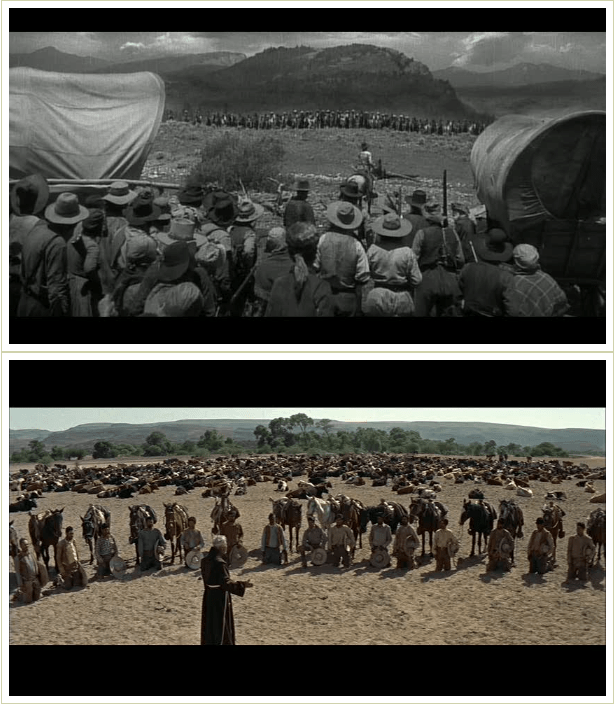
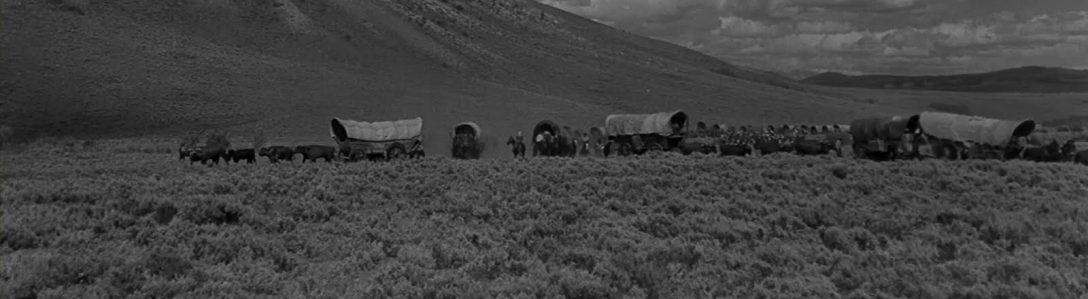
Walsh’s dynamic visual sense was as equally pragmatic as his upbringing. The stills above are from films 27 years apart, but his mastery of widescreen composition remains, whether in the 70mm Fox Grandeur format of The Big Trail, or the CinemaScope of The Tall Men. He composed in depth in arcing lines, framing his images to fit the horizontals of the format, instead of the more vertically oriented Academy Ratio that preceded and followed the box office failure of The Big Trail. The vertiginous conclusions of White Heat, High Sierra and Colorado Territory attest to his expertise in the latter. But when he had wide aspect ratios to deal with, he adapted: in his ‘Scope films his people die sideways. This might seem intuitive, but the clunky framings of early Scope experiments like The Robe, made 23 years after his commandingly wide Big Trail, shows how ahead of his time, and downright experimental his creatively practical approach was. These are images of beauty but also of narrative tension. John Wayne traverses the middle ground in the top image from Trail, caught as he is between his Native American friends and the covered wagon train he’s leading to Oregon. The crowds look like massed armies, and the centered mountain provides an ominous roadblock. But Wayne’s bright beige buckskin outfit cuts a deal and a way through.

The image from The Tall Men is less dramatic, a minor aside before the big drive to Montana. The group of vaqueros that Clark Gable hired takes a moment to pray as the cattle nap in the background. If Walsh’s heroes are “sustained by nothing more than a feeling for adventure”, as Sarris claimed, or what Kehr calls “runaway individualism”, this shot displays what this recklessness and freedom has put at stake: the lives of these pious men are on the line for these indolent cows. It is a tossed off moment of nobility for these nameless workers, whom Gable leads on an impossibly dangerous journey through Oglala Sioux territory. His Civil War colonel turned stick-up artist is once again a leader of men, and it brings riches and death.

Walsh’s men are truculently free spirits, and look for women of similar combativeness. For romantic relationships are as central to Walsh’s world as reckless  individuality. The tension between the two motors most of his work, echoing a quote from Johannes Brahms: “It is my misfortune still to be unmarried, thank God!”  The Strawberry Blonde and Battle Cry are almost exclusively concerned with this dilemma. James Cagney gives another irascible fireplug performance as Biff Grimes, a dentist and perpetual black-eye wearer. Giving remarkable detail to the speech (“that’s just the kind of hairpin I am”), clothes and bearing of lower middle-class immigrant strivers in the gay ’90s (the only richer milieu Walsh created was the 30s lower East Side of Me and My Gal), Walsh presents Biff as an all-American loser, and is one of his (and Cagney’s) most beautiful creations. Biff is quick to fight and quicker to hold a grudge, a mulish sap who contains deep reserves of dignity. He loves his lusty father, but falls hard for the measurable charms of Rita Hayworth’s social climber. Roped into being a wingman for his huckster-entrepeneur friend Hugo, he’s hooked into a date with Amy (Olivia de Havilland) instead, a budding suffragette who talks women’s rights on the first date, and who prefers to get just as frisky as the men. They are both odd fits for society, two weirdos who love running their mouths, getting into scrapes, nursing, and dentistry. So the most romantic scene in the film concludes in a tooth pull without anesthetic. It’s a hilarious, vengeful moment against Hugo, but also an inadvertent revelation of his own happiness with Amy. Love is laughter and the restraint of murderous impulses. I now place it alongside Me and My Gal as my favorite Walsh film.

Battle Cry is a war film that’s almost entirely about love affairs. Walsh keep eliding battles in order to return to town where Aldo Ray and Tab Hunter get entangled with conflicted ladies in San Diego and Wellington, New Zealand. It is a very strange film, a big-budget spectacular that eschews spectacle for moments in-between the fights. There are more shots of men sitting than shooting. It’s a case study for what Jean-Pierre Coursodon has called his “basically leisurely approach to filmmaking.” He slackens the normal pace of this WWII propaganda picture, made with the support of the U.S. Marines, to dig into one-night stands and poignant love affairs. Coursodon continues in his “American Directors” essay:

“when confronted with a war picture, and therefore a predominantly male cast, Walsh uses the flimsiest pretexts to sneak in as many women as possible. Most of Battle Cry’s 149 minutes’ running time is devoted to the likes of Mona Freeman, Nancy  Olson, Dorothy Malone, and Anne Francis pleasantly cavorting with their boyfriends in blissful oblivion of whatever is meant by the film’s title.”

It’s a film about raucous canteens, maudlin bars, and the chatter that fills it up. James Whitmore’s Captain complains that he couldn’t read Hamlet, because “he reminds me of an uncle of mine in Dayton.” Then there are the mournful wives, girlfriends, mothers and one-night stands who populate their off-hours, replacing the ghosts of their sons and lovers with the lonely, eager visages of new recruits. Some live and some die, there are break-ups and weddings, and Walsh doesn’t linger on any of it.

“The great traffic cop of the movies”, as Manny Farber called him, kept things moving, as the world went ahead without them. One of the most expressive shots for me was in The Big Trail, in which a covered wagon gets ripped downstream as it tries to ford a river.  There are no close-ups or dramatic music swells or star actors, just a family losing all they own. Then there’s a cut, and our hero must move on.

THE 30TH ANNIVERSARY OF AIRPLANE!

August 20, 2010

Screen Shot 2020-01-24 at 4.49.53 PM

On July 2nd, 1980, AIRPLANE! was released in the United States. For its 30th anniversary, the Film Society at Lincoln Center held a screening and a Q&A last night with directors and writers David Zucker, Jim Abrahams and Jerry Zucker (hereafter known as ZAZ). Ever since I stumbled out of THE NAKED GUN (1988) as a giddy seven-year-old, the ZAZ initials have been emblazoned in my consciousness, their screenplays replacing large chunks of my grey matter. I am not an impartial observer. But it wouldn’t be hyperbole to say that ZAZ’s peak equaled those of the Marx Brothers and Mel Brooks in the density of quality jokes-per-minute. Their approach was unique in that these comedies didn’t use comedians. Their laughs came from the cognitive dissonance of watching handsome leading men spout intricate absurdities. All of the performers play the straight man, while the writing is the star.

As Zucker put it, it was “as if we were taking real movies and re-dubbing them.”  (From my main source,  Robert J. Emery’s The Directors: Take One, Vol. 1) It is a constricted style, with little room for characterization or pathos. We are always laughing at these characters, rather than with the complicit guffaws of a Duck Soup. If the jokes fail, there is nothing left. But the ZAZ team was so relentlessly creative within these limitations that the strain never showed until Naked Gun 33 1/3 (1994), which I still treasure anyway.

Jerry and David Zucker grew up in the suburbs of Milwaukee, where their mother, David said, would “talk back to the TV and criticize what was going on. That’s kind of where the satire comes from.  She was an actress from the time she was five.” When they went to college, they started making jokey Super-8 movies, including one “about Jerry running around campus trying to find a place to leak.” (I urge Paramount to spend large amounts of money restoring this). After graduation, they hooked up with childhood friend Jim Abrahams, and in 1971 started up the Kentucky Fried Theater in the back of a Madison, Wisconsin bookstore.  Their blend of live improvisation with film and video skits landed in Los Angeles a year later, and became a cult hit.

Airplane! was the first screenplay ZAZ wrote, but they couldn’t sell it, so they adapted their stage show to the screen, and the Kentucky Fried Movie (1977), directed by John Landis, became a considerable success. Airplane! was next, the result of a fortuitous night of television:

We used to leave the video tape recorder on overnight just to catch the late movies and to get the commericals so we could re-dub later and spoof them in some way. One night we recorded a movie called Zero Hour. It’s a 1957 movie starring Dana Andrews, Linda Darnell and Sterling Hayden. It was one of those “airliner in trouble” movies.

With the series of Airport films topping the box office, ZAZ took Zero Hour as their template for a parody, making a remarkably faithful adaptation. At the Q&A ZAZ said they even mimicked the camera setups, needing all the shortcuts they could get as first-time directors.

Originally the structure was going to be the same as Kentucky Fried Movie, with spoof commercials breaking up the main feature, an airline disaster film. But the feature was getting such a positive reaction, they cut everything else out. Intent on making a film with the same feel as Zero Hour and other late night flicks they were watching, they hired Joseph Biroc as their DP (Robert Aldrich’s long time lensman, he would shoot …All the Marbles the following year), and Elmer Bernstein to do the score. When they told Bernstein that they wanted a B movie score, he deadpanned, “so you think I’m the right one for it?” After he guffawed throughout the test screening, David remembered, they knew they had the right man.

Next came the casting. David Zucker:

We were watching these Airport movies and thinking, “Charlton Heston is just too funny.” The trick was to cast serious actors like Robert Stack, Leslie Nielsen, Peter Graves and Lloyd Bridges. These were people who up to that time had never done comedy. We thought they were much funnier than the comedians of the time were.

Paramount originally pushed Barry Manilow for the Ted Striker role, but then reluctantly agreed to ZAZ’s plan for the leads. As a compromise, Paramount insisted on casting name comedians (Bill Murray, Chevy Chase, Robin Williams) in supporting roles.  During the Q&A at Lincoln Center, Jerry Zucker talked about how they kept this from happening. Their producer, Howard Koch, supported their decision to go with dramatic actors, so he would intentionally bomb the pitch, telling the comics that the script was “shit”. Jimmie Walker was the only star to sneak through their defenses: he cleans the plane’s windows before bouncing off the fuselage.

The actor most closely associated with ZAZ is Leslie Nielsen, but his part was originally offered to Vince Edwards, who turned them down, irrevocably changing the course of Nielsen’s career and my childhood (Jerry Zucker said they also pursued Charlton Heston and Jack Webb for different roles, to no avail). At that time, Nielsen was taking anodyne TV roles, and the studio told Zucker that he’s “the guy you hire the night before.” But Nielsen was eager to sign, telling his agent, “I don’t care if you have to pay them. I want to do this movie.”

Graves was the most reluctant, unsure of why he was being cast in a comedy. Here was Zucker’s pitch:

We told him it was going to be a new kind of comedy that didn’t rely on comedians but relied on the jokes and the seriousness of the characters and the absurdity of the situations. And the straighter he could play it the better it would be.

While this group of old professionals may have been wary, they got the job done, as usual. Of all of the straight men, Lloyd Bridges’ work still stands out. His air traffic controller, McCroskey, spoke with the speed and bravado of Lee Tracy from a 30s newspaper film like Blessed Event. It’s a performance of controlled mania that ZAZ gifts with some of their greatest riffs, including the “I guess I picked the wrong week to stop drinking” routine that Bridges snaps off with a growling panache. He’s also superb in the ZAZ spinoff Hot Shots as the absent-minded President, whose endearing idiocy now looks like a model of Will Ferrell’s buffoonish take on George W. Bush.

One of the greatest unsung performances in the spoof pantheon is Stephen Stucker’s Johnny, Bridges’  flamboyant assistant who is always ready with a sarcastic retort. In deference to his wit, ZAZ let Stucker, a Kentucky Fried Theater alum, write all of his own lines  – which still generate some of the biggest laughs in the movie. A whirligig of transgressive jollity, he could turn a weather map into a pterodactyl and impishly unplug the runway lights before an emergency landing. He’s a force of nature, the only actor ZAZ allows to be a comedian, mocking the proceedings from the inside. A legendary character, he was a classically trained pianist who showed up to his Kentucky Fried Theater interview in two-toned leather hot pants. Tragically, he was one of the first actors to announce he was suffering from HIV. He died in 1986 at the age of 38.

The other sublime work here is by Leslie Nielsen, as Dr. Rumack. He is perhaps the straightest man in film history. He paralyzes his facial muscles as much as his immovable silver hair – there is not even a hint of a smile or a glint of emotion. His eyes are glazed and serious, and rarely looks at anyone in the face. He prefers to tip his head up to gaze dramatically off camera. It is a turn of extraordinary woodenness, a solid oak of uninflected speech and metronomic movement. It is the Platonic ideal of ZAZ performances. Nielsen’s commitment to looking oblivious is unshakable, and that kind of perfection is beautiful, and forever funny. He would be nominated for an Emmy for a similarly flawless routine in Police Squad! (1982), ZAZ’s short lived cop show spoof that was canceled by ABC after six episodes. They were able to revive the concept for The Naked Gun six years later, which taught me how to boil a roast: “Very hot. And awfully wet.”

At the end of his late 90s interview with Robert Emery, David Zucker says, “I guess the test is if the movie still works twenty years later. We’ll see in a couple of years if it’s still funny.” Now it’s been over 30 years, and it’s still cracking me up.

Postscript: Top Secret (1984) is incredible too.