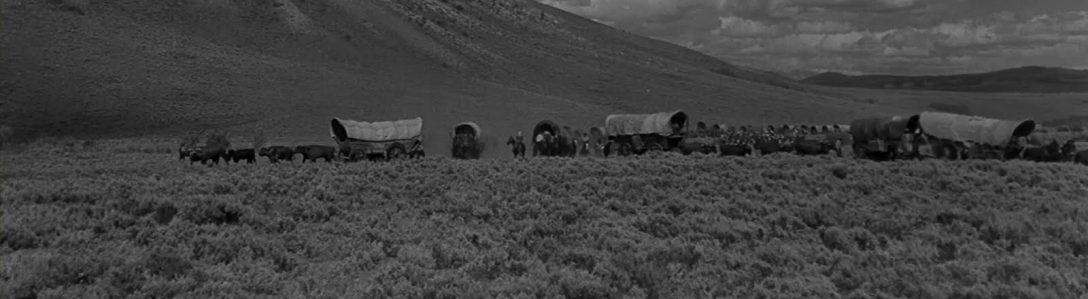
VCI. DVD. OMG.

September 7, 2010

vci

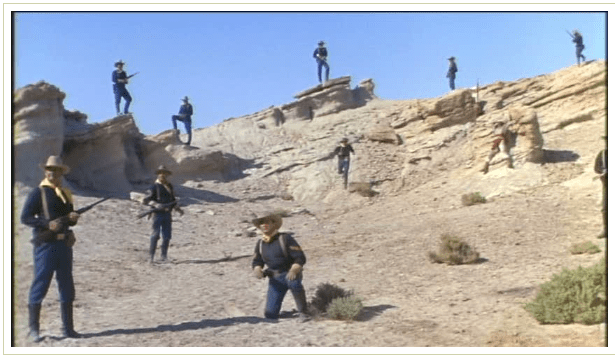
Last week VCI Entertainment released two obscure DVDs into the wild: William Witney’s Apache Rifles (1964, above) and Four in the Morning (1965), which features Judi Dench in her first leading role. Neither are deathless masterpieces, but each are valuable in their own inimitable way. Witney, a prolific director of movie serials for Republic Pictures (he specialized in Roy Rogers and Dick Tracy films, among scores of others), has a small (and growing) auteurist cult, receiving plaudits from Quentin Tarantino in recent years. In 2000, he told the NY Times that, “William Witney is ahead of them all, the one whose movies I can show to anyone and they are just blown away.”

A blunt descendant of The Searchers, it casts Audie Murphy as an Indian-hating U.S. Calvary Captain thrown into a moral quandary when he falls in love with a woman who is half Comanche. Making good use of the desert landscape, Witney starts off with wide shots during Murphy’s vengeful phase, and slowly closes in until the psychologically wrought final sequences take place in intimate two-shots. The first half is shoot outs, the second half fistfights (including a particularly brutal one with L.Q. Jones).

Released the same year as John Ford’s Cheyenne Autumn, Witney’s film is a smaller-budgeted effort to improve the representation of Native Americans on film, although the Apache “Red Hawk” is played by the Italian-American Michael Dante, and the unfortunate ending has him embracing the tribe’s forced relocation to Texas. But the rest of the film is a no-nonsense actioner that pragmatically diagnoses the causes of ethnic violence. That is, the Apache’s land equals money for the town’s miners, and so a higher standard of living for the community. So the “savagery” of the Native Americans is played up by the town leaders in order to provoke a fight. Murphy negotiated a truce with the Apaches mandating that work cease on the local mines, but it swiftly collapses when an Apache is falsely accused of murder. Self-interest always wins out.

Audie Murphy does not have the tools to navigate the minute psychological turns of his character – his bland handsomeness rather dulls the edge of his supposedly violent nature, tempering the drama of his shift in attitude to the Apaches. Witney surrounds him with capable bit players (Jones, Ken Lynch, Bob Brubaker), and matches cuts on action to keep things moving, a whirling film without a center.  To compare Murphy to John Wayne in The Searchers is to see the greatness of John Wayne.

Four in the Morning is a morose bit of British kitchen sink realism, following three tales of working class woe through a single evening. Judi Dench is a harried young mother tending to her wailing and teething infant while her husband gets loaded (she won the “Most Promising Newcomer” award at the BAFTAs). Ann Lynn plays a lonely nightclub gal who strolls the London docks with the eagerly flirtatious Brian Phelan, and they soon alienate each other with a series of power-shifting mind games. In between these two stories, director Anthony Simmons details the fate of a female corpse that washed ashore, documenting the bureaucratic wrangling to send her to the grave.

As a narrative it’s overdetermined and suffocatingly miserabilist, but the stark B&W images of the mud-spattered London ports by DP Larry Pizer subtly expresses the aimless malaise of its characters (Pizer also shot Mannequin 2: On the Move. It’s a job, after all). The scuffed top of the coffin that carries away the Jane Doe says far more, and carries more metaphorical weight, than the overwrought script. If Simmons trimmed the overly theatrical dialogue and let the camera speak, Four in the Morning might be known as more than a footnote in Dench’s career.

The only relationship between these two films is that, luckily, VCI got their industrious hands on them. Of the innumerable companies that release public domain titles, VCI is the only one to put care into their releases. Apache Rifles, as you can see, looks a bit soft, while Four in the Morning has nice sharpness, but exhibits some digital artifacts while in motion. But they are eminently watchable presentations, considering that VCI is dealing with original materials of questionable quality and working on a low budget. Apache Rifles is also festooned with an interview with Michael Dante, and a short, informative documentary about the film.

VCI started in 1961 as a non-theatrical booking company known as United Films, distributing studio titles to college campuses and ships at sea. In 1976 the owner/founder Bill Blair started up a division he named Video Communications, Inc., and they claim to be the first business to sell films directly to home theater owners. They clearly have a strong sense of film history, having also released Douglas Sirk’s Summer Storm and Lewis Milestone’s A Walk in the Sun earlier this year. A rescuer of orphaned films otherwise languishing in flickering boxes on YouTube, VCI is doing cinephilic yeoman’s work, and they should be thus honored.

RAOUL WALSH, ADVENTURER

August 31, 2010

Walsh3

For a man who toiled in the studio system for close to 50 years, cranking out genre quickies and prestige productions with equal aplomb, Raoul Walsh’s work remains astonishingly coherent. My grab-bag syle of viewing has made this resoundingly clear. This week I watched his earliest work, Regeneration (1915) and The Thief of Bagdad (1925) through two films he made in 1953: The Lawless Breed and Gun Fury. The above still is from Along the Great Divide, a spare, Oedipal Western from 1951. All of them, in one guise or another, deals with Walsh’s major concern, the benefits (freedom) and costs (self-absorption, loneliness) of individuality.

In Along the Great Divide (available from the Warner Archive), men are subsumed under vaulting rock formations, isolated and doomed. Kirk Douglas, in his first Western, plays a neurotic U.S. Marshal intent on protecting a cattle rustler accused of murder (Walter Brennan) from his would-be lynchers, and on bringing him to justice. He pushes his deputies as hard as his prisoners, eventually alienating all of them over a harsh drive through the desert. Douglas represses his world-devouring charisma into a bottled-up rage, unleashed only when a bemused, sardonic Brennan starts incessantly humming a tune, “Down In the Valley”, that the Marshal’s Dad used to sing, triggering unwelcome memories.

Filmed in the emptied out High Sierras and the Mojave desert, Walsh shoots his actors in long shots against the alien landscape, reduced to motile dots during shoot-outs. When he comes in close, people are breaking down. The group’s loyalties are in constant flux, and love affairs fall apart on the second half of a shot-countershot. After cooing over a sunset, Virginia Mayo turns a gun on Douglas, eager to save her father (Brennan) from the noose. Everyone acts out of base self-interest, and it is revealed that the Marshal’s obsessive fealty to the law is merely his guilt-ridden reaction to his failure to protect his father. There is a complete interpersonal breakdown, with every man and woman looking after their own interests. As Renoir famously said in the The Rules of the Game, “everyone has their reasons.”

The faces are the landscapes in his debut feature Regeneration (on DVD from Image), a raw urban melodrama of gang life on the lower east side of NYC. Walsh told Peter Bogdanovich:

…I got a thing called Regeneration, a gangster picture, which is right up my alley because I knew all those bloody gangster kids and everybody in in New York. …I went down around the waterfront and around the docks and into the saloons and got all kinds of gangster types, people with terrible faces, hiding in doorways.

In his autobiography he said that, “There were enough bums and winos around to cut down on extras.” Equipped with these authentic visages, Walsh produced a downbeat piece of  social realism that runs underneath the stock drama, a mixture of fiction and documentary that is being mined today by international auteurs like Lisandro Alonso and Pedro Costa (Dennis Lim has a fine overview of this contemporary trend). It tells the story of John McCann (the immortally named Rockliffe Fellowes), a kid whose parents abandon him to fend for himself on the poverty-stricken streets. He turns into a brutal young hood, who softens only under the glare of social worker Mamie Rose (Anna Q. Nilsson), who tries to reform him. As a Walshian hero, though, McCann can never entirely be domesticated, the lure of dissolute freedom is too great. For Walsh, it was a natural decision to use “real” people to fill the cast, a cost-cutting maneuver that also allowed him to film those “terrible faces” which attracted him so much.

Previously employed as an actor by D.W. Griffith, as John Wilkes Booth in A Birth of a Nation and a host of Biograph shorts, there is a strong influence in Regeneration from his mentor. Walsh remembers that he learned “not to allow leads to ‘eat up the scenery’ by overacting’ from him, and describes one of the final sequences of the film:  “I had the camera move in for a close-up in the best Billy Bitzer style.” The close-ups are extraodinary, intimate portraits that impede the story, unnecessary to the action but essential to understand the time and place. More is revealed in a shot of a tattered t-shirt on McCann’s drunken stepfather than any inter-title could convey. Poverty is portrayed matter-of-factly, without condescension or embellishment, and it is this oppressive sense of reality that lends Regeneration its sizable force.

The Thief of Bagdad (streaming on Netflix Instant)was a mega-production, and while it’s more of a triumph for set designer William Cameron Menzies and Douglas Fairbanks’ chest, it continues Walsh’s interest in outsiders, albeit in a brighter, more rakish tone than Regeneration or even Along the Great Divide. Fairbanks’ thief is a charming rogue, but a solitary one, getting tips from a variety of magical grotesques, but his feats of strength and wit are all accomplished alone.

Walsh made two westerns with Rock Hudson in 1953, which deal with opposing visions of masculinity. In The Lawless Breed (on Wesley Hardin escapes the religious strictures of his father, only to fall into the  life of an outlaw. While in Gun Fury (on DVD) Hudson is an upstanding type, a fumbling fiance forced into vengeance when his wife is kidnapped.

The Lawless Breed seems like a dry run for The Tall Men a few years later, as Hardin has a dream of owning a farm and living the quiet life, while his dancehall gal is skeptical. The same dynamic is present between Clark Gable and Jane Russell in the later film, but what they make playful and flirtatious is rendered stolid and melodramatic here. The creaking script makes excuses for all of Hardin’s murders, straining visibly to whitewash his character into a spotless hero. This pushes against Walsh’s instinct to problematize the heroic instinct, and the resulting film is an intriguing failure. The shootouts are crisp and well-staged, but there is no tension or shading in Hardin’s character, with little of the ambivalent violence of Gable, who is a shown as a thief in the opening shot of The Tall Men.

Hudson made Gun Fury with Walsh the same year, which was shot in 3D. It has the most inventive use of 3D technology I’ve seen, mainly in the use of depth effects, which he was already a master at in the lowly 2D format. But here images in the foreground gain a new solidity, with dust kicking up in front of our eyes as a horse cuts through the back third of the frame. There’s a density and volume to the images that is absent from the recent 3D cycle, achieved through the constant interplay between background and foreground that elasticizes the screen space.

Hudson plays Ben Warren, left for dead by a brutal gang who abscond with his wife-to-be Donna Reed. Warren is no fighter, getting gunned down while futzing with a shotgun, and accepts the help of a former member of the gang, and a Native American who had suffered at their hand. The narrative is sleek and focused, pushing Warren forward even when he’d rather not, an accidental hero who’s not very good at his role.

For now, this will be my last post on Walsh, and it’s been nothing less than a revelation for me. His “invisible” style is never less than expressive, from the heights of Manpower to the lengths of the ‘Scope Tall Men, he has an instinctual touch for how to pack his frames for maximum dramatic impact. His heroes are bruised, his women are cynical, but when Walsh alights on a rich vein of dialect (Me and My Gal, Strawberry Blonde), he can be downright hilarious. He’s a shifting target, but I’m in the beginning stages of tracking him down.

RAOUL WALSH’S GROUP THERAPY

August 24, 2010

walsh2

My  hopscotching education in Raoul Walsh skitters on this week, with five gut-punching thrillers. I’m jumping through his career haphazardly, watching whatever I can easily acquire. Last week led me from 1930 to 1955, but today I’m mired in the 1940s, thanks to the Warner Bros.-TCM box set, Errol Flynn Adventures (feel free to ignore this post if you think the TCM branding compromises my objectivity).  Along with Lewis Milestone’s Edge of Darkness, it includes the Walsh-directed Desperate Journey (1942), Northern Pursuit (1943), Uncertain Glory (1944) and Objective, Burma! (1945). I supplemented these with the Warner Archive disc of Manpower (1941).

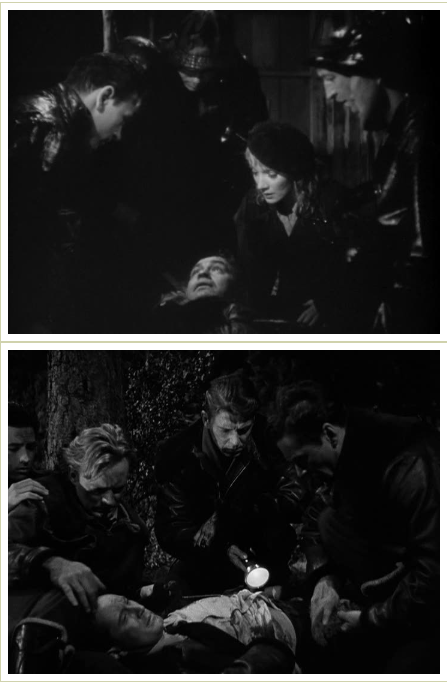
The images at the top present two communities of wisecracking men, and Marlene Dietrich, sending off one of their own. They are from Manpower and Desperate Journey, two mournful studies of male camaraderie. Manpower takes the love triangle (and Edward G. Robinson) from Howard Hawks’ Tiger Shark (1932) and moves it from a fishing village to the road crew for a power company. It’s there that Robinson and buddy George Raft tell tall tales about their amorous accomplishments with fellow boozers Alan Hale, Ward Bond and a group of other grinning mugs. Walsh packs the frame with group shots, of leering, laughing and impulsive men. They gather in semi-circles to trade quips, and end the film in the same group formations saying their final goodbyes.

Marlene Dietrich spends the time in between wisecracks sullenly vamping around Raft and Robinson, in love with the former and married to the latter. She is arresting in the luxurious slowness of her movements, a Josef Von Sternberg-taught dreaminess that seems out of place in the blunt realism and speed of Walsh’s world. The men are in constant overdrive, scampering up transformers to fix high voltage lines in shots of dizzying verticality. Even their diner’s waiter gets amped up, translating their orders into his own intricate lingo. He changes “a bottle of sherry” into “grapes of wrath in a sport jacket”, directly addressing the camera. It is Walsh reveling in working class argot, which he also privileged in Me and My Gal, where J. Farrell MacDonald faced the camera. Instead of this unique (male) mastery, at her wedding Dietrich is framed in between the two fake power grids on the cake, pinned and isolated in her seat.  She is entirely alone. In the top-most photo, Dietrich’s face glows under Ernest Haller’s cinematography, but Robinson’s gaze is irrevocably drawn to Raft’s. It is, as Hawks referred to A Girl in Every Port, a love story between two men.

Raoul Walsh described Desperate Journey in his autobiography as, “a war comedy spiced with enough tragedy to give it reality.” He seems to have it backwards. Shot with low-key lighting by Bert Glennon, it is a relentlessly grim-looking film that its characters face with disconcerting joviality. Errol Flynn is the rakish Flight Lt. Terry Forbes, who crash lands in Germany with a crew that includes Officer Johnny Hammond (Ronald Reagan), Sgt. Kirk Edwards (Alan Hale) and Officer Jed Forest (Arthur Kennedy). They are the former Robin Hood’s merry band of saboteurs, with Hale playing Little John as he did next to Flynn in 1938. He spits seeds at a Nazi prison guard and bellows his way through the epic chase scene that makes up the rest of the film.

The banter that lit up Manpower seems brittle here, forced. It papers over the “1 in 10,000 chance we get out of here”, as Forbes admits. Officer Forest is the realist who refuses to participate in the general raillery. He is, he tells Forbes, just there to do a job and get out, which is later echoed by a female resistance fighter. The male group is no longer a community, but a collection of individuals trying to survive a war, and the film tracks Forbes’ growing realization of this fact.  He begins as a traditional Errol Flynn hero, dashing blithely into danger and improvising a way out. But larger stakes are on the line, and Forrest’s pragmatism begins to infect Forbes, and in turn alters Flynn’s persona in his next few films with Walsh.

In Northern Pursuit, set in the snow white Northwest Territories of Canada, Flynn operates his undercover operation completely alone. He still maintains the dapper moustache while infiltrating a Nazi spy ring, but he’s otherwise cold and calculated. The narrative doesn’t have the normal oomph of a Walsh production, getting bogged down in exposition and failing to take full advantage of the spectacular snow-capped landscapes. Walsh placed Northern and Uncertain Glory along with Background to Danger as “three quickies” he knocked off after completing Gentleman Jim (1941).

Uncertain Glory has more than a passing interest, however. Here Flynn plays his most disreputable character, a thief and murderer in wartime Paris unconcerned with the fate of his countrymen. Arrested by a famed inspector played by Paul Lukas, he’s headed for the guillotine. The Nazis plan on executing 100 Frenchman, however, if a resistance fighter does not turn himself in. Flynn, doomed regardless, proposes to impersonate the saboteur for the preferable death by rifle fire. Filmed in suffocating close-ups and two shots, it’s an earnest, troubled bit of propaganda, in which Flynn offers various shades of guilt and self-absorption. A quickie, but a haunting one.

The Warner Bros. set closes with the monumental Objective, Burma!, an implacably brutal war procedural in which Walsh unleashes all of his plastic gifts. It follows an Army platoon as they are marooned in Burma following a successful demolition job. Hemmed in by Japanese forces, there is no way for them to escape except for a long, grueling hike. With the great lensman James Wong Howe, Walsh is constantly panning the camera, a visual roll call for each soldier. They are given thumbnail characterizations through brief physical tics, whether it’s fastidious nail clipping or a penchant for napping. There are no longer any attempts at the egalitarian community of Manpower – Errol Flynn’s Captain Nelson is more of a haggard motivational speaker, cajoling and halfheartedly inspiring his exhausted men into action.

But character is the least of the film’s concerns, it is interested mainly with process, how a parachute jump is executed, or a supply drop is triangulated. In this emphasis on the mechanics of labor, it finds many points of contact with The Big Trail. The attention to operational detail recalls the intricate way in which the covered wagons were winched down a sheer cliff face or forded across a river in his 1930 Western.

The metronomic regularity of the camera movement emphasizes the men who have been lost from its countdown. The shots grow shorter as the group is picked off one by one, culminating in a night-time shootout where the half-starved, dug-in troops look like gaunt prairie dogs. This final battle takes place in darkness, where an inadvertant rustle can equal death. A dissipating flare offers a few seconds of traditional battle (a similar sequence is found in Johnnie To’s recent Vengeance, where the moonlight hides behind the clouds and shrouds the fight in darkness), but then the enemy returns to being myth and rumor. It is, as Jean-Pierre Coursodon writes, “an awesome achievement”, Walsh at the peak of his technical mastery, and at his most resignedly individualist.

Postscript: In an unnecessary aside, I have to throw in one of my favorite quotes from Walsh’s unreliable but hugely entertaining autobiography, Each Man In His Time. Hanging out with Errol Flynn on the press tour for Objective, Burma!, Walsh relates that, “[Flynn] once told me that when he bought perfume for a present, he always inquired for Chanel number 10. ‘I don’t like my women to be only half sure.’”

LEARNING TO LOVE RAOUL WALSH

August 17, 2010

Screen Shot 2020-01-24 at 5.17.16 PM

Raoul Walsh was nothing if not adaptable. As a teenager, he tagged along with his uncle on a trading mission to Cuba and Mexico. The schooner was damaged in a storm and had a long layover in Vera Cruz. It was there, Walsh claimed, that he learned roping from a man he only knew as Ramirez, whom he paid in Cuban rum. He stayed ashore when the ship returned to NYC, and was soon hired as a cowboy to drive cattle into Texas. His accidentally gained expertise landed him a horse riding gig on Broadway (in a version of THE CLANSMAN, later filmed by D.W. Griffith as THE BIRTH OF A NATION, in which Walsh played John Wilkes Booth), and later got him hired at the Pathe Film Studios, who also needed a horseman. Once he was primed to break out as a leading man in IN OLD ARIZONA, a jackrabbit flew through his windshield, and the glass shards gouged out an eye (he was replaced by Warner Baxter). Hence his eyepatch, and his practically-minded move behind the camera.

Dave Kehr commented on on his blog, relating to his NY Times piece on the Errol Flynn Adventures box set that TCM released with Warner Bros., that “for me Walsh belongs with Ford and Hawks as one of the Big Three American directors, but there has been surprisingly little of substance written about him in English or in French.”  I felt I should be as practical as the director and take this as a sign to dig further into Walsh’s work. There was further discussion of how little he’s esteemed in the under-30 crowd, of which I’m a member for the next few months. And it’s undeniably true. I’ve never had a conversation about Walsh with anyone of my own age group.  So until I hit that magic number in February, I’ll be assessing and re-assessing his work, to find my way through Walsh’s massive filmography and hopefully spark further discussion about this major figure in film history.

Kehr’s erudite readers also took up the challenge, especially Blake Lucas, who wrote an essay-long breakdown of Walsh’s career. Spring 2011 promises a flood of material, with an essay on Walsh in Kehr’s eagerly awaited collection When Movies Mattered, and a forthcoming biography, Raoul Walsh: The True Adventures of Hollywood’s Legendary Director(University Press of Kentucky), by Marilyn Ann Moss. I’m adding my rather undigested thoughts here, and will contribute more in the coming weeks the more I see. I watched The Big Trail  (1930), The Strawberry Blonde (1941), Battle Cry (1955), and The Tall Men (1955) in quick succession with comment below, and my bits on Me and My Gal (1932) and Colorado Territory (1949) are here and here.

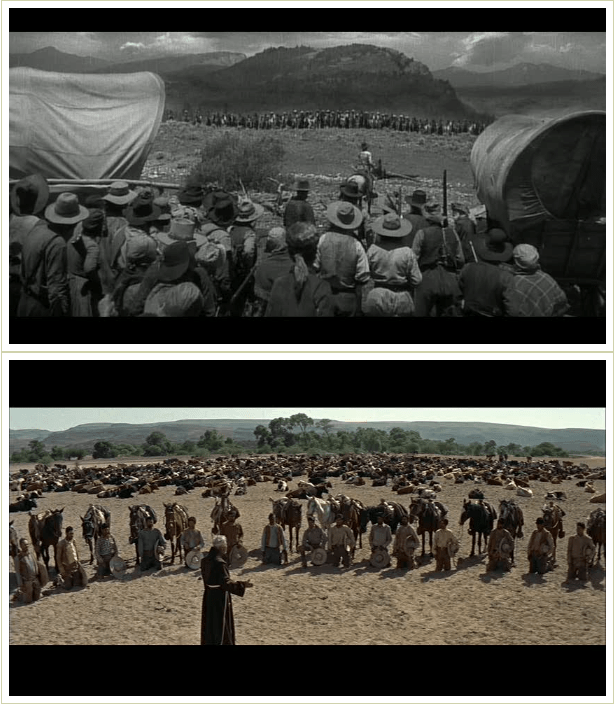
Walsh’s dynamic visual sense was as equally pragmatic as his upbringing. The stills above are from films 27 years apart, but his mastery of widescreen composition remains, whether in the 70mm Fox Grandeur format of The Big Trail, or the CinemaScope of The Tall Men. He composed in depth in arcing lines, framing his images to fit the horizontals of the format, instead of the more vertically oriented Academy Ratio that preceded and followed the box office failure of The Big Trail. The vertiginous conclusions of White Heat, High Sierra and Colorado Territory attest to his expertise in the latter. But when he had wide aspect ratios to deal with, he adapted: in his ‘Scope films his people die sideways. This might seem intuitive, but the clunky framings of early Scope experiments like The Robe, made 23 years after his commandingly wide Big Trail, shows how ahead of his time, and downright experimental his creatively practical approach was. These are images of beauty but also of narrative tension. John Wayne traverses the middle ground in the top image from Trail, caught as he is between his Native American friends and the covered wagon train he’s leading to Oregon. The crowds look like massed armies, and the centered mountain provides an ominous roadblock. But Wayne’s bright beige buckskin outfit cuts a deal and a way through.

The image from The Tall Men is less dramatic, a minor aside before the big drive to Montana. The group of vaqueros that Clark Gable hired takes a moment to pray as the cattle nap in the background. If Walsh’s heroes are “sustained by nothing more than a feeling for adventure”, as Sarris claimed, or what Kehr calls “runaway individualism”, this shot displays what this recklessness and freedom has put at stake: the lives of these pious men are on the line for these indolent cows. It is a tossed off moment of nobility for these nameless workers, whom Gable leads on an impossibly dangerous journey through Oglala Sioux territory. His Civil War colonel turned stick-up artist is once again a leader of men, and it brings riches and death.

Walsh’s men are truculently free spirits, and look for women of similar combativeness. For romantic relationships are as central to Walsh’s world as reckless  individuality. The tension between the two motors most of his work, echoing a quote from Johannes Brahms: “It is my misfortune still to be unmarried, thank God!”  The Strawberry Blonde and Battle Cry are almost exclusively concerned with this dilemma. James Cagney gives another irascible fireplug performance as Biff Grimes, a dentist and perpetual black-eye wearer. Giving remarkable detail to the speech (“that’s just the kind of hairpin I am”), clothes and bearing of lower middle-class immigrant strivers in the gay ’90s (the only richer milieu Walsh created was the 30s lower East Side of Me and My Gal), Walsh presents Biff as an all-American loser, and is one of his (and Cagney’s) most beautiful creations. Biff is quick to fight and quicker to hold a grudge, a mulish sap who contains deep reserves of dignity. He loves his lusty father, but falls hard for the measurable charms of Rita Hayworth’s social climber. Roped into being a wingman for his huckster-entrepeneur friend Hugo, he’s hooked into a date with Amy (Olivia de Havilland) instead, a budding suffragette who talks women’s rights on the first date, and who prefers to get just as frisky as the men. They are both odd fits for society, two weirdos who love running their mouths, getting into scrapes, nursing, and dentistry. So the most romantic scene in the film concludes in a tooth pull without anesthetic. It’s a hilarious, vengeful moment against Hugo, but also an inadvertent revelation of his own happiness with Amy. Love is laughter and the restraint of murderous impulses. I now place it alongside Me and My Gal as my favorite Walsh film.

Battle Cry is a war film that’s almost entirely about love affairs. Walsh keep eliding battles in order to return to town where Aldo Ray and Tab Hunter get entangled with conflicted ladies in San Diego and Wellington, New Zealand. It is a very strange film, a big-budget spectacular that eschews spectacle for moments in-between the fights. There are more shots of men sitting than shooting. It’s a case study for what Jean-Pierre Coursodon has called his “basically leisurely approach to filmmaking.” He slackens the normal pace of this WWII propaganda picture, made with the support of the U.S. Marines, to dig into one-night stands and poignant love affairs. Coursodon continues in his “American Directors” essay:

“when confronted with a war picture, and therefore a predominantly male cast, Walsh uses the flimsiest pretexts to sneak in as many women as possible. Most of Battle Cry’s 149 minutes’ running time is devoted to the likes of Mona Freeman, Nancy  Olson, Dorothy Malone, and Anne Francis pleasantly cavorting with their boyfriends in blissful oblivion of whatever is meant by the film’s title.”

It’s a film about raucous canteens, maudlin bars, and the chatter that fills it up. James Whitmore’s Captain complains that he couldn’t read Hamlet, because “he reminds me of an uncle of mine in Dayton.” Then there are the mournful wives, girlfriends, mothers and one-night stands who populate their off-hours, replacing the ghosts of their sons and lovers with the lonely, eager visages of new recruits. Some live and some die, there are break-ups and weddings, and Walsh doesn’t linger on any of it.

“The great traffic cop of the movies”, as Manny Farber called him, kept things moving, as the world went ahead without them. One of the most expressive shots for me was in The Big Trail, in which a covered wagon gets ripped downstream as it tries to ford a river.  There are no close-ups or dramatic music swells or star actors, just a family losing all they own. Then there’s a cut, and our hero must move on.

THE 30TH ANNIVERSARY OF AIRPLANE!

August 20, 2010

Screen Shot 2020-01-24 at 4.49.53 PM

On July 2nd, 1980, AIRPLANE! was released in the United States. For its 30th anniversary, the Film Society at Lincoln Center held a screening and a Q&A last night with directors and writers David Zucker, Jim Abrahams and Jerry Zucker (hereafter known as ZAZ). Ever since I stumbled out of THE NAKED GUN (1988) as a giddy seven-year-old, the ZAZ initials have been emblazoned in my consciousness, their screenplays replacing large chunks of my grey matter. I am not an impartial observer. But it wouldn’t be hyperbole to say that ZAZ’s peak equaled those of the Marx Brothers and Mel Brooks in the density of quality jokes-per-minute. Their approach was unique in that these comedies didn’t use comedians. Their laughs came from the cognitive dissonance of watching handsome leading men spout intricate absurdities. All of the performers play the straight man, while the writing is the star.

As Zucker put it, it was “as if we were taking real movies and re-dubbing them.”  (From my main source,  Robert J. Emery’s The Directors: Take One, Vol. 1) It is a constricted style, with little room for characterization or pathos. We are always laughing at these characters, rather than with the complicit guffaws of a Duck Soup. If the jokes fail, there is nothing left. But the ZAZ team was so relentlessly creative within these limitations that the strain never showed until Naked Gun 33 1/3 (1994), which I still treasure anyway.

Jerry and David Zucker grew up in the suburbs of Milwaukee, where their mother, David said, would “talk back to the TV and criticize what was going on. That’s kind of where the satire comes from.  She was an actress from the time she was five.” When they went to college, they started making jokey Super-8 movies, including one “about Jerry running around campus trying to find a place to leak.” (I urge Paramount to spend large amounts of money restoring this). After graduation, they hooked up with childhood friend Jim Abrahams, and in 1971 started up the Kentucky Fried Theater in the back of a Madison, Wisconsin bookstore.  Their blend of live improvisation with film and video skits landed in Los Angeles a year later, and became a cult hit.

Airplane! was the first screenplay ZAZ wrote, but they couldn’t sell it, so they adapted their stage show to the screen, and the Kentucky Fried Movie (1977), directed by John Landis, became a considerable success. Airplane! was next, the result of a fortuitous night of television:

We used to leave the video tape recorder on overnight just to catch the late movies and to get the commericals so we could re-dub later and spoof them in some way. One night we recorded a movie called Zero Hour. It’s a 1957 movie starring Dana Andrews, Linda Darnell and Sterling Hayden. It was one of those “airliner in trouble” movies.

With the series of Airport films topping the box office, ZAZ took Zero Hour as their template for a parody, making a remarkably faithful adaptation. At the Q&A ZAZ said they even mimicked the camera setups, needing all the shortcuts they could get as first-time directors.

Originally the structure was going to be the same as Kentucky Fried Movie, with spoof commercials breaking up the main feature, an airline disaster film. But the feature was getting such a positive reaction, they cut everything else out. Intent on making a film with the same feel as Zero Hour and other late night flicks they were watching, they hired Joseph Biroc as their DP (Robert Aldrich’s long time lensman, he would shoot …All the Marbles the following year), and Elmer Bernstein to do the score. When they told Bernstein that they wanted a B movie score, he deadpanned, “so you think I’m the right one for it?” After he guffawed throughout the test screening, David remembered, they knew they had the right man.

Next came the casting. David Zucker:

We were watching these Airport movies and thinking, “Charlton Heston is just too funny.” The trick was to cast serious actors like Robert Stack, Leslie Nielsen, Peter Graves and Lloyd Bridges. These were people who up to that time had never done comedy. We thought they were much funnier than the comedians of the time were.

Paramount originally pushed Barry Manilow for the Ted Striker role, but then reluctantly agreed to ZAZ’s plan for the leads. As a compromise, Paramount insisted on casting name comedians (Bill Murray, Chevy Chase, Robin Williams) in supporting roles.  During the Q&A at Lincoln Center, Jerry Zucker talked about how they kept this from happening. Their producer, Howard Koch, supported their decision to go with dramatic actors, so he would intentionally bomb the pitch, telling the comics that the script was “shit”. Jimmie Walker was the only star to sneak through their defenses: he cleans the plane’s windows before bouncing off the fuselage.

The actor most closely associated with ZAZ is Leslie Nielsen, but his part was originally offered to Vince Edwards, who turned them down, irrevocably changing the course of Nielsen’s career and my childhood (Jerry Zucker said they also pursued Charlton Heston and Jack Webb for different roles, to no avail). At that time, Nielsen was taking anodyne TV roles, and the studio told Zucker that he’s “the guy you hire the night before.” But Nielsen was eager to sign, telling his agent, “I don’t care if you have to pay them. I want to do this movie.”

Graves was the most reluctant, unsure of why he was being cast in a comedy. Here was Zucker’s pitch:

We told him it was going to be a new kind of comedy that didn’t rely on comedians but relied on the jokes and the seriousness of the characters and the absurdity of the situations. And the straighter he could play it the better it would be.

While this group of old professionals may have been wary, they got the job done, as usual. Of all of the straight men, Lloyd Bridges’ work still stands out. His air traffic controller, McCroskey, spoke with the speed and bravado of Lee Tracy from a 30s newspaper film like Blessed Event. It’s a performance of controlled mania that ZAZ gifts with some of their greatest riffs, including the “I guess I picked the wrong week to stop drinking” routine that Bridges snaps off with a growling panache. He’s also superb in the ZAZ spinoff Hot Shots as the absent-minded President, whose endearing idiocy now looks like a model of Will Ferrell’s buffoonish take on George W. Bush.

One of the greatest unsung performances in the spoof pantheon is Stephen Stucker’s Johnny, Bridges’  flamboyant assistant who is always ready with a sarcastic retort. In deference to his wit, ZAZ let Stucker, a Kentucky Fried Theater alum, write all of his own lines  – which still generate some of the biggest laughs in the movie. A whirligig of transgressive jollity, he could turn a weather map into a pterodactyl and impishly unplug the runway lights before an emergency landing. He’s a force of nature, the only actor ZAZ allows to be a comedian, mocking the proceedings from the inside. A legendary character, he was a classically trained pianist who showed up to his Kentucky Fried Theater interview in two-toned leather hot pants. Tragically, he was one of the first actors to announce he was suffering from HIV. He died in 1986 at the age of 38.

The other sublime work here is by Leslie Nielsen, as Dr. Rumack. He is perhaps the straightest man in film history. He paralyzes his facial muscles as much as his immovable silver hair – there is not even a hint of a smile or a glint of emotion. His eyes are glazed and serious, and rarely looks at anyone in the face. He prefers to tip his head up to gaze dramatically off camera. It is a turn of extraordinary woodenness, a solid oak of uninflected speech and metronomic movement. It is the Platonic ideal of ZAZ performances. Nielsen’s commitment to looking oblivious is unshakable, and that kind of perfection is beautiful, and forever funny. He would be nominated for an Emmy for a similarly flawless routine in Police Squad! (1982), ZAZ’s short lived cop show spoof that was canceled by ABC after six episodes. They were able to revive the concept for The Naked Gun six years later, which taught me how to boil a roast: “Very hot. And awfully wet.”

At the end of his late 90s interview with Robert Emery, David Zucker says, “I guess the test is if the movie still works twenty years later. We’ll see in a couple of years if it’s still funny.” Now it’s been over 30 years, and it’s still cracking me up.

Postscript: Top Secret (1984) is incredible too.

WOODY STRODE AND SERGEANT RUTLEDGE (1960)

Originally published at Movie Morlocks, the official blog of Turner Classic Movies

August 3, 2010

Screen Shot 2020-01-24 at 4.41.33 PM

When John Ford decided to cast Woody Strode in the title role of Sergeant Rutledge, Warner Bros.  pleaded with him to cast a better known actor like Sidney Poitier or Harry Belafonte. Ford replied, “They aren’t tough enough.” That story, relayed by Joseph McBride in his Searching for John Ford biography, defines the mystique of Woodrow Wilson Woolwine Strode. With his taciturn manner and wiry athleticism, he was an immediately arresting presence on-screen. He brought more than an intimidating physicality though, secreting a constant melancholy behind those hooded eyes and chiseled face.

His tough-guy credentials were unassailable. He was a tight end at UCLA, blocking for star running back Kenny Washington. In their senior year of 1939, they shared the field with Jackie Robinson (they were called  “The Gold Dust Trio”) and went undefeated, ranking 7th in the year-end AP poll. But in the years immediately following graduation, they were blocked from joining the NFL because of their race. From 1934 – 1946, there was a gentlemen’s agreement of sorts between league owners not to sign black athletes, despite the success of players like Fritz Pollard in the ’20s.  In the prime of their careers, Strode and Washington played for the Hollywood Bears of the Pacific Coast Football League (PCFL).  In 1946, they broke the re-instated NFL color barrier by signing with the L.A. Rams after an intense campaign by sportswriter William Harding. (for the full story, read Alexander Wolff’s great article in Sports Illustrated). Strode told Wolff, “They didn’t take Kenny because of his ability. They didn’t take me on my ability. It was shoved down their throats.”

Strode was already 32 years old, and he was cut after one forgettable season (Pro Football Reference shows he played in 10 games, and caught only 4 passes, although he was probably a solid blocker). Washington lasted for three intermittently productive years. It was a disillusioning experience:

“Integrating the NFL was the low point of my life,” Strode told SI in an unpublished interview before his death. “There was nothing nice about it. History doesn’t know who we are. Kenny was one of the greatest backs in the history of the game, and kids today have no idea who he is.”
“If I have to integrate heaven, I don’t want to go.”

In 1948, he moved to the Canadian Football League (CFL), to greater success. Playing both offense and defense, he led the Calgary Stampeders over the Ottawa Roughriders to win the Grey Cup, 12 – 7. He played for two more years, and helped pay the bills by working as a professional wrestler during the offseason.

By 1951, he was ‘rasslin full time. In his autobiography, Goal Dust, he reminisced about balancing fighting and entertainment:

It’s a thin line between the showmanship and the straight wrestling. Straight wrestling is too dull. If I’ve got a headlock on you and stop your circulation, you’ll faint. They fans won’t pay to see that. The real artists can hit you without doing any damage. They can throw a punch and land it right on your skin. That’s how good you have to be. The guys who miss are not good.

While honing his acting skills in the ring, he started to get regular work on television and film as an exotic other, his first regular gig a stint on “Ramar of the Jungle” as a native named “Big Boy”.  His film work was more of the same stereotyped nonsense until he nabbed a part in Lewis Milestone’s Pork Chop Hill in 1959. It was on that set where he caught John Ford’s eye, as told to Frank Manchel, excerpted in Volume 25, Vol. 2 of The Black Scholar:

[Pork Chop Hill] is the first dramatic thing that I had done, and he [Ford] was on the same lot with me, and he sent his chauffer over to find me. So I went over to see him, and he says, ‘I hear you’re trying to be an actor.’ At that point I was wrestling for a living, and I said, ‘Oh, I’m just making a little money.’ He said, ‘I’ll tell you what, Woody. I got a little job for you, and I’ll tell you about it when I get through with this picture I’m doing.

Ford was finishing up The Horse Soldiers (1959), and in the meantime Strode caught bit parts in Spartacus (1960) and The Last Voyage (1960). Eventually Ford, who always referred to his profession as a “job of work”, must have admired Strode’s similar attitude, handed him the title role to Sergeant Rutledge.  For contractual reasons, Jeffrey Hunter and Constance Towers were given lead billing, while Strode was merely listed as a featured player, but he is the heart and soul of the film. It is a courtroom drama that documents the court-martial trial of Sergeant Braxton Rutledge, an officer in the Ninth Cavalry Regiment (nicknamed the “Buffalo Soldiers”), accused of the rape and murder of a white teenage girl (Toby Richards) and her father, his superior officer. Hunter is the earnest, conflicted defense lawyer who argues the case in front of the distracted, buffoonish panel of Army judges.

The script, by James Warner Bellah and Willis Goldbeck, was inspired by a Frederic Remington picture “of black calvarymen on the western frontier.” Without access to their first draft, Joseph McBride reports on Bellah’s novelization of the film as “patronizing”, and that “Rutledge seems less intelligent in the book than he does on-screen, and the author finds a familiar outlet for his prurient racist fantasizing….” Suffice it to say that Ford made major revisions to the screenplay before it was finalized – McBride reports he spent ten days with the writers fixing it up. Strode remembers the script fondly: “it was so well written…. When I say them lines, I still feel it. Do you hear me?”

It is Ford’s most straightforward film about race, placing Strode’s soldier as a good worker (his highest compliment) railroaded  by a justice system riven by bigotry. But there is ambivalence threaded throughout Sergeant Rutledge that makes it much more than a simple message movie. It is clear Ford is making a case for racial equality, but beyond the conclusion of this one individual case, he doesn’t offer much hope. The panel of judges are amusing but clueless drunks, the lead prosecutor a race baiter, and the Buffalo Soldiers themselves despair as to their place in society. As Moffat, one of the 9th Regiment, is dying, he tells Rutledge, “Some day. You always talkin’ about some day, like it gonna be Promised Land here on earth. Brax! We’re fools to fight the white…white man’s war.”

Rutledge tries to reassure him that they are not fighting the white man’s war, but that they fight in order “to make us proud.” Ford’s grand theme had always been about building communities (the church-raising scene in My Darling Clementine is the peak of this strain), but there was a skepticism regarding official institutions that ran throughout (the sheriff at the beginning of Clementine is a coward), but he found men who could do their jobs in spite of it all. The 9th regiment is not sacrificing their lives for the United States, but for their self-respect, and in this sense falls in line with the tension in Ford’s work between the individual and the community that he’d been mining his entire career. Earp leaves town at the end of Clementine, leaving the civilizing to others, but Rutledge soldiers on in order to empower more young black men. In his most dramatic speech, and probably the finest piece of acting he put on film, Strode responds to the prosecutor’s goading about his refusal to desert. It was “because the Ninth Cavalry was my home. My real freedom. And my self-respect. And the way I was desertin’ it, I wasn’t nothing but a swamp-runnin’ ni**er. And I ain’t that! Do you hear me? I’m a man.”

In collaboration with the great cinematographer Bert Glennon (Stagecoach, Wagon Master), Ford shoots Strode from dramatic low angles and pushes the artifice to an expressionist degree during the witness’s flashback testimony. It is Ford’s most theatrical film, or at least the most self-reflexively artificial, allowing him to shoot heroic shots of Strode that might have made John Wayne blush. There are some shots that look like Strode is posed in front of a moonlight drenched Casper David Friedrich painting.

But the most telling sequences come at the end. After the rote romantic clinch between Jeffrey Hunter and Constance Towers is finished outside the courthouse, the Buffalo Soldiers march in formation past them, and towards the camera. It is a remarkable hand-off between the ostensible, contractually obligated stars, and the real ones. The final shot shows the regiment riding over Monument Valley, and regardless of the fact that the film was a flop, it contained indelible images. In 1971, Strode told Charlayne Hunter of the New York Times that, “You never seen a Negro come off a mountain like John Wayne before. I had the greatest Glory Hallelujah ride across the Pecos River that any black man ever had on the screen. And I did it myself. I carried the whole black race across that river.”

INTRODUCING OLIVE FILMS

July 27, 2010

Screen Shot 2020-01-24 at 1.45.40 PM

Like a herd of cattle ready to run down a restive kidnapper, Olive Films bursts into stores today with a phalanx of five DVDs licensed from Paramount Pictures: Union Station (1950), Appointment With Danger(1951), Dark City (1951), Crack in the World (1965), and Hannie Caulder (1971). A wholesale distributor and retailer of independent and art-house releases, Olive is now expanding its own acquisitions slate, starting with this brawny group of  genre titles. With multiple studios now experimenting with the mixed blessings of burn-on-demand technology (more releases, but higher prices and less quality control) for their library titles, it’s encouraging that a company is still willing to put out fully authored discs, in strong new transfers.

With the forthcoming, and essential, Josef Von Sternberg collection coming from Criterion, it’s clear that Paramount is becoming more aggressive in licensing its material.  Olive will release 27 Paramounts over the next year or so, including Nicholas Ray’s The Savage Innocents, Otto Preminger’s legendary and fascinating flop Skidoo, and Ingmar Bergman’s Face to Face. I spoke with the Director of Acquisitions and Sales at Olive, Frank Tarzi, and he confirms that much more is on the way. Olive has closed deals with multiple studios, and their future slate shows off adventurous and eclectic taste, with Tarzi confirming the following: Robert Aldrich’s Twilight’s Last Gleaming, Billy Wilder’s Fedora, Rainer Werner Fassbinder’s Despair, The Stationmaster’s Wife (uncut), and I Only Want You to Love Me (uncut), Abel Gance’s J’Accuse, Claude Chabrol’s Ophelia, and, most exciting of all, Jean-Luc Godard’s complete Histoire(s) du cinema.

But enough of the tantalizing future.  Union Station is a taut, architectural noir from Rudolph Maté, the ace Polish cameraman who lensed Carl Dreyer’s Passion of Joan of Arc and Vampyr. His career in Hollywood never reached those aesthetic heights, but he was a consummate craftsman with an eye for visual detail. Here he’s given a police procedural about the kidnapping of a blind girl, and although set in Chicago, much of it was shot at Los Angeles’ Union Station (Thom Anderson pinched some scenes for Los Angeles Plays Itself, his history of L.A. on film).

Maté maps out the station with a near 180 degree pan, taking in the information booth and the crowds before settling on the STATION POLICE HEADQUARTERS sign. In the same shot, he then tilts up to a filigreed window which houses the station’s security services, where William Holden barks irritated orders to his indolent staff. Knowing every inch of his turf, he seems to blend into the walls when peering around corners for the jowly perps he’s tailing. The attention to spatial detail turns the film into a documentary of Union Station, with the plot just an excuse for exploration.

Holden’s expertise is gained through repetition, and he looks appropriately bored throughout. It’s just his job, after all. In the study that essentially defined “film noir”, Raymond Borde and Etienne Chaumeton’s Panorama of American Film Noir, 1941-1953 (first published in 1955), the writers compare it unfavorably to He Walked By Night, but find some saving (violent) graces:

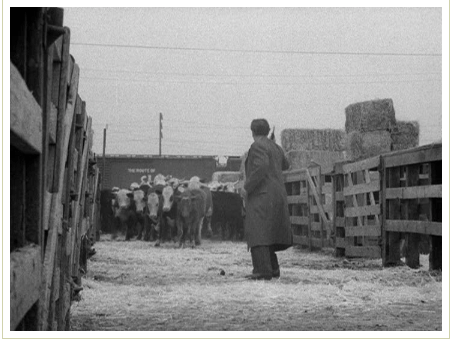
“The film is interesting, though, for showing how the security services of a big train station work. Aside from the ill-treatment inflicted on a blind girl by her kidnapper, there are two scenes of momentarily authentic noir cinema: a gangster flattened during his escape by a stampeding herd of steers maddened by gunfire [top image]; the pressing invitations to spill the beans exercised by the cops on an untalkative accessory to a crime. After giving him a working over using state-of-the-art methods, they drag him onto a platform overlooking the railroad track. “Make it look accidental,” the police inspector orders. When a train passes beneath, they grab hold of the “tough boy” and make as if to push him off [see left]. The guy immediately screams that he’ll “talk,” and he’s led away distraught, ready to sell out father and mother alike.”

Dark City is an altogether seedier affair, a story of greedy low-lifes who bilk a sucker out of his cash, driving him to suicide. No big deal, except the dead man’s psychopathic brother targets them for strangling. Charlton Heston, in his first starring role, is the most sympathetic low-life, Danny. But when the competition is Jack Webb at his sleaziest, playing a dirtbag named “Augie”, it’s not much of an accomplishment. Directed by Hungarian emigre William Dieterle in looming close-ups and dramatic chiaroscuro from DP Victor Millner (who has an incredible resume), it’s a woozy, sluggish and occasionally haunting noir about guilt, failure, class and forgetting. Danny is a college grad and army vet, and so, the police captain tells him, he has no excuse to live the life he does, not like the street boys he runs with.

Heston plays him as somnolent and dreamy, his every line pulled out with stubborn slowness, like Robert Mitchum on vicodin. It’s a hypnotically effective performance, of a man who no longer wants anything to do with his body. He repeatedly tells his ignored girlfriend Fran (Lizabeth Scott), of his need to be alone, but she still loves him anyway. James Naremore, who has written the best recent book on noir, More Than Night, offers an adolescent memory of the film in his introduction“What I remember best are the fetishized details – Lizabeth Scott’s unreal blondness and husky voice in Dark City, or Edmond O’ Brien’s rumpled suit as he runs desperately down the crowded street in D.O.A. [directed by Rudolph Maté]“. To that I’ll add one more: Harry Morgan’s fake upturned nose, a physical marker of his pugilist past and the cause of his punchy good humor. He’s been knocked silly once too many, but Morgan’s ebullient and melancholic turn makes him much more than a punchline.

Appointment With Danger re-teams Webb and Morgan, the future Dragnet partners, and this time they’re both hoods. They are planning a heist with the heavy-lidded Paul Stewart, but an errant corpse spied by a nun sets the plot machinery in motion. Alan Ladd is the cynical motor, an expressionless slab who is smart enough not to impede the snappy dialogue by Richard L. Breen (who would later pen the Dragnet movie) and Warren Duff (“Love is between a man and a .45 pistol that won’t jam”). He plays a postal inspector, one of the raft of government employees feted in procedurals of this era (including Holden in Union Station).

I relinquish the rest of this review to three separate pieces from Manny Farber:

“Appointment With Danger is a fascinating textbook on the Average American Flop – his speech, mien, sage misanthropy, doubt. It is also a well-done report on the geography of Gary, Indiana, a place that seems crowded with failures.”

***

“Tight plotting, good casting, and sinuously droopy acting by Jan Sterling, as an easily had broad who only really gets excited about – and understands – waxed bop.”

***

“A YMCA scene that emphasizes the wonderful fat-waisted, middle-aged physicality of people putting on tennis shoes and playing handball.”

***

And I will note one last notable occurrence: Harry Morgan’s quavering face as he gives a speech about his estranged son, protesting that he will not run off to St. Louis to avoid the heat of being named to the cops. His features are close to collapsing, but he re-harnesses them in a flush of machismo. He mentions his son’s bronzed booties. Webb than takes one of them and beats Morgan to death.

JOSEPH H. LEWIS AND SO DARK THE NIGHT (1946)

July 20, 2010

Screen Shot 2020-01-24 at 1.12.26 PM

“Do you miss it – directing?

-I miss it only when I see things on the screen that make me want to vomit.”

Peter Bogdanovich interviewing Joseph H. Lewis, Who the Devil Made It

I should let this magical quote stand on its own, but I’m a writer, so I’ll write.  Last week, TCM devoted a night to the films of Joseph H. Lewis, including some rare items surrounding his acknowledged masterpiece, Gun Crazy (1950). The tastiest morsel was So Dark the Night (1946) (made soon after the modest success of the equally awesome, but better known, My Name is Julia Ross (1945)). A rural psychological thriller, it’s an extreme example of Lewis’ idiosyncratic visual sense (the son of a NYC optometrist, he grew up with lenses). As he went on to tell Bogdanovich:  “What interested me most was telling the story through the eyes of a camera. I didn’t like words – wherever I could, I cut words out, and told it silently through the camera.”

So Dark the Night is structured around his silent, highly expressive storytelling (major spoilers ahead!). Famed Paris detective Henri Cassin (Steven Geray) takes a break from sleuthing to soak in the rustic charms of the country town of St. Margot. He’s welcomed as a celebrity by the Michaud family, who operate the inn he’s vacationing at. Daughter Nanette (Micheline Cheirel), with dreams of city life, begins flapping her eyelashes in his general direction. Lewis first frames her as a pair of hands fidgeting with a sheet on a laundry line, who then pulls down to reveal her eyes and arched brows. Then she scoots to the right, her beaming mug filling half the frame (with a limited budget for sets, Lewis is big on close-ups). Cassin was also bifurcated upon introduction, shot from the legs down as he strolls around an idyllic urban street. His full body isn’t shown until he kneels to chat with a shoeshine boy. Both are visually split, a motif that continues throughout, and which pays off thematically in the bravura twist ending.

But back to the flirtation. Cassin returns her interested gaze in a medium shot, Nanette reciprocates, and then Lewis cuts to a montage of the detective’s chrome car. There are close-ups of the bulbous headlights, the erect front grille, the sloped handle, and the ornate hubcap – a burst of pure visual metaphor that is shocking in the context of a Hollywood thriller. Cassin is reduced by Nanette into images of luxury, industry, sex…as well as escape.

The sequence continues with an extraordinary tracking shot, following Cassin as he traverses Nanette’s gaze and crosses into the inn itself. Jean-Pierre Coursodon rhapsodizes about this shot in his (out of print) AMERICAN DIRECTORS. He translated this bit himself in the comments section of DaveKehr.com:

“The camera moves across the courtyard, reaches the corner of the house, and continues tracking inside the inn’s main room without a cut, as though it had moved in right through an invisible wall. By removing the fourth wall — in deliberate disregard of realism — Lewis suggests that, together with the protagonist, , we are entering a stage upon which a drama will soon be enacted…”

In this one scene, Lewis sets up the central romance, undercuts said romance with images of division and materialism, and displays a self-reflexive theatricality that foreshadows the action to come. This, my dear readers, is masterful filmmaking.

Soon the plot machinations do their work, and Cassin has two corpses on his hands in a seemingly unsolvable case. Through it all, Nanette is repeatedly composed inside the inn’s window frame, and Cassin is seen cut-up behind his bed’s headboard. There is also some balletic action with push-ins and pull-outs, with the camera repeatedly pulling away from Cassin, and moving forward to Nanette’s boyfriend, who’s eager to quash the detective’s amorous dreams. Not to mention his ominous use of downward tilts, which reveal a third dead body and a knocked out guard in succession (which rhyme with Cassin’s initial bow down to the street urchin).

All of it effortlessly builds up to the moment when Cassin solves the case – and implicates himself as the only possible suspect, despite lacking any memory of the crime. He is, of course, schizophrenic, hence the dense visual patterns that sliced him up. The extraodinary final images explode the cataract of split compositions that Lewis had been creating throughout, as Cassin is shot by the police through the pane of glass that previously showed Nanette whole. He staggers up to the pane, and in the reflection sees a flashback of himself as he existed before the murders. With a fireplace poker he smashes the whole edifice down, and with it the motifs Lewis had been building the whole film. Coursodon reads even more into it:

“the climactic scene in which the the protagonist eradicates both his reflection and the recalled image of his former self by smashing the window in a gesture of revulsion [recalls] Oedipus’ blinding of himself after finding out the truth.”

This mythical interpretation of Cassin’s final act gibes with Coursodon’s reading of the tracking shot as announcing a theatrical space.  Cassin’s extreme rationality solves the case, but destroys his life. His final words: “I caught him, I killed him” are a kind of perverse triumph of the mind over its own physical limitations. And no-one got more delight, or more success, out of creatively overcoming the limitations of low budgets than the self-described “artist without a diploma”, Mr. Joseph H. Lewis.

UNDERRATED EASTWOOD: FIREFOX (1982)

July 6, 2010

Screen Shot 2020-01-23 at 5.49.06 PM

Beginning on July 9th, the Film Society at Lincoln Center in NYC will be mounting their misleadingly titled“Complete Clint Eastwood” series, which will run all the films he directed, but only a select few of his key acting turns (it’s a superb program regardless). It’s in honor of his 80th birthday, which our own Susan Doll celebrated a few months back. With Clint well represented on home video, it’s easy for anyone outside NYC to curate their own Eastwood retrospective, and one that I suggest deserves re-evaluation is his 1982 spy thriller, Firefox. His entire early 80s output, from Bronco Billy (1980) through Sudden Impact (1983), is extraordinary and relatively forgotten, but Firefox, perhaps due to its bizarre sci-fi trappings, has been judged harshly and dumped into the late-night cable dustbin.

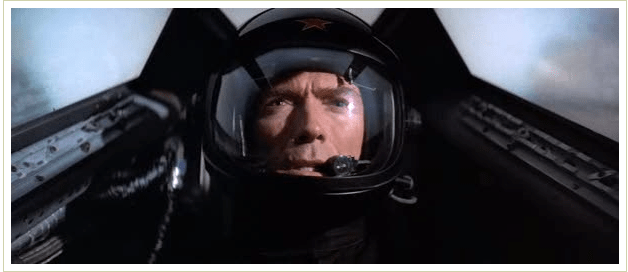
Eastwood plays Mitchell Gant, a retired Air Force pilot suffering from hallucinations of his time as a POW in the Vietnam War. He’s called back into action after the U.S. learns that the USSR had completed construction of a high-tech MiG-31 plane, code-named Firefox. Able to fly at 6-times the speed of sound, invisible to radar, and with a weapons system commanded by the pilot’s mind, eliminating reaction time during dogfights, it could swing the arms race and the momentum of the Cold War. Gant is tasked to steal it because of his language skills, since the plane’s system will work only with someone thinking in Russian. In comparing it to his more satiric Eiger Sanction, Eastwood said, “Firefox was more ‘square’, more traditional. It was about bad guys with pink eyes, but ordinary characters faced with an impossible mission.”

Gant is so ordinary as to be anonymous. Thrust rather unwillingly into the teeth of the Cold War, he is a bundle of anxiety. Eastwood works out various permutations of uneasiness on his face, raising his lips in grimaces and lowering them in scowls representative of a man supremely uncomfortable in his own skin. Shuttled from disguise to disguise and personality to personality (from an American heroin dealer to a tourist to a Russian pilot) acts as a subtle commentary on his own constructed personas. The ironic anti-heroism of his Man With no Name and the obsessive obstreperousness of Dirty Harry, then, are merely other skins, and his queasy performance reflects his ambiguous relationship to them. All of his films, it seems, are re-evaluations and deconstructions of his own personality, and Firefox is one of the earliest and smartest examples of this (taken up later by Sudden Impact straight through to Unforgiven and Gran Torino).

Gant isn’t a heroic figure as much as a man buoyed by circumstance. He never seems in control, pushed forward by his CIA handlers, then handed off to his resistance contacts in Russia, always instructed carefully, never in charge of his own fake lives. In fact, Gant is repeatedly chastised for his performances, encouraged to feign sickness to cover-up his awkward acting chops. His awkwardness and ever-present fear make this film more in the vein of John Le Carre than James Bond, and Bruce Surtees’ low-light photography perfectly expressive of its harshly deterministic narrative. Each of the men he meets is invested body and soul for the future of Russia, and stoically give up their lives for their cause, while Gant is a confused hired gun doing the job because he’s the only one who can. He seems without ideology, disturbed by the resistance fighters heroic sacrifices, giving their lives on the slim chance that Gant will succeed. It’s a utilitarian spy movie,  a morbid landscape where bodies are disposed of after they fulfill their mission, a grim game where deaths are freely given for the slim hope of success. Dave Kehr has even described the film’s terseness as “Bressonian” in his Chicago Reader capsule review, and it’s hard to disagree, or even think of another 80s action movie where that could even be remotely applicable.

In an interview with Michael Henry, he says that Firefox “is the only one of my pictures I used storyboards on.” And while he specifically mentions how he mapped out the final plane special effects sequences, the film as a whole seems finely structured. The major movement is from the dark spy sequences to the bright blue skies of the flight out of Russia, but there are micro-movements inside, including some expertly paced cross-cutting sequences. The opener cuts between the U.S. government war room and the attempt to convince Gant to join the mission at his woodsy home.

It quickly dispenses with the back-story while introducing the idea that Gant is a small pawn in major geo-political movements. This becomes clear during the final cross-cutting sequence, which shifts between the Soviet and U.S. war rooms tracking Gant’s movements in the air, with Gant himself caught in the middle, speaking Russian to an obliging super-plane.

Gant seems happiest in this final movement, cut off from humanity, and submerging his personality into a machine.He’s destroying his individuality while ostensibly flying to freedom. The images brighten as thematically the film grows even darker – self-annihilation as a kind of euphoric release.

THE WOMAN ON THE BEACH (1947)

April 27, 2010

wotb2

While the TCM Classic Film Festival was wrapping up out in L.A., I was pursuing my own personal Jean Renoir festival back in NYC. The Brooklyn Academy of Music is currently exhibiting a must-see retrospective that will hopefully tour a city near you. My personal highlight of the series so far is The Woman on the Beach, his last production in Hollywood, and by far his strangest, a somnabulist’s vision of a violent love triangle.  Its peculiar, almost abstracted plot was aided by extensive re-shoots after a disastrous preview screening, which trimmed out the exposition, leaving only the trio of lovers’ impulsive, and occasionally inexplicable actions.  Renoir had already pushed the visuals  in an oneiric direction, foggy, emptied-out landscapes of hollowed-out hulls and vertiginous cliffs. He even challenged his sound man to record the dialogue at an unusually low level, to emphasize the characters’ loneliness.

The pared-down result of the studio interference then, actually reinforces Renoir’s stylistic choices, and quite possibly made it a better film. This is exactly what Janet Bergstrom argues in her superb production history: “Oneiric Cinema: The Woman on the Beach”, which she published in the Film History journal in 1999. It is my main source for this post.

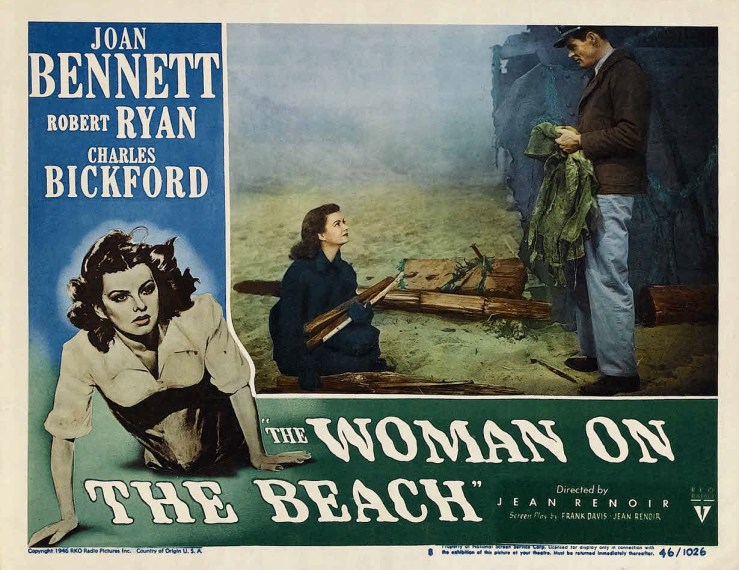
The story concerns a shell-shocked Navy vet, Scott (Robert Ryan), whose recurring nightmares of being torpedoed keep him in a constant state of anxiety. Attempting to banish these neuroses, he quickly proposes to his girlfriend Eve (Nan Leslie). After her skittish response, in which she is clearly shaken by his unhinged intensity, Scott begins a flirtation with Peggy Butler (Joan Bennett), who has been scarred by violence in her own manner. During a fight with her husband Tod (Charles Bickford), a painter, she accidently severed his optic nerve, blinding him for life. Bonding over their mutual traumas, they engage in a furtive affair, while Scott still manages a combative friendship with Tod. Ultimately driven to the brink of madness by their insecurities, Scott and Tod come into conflict…

Renoir recognized the strangeness of his conception of this film, describing it as “the sort of avant-garde film which would have found its niche a quarter of a century earlier, between Nosferatu and Caligari.” And emphasizing that its “subject was the opposite of everything I had been working toward in the cinema up to that point.” He went on:

The Woman on the Beach was a perfect theme for treating the drama of isolation. Its simplicity made all kinds of development possible. The actions of the three principal characters were wholly stripped of colourful detai; they took place in empty landscapes and in a perfectly abstract style…In all my previous films I had tried to depict the bonds uniting the individual to his environment…now I was embarked on a study of persons whose sole idea was to close the door on that absolutely concrete phenomenon which we call life.”

Renoir closes this door when he uses a dream sequence to introduce Robert Ryan. He begins as a nightmare. With the strains of “Home on the Range” ironically cooing in the background, Ryan imagines himself on a ship – followed by a massive explosion. He sinks to what looks like the bottom of an aquarium, where Eve is waiting for him in an evening gown with open arms. Right before he embraces her, there is another explosion. His war experiences are explicitly blocking him from a life with Eve, and dooming him to one of apparitions and hallucinations. He is like the character of Cesar from Caligari, motoring through his inexplicable deeds without a will of his own.

So when he begins to obsess that Tod is lying about his blindness, or insist upon a fishing trip in a rainstorm, he is operating solely on his unconscious drives – the neuroses engendered from battle. Peggy is on a similar path, wracked with guilt over stealing her lovers’ sight, and destroying his successful career as a painter. She is filled with hate for herself and with Tod, which can exhibit itself in improbably nurturing ways. As always with Renoir, “everyone has their reasons”, and it’s impossible to pin any of the characters down as the villain. All show flashes of sympathy and rage – Peggy snuggling on the couch with Tod, reminiscing about their youthful days in NYC, or Scott snapping from protective lover to vengeful cuckold. All three actors are fascinating to watch, and Renoir carefully balances their power relations in his fluid compositions [the most explicit is the interior boat shot above, where Scott and Peggy embrace inside while Tod is isolated in a separate plane outside the porthole].

Ryan is earnest and bereft, all-too-aware of his crumbling psyche and his inability to heal it. He has a seaman’s bearing that bends under the weight of the Butler household’s demands. Bickford is prickly and condescending as Tod, a bellowing ironist with an uneasy gait, his vast array of ascots unable to hold back the bile he irresistibly spews, mainly at his wife, who he delights in harming. Bennett is enigmatic and cold, her love of Tod turned to hate, but who still recognizes its original provenance. She shares her husband’s sarcasm and cynicism, but stays in the marriage because of an unshakable nostalgia and loyalty. With her melancholy eyes mixing pity and desperation, she casts the most elusive portrait of the three. Bennet was the one who demanded Renoir direct the film, after producer Val Lewton recommended Jacques Tourneur and Robert Wise, among others. She remained steadfast.

The film was first finished on July 1946, and a preview screening took place on August 2. The reaction was so negative that major revisions took place. The second version of the film was not released until June 8, 1947. Early in the pre-production process, the Production Code Adminstration (PCA) demanded the removal of any explicit reference to a “sex affair between Peggy and Scott and to omit any of the passionate kisses indicated in the present story.” Renoir reluctantly obliged. As Bergstrom notes:

“when ‘human desire’, as Lang would call it in his 1953 remake of La Bete Humaine, could not be acknowledged as the dominant theme, Scott’s neurosis because of his war experiences had to carry much more weight in his abrupt turn from the stability of his life with Eve toward his unsettling, moth-to-the-flame meetings with Peggy and Tod.”

Along with this repression of the sexual theme, Renoir dropped some boilerplate sub-plots that turned Peggy into a generic femme fatale.

Following some re-editing,  RKO solicited suggestions from other directors. John Huston “recommended that the film tell one story and that Scott’s neurosis should be eliminated.” Mark Robson advised “going back to Renoir’s original version because the film as it now exists is too confusing and choppy to make much sense.” Neither suggestion was agreeable to the studio, so RKO hired writer Frank Davis to re-work some scenes, beginning on September 23, 1946. Renoir greeted him with hope: “I have found my ideal collaborator.”

With Davis, a great deal of footage was re-shot. Renoir tells Pierre Lestringuez that it was nearly half the film. Nine years later he told Rivette and Truffaut that it was a third of the film, “essentially the scenes between Joan Bennett and Robert Ryan.” For unknown reasons, they also re-cast the role of Eve, replacing Virginia Huston with Nan Leslie, necessitating re-shoots for all of those scenes as well. It was a laborious and inevitably annoying process, but one with curiously positive results. As Bergstrom writes, and I agree, the film becomes almost Langian in its determinism and sparseness, rare for Renoir, but an appropriate reflection of his alienation from the studio system at this time. What was originally going to be a routine melodrama of sex and death becomes something more mysterious, where a trio of damaged lovers work out their unconscious drives on-screen, turning it into a  bewitching kind of trance film.

The Woman on the Beach is available in a Region 2 DVD from the French company Editions Montparnasse. Glenn Kenny reviews the disc here.